

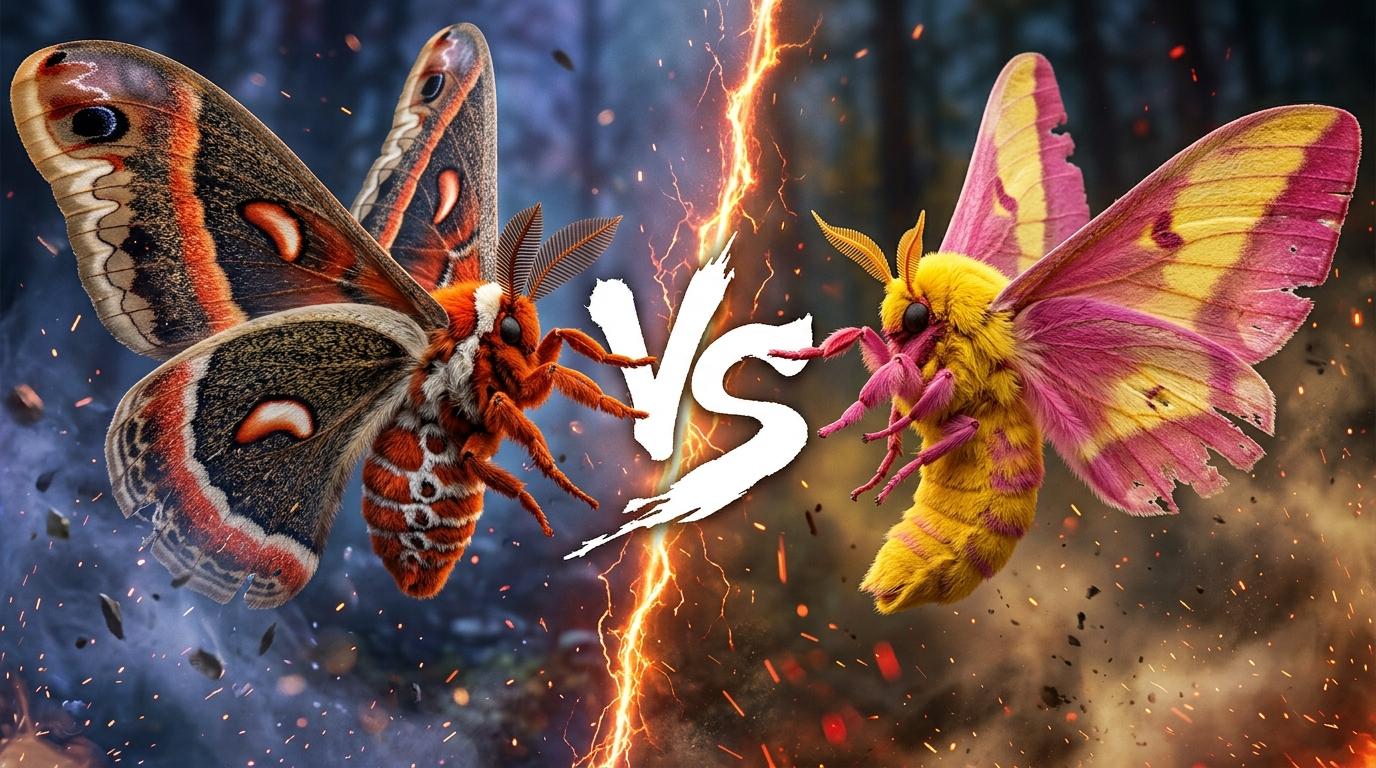
Cecropia Moth vs Rosy Maple Moth: Who Actually Wins?
Cecropia moth vs rosy maple moth: North America's largest moth meets a pink-and-yellow pocket silkmoth. See who wins on size, flight power and survival tactics.
Cecropia Moth vs Rosy Maple Moth
Matchup winner
Cecropia Moth
Quick verdict
Start with the direct answer, then use the structured comparison below to see what changes the outcome.
The Cecropia Moth wins clearly. It is North America's largest native moth, with a wingspan of up to about 15 cm (6 in) against the Rosy Maple Moth's roughly 3–5 cm. That makes it several times heavier, with far more wing area and flight muscle. Neither species can truly fight, because adults of both have reduced, non-feeding mouthparts and no stingers or bite. So any "battle" comes down to who can push, shove and out-fly the other around a perch or a mate's scent trail. In that frame, sheer mass and wingbeat force decide it. The Rosy Maple Moth is a bit more agile for its size and is just as hardy, but it is simply outclassed in physical presence.
Read the full explanation
Winner: Cecropia Moth, thanks to a huge size and wingspan advantage.
Neither moth can bite or sting, because the adults don't even eat.
Any contest is about shoving, displacing and out-flying the other, not wounding it.
The Rosy Maple Moth is compact and maneuverable but far too light to hold ground.
Reader vote
Who do you think wins?
Pick a side — no account needed. Results update live.
No votes yet — be the first to call it.
Editorial note
Why people disagree
Some readers assume brighter colors mean more danger. The rosy maple's pink-and-yellow coat is not a proven warning signal, and it carries no weapon.
Body mass and frame
In a contest with no weapons, mass is the main way to displace a rival from a perch.
Flight power
Bigger wings move more air, so the cecropia can buffet a smaller moth aside in close airspace.
Tight-space agility
The rosy maple can slip through clutter and escape, but escaping is not the same as winning.
Read the full explanation +
Both are giant silkmoths (Saturniidae), so people expect a close family matchup. In reality, the size gap is enormous.
Speed fans point to small-bodied agility. But the cecropia's powerful wingbeats keep it competitive in flight anyway.
Comparison FAQ
Short, direct answers to the next questions readers usually ask after the headline verdict.
Would a cecropia moth beat a rosy maple moth?+
Yes. Its much greater size and flight power let it displace the rosy maple in nearly every realistic contest.
Which moth is stronger?+
The Cecropia Moth. It is several times larger by wingspan and much heavier, with far more flight muscle.
Can either moth hurt the other?+
Not really. Adults of both species lack functional mouthparts and have no stinger, so contact is limited to pushing and wing-buffeting.
Why is the rosy maple moth still a dangerous opponent?+
Its agility lets it escape and win in cluttered spaces. Its small size also makes it hard to pin down, so it rarely loses in any way that costs it its life.
Are these moths dangerous to humans?+
No. Both are harmless and are popular with nature watchers.
Head-to-head species stats
These are the same core AnimalDex stat dimensions used on the dedicated animal pages, pulled side by side so the matchup is faster to scan.
Cecropia Moth
Tier DRosy Maple Moth
Tier ETrait-by-trait comparison
Only the categories that matter to this matchup are included. The goal is not filler stats, but the real design differences that change the result.
Up to ~15 cm wingspan, heavy furred body
Body mass and frame
Cecropia Moth
~3–5 cm wingspan, small fuzzy body
Body mass and frame
Cecropia Moth
Slow, powerful wingbeats with big lift
Flight power
Cecropia Moth
Quick, light, fluttery flight
Flight power
Cecropia Moth
Broad wings, wide turns
Tight-space agility
Rosy Maple Moth
Compact and nimble
Tight-space agility
Rosy Maple Moth
None; non-feeding adult
Offensive tools
Cecropia Moth
None; non-feeding adult
Offensive tools
Cecropia Moth
Eyespots and a looming, startling size
Predator deterrence
Cecropia Moth
Small size; bright colors (a debated signal)
Predator deterrence
Cecropia Moth
Large feathery male antennae track females over long distances
Scent-tracking reach
Cecropia Moth
Feathery male antennae, smaller range
Scent-tracking reach
Cecropia Moth
How the verdict forms
Verdict timeline
01 · Body mass and frame
Cecropia Moth
02 · Flight power
Cecropia Moth
03 · Tight-space agility
Rosy Maple Moth
04 · Offensive tools
Cecropia Moth
05 · Predator deterrence
Cecropia Moth
06 · Scent-tracking reach
Cecropia Moth
Change the conditions
Scenario breakdown
This is where shallow battle content usually fails. Terrain, spacing, timing, and engagement style can change the answer.
Scenario lean
Cecropia Moth
Verdict confidence
82%
Cecropia holds the perch.
On a twig in leaf cover, the moths jostle by crawling and wing-fanning. The cecropia's weight and wide wingspan let it occupy and defend space, so the rosy maple's only option is to move off.
AnimalDex field profiles
Explore these animals
Cecropia Moth
Hyalophora cecropia
deciduous woodland and suburban tree cover
Rosy Maple Moth
Dryocampa rubicunda
deciduous woodland and suburban tree cover
Systems Intelligence & Hidden Purpose
See the animals behind this comparison as engineered biological systems: what each one is built to do, where it gains leverage, and why the matchup changes by scenario.
Specialized Hardware
giant russet wings with pale crescents, fuzzy red-and-white body, and short-lived adult emergence give the Cecropia Moth a body plan tuned for its niche.
Systems Script
Cecropia Moths operate through deciduous woodland and suburban tree cover. Their design links movement, feeding, shelter, and timing into one workable survival system.
Strategic Insight
Dense environments reward precision, patience, and the ability to read layered cover.
Specialized Hardware
pink-and-yellow fluffy wings, soft feathery body, and night maple-forest flight give the Rosy Maple Moth a body plan tuned for its niche.
Systems Script
Rosy Maple Moths operate through deciduous woodland and suburban tree cover. Their design links movement, feeding, shelter, and timing into one workable survival system.
Strategic Insight
Dense environments reward precision, patience, and the ability to read layered cover.
Final take
The Cecropia Moth is the overall winner. Between two weaponless, non-feeding adult silkmoths, the decisive factor is physics: mass, wing area and the ability to hold space.
Read the full explanation
The Rosy Maple Moth earns respect for agility and staying power in clutter, but it is a tiny contender facing one of the continent's true giant moths.
Collect both animals in AnimalDex
Track the species behind this matchup, compare their real traits, and build the rivalry into your AnimalDex collection.
Related comparisons
Continue with nearby matchups to compare more real-world animal traits without dropping into junky who-wins filler.

Rosy Maple Moth vs Stick Insect: Who Actually Wins?
The stick insect wins. Neither insect is built to fight, and neither would hunt the other, but a contested encounter comes down to body mass, reach, and defensive hardware. Stick insects range from finger-length to over 30 cm, and some species carry spiny hind legs that clamp and kick or glands that spray irritating chemicals. The adult Rosy Maple Moth is a soft, fuzzy flier with a wingspan around 3–5 cm. Its mouthparts are reduced and non-feeding, and it lives only days to reproduce. The moth's real advantage is flight. It can leave, but it cannot push a stick insect off a branch. In any frame where someone has to give ground, the bigger, tougher, more stubborn phasmid holds the perch.
Read comparison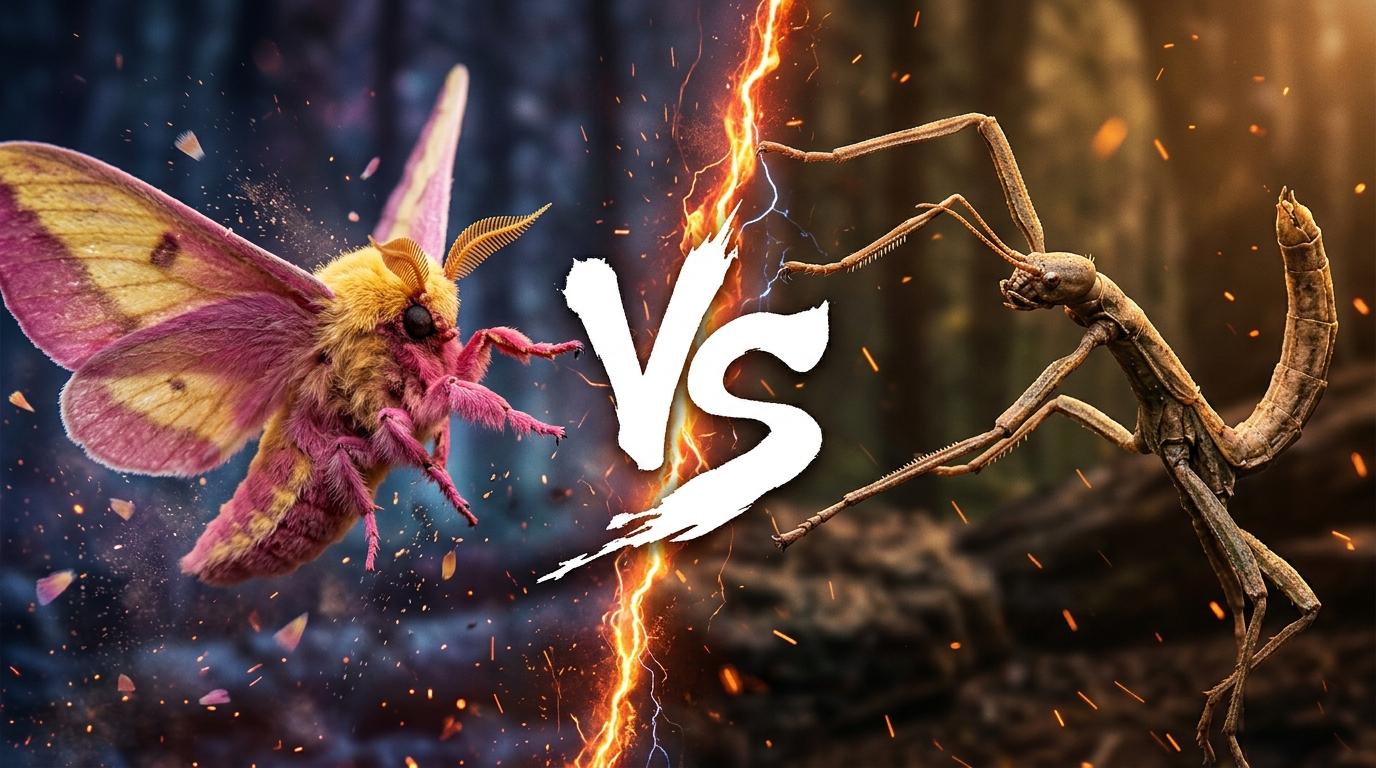
Rosy Maple Moth vs Northern Walkingstick: Who Actually Wins?
The Northern Walkingstick wins this matchup clearly. It is a much longer, heavier-bodied insect, often 7 to 9 cm long against a moth whose wings span roughly 3 to 5 cm. It has a tougher exoskeleton, clinging legs that lock onto bark and twigs, and a life built around staying put while the Rosy Maple Moth lives fast and fragile. The moth has no functional mouthparts as an adult and lives only about a week on its caterpillar reserves. Its scale-covered wings tear easily, and its only real move is flight. Neither species is a fighter. Both are plant-eaters that never evolved to attack, so any contest comes down to mass, grip, durability, and who can push the other off a branch. On every physical measure except getting away, the walkingstick holds the edge.
Read comparison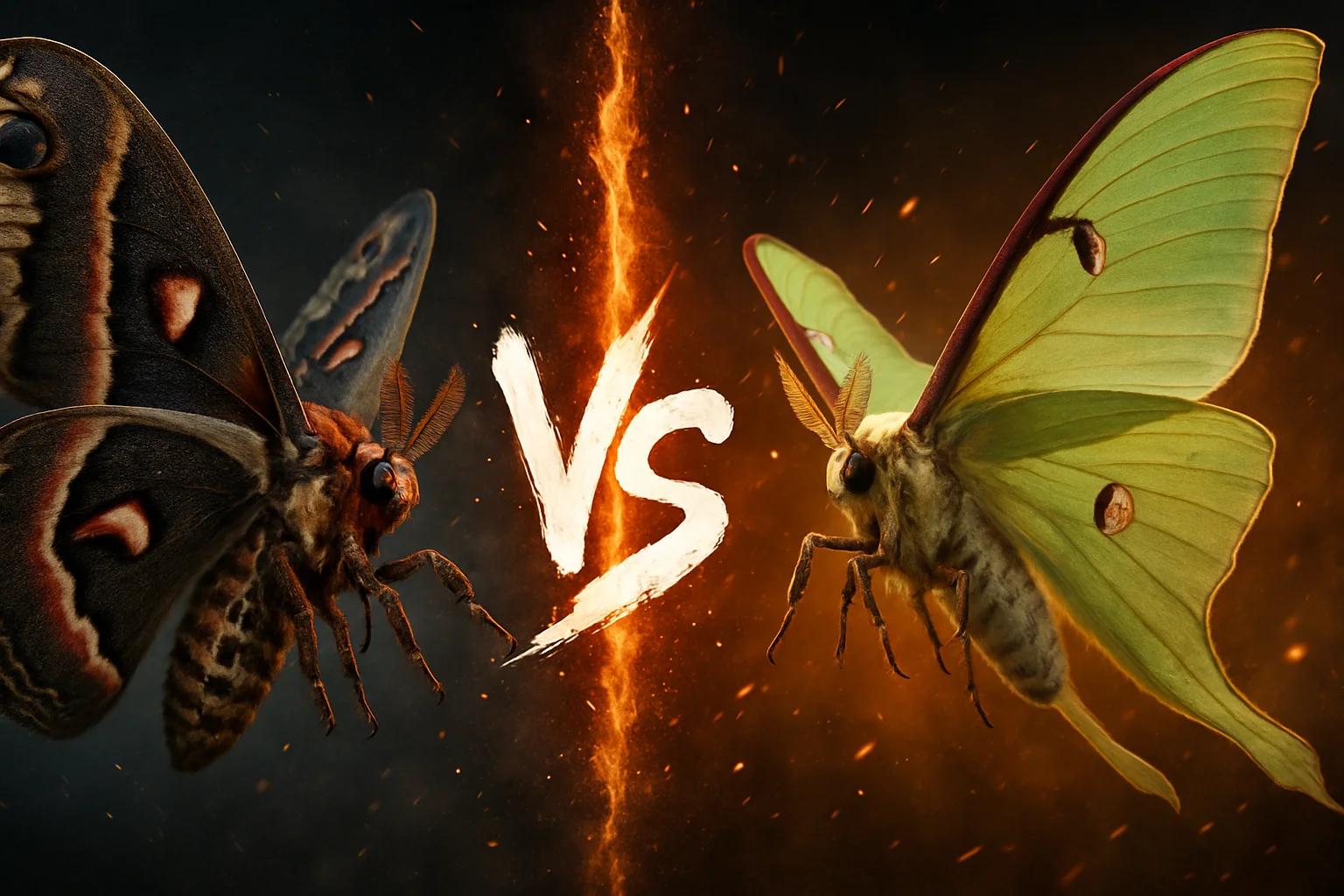
Cecropia Moth vs Luna Moth: Who Actually Wins?
The Cecropia Moth wins this matchup. As North America's largest native moth, with wingspans that can reach about 15 cm (roughly 6 inches) and a heavier, furrier body, Hyalophora cecropia brings more mass, sturdier wing structure and more bulk to any physical contest than the Luna Moth. Neither species can feed as an adult, because both have reduced, non-functional mouthparts, and neither is built to fight, so 'winning' really means displacing, outlasting or out-muscling the other in jostling contact. Actias luna is lighter and has fragile, trailing hindwing tails. Those tails are a brilliant anti-bat decoy, but they are a liability in physical contact. The cecropia's larger frame and robust wings give it the edge in nearly every realistic frame.
Read comparison
Luna Moth vs Rosy Maple Moth: Who Actually Wins?
The Luna Moth wins. Neither species has weapons, venom, or working mouthparts as an adult, so a 'fight' between them is really a contest of mass, wing thrust, and staying power on a contested perch. On those terms the Luna Moth's advantages are hard to overcome. Its wingspan of roughly 8–11.5 cm is about twice the Rosy Maple Moth's 3–5.5 cm, which gives it far more wing area to buffet, shove, and hold a surface. Its long, twisting hindwing tails also give it a documented edge against bats, the predator that actually decides most moth 'battles.' The Rosy Maple Moth is stockier for its size and better suited to tight foliage. Still, when two moths collide on a branch, a window screen, or under a porch light, the much larger moth usually keeps its spot.
Read comparison
Discussion
What do you think?
Share your reasoning with other readers. Be civil and stick to the animals.
Sign in to join the discussion.
Sign inNo comments yet. Start the conversation.