


Central American Agouti vs Southern Tamandua: Who Actually Wins?
Agouti vs tamandua: a biology-first look at which Neotropical mammal wins a confrontation. Hook-clawed anteater against a sprinting seed hoarder, compared on size, weapons, defense and escape.
Central American Agouti vs Southern Tamandua
Matchup winner
Southern Tamandua
Quick verdict
Start with the direct answer, then use the structured comparison below to see what changes the outcome.
The Southern Tamandua wins a real confrontation. At roughly 4–7 kg it outweighs the 3–4 kg Central American Agouti, and it carries the decisive hardware. Its forelimbs end in enormous hooked claws built to rip open termite mounds and rotten logs. Its signature defense is to rear back on its hind legs and prehensile tail and slash at anything that comes close. The agouti is fast, alert and has sharp rodent incisors, but it is a prey-built sprinter whose whole survival script is to bolt, freeze or leap away rather than grapple. If the agouti commits to a fight, it walks into the tamandua's tripod stance and claw arc, and it has no good answer to that. The agouti's real win condition is leaving, and leaving is not winning.
Read the full explanation
Winner: Southern Tamandua, thanks to more mass, huge hooked foreclaws and a braced tripod defense stance.
The agouti is faster and more agile but built to escape, not to fight.
Agouti incisors can bite hard, yet the tamandua's thick coarse fur and reach blunt them.
The agouti 'wins' only by fleeing, so in any committed clash the tamandua takes it.
Reader vote
Who do you think wins?
Pick a side — no account needed. Results update live.
No votes yet — be the first to call it.
Editorial note
Why people disagree
Speed looks like power: the agouti's explosive sprints make it seem dominant until you remember it uses them to run away.
Size and mass
In small-mammal clashes, extra mass plus forelimb strength controls the exchange.
Primary weapons
Claws built for tearing termite mounds hit with reach the agouti's mouth can't match.
Explosive speed
Speed decides whether a fight happens at all, but not who wins once it does.
Read the full explanation +
Anteaters seem harmless because they have no teeth, but tamandua claws are serious weapons that predators like ocelots respect.
Rodent incisors cut through Brazil-nut-hard shells, so some readers assume the agouti bite decides things. Reach and claws get there first.
Comparison FAQ
Short, direct answers to the next questions readers usually ask after the headline verdict.
Would a Central American Agouti beat a Southern Tamandua?+
No. In a committed fight the tamandua's claws, mass and defensive stance beat the agouti. The agouti's best outcome is escaping.
Which is stronger, an agouti or a tamandua?+
The tamandua. Its forelimbs are powerful enough to tear open termite mounds, and it is generally heavier.
Why is the agouti still dangerous?+
Its rodent incisors are built to crack extremely hard nut shells and can inflict painful bites. Its speed also means it can't easily be caught or pinned.
Is a tamandua dangerous despite having no teeth?+
Yes. Its hooked claws can wound predators and even humans, and its upright defensive posture makes it hard to approach safely.
Head-to-head species stats
These are the same core AnimalDex stat dimensions used on the dedicated animal pages, pulled side by side so the matchup is faster to scan.
Central American Agouti
Tier CSouthern Tamandua
Tier BTrait-by-trait comparison
Only the categories that matter to this matchup are included. The goal is not filler stats, but the real design differences that change the result.
About 3–4 kg, slender-legged
Size and mass
Southern Tamandua
About 4–7 kg, stocky and muscular forelimbs
Size and mass
Southern Tamandua
Chisel incisors, kicks while fleeing
Primary weapons
Southern Tamandua
Massive hooked third-digit claws
Primary weapons
Southern Tamandua
Elite sprinter, leaps over 1.5 m
Explosive speed
Central American Agouti
Slow, shuffling walker
Explosive speed
Central American Agouti
Thin coat, relies on vigilance
Close-range durability
Southern Tamandua
Coarse thick fur, tail-braced upright stance
Close-range durability
Southern Tamandua
Hyper-alert, alarm calls, foot-stamps
Threat detection
Central American Agouti
Poor eyesight, strong smell
Threat detection
Central American Agouti
Ground-only, burrow and log refuges
Terrain control
Southern Tamandua
Semi-arboreal with prehensile tail
Terrain control
Southern Tamandua
How the verdict forms
Verdict timeline
01 · Size and mass
Southern Tamandua
02 · Primary weapons
Southern Tamandua
03 · Explosive speed
Central American Agouti
04 · Close-range durability
Southern Tamandua
05 · Threat detection
Central American Agouti
06 · Terrain control
Southern Tamandua
Change the conditions
Scenario breakdown
This is where shallow battle content usually fails. Terrain, spacing, timing, and engagement style can change the answer.
Scenario lean
Southern Tamandua
Verdict confidence
82%
Tamandua stands and slashes; the agouti has no safe angle.
In tight forest cover the agouti's sprint lanes vanish. The tamandua backs against a trunk, rears up on its tail tripod and sweeps its claws, so any bite attempt costs the agouti deep lacerations.
AnimalDex field profiles
Explore these animals
Central American Agouti
—
Habitat details are not published on a dedicated AnimalDex species page yet.
Species guide coming soon.
Southern Tamandua
Tamandua tetradactyla
forest edge, savannah woodland, and tropical scrub
Systems Intelligence & Hidden Purpose
See the animals behind this comparison as engineered biological systems: what each one is built to do, where it gains leverage, and why the matchup changes by scenario.
Specialized Hardware
hooked claws for tearing nests, long sticky tongue, and tree-and-ground insect hunting give the Southern Tamandua a body plan tuned for its niche.
Systems Script
Southern Tamanduas operate through forest edge, savannah woodland, and tropical scrub. Their design links movement, feeding, shelter, and timing into one workable survival system.
Strategic Insight
Dense environments reward precision, patience, and the ability to read layered cover.
Final take
The Southern Tamandua is the clear winner. It isn't a hunter, but evolution armed it for exactly this kind of standoff: hooked claws, a braced upright stance and a body heavier than the agouti's.
Read the full explanation
The Central American Agouti is a superb survivor. Its speed, vigilance and caching make it a keystone seed disperser. Those strengths all point toward avoiding fights, though, and in any frame where the two actually engage, the tamandua holds the stronger cards.
Collect both animals in AnimalDex
Track the species behind this matchup, compare their real traits, and build the rivalry into your AnimalDex collection.
Related comparisons
Continue with nearby matchups to compare more real-world animal traits without dropping into junky who-wins filler.
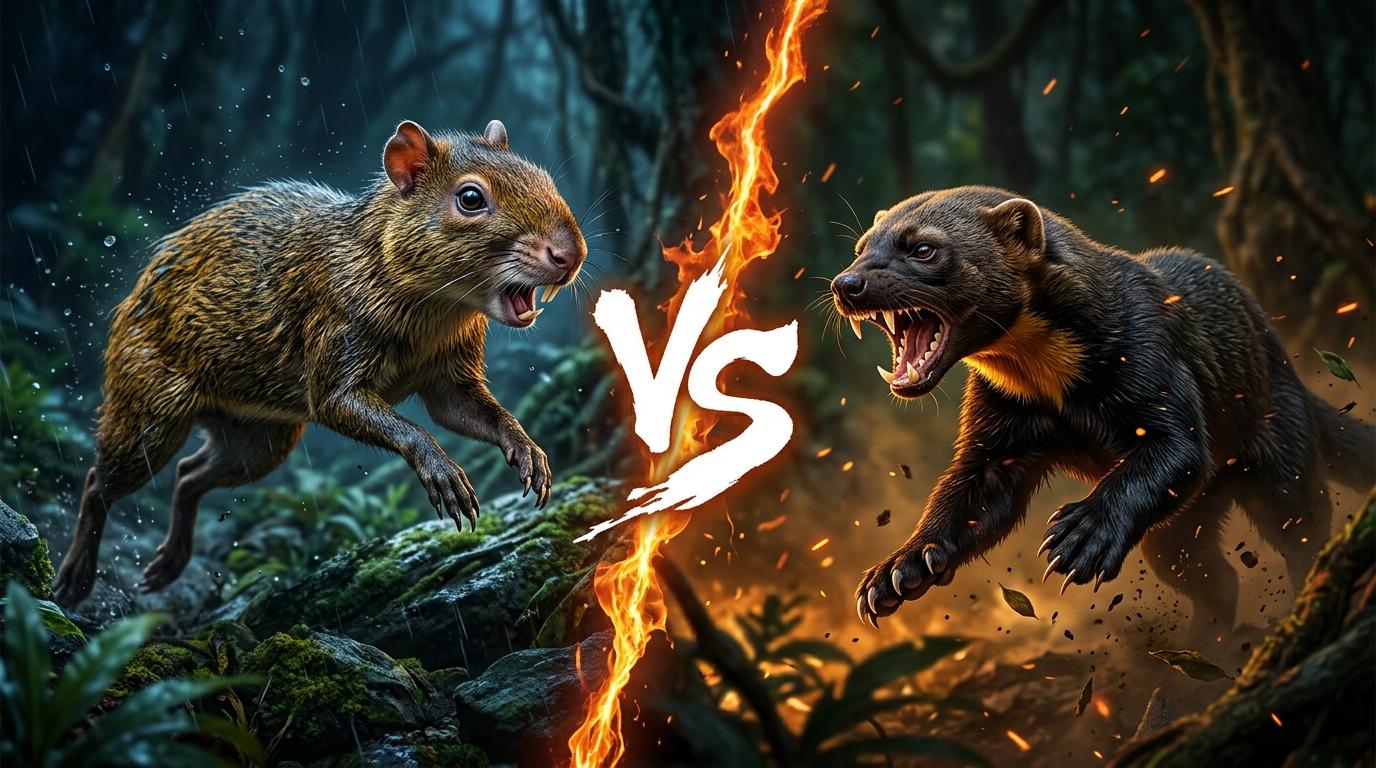
Central American Agouti vs Tayra: Who Actually Wins?
The tayra wins clearly. This weasel-family hunter weighs roughly 3–6 kg against the agouti's 3–4 kg, but the weight gap is not what decides it. The tayra is built to kill. It has a carnivore's skull, shearing carnassial teeth, strong forelimbs, curved claws and the tireless pursuit style of the mustelid family. The agouti is a superb prey animal. It bursts into a sprint, leaps up to about 2 m, and has chisel incisors that can draw blood. But it has no killing toolkit, and its whole strategy is to disengage. If the encounter becomes a real contest, the tayra controls it. The agouti's best outcome is not winning but getting away into dense cover or a burrow before the tayra closes.
Read comparison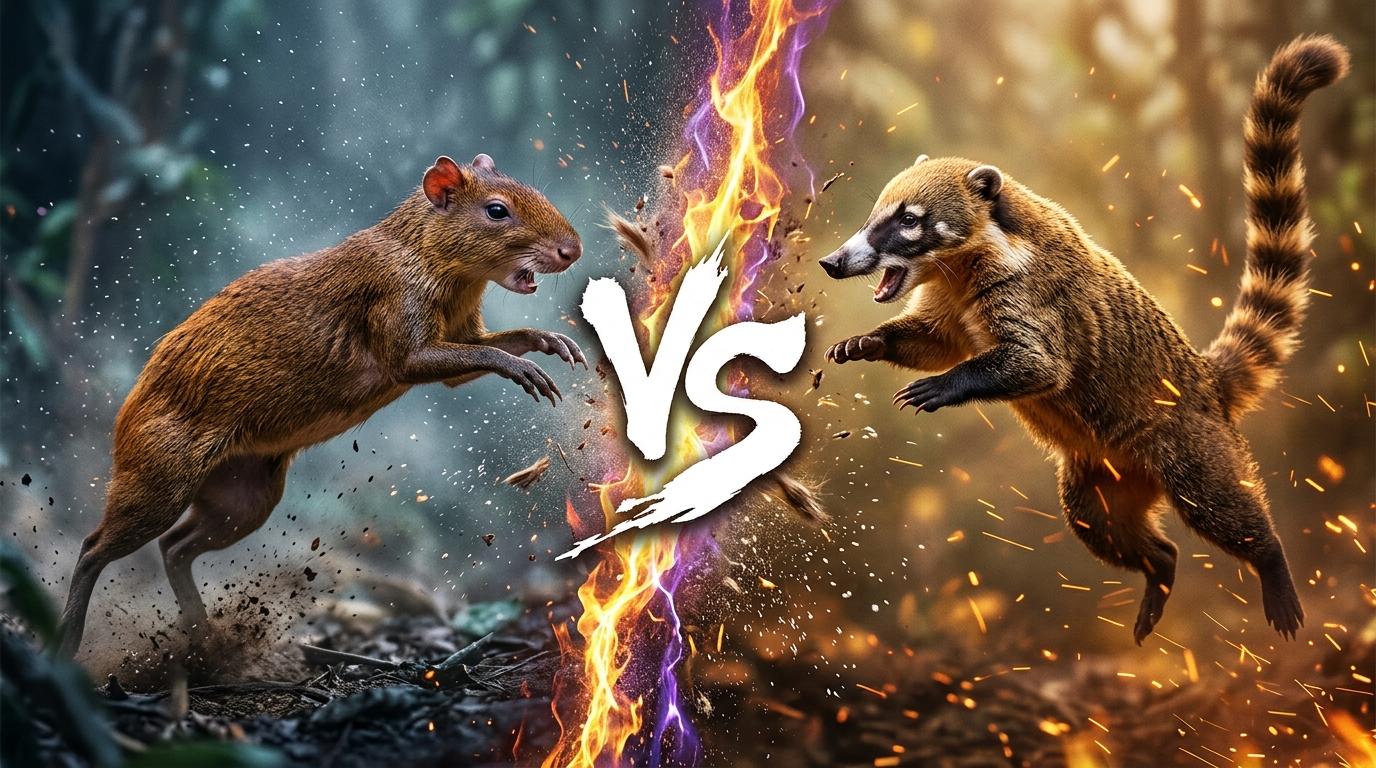
Central American Agouti vs White-nosed Coati: Who Actually Wins?
The White-nosed Coati wins this matchup clearly. At roughly 4–6 kg against the agouti's 3–4 kg, the coati brings more mass, long carnivoran canines, strong digging claws, flexible ankles and a tail-balanced body built for grappling. It also has a bolder, more problem-solving temperament shaped by an omnivorous, forage-and-fight lifestyle. The Central American Agouti is a superbly tuned escape artist. It has long, springy legs, explosive bursts and razor-sharp rodent incisors, but its entire design favors flight over combat. If the agouti gets distance or a burrow, it survives. If the coati closes and commits, the coati's weapons and wrestling ability decide it.
Read comparison
Central American Agouti vs Paca: Who Actually Wins?
The paca wins. At roughly 6–12 kg, a paca (Cuniculus paca) often weighs two to three times as much as a 3–4 kg Central American agouti (Dasyprocta punctata). It also has a stockier, low-slung body and a broad, heavily built skull with large gnawing incisors. In any confrontation decided at close range, such as a burrow mouth, a fallen-fruit patch or a riverbank, that mass and frame let the paca shove, bite and hold ground in ways the slender agouti cannot match. The agouti is no pushover. It has long legs and is a quick, alert runner. Those traits help it avoid fights, not win them. It is also active by day while the paca forages at night, so the two rarely compete head to head. When they do collide, the heavier, more grounded rodent controls the exchange.
Read comparison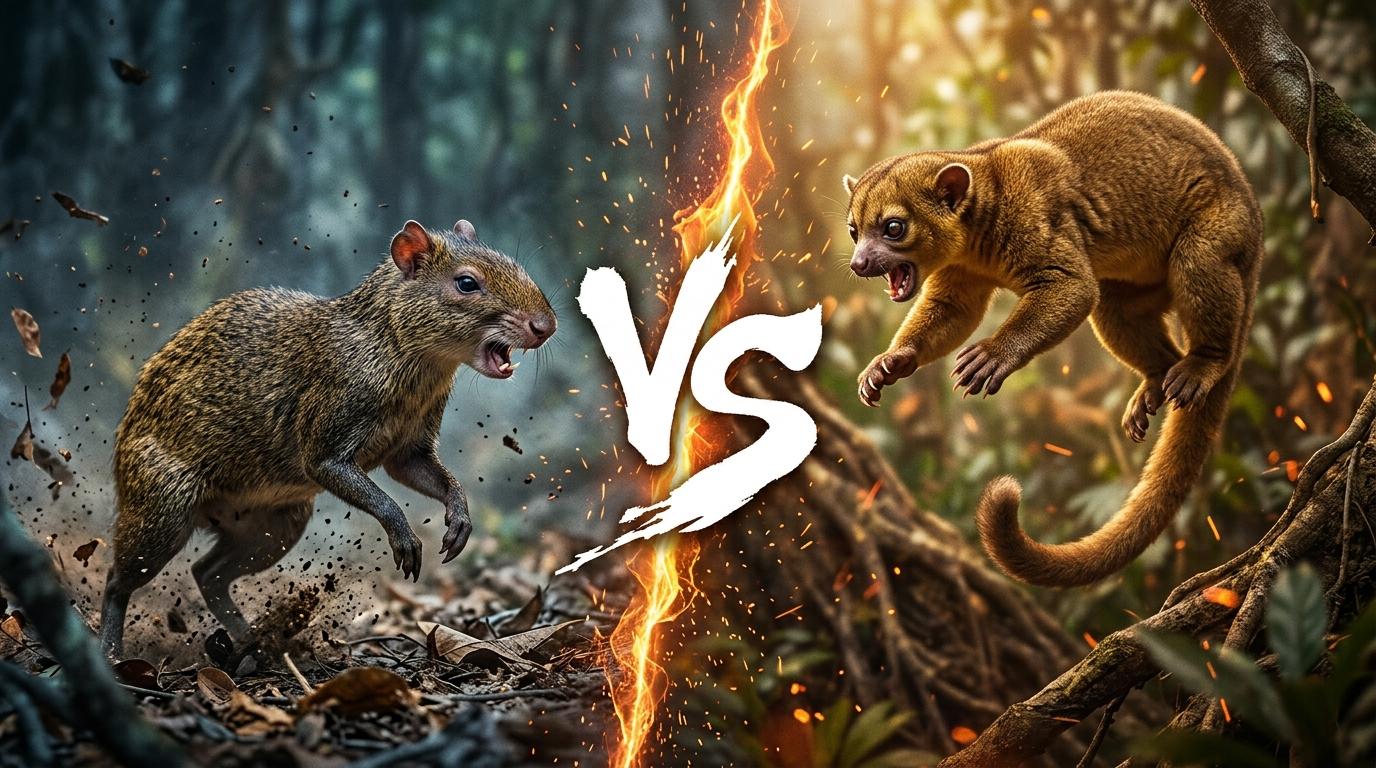
Central American Agouti vs Kinkajou: Who Actually Wins?
The kinkajou wins this matchup. The two weigh about the same, roughly 2–4.5 kg each, but the kinkajou is built very differently. It is a procyonid carnivoran with a dense, muscular body, a gripping prehensile tail, sharp curved claws and a carnivoran jaw with real canines. It is also known to be surprisingly fierce when cornered or handled. The agouti is a long-legged rodent built for one thing above all: escape. Its chisel incisors can deliver a painful bite, and its burst speed and leaping are excellent, but it has little grappling ability and no habit of holding its ground. In any encounter where the two actually make contact, the kinkajou's grip, claws and willingness to fight decide it. The agouti's best outcome is almost always a clean getaway rather than a win.
Read comparison
Discussion
What do you think?
Share your reasoning with other readers. Be civil and stick to the animals.
Sign in to join the discussion.
Sign inNo comments yet. Start the conversation.