


Chamois vs Mouflon: Who Actually Wins?
Chamois vs mouflon: a biology-based look at which European mountain ungulate wins a head-to-head fight, scenario by scenario, and why the cliff-jumping chamois is still risky to engage.
Chamois vs Mouflon
Matchup winner
Mouflon
Quick verdict
Start with the direct answer, then use the structured comparison below to see what changes the outcome.
The mouflon wins a straight fight more often than not. The two are close in body weight, with adult males of both species commonly in the 30–55 kg range, so the result comes down to weapon design. The mouflon ram is a dedicated collision specialist. Heavy spiral horns, a reinforced skull and a thick neck let it absorb repeated head-on impacts and drive through an opponent's center line. The chamois carries short, backward-hooked horns built for raking and hooking an opponent's flank or belly. That weapon can wound badly, but it needs space, angle and timing to land. In a close-quarters exchange, the mouflon's frontal armor and shoving mass usually take that time away. The chamois holds a real edge in speed, agility and steep terrain. On a cliff face the matchup flips, which is why this isn't a blowout. On neutral ground the ram's battering-ram build is the deciding trait.
Read the full explanation
Overall winner: the mouflon, thanks to its impact-hardened skull and heavy horns built for head-on clashes.
The chamois is faster, more agile and far better on steep rock. On a cliff, it wins.
The chamois's hooked horns can cause serious flank wounds, so it is never a safe opponent.
In open or level ground, the ram's shoving power and frontal durability usually decide it.
Reader vote
Who do you think wins?
Pick a side — no account needed. Results update live.
No votes yet — be the first to call it.
Editorial note
Why people disagree
Equal sizes, different weapons. Chamois fans point to hooked horns that can gore, and mouflon fans point to a skull built to survive collisions. The answer depends on whether the fight stays frontal.
Explosive power
In contact fighting, power delivered through the skull matters more than leaping ability. The ram converts its body mass straight into impact.
Weapon design
Hooked horns need a flank angle to work. Massive curled horns both strike and shield, so they work from the front where most clashes happen.
Close-range durability
The animal that can absorb blows without disengaging controls the tempo of a close fight.
Read the full explanation +
Terrain bias is huge. Picture an Alpine ledge and the chamois looks unbeatable. Picture a meadow and the ram looks dominant.
Neither species normally fights the other. Both settle disputes within their own species through ritual display, so any cross-species outcome is inferred from anatomy and fighting style rather than observed brawls.
Comparison FAQ
Short, direct answers to the next questions readers usually ask after the headline verdict.
Would a chamois beat a mouflon in a fight?+
Usually not on level ground. The mouflon's heavy horns and impact-adapted skull let it win a frontal clash. The chamois's best chance is steep, rocky terrain where the ram cannot brace.
Which is stronger, a chamois or a mouflon?+
The mouflon has more usable fighting strength. Its body mass is similar, but its neck, skull and horns are built to deliver and absorb heavy head-on impacts.
Is a chamois faster than a mouflon?+
Yes. The chamois is quicker and far more agile, especially over broken rock and cliffs.
Why is the chamois still dangerous even if it loses?+
Its sharply hooked horns are designed to rake an opponent's flank and belly, and in fights between chamois these wounds can be serious. A ram that exposes its side can still be badly hurt.
Do chamois and mouflon fight in the wild?+
Encounters are uncommon and rarely violent. Both species overlap in parts of Europe where mouflon were introduced, but serious combat happens mostly within each species during the rut.
Head-to-head species stats
These are the same core AnimalDex stat dimensions used on the dedicated animal pages, pulled side by side so the matchup is faster to scan.
Chamois
Tier CMouflon
Tier CTrait-by-trait comparison
Only the categories that matter to this matchup are included. The goal is not filler stats, but the real design differences that change the result.
Springy bounding, strong launch from rock
Explosive power
Mouflon
Short charging burst into a head-on impact
Explosive power
Mouflon
Short, sharply hooked horns for raking
Weapon design
Mouflon
Heavy spiral horns for ramming and blocking
Weapon design
Mouflon
Lean, light build with little frontal armor
Close-range durability
Mouflon
Reinforced skull and thick neck adapted to repeated clashes
Close-range durability
Mouflon
Elite rock-hopper, very fast over broken ground
Mobility and agility
Chamois
Sure-footed but less agile on sheer terrain
Mobility and agility
Chamois
Specialized hooves for cliffs and ledges
Vertical terrain mastery
Chamois
Prefers steep grassland and rocky slopes, not sheer faces
Vertical terrain mastery
Chamois
Chases and hooks, often ends contests through pursuit
Contest temperament
Mouflon
Stands and clashes repeatedly until one side yields
Contest temperament
Mouflon
How the verdict forms
Verdict timeline
01 · Explosive power
Mouflon
02 · Weapon design
Mouflon
03 · Close-range durability
Mouflon
04 · Mobility and agility
Chamois
05 · Vertical terrain mastery
Chamois
06 · Contest temperament
Mouflon
Change the conditions
Scenario breakdown
This is where shallow battle content usually fails. Terrain, spacing, timing, and engagement style can change the answer.
Scenario lean
Mouflon
Verdict confidence
82%
Mouflon by impact
Flat footing lets the ram brace, charge and drive its full mass through its horns. The chamois cannot easily circle to the flank without being met head-on, and its lighter frame takes the worse of each collision. Its best option here is to flee, which counts as a loss of the encounter.
AnimalDex field profiles
Explore these animals
Chamois
Rupicapra rupicapra
alpine meadow, rocky slope, and mountain forest edge
Mouflon
Ovis gmelini musimon
rocky grassland, mountain scrub, and Mediterranean slope
Systems Intelligence & Hidden Purpose
See the animals behind this comparison as engineered biological systems: what each one is built to do, where it gains leverage, and why the matchup changes by scenario.
Specialized Hardware
hooked black horns, mountain running agility, and sure-footed cliff balance give the Chamois a body plan tuned for its niche.
Systems Script
Chamoiss operate through alpine meadow, rocky slope, and mountain forest edge Their design links movement, shelter, feeding, and survival into one workable system.
Strategic Insight
A hard surface becomes easier when balance is built into every step.
Specialized Hardware
heavy curling horns, stocky hill-grazing body, and rocky slope flocking give the Mouflon a body plan tuned for its niche.
Systems Script
Mouflons operate through rocky grassland, mountain scrub, and Mediterranean slope. Their design links movement, feeding, shelter, and timing into one workable survival system.
Strategic Insight
In steep terrain, balance and route control matter more than brute force.
Final take
The mouflon is the better fighter in a head-to-head battle. Its whole build is engineered for one job: meeting force with force through a reinforced skull and heavy horns. When two animals of similar size collide, that collision-proof design decides most outcomes.
Read the full explanation
The chamois is not outclassed, just differently specialized. Its hooked horns can inflict real wounds, and on the vertical terrain it calls home it controls the fight. Give it a cliff and it wins. Give the ram level footing and the ram wins, and level footing is the more neutral, more common battleground.
Collect both animals in AnimalDex
Track the species behind this matchup, compare their real traits, and build the rivalry into your AnimalDex collection.
Related comparisons
Continue with nearby matchups to compare more real-world animal traits without dropping into junky who-wins filler.
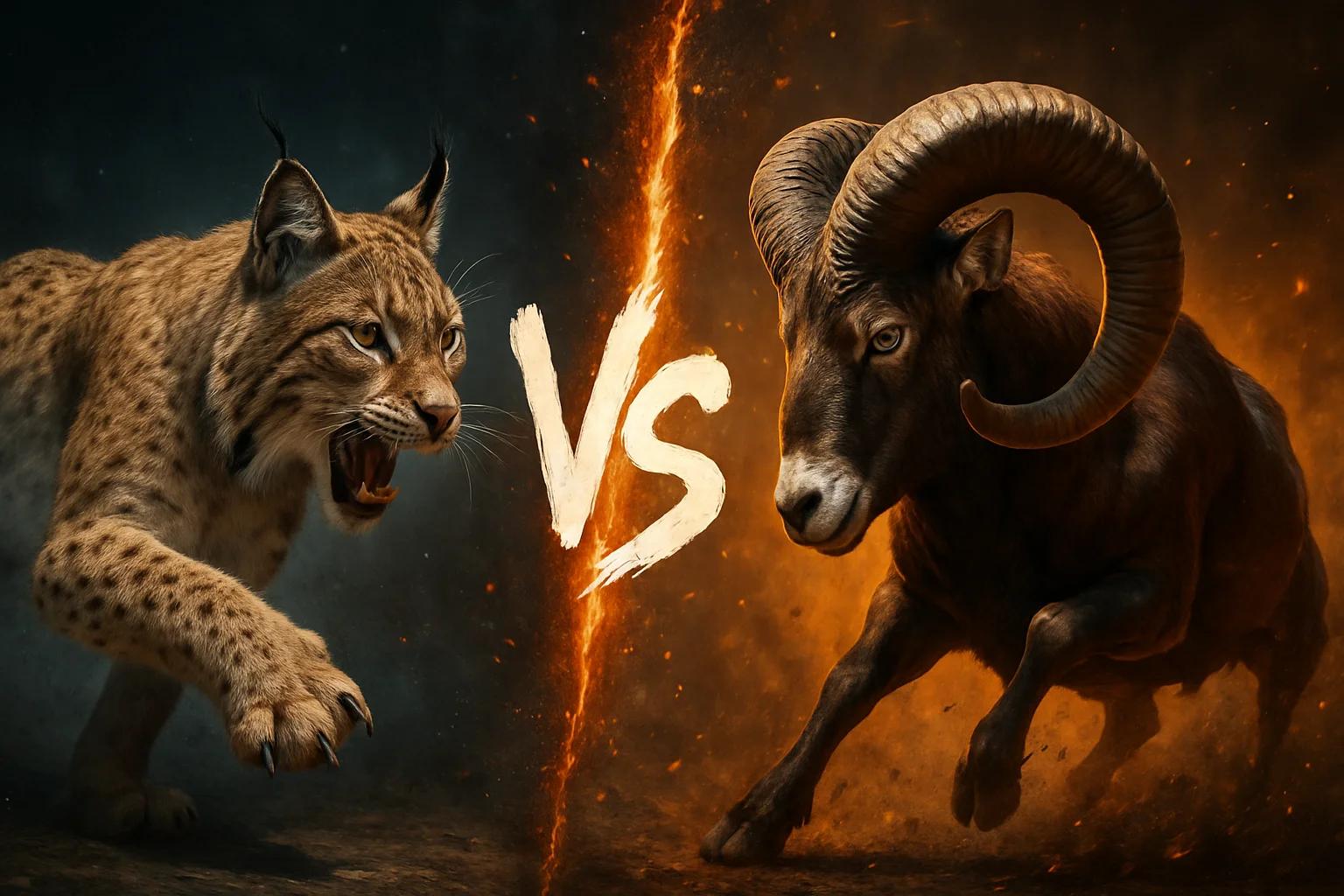
Eurasian Lynx vs Mouflon: Who Actually Wins?
The Eurasian lynx wins this matchup, and not by accident: mouflon are on the lynx's actual menu. Lynx regularly kill roe deer, chamois, and young ungulates of similar or larger size, and wild sheep are well within that range. A 18–30 kg lynx built for stalking cover, explosive short bursts, and a precise throat bite meets a 25–50 kg mountain sheep whose defenses are vigilance, sure-footed escape, and horns evolved mainly for ramming rivals head-on, not for fending off a cat clamped to its neck. If the lynx closes the gap unseen, the contest is usually over in seconds. The mouflon's real wins come from detection and terrain: spot the cat early on open rock, and it simply leaves. A mature ram can also punish a sloppy frontal approach.
Read comparison
Discussion
What do you think?
Share your reasoning with other readers. Be civil and stick to the animals.
Sign in to join the discussion.
Sign inNo comments yet. Start the conversation.