Animal field guide
Mouflon
Ovis gmelini musimon
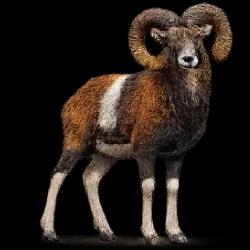
Mouflon teaches Horn Boundary through a wild sheep whose curled horns make conflict legible before it becomes chaos. Rocky footing, herd awareness, rut contests, and visible male horns turn boundary into structure, not random force.
Mouflon at a glance
Mammal · Europe and western Asia · rocky grassland · Females and young rely more on · Uncommon
Known for: Large curved horns in males make dominance contests, Sure-footed movement helps the flock use rocky, Herd vigilance turns individual boundaries into, Dry-hill grazing keeps the animal moving between
Its Power
Horn Boundary
Curled-Horn Slope Defense
A strong boundary can prevent a contest from becoming chaos.
“Hold the horn line.”
Capture a Mouflon, and it's yours when you finish one step it gives you.
Biological basis
heavy curling horns, stocky hill-grazing body, and rocky slope flocking give the Mouflon a body plan tuned for its niche. Mouflons operate through rocky grassland, mountain scrub, and Mediterranean slope. Their design links movement, feeding, shelter, and timing into one workable survival system.
What does the mouflon symbolize?
The mouflon symbolizes horn boundary: curled-Horn Slope Defense. It represents strategy, discipline and long-term thinking. Its AnimalDex motto: "Hold the horn line."
The mouflon as a spirit animal
If the mouflon is your spirit animal, the AnimalDex reading is Horn Boundary: a strong boundary can prevent a contest from becoming chaos. It suggests a strength in strategy and discipline, and a reminder to use it on purpose.
What can the mouflon help you with in life?
The mouflon is a guide for strategy, discipline and long-term thinking. Its lesson applies wherever strategy matters: a strong boundary can prevent a contest from becoming chaos.
- Strategy
- Discipline
- Long-Term Thinking
What does it mean to dream about or encounter a wild mouflon?
Meeting a wild mouflon, asleep or awake, is often a nudge toward strategy, the quality the mouflon is built around. In AnimalDex, the mouflon's principle is Horn Boundary: curled-Horn Slope Defense. Read the moment through its core lesson: A strong boundary can prevent a contest from becoming chaos.
Neither good nor bad on its own. How the mouflon acts matters: at ease, it reflects strategy; hostile, it flags strategy out of balance.
Spotting a mouflon in the wild
If a mouflon crosses your path, take it as a cue to look at where strategy fits your day. Its AnimalDex motto: "Hold the horn line."
A mouflon that keeps appearing
Seeing the mouflon again and again, in dreams or outside, suggests strategy is a theme you have not settled yet.
Dreaming of being chased by a mouflon
Being chased suggests you are avoiding the Horn Boundary the mouflon stands for: a strong boundary can prevent a contest from becoming chaos. Ask what you keep postponing that needs strategy.
Dreaming that a mouflon attacks you
When the mouflon attacks, the dream may be about pressure: discipline or long-term thinking applied too hard, by you or by someone close to you.
A calm or friendly mouflon
A calm mouflon suggests you have made peace with strategy and can use it without force.
A dead or injured mouflon
An injured mouflon often reflects strategy under strain; rest and repair come before pushing again.
These readings are reflective prompts drawn from how the mouflon really lives, not predictions. If you meet one in the wild, watch from a distance and leave it undisturbed.
Capture your own Mouflon
Photograph or film one in the wild, at a zoo or at home with the app. It becomes yours: it remembers you, gives you steps, and can debate your problems with your other animals.
Animal field guide
Mouflon
Sign in to hear this read by a natural AI voice instead of your browser's.
The Mouflon is a mammal with heavy curling horns, stocky hill-grazing body, and rocky slope flocking. In human life, that means good boundaries can prevent problems before they become fights.
Native range
Natural range, not this capture location
rocky grassland, mountain scrub, and Mediterranean slope
Search near meAnimalDex stats
Dominance
46
Speed
53
Size
38
Intelligence
37
Rarity
57%
Total
231
Size scale
Understand the animal
Understand the Mouflon
Factual biology first: what this animal is like, where it lives, how it survives, and why those traits exist.
01
Introduction to Mouflon
Mouflon teaches Horn Boundary through a wild sheep whose curled horns make conflict legible before it becomes chaos. Rocky footing, herd awareness, rut contests, and visible male horns turn boundary into structure, not random force.
How to identify a Mouflon
- Large curved horns in males make dominance contests visible and structured.
- Sure-footed movement helps the flock use rocky slopes as refuge.
- Herd vigilance turns individual boundaries into shared safety.
- Dry-hill grazing keeps the animal moving between food, cover, and contest ground.
02
Adaptations and biological abilities
03
Why does Mouflon behave this way?
- Mouflon are often treated as one of the wild ancestors or close relatives behind domestic sheep.
- Males clash horns during the breeding season, but the ritualized contest helps sort dominance without constant disorder.
- Their rugged habitat makes balance part of survival, not just an athletic trait.
- Females and young rely more on flock movement and terrain than on the dramatic horns of adult rams.
Mouflon are mainly active by day and around cooler dawn or dusk periods, feeding and resting according to heat and safety.
04
Why rocky grassland?
Habitat: rocky grassland, mountain scrub, and Mediterranean slope
Native range: Europe and western Asia
Native range
Natural range, not this specific capture location.
Some regional overlays are unavailable in this web build.
rocky grassland, mountain scrub, and Mediterranean slope
05
Why this diet?
Grasses, herbs, shrubs, leaves, and bark.
06
Activity, rest, and lifespan
Mouflon are mainly active by day and around cooler dawn or dusk periods, feeding and resting according to heat and safety.
Mouflon can live around a decade in the wild, with longer lives possible under protected conditions. That span gives repeated seasons for young animals to learn routes, flock rules, and the difference between panic and a clear horn line.
07
Mouflon reproduction
Females usually give birth to one lamb after the breeding season, choosing cover and flock proximity so the young can stand and follow quickly. Offspring survival depends on early footing, watchful mothers, and the herd’s shared sense of danger.
Males are usually larger and carry the most dramatic curled horns, while females are smaller and may have small horns or none depending on population.
08
Predators, threats, and defense
09
Conservation and rarity
Rarity: Uncommon · 57/100. Mouflon can still be found in good habitat, but local numbers shift when rocky grassland, mountain scrub, and Mediterranean slope changes.
- Keep distance and let the animal choose the space.
- Avoid blocking movement routes, nesting areas, or feeding behavior.
- Use optics, patience, and quiet observation instead of crowding for a closer view.
Talk to it
Talk to the Mouflon
It answers as itself: ask about how it lives, or bring it something of yours and hear what it would do, from its own Power.
Anonymous: 3/day. Signed-in: 10/day. Pro: 100/day.
Side by side
The Mouflon, side by side
Where to find them
Where to find Mouflon
To find Mouflon in the wild, focus on the exact habitat patches that match its body design and daily behavior, not just the broad country where it exists. You usually do better by working one good piece of habitat inside europe and western Asia than by covering too much ground.
- Rocky slopes, ridge lines, cliff ledges, or open mountain meadows with a wide view
- Open grassland edges, lightly wooded plains, or raised ground where you can scan long distances
- Protected habitat blocks within europe and western Asia
Scientific name
Ovis gmelini musimon
Category
Mammal
Habitat
rocky grassland, mountain scrub, and Mediterranean slope
Rarity
Uncommon · 57/100
Native range
Europe and western Asia
Related animals
Chamois
Chamois is a mammal known for hooked black horns, mountain running agility, and…
Read species guideEurasian Lynx
Eurasian Lynx is a mammal known for tufted ears for focused listening, long-legged snow…
Read species guideEuropean Hedgehog
The European hedgehog is a small nocturnal mammal covered in spines and known for…
Read species guideMore animals with Strategy
African Grey Parrot
The African grey parrot is a highly intelligent parrot known for gray plumage, red…
Read species guideAldabra Giant Tortoise
Aldabra Giant Tortoise is a reptile known for immense domed shell, very long lifespan,…
Read species guideAlpine Newt
Alpine Newt is a amphibian known for orange belly in breeding season, smooth pond-ready…
Read species guideTake the encyclopedia outside
AnimalDex helps you scan real animals, identify species, collect cards, and learn from nature wherever you are.