


Chinese Cobra vs Chinese Water Dragon: Who Actually Wins?
Chinese cobra vs Chinese water dragon: a biology-first look at venom, speed, bite force and escape tactics, with a clear verdict on who wins and why.
Chinese Cobra vs Chinese Water Dragon
Matchup winner
Chinese Cobra
Quick verdict
Start with the direct answer, then use the structured comparison below to see what changes the outcome.
The Chinese cobra (Naja atra) wins this matchup clearly. It is longer and heavier than the Chinese water dragon, and it carries a potent neurotoxic and cytotoxic venom that can disable a lizard of this size within minutes. Its hood display, raised strike posture and willingness to stand its ground give it control of any close encounter. The water dragon is quicker over short bursts, has a strong bite, and can whip its tail. But none of that offsets a single well-placed envenomating bite. The lizard's real edge is evasion. It can sprint, climb, or dive and stay submerged for long stretches. In a forced confrontation, though, the cobra holds the decisive tool, and small reptiles, lizards included, are a natural part of cobra diets across southern China and Southeast Asia.
Read the full explanation
Winner: Chinese cobra. Venom ends the contest faster than anything the water dragon can do.
The cobra is longer (often 1.2 to 1.8 m) and heavier than an adult water dragon, which is mostly tail.
The water dragon wins at escape, not at fighting. Water and trees are its lifelines.
Expect the cobra to win most forced encounters. The dragon survives mostly by fleeing early.
Reader vote
Who do you think wins?
Pick a side — no account needed. Results update live.
No votes yet — be the first to call it.
Editorial note
Why people disagree
Water dragons look bigger than they are. Up to two-thirds of their length is tail, so real body mass favors the cobra.
Lethal payload
One successful envenomation can decide the encounter outright. The dragon has no equivalent finisher.
Body mass & reach
The cobra can strike from a standing coil, while the dragon must close the distance to do any damage.
Burst escape
Speed lets the dragon avoid the fight entirely, which is its best real-world strategy.
Read the full explanation +
Some readers assume a fast lizard can bite first and win. The dragon's bite stings, but it is not a fight-ender against a defensive cobra.
Habitat swings the story. Near a stream with overhanging branches, the dragon often simply leaves, and some people count that as a win.
Comparison FAQ
Short, direct answers to the next questions readers usually ask after the headline verdict.
Would a Chinese cobra beat a Chinese water dragon?+
Yes, in most forced encounters. The cobra's venom and reach outclass the dragon's bite and claws.
Which is stronger, the Chinese cobra or the Chinese water dragon?+
The cobra. It has more muscle mass and a far more dangerous weapon. The dragon's apparent size comes mostly from its tail.
Do Chinese cobras eat lizards?+
Yes. Chinese cobras are generalist predators that take rodents, frogs, other snakes and lizards, so small and medium lizards fit their diet.
Why is the water dragon still dangerous to the cobra?+
It can deliver a painful bite with strong jaws and lash with its tail. Its speed also means the cobra may waste energy, take minor injuries, or lose the prey entirely when the dragon flees into water.
Can the water dragon escape a cobra?+
Often, yes. Near streams it can dive and stay submerged for extended periods, or climb out of reach, which is its main survival strategy.
Head-to-head species stats
These are the same core AnimalDex stat dimensions used on the dedicated animal pages, pulled side by side so the matchup is faster to scan.
Chinese Cobra
Tier CChinese Water Dragon
Tier CTrait-by-trait comparison
Only the categories that matter to this matchup are included. The goal is not filler stats, but the real design differences that change the result.
Potent neurotoxic and cytotoxic venom
Lethal payload
Chinese Cobra
No venom, mechanical bite only
Lethal payload
Chinese Cobra
Long muscular body with a raised strike range
Body mass & reach
Chinese Cobra
Slim body, most of the length is tail
Body mass & reach
Chinese Cobra
Moderate ground speed
Burst escape
Chinese Water Dragon
Fast sprinting, bipedal bursts, strong climber
Burst escape
Chinese Water Dragon
Capable swimmer but not specialized
Aquatic refuge
Chinese Water Dragon
Dives readily and stays submerged for long periods
Aquatic refuge
Chinese Water Dragon
Hood spread, hissing, standing strike posture
Threat display & control
Chinese Cobra
Throat display, tail lashing
Threat display & control
Chinese Cobra
Can absorb bites and scratches without losing striking ability
Close-range durability
Chinese Cobra
Thin-skinned and vulnerable once bitten
Close-range durability
Chinese Cobra
How the verdict forms
Verdict timeline
01 · Lethal payload
Chinese Cobra
02 · Body mass & reach
Chinese Cobra
03 · Burst escape
Chinese Water Dragon
04 · Aquatic refuge
Chinese Water Dragon
05 · Threat display & control
Chinese Cobra
06 · Close-range durability
Chinese Cobra
Change the conditions
Scenario breakdown
This is where shallow battle content usually fails. Terrain, spacing, timing, and engagement style can change the answer.
Scenario lean
Chinese Cobra
Verdict confidence
82%
The cobra wins in leaf litter and undergrowth.
In tight cover the dragon loses its sprint lanes and cannot see the strike coming. The cobra hunts naturally through this terrain, using ambush range and chemical detection by tongue-flicking to locate prey. Short distances favor the animal with the instant finisher.
AnimalDex field profiles
Explore these animals
Chinese Cobra
Naja atra
forest edge, farmland margin, and subtropical hillside
Chinese Water Dragon
Physignathus cocincinus
riverbank forest, humid ravine, and subtropical woodland
Systems Intelligence & Hidden Purpose
See the animals behind this comparison as engineered biological systems: what each one is built to do, where it gains leverage, and why the matchup changes by scenario.
Specialized Hardware
bright green streamside body, long balancing tail, and water-diving escape behavior give the Chinese Water Dragon a body plan tuned for its niche.
Systems Script
Chinese Water Dragons operate through riverbank forest, humid ravine, and subtropical woodland. Their design links movement, feeding, shelter, and timing into one workable survival system.
Strategic Insight
Dense environments reward precision, patience, and the ability to read layered cover.
Final take
The Chinese cobra is the overall winner. It brings more body mass, longer reach and a venom payload that a medium-sized lizard simply cannot absorb. In any forced, close-quarters encounter, the cobra holds the decisive tool.
Read the full explanation
The Chinese water dragon is no pushover, but its strengths are defensive. It survives through speed, climbing and diving rather than by trading blows. Near water it often walks away unharmed, which is exactly what its body is built to do.
Collect both animals in AnimalDex
Track the species behind this matchup, compare their real traits, and build the rivalry into your AnimalDex collection.
Related comparisons
Continue with nearby matchups to compare more real-world animal traits without dropping into junky who-wins filler.
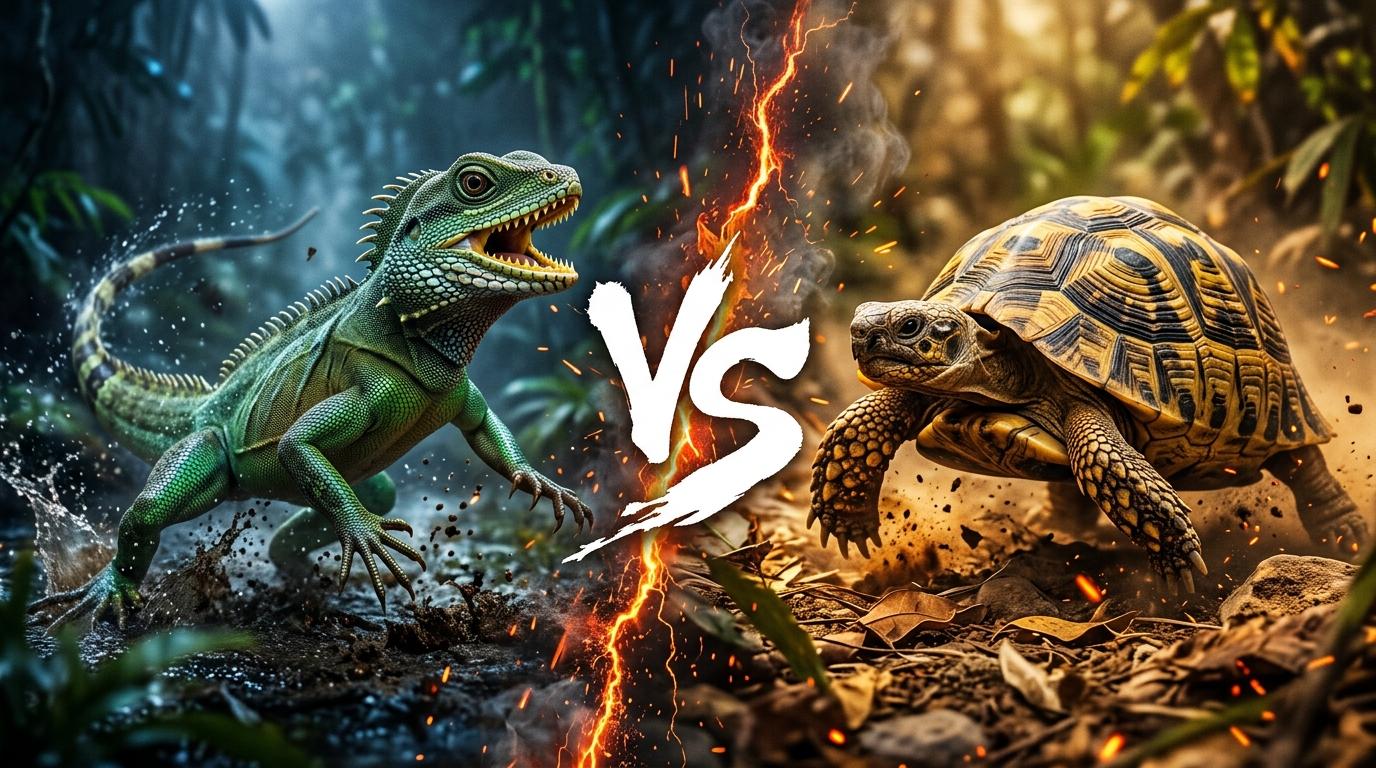
Chinese Water Dragon vs Elongated Tortoise: Who Actually Wins?
The Chinese water dragon wins overall, but only because it can control the encounter rather than overpower the tortoise. Physignathus cocincinus is a fast, alert agamid lizard that reaches roughly 60–90 cm with most of that length in tail. It has sharp claws, a respectable bite, quick reflexes and an escape-to-water reflex that lets it decide when contact starts and ends. The elongated tortoise (Indotestudo elongata) is a slow, armored forest-floor grazer of about 25–33 cm shell length. Its domed carapace and retractable limbs make it nearly impossible for a dragon-sized lizard to injure. Neither animal can realistically hurt the other badly, so this is a contest of control. The dragon wins on initiative, mobility and nerve. The tortoise wins only in the narrow sense that it cannot be beaten into submission.
Read comparison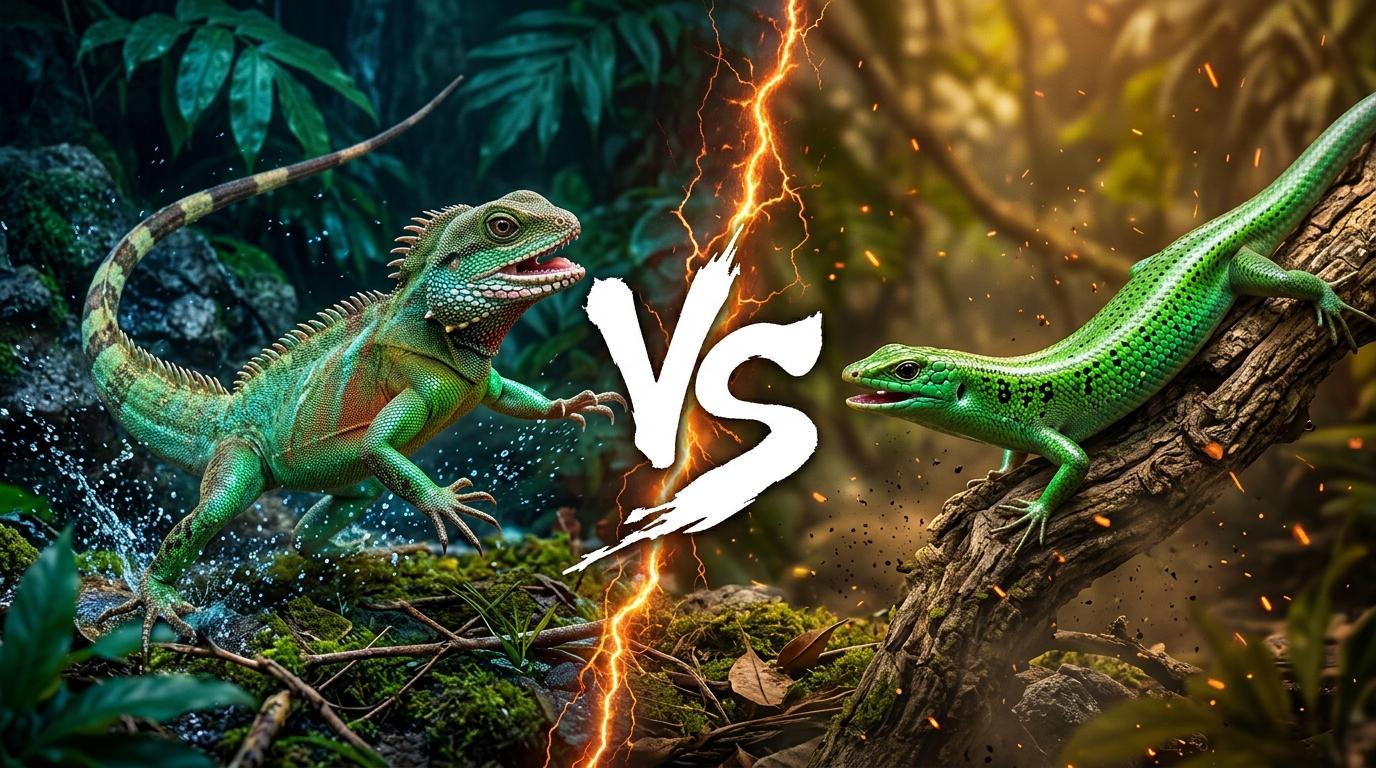
Chinese Water Dragon vs Emerald Tree Skink: Who Actually Wins?
The Chinese water dragon wins, and it isn't close in a straight confrontation. A big male dragon can reach about 90 cm long and outweighs an emerald tree skink many times over. The skink is a slim canopy lizard of roughly 20–25 cm. The dragon has a broad head, strong jaws, sturdy limbs, and a crested, muscular frame built for riverbank scrambles, swimming, and seizing live prey, including small vertebrates. The skink is a sleek, smooth-scaled insect hunter whose real strengths are agility, grip on bark, and getting away fast. Wherever the two meet on the ground, on the riverbank, or over a shared basking spot, the dragon's size and bite decide it. The skink's one dependable result is not losing: in a tangle of thin branches it can climb, dodge, and drop its tail to escape.
Read comparison
Discussion
What do you think?
Share your reasoning with other readers. Be civil and stick to the animals.
Sign in to join the discussion.
Sign inNo comments yet. Start the conversation.