

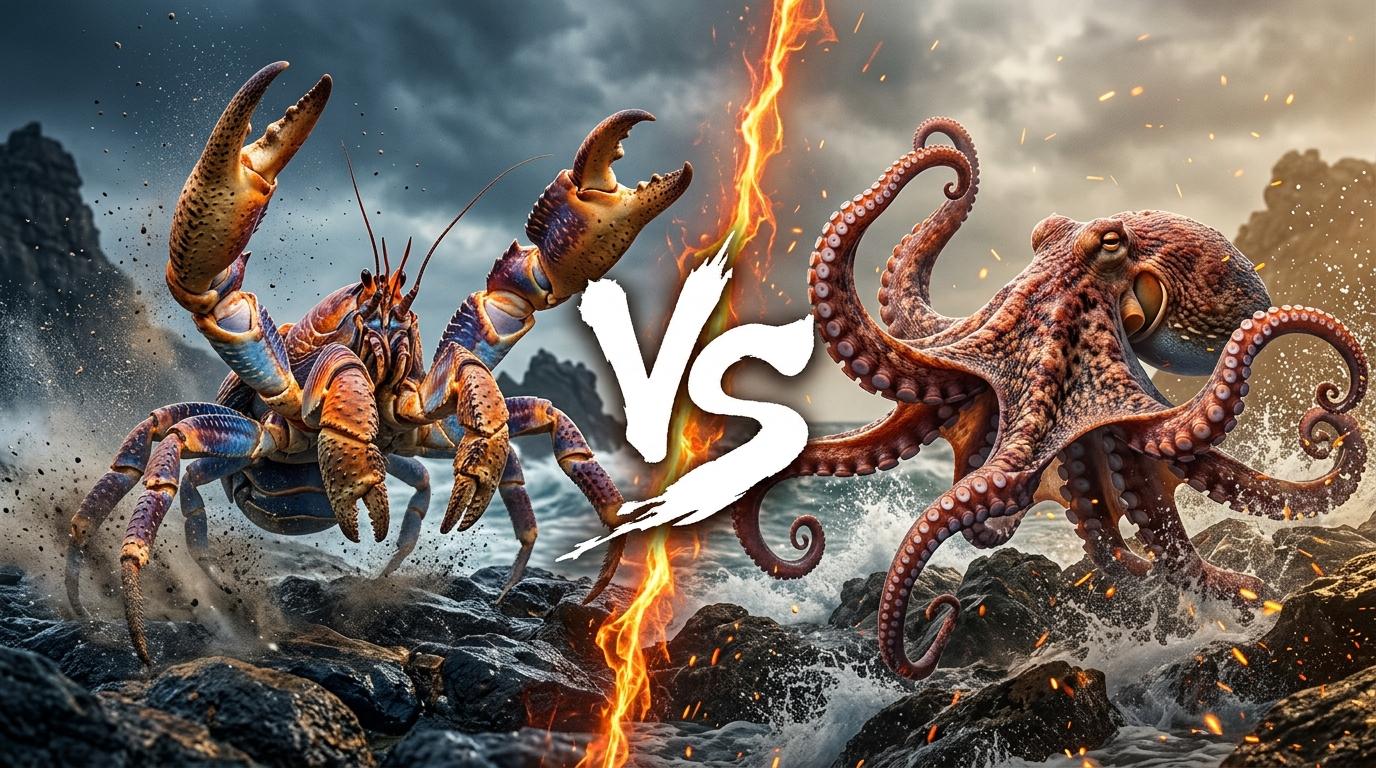
Coconut Crab vs Giant Pacific Octopus: Who Actually Wins?
Coconut crab vs giant pacific octopus: who would win? We compare crushing claws, eight-armed grappling, size, intelligence, and habitat to find the winner and where each one wins.
Coconut Crab vs Giant Pacific Octopus
Matchup winner
Giant Pacific Octopus
Quick verdict
Start with the direct answer, then use the structured comparison below to see what changes the outcome.
The Giant Pacific Octopus wins this matchup overall, and it is not especially close in the setting where the two could realistically meet: water. The octopus is many times heavier, commonly 15 kg or more against a coconut crab's maximum of about 4 kg. Its arm span runs to several meters, lined with hundreds of suckers that can pin a target from every angle at once. Most importantly, the octopus is a specialist crab hunter. It has a hard parrot-like beak, a tongue-like radula that can drill through shell, and venomous saliva that weakens prey from the inside. The coconut crab carries one of the strongest pinches measured in any crustacean, and a well-placed claw can sever an arm. But an adult coconut crab breathes air through modified gill chambers and drowns if it stays submerged. Once it is in the water, it is fighting the clock, the grapple, and an animal built to dismantle armored prey. Flip the setting to dry land and the crab takes over, because the octopus quickly loses strength, coordination, and oxygen out of water. That is a habitat edge, though, not a combat edge. On balance, the octopus has the better toolkit for actually ending a fight.
Read the full explanation
Overall winner: Giant Pacific Octopus. It is far larger, it grapples with eight arms, and it hunts crabs for a living.
In water or tide pools, the octopus wins decisively, because an adult coconut crab drowns when submerged.
On dry land, the coconut crab wins, because the octopus can't breathe or move well out of water.
The crab's claw is a real threat. A clean pinch can crush or sever an octopus arm.
Reader vote
Who do you think wins?
Pick a side — no account needed. Results update live.
No votes yet — be the first to call it.
Editorial note
Why people disagree
The claw-strength headline: coconut crab pinch-force figures go viral, so people assume crushing power settles everything. Grappling, mass, and venom matter more once the crab is wrapped up.
Crushing power
This is the crab's best weapon and its main path to wounding the octopus. One clean pinch can disable an arm.
Size and mass
A several-fold weight edge lets the octopus smother, pin, and drag the crab instead of trading blows.
Grapple control
The octopus can restrain the claws while other arms work the body. Restraint beats raw force in close quarters.
Read the full explanation +
Habitat confusion: many readers picture both animals on a beach. These two live in almost opposite worlds, and wherever the fight takes place usually decides the winner.
Armor vs intelligence: some see the crab's thick exoskeleton as impenetrable. Octopuses routinely beat crustacean armor with drilling, toxins, and patience.
Comparison FAQ
Short, direct answers to the next questions readers usually ask after the headline verdict.
Would a coconut crab beat a giant pacific octopus?+
Usually not. The octopus wins in water or at the shoreline thanks to its size, grappling arms, and crab-hunting tools. The crab only wins if the fight happens fully on dry land.
Which is stronger, the coconut crab or the giant pacific octopus?+
The coconut crab has the stronger concentrated pinch, which is one of the most powerful of any crustacean. The octopus has far more total body strength and grip, spread across eight muscular arms, and outweighs the crab several times over.
Can a coconut crab hurt an octopus?+
Yes. A solid claw grip can crush or sever an octopus arm. That is why the crab stays dangerous even while losing, and why the octopus works to restrain the claws first.
Can a coconut crab swim?+
No. Adult coconut crabs are land animals that breathe air and can drown if they stay submerged, which is the crab's biggest weakness in this matchup.
Do octopuses eat crabs?+
Yes. Crabs are a staple prey for the giant pacific octopus, which uses its beak, a drilling radula, and toxic saliva to get through their shells.
Head-to-head species stats
These are the same core AnimalDex stat dimensions used on the dedicated animal pages, pulled side by side so the matchup is faster to scan.
Coconut Crab
Tier CGiant Pacific Octopus
Tier CTrait-by-trait comparison
Only the categories that matter to this matchup are included. The goal is not filler stats, but the real design differences that change the result.
Elite claw pinch, among the strongest of any crustacean
Crushing power
Coconut Crab
Hard beak, strong but used at close range
Crushing power
Coconut Crab
Up to about 4 kg, legs spanning roughly 1 m
Size and mass
Giant Pacific Octopus
Often 15+ kg, arm span of several meters
Size and mass
Giant Pacific Octopus
Pincers and walking legs, limited reach
Grapple control
Giant Pacific Octopus
Eight independent arms with hundreds of suckers
Grapple control
Giant Pacific Octopus
Thick calcified exoskeleton
Close-range durability
Coconut Crab
Soft body, no shell, but can regenerate arms
Close-range durability
Coconut Crab
Persistent forager, simple tactics
Tactical problem-solving
Giant Pacific Octopus
Highly flexible learner, adapts tactics mid-encounter
Tactical problem-solving
Giant Pacific Octopus
None needed; it is the armored one
Anti-armor toolkit
Giant Pacific Octopus
Beak, shell-drilling radula, paralyzing saliva
Anti-armor toolkit
Giant Pacific Octopus
How the verdict forms
Verdict timeline
01 · Crushing power
Coconut Crab
02 · Size and mass
Giant Pacific Octopus
03 · Grapple control
Giant Pacific Octopus
04 · Close-range durability
Coconut Crab
05 · Tactical problem-solving
Giant Pacific Octopus
06 · Anti-armor toolkit
Giant Pacific Octopus
Change the conditions
Scenario breakdown
This is where shallow battle content usually fails. Terrain, spacing, timing, and engagement style can change the answer.
Scenario lean
Giant Pacific Octopus
Verdict confidence
82%
The octopus wins decisively.
Submerged, the coconut crab is on a timer: its air-breathing system fails, and every second it spends struggling burns oxygen. The octopus moves freely here. It can envelop the crab, pin the claws, and bite at leg joints while its saliva weakens the crab's tissue. Even a strong pinch rarely reverses a fight once the crab is fully wrapped.
AnimalDex field profiles
Explore these animals
Coconut Crab
Birgus latro
Tropical islands, coastal forest, rocky shore, and inland scrub.
Giant Pacific Octopus
Enteroctopus dofleini
rocky reef, kelp forest, and cold coastal sea floor
Systems Intelligence & Hidden Purpose
See the animals behind this comparison as engineered biological systems: what each one is built to do, where it gains leverage, and why the matchup changes by scenario.
Specialized Hardware
Very large crab body on land, strong heavy claws, and long legs for climbing and walking give the Coconut Crab a body plan tuned for its niche.
Systems Script
Coconut Crabs operate in tropical islands, coastal forest, rocky shore, and inland scrub. Their design helps them match food access, shelter, and timing inside that environment.
Strategic Insight
A powerful grip turns locked resources into open ones.
Specialized Hardware
huge arm span, shape-shifting camouflage, and complex problem-solving behavior give the Giant Pacific Octopus a body plan tuned for its niche.
Systems Script
Giant Pacific Octopuss operate through rocky reef, kelp forest, and cold coastal sea floor Their design links movement, shelter, and feeding into one workable survival system.
Strategic Insight
Distributed control becomes even more impressive when the body itself stays adaptable.
Final take
The Giant Pacific Octopus is the clear overall winner. It brings mass, reach, multi-arm control, and a hunting kit refined over millions of years against exactly this kind of opponent: armored crustaceans.
Read the full explanation
The coconut crab is not a pushover. Its claw is a genuine arm-ending weapon, its shell is excellent armor, and on dry land it wins outright. But in any realistic meeting at the water's edge, the octopus can pull the fight into the sea, where the crab literally cannot breathe.
Collect both animals in AnimalDex
Track the species behind this matchup, compare their real traits, and build the rivalry into your AnimalDex collection.
Related comparisons
Continue with nearby matchups to compare more real-world animal traits without dropping into junky who-wins filler.
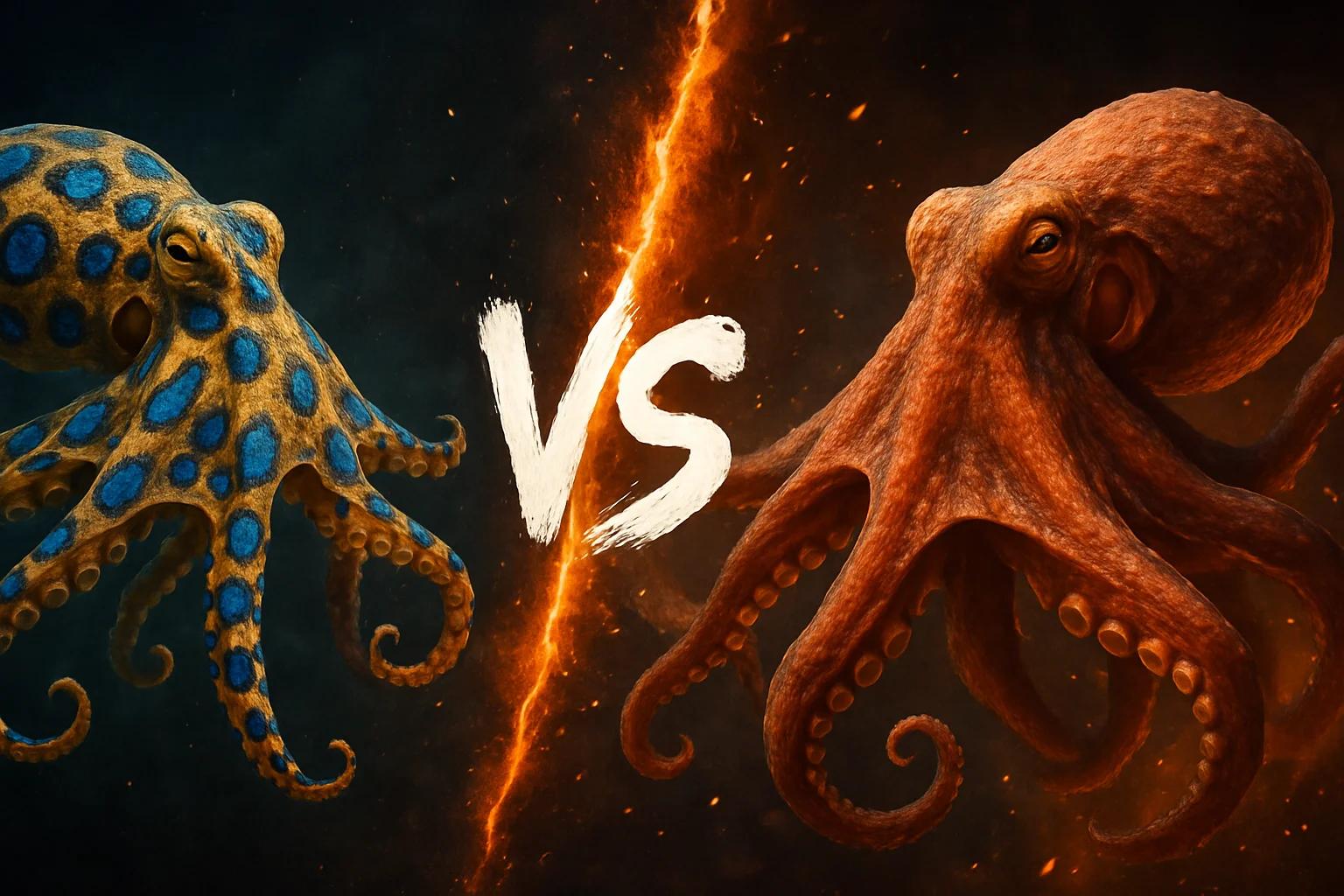
Blue-ringed Octopus vs Giant Pacific Octopus: Who Actually Wins?
The Giant Pacific Octopus wins most realistic encounters. A large adult can weigh well over a hundred times as much as a Blue-ringed Octopus. Its arms reach farther than the smaller animal's whole world, and it can control prey from a distance with hundreds of strong suckers before any beak contact happens. The Blue-ringed Octopus carries one of the ocean's most potent neurotoxins, tetrodotoxin, in its saliva. But that toxin is delivered by a bite, and a bite requires getting the beak onto soft tissue. A giant octopus that pins it arm-first and keeps it away from its mantle denies that chance. The upset path is real: one solid bite could plausibly disable even a giant. This is a decisive size-and-control win with a genuine venom asterisk, not a mismatch.
Read comparison
Discussion
What do you think?
Share your reasoning with other readers. Be civil and stick to the animals.
Sign in to join the discussion.
Sign inNo comments yet. Start the conversation.