

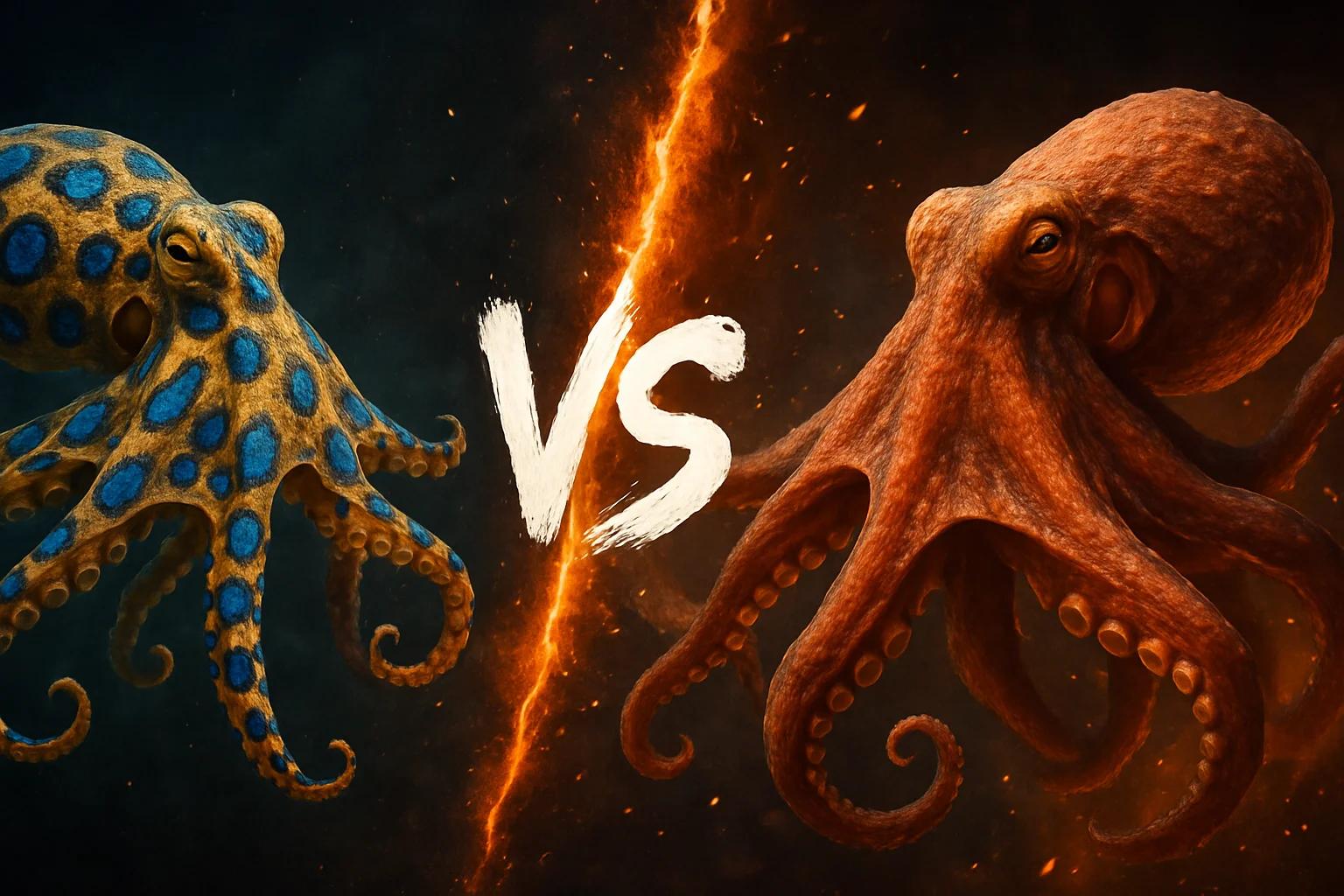
Blue-ringed Octopus vs Giant Pacific Octopus: Who Actually Wins?
A tiny venomous reef octopus versus the world's largest octopus. Here is how size, reach, venom, and cephalopod intelligence decide a Blue-ringed Octopus vs Giant Pacific Octopus fight.
Blue-ringed Octopus vs Giant Pacific Octopus
Matchup winner
Giant Pacific Octopus
Quick verdict
Start with the direct answer, then use the structured comparison below to see what changes the outcome.
The Giant Pacific Octopus wins most realistic encounters. A large adult can weigh well over a hundred times as much as a Blue-ringed Octopus. Its arms reach farther than the smaller animal's whole world, and it can control prey from a distance with hundreds of strong suckers before any beak contact happens. The Blue-ringed Octopus carries one of the ocean's most potent neurotoxins, tetrodotoxin, in its saliva. But that toxin is delivered by a bite, and a bite requires getting the beak onto soft tissue. A giant octopus that pins it arm-first and keeps it away from its mantle denies that chance. The upset path is real: one solid bite could plausibly disable even a giant. This is a decisive size-and-control win with a genuine venom asterisk, not a mismatch.
Read the full explanation
Giant Pacific Octopus wins most fights through overwhelming size, reach, and sucker control.
The Blue-ringed Octopus's tetrodotoxin bite is its only real win condition, and it needs close beak contact to use it.
In cramped cover where the small octopus can strike first, the upset odds rise sharply.
In the wild they never meet: one lives on warm Indo-Pacific reefs, the other in the cold North Pacific.
Reader vote
Who do you think wins?
Pick a side — no account needed. Results update live.
No votes yet — be the first to call it.
Editorial note
Why people disagree
Venom fans argue potency beats mass. Delivery matters as much as toxicity, though, and a bite is harder to land than a sting or spit.
Raw mass and reach
Reach decides who touches whom first. The giant can grip from a range where the small octopus cannot answer.
Lethal payload
This is the single biggest swing factor in the matchup and the reason the Blue-ringed Octopus is never harmless.
Grip and pin control
Pinning the opponent's arms and beak away from the body neutralizes a bite-dependent weapon.
Read the full explanation +
Some assume octopuses are immune to octopus venom. Blue-ringed octopuses resist their own toxin, but no one has shown that a Giant Pacific Octopus would.
Both are elite problem-solvers, so people expect a clever stalemate. At this size gap, intelligence mostly amplifies the bigger animal's advantages.
Comparison FAQ
Short, direct answers to the next questions readers usually ask after the headline verdict.
Would a Giant Pacific Octopus beat a Blue-ringed Octopus?+
Usually, yes. Its massive size and sucker grip let it pin the smaller octopus before a bite lands. A close-range ambush in tight cover is the main exception.
Which octopus is stronger?+
The Giant Pacific Octopus, by an enormous margin. It can grip and pull with force the tiny Blue-ringed Octopus cannot approach.
Could Blue-ringed Octopus venom kill a Giant Pacific Octopus?+
Possibly. Tetrodotoxin blocks sodium channels in nerves, and no one has shown that Giant Pacific Octopuses resist it. The hard part is landing the bite.
Why is the Blue-ringed Octopus still dangerous if it loses?+
Its toxin is potent enough to be lethal to humans, and it needs only one well-placed bite. That gives it a real upset chance and makes many predators avoid it.
Do they ever meet in the wild?+
No. Blue-ringed octopuses live on warm Indo-Pacific reefs and tide pools, while Giant Pacific Octopuses live in the cold North Pacific.
Head-to-head species stats
These are the same core AnimalDex stat dimensions used on the dedicated animal pages, pulled side by side so the matchup is faster to scan.
Blue-ringed Octopus
Tier CGiant Pacific Octopus
Tier CTrait-by-trait comparison
Only the categories that matter to this matchup are included. The goal is not filler stats, but the real design differences that change the result.
Golf-ball body, arm span around 20 cm
Raw mass and reach
Giant Pacific Octopus
Often 15–50 kg, arm span several meters
Raw mass and reach
Giant Pacific Octopus
Tetrodotoxin bite that can kill a human
Lethal payload
Blue-ringed Octopus
Mild venom suited to crabs and clams
Lethal payload
Blue-ringed Octopus
Small suckers, built for crabs
Grip and pin control
Giant Pacific Octopus
Over 2,000 suckers with heavy holding power
Grip and pin control
Giant Pacific Octopus
Tiny soft body, little margin for error
Close-range durability
Giant Pacific Octopus
Large mantle, can lose arm tips and regrow them
Close-range durability
Giant Pacific Octopus
Flashing iridescent blue rings
Warning display
Blue-ringed Octopus
Rapid color change and camouflage
Warning display
Blue-ringed Octopus
Clever, secretive reef forager
Tactical problem-solving
Giant Pacific Octopus
Famous puzzle-solver with strong learning ability
Tactical problem-solving
Giant Pacific Octopus
How the verdict forms
Verdict timeline
01 · Raw mass and reach
Giant Pacific Octopus
02 · Lethal payload
Blue-ringed Octopus
03 · Grip and pin control
Giant Pacific Octopus
04 · Close-range durability
Giant Pacific Octopus
05 · Warning display
Blue-ringed Octopus
06 · Tactical problem-solving
Giant Pacific Octopus
Change the conditions
Scenario breakdown
This is where shallow battle content usually fails. Terrain, spacing, timing, and engagement style can change the answer.
Scenario lean
Blue-ringed Octopus
Verdict confidence
82%
The Blue-ringed Octopus's best shot at an upset.
In tight rock gaps the giant cannot spread its arms or use its reach. A small octopus that is already close can bite soft tissue before being pinned. Ambush range erases the size advantage, and if the toxin acts on the giant's nervous system, the fight could end quickly.
AnimalDex field profiles
Explore these animals
Blue-ringed Octopus
Hapalochlaena lunulata
shallow reef, tide pool, and rocky coastal water
Giant Pacific Octopus
Enteroctopus dofleini
rocky reef, kelp forest, and cold coastal sea floor
Systems Intelligence & Hidden Purpose
See the animals behind this comparison as engineered biological systems: what each one is built to do, where it gains leverage, and why the matchup changes by scenario.
Specialized Hardware
tiny body with flashing blue rings, strong venom, and reef-crevice camouflage give the Blue-ringed Octopus a body plan tuned for its niche.
Systems Script
Blue-ringed Octopuss operate through shallow reef, tide pool, and rocky coastal water Their design links movement, shelter, and feeding into one workable survival system.
Strategic Insight
A very small system can still command distance if the warning is unmistakable.
Specialized Hardware
huge arm span, shape-shifting camouflage, and complex problem-solving behavior give the Giant Pacific Octopus a body plan tuned for its niche.
Systems Script
Giant Pacific Octopuss operate through rocky reef, kelp forest, and cold coastal sea floor Their design links movement, shelter, and feeding into one workable survival system.
Strategic Insight
Distributed control becomes even more impressive when the body itself stays adaptable.
Final take
The Giant Pacific Octopus is the overall winner. In cephalopod fights, the animal that controls distance controls the outcome, and a multi-meter arm span beats a beak that has to touch skin to work.
Read the full explanation
Respect the asterisk. The Blue-ringed Octopus is one of the most dangerous animals in the sea for its size. Even a giant that blunders into a close-range exchange could pay for it. The giant wins the matchup; it does not get to ignore the venom.
Collect both animals in AnimalDex
Track the species behind this matchup, compare their real traits, and build the rivalry into your AnimalDex collection.
Related comparisons
Continue with nearby matchups to compare more real-world animal traits without dropping into junky who-wins filler.
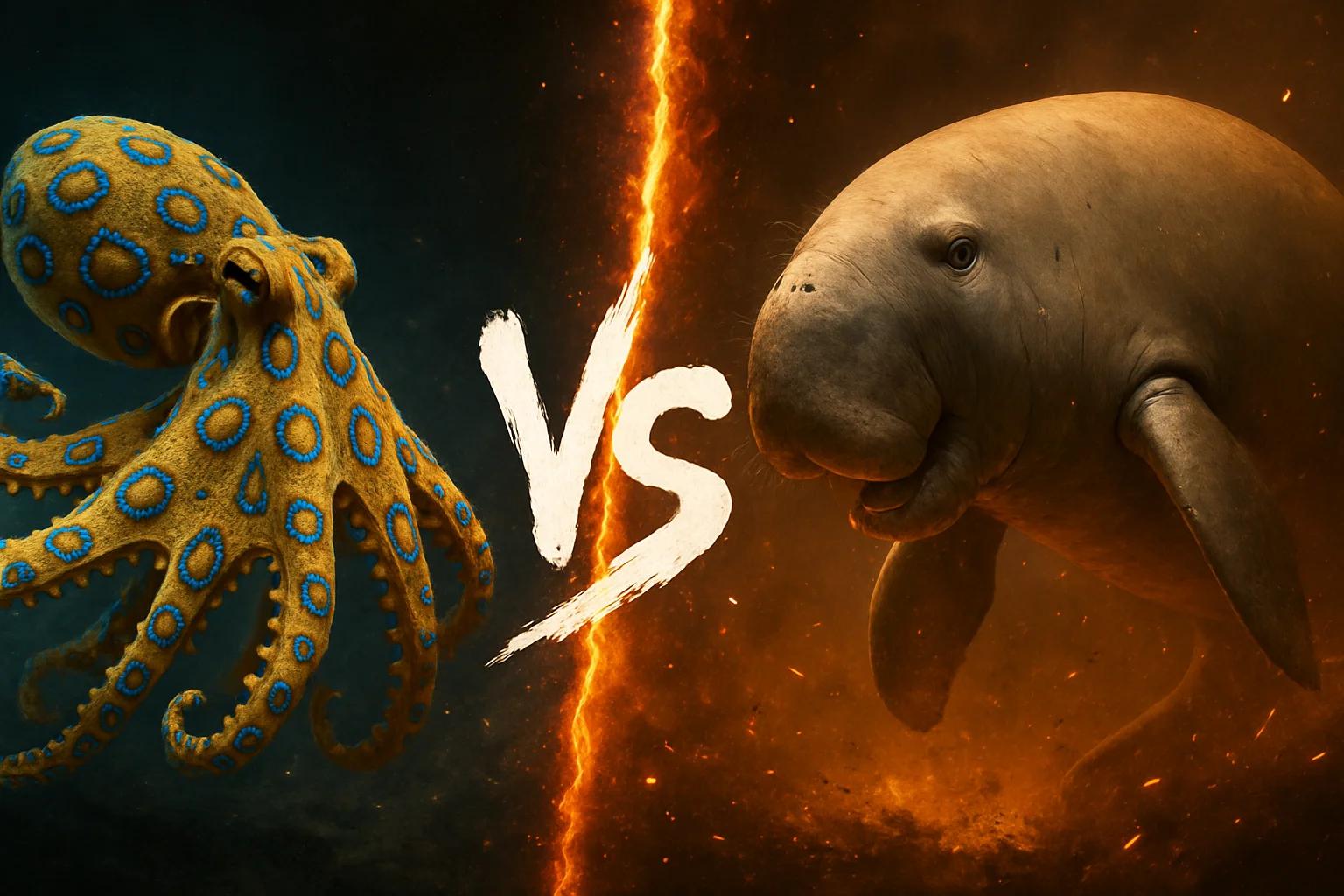
Blue-ringed Octopus vs Dugong: Who Actually Wins?
The Dugong wins this matchup, though the margin is narrower than the size gap suggests. A Blue-ringed Octopus carries tetrodotoxin (TTX), a nerve toxin with no antidote. In theory, one octopus holds enough to kill an animal far heavier than a dugong. In practice, the octopus has to deliver it. That means biting through thick, tough sirenian hide with a beak only a few millimeters across, then holding on long enough for the toxin to spread through a large, slow-metabolism body. Dugongs do not hunt octopuses. They plow seagrass, push through sediment and shrug off contact. The octopus's whole strategy is to avoid fights: it flashes warning rings and retreats into rubble. Most realistic encounters therefore end with the dugong unharmed and the octopus hidden, and on a battle page that counts as a win for the larger animal. The real exception is if a dugong accidentally swallows an octopus while grazing. That scenario is genuinely dangerous for the dugong and is why the octopus never stops being a threat.
Read comparison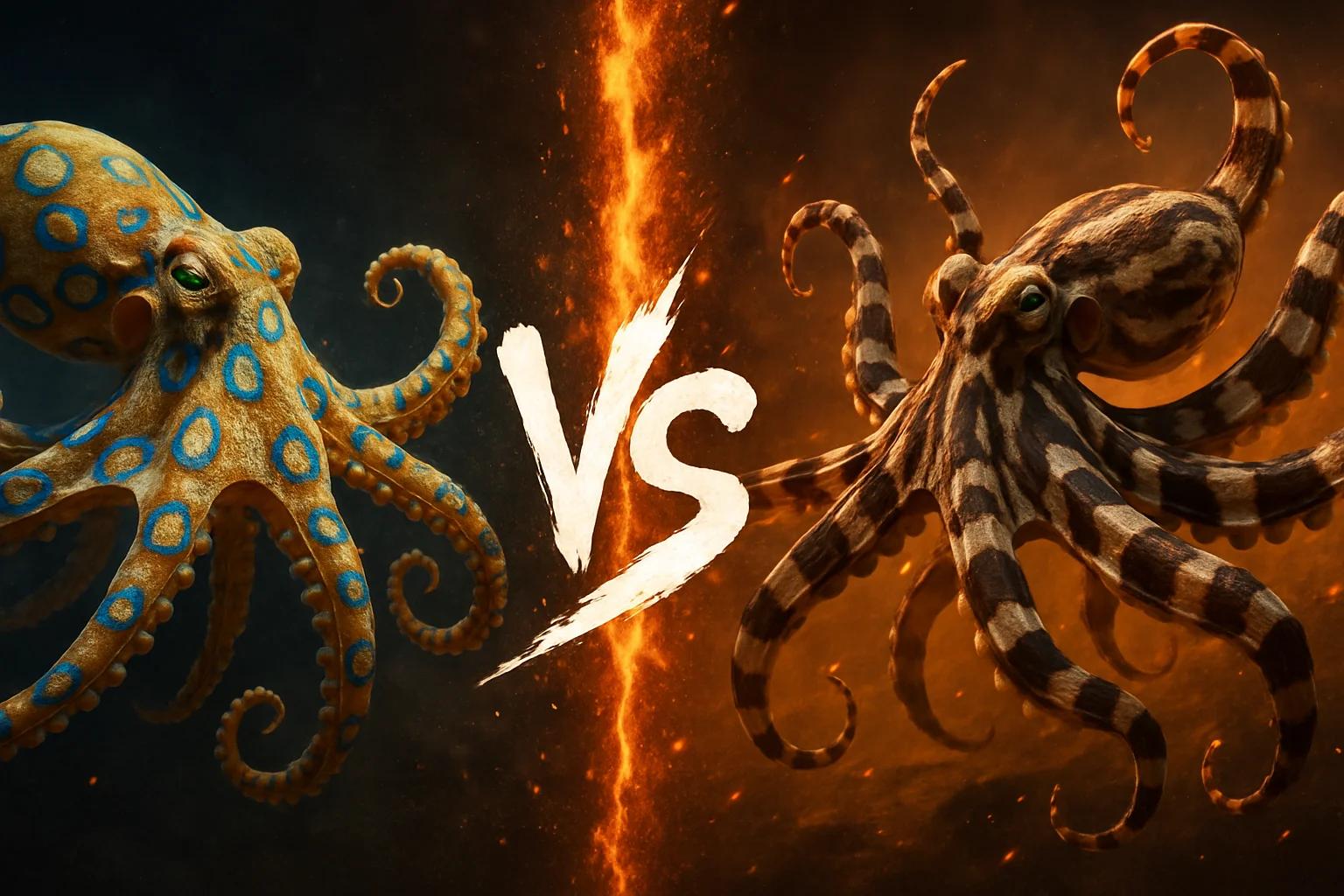
Blue-ringed Octopus vs Mimic Octopus: Who Actually Wins?
The blue-ringed octopus wins. The mimic octopus has every physical edge: a longer body, faster movement and one of the most sophisticated disguise repertoires in the ocean. Those edges matter for avoiding a fight, not for finishing one. Octopus-on-octopus combat is an arm-tangle that ends at the beak, and the blue-ringed octopus's bite delivers tetrodotoxin. That neurotoxin, produced by symbiotic bacteria in its salivary glands, blocks sodium channels and can paralyse animals far larger than a mimic. The mimic's tricks, such as impersonating lionfish, sea snakes and flatfish, are tuned to fool visual fish predators. They do little against a tiny, venom-armed cephalopod already in grappling range. If the mimic engages, a single bite likely decides it. The mimic's real win condition is refusing the fight on open sand.
Read comparison
Discussion
What do you think?
Share your reasoning with other readers. Be civil and stick to the animals.
Sign in to join the discussion.
Sign inNo comments yet. Start the conversation.