

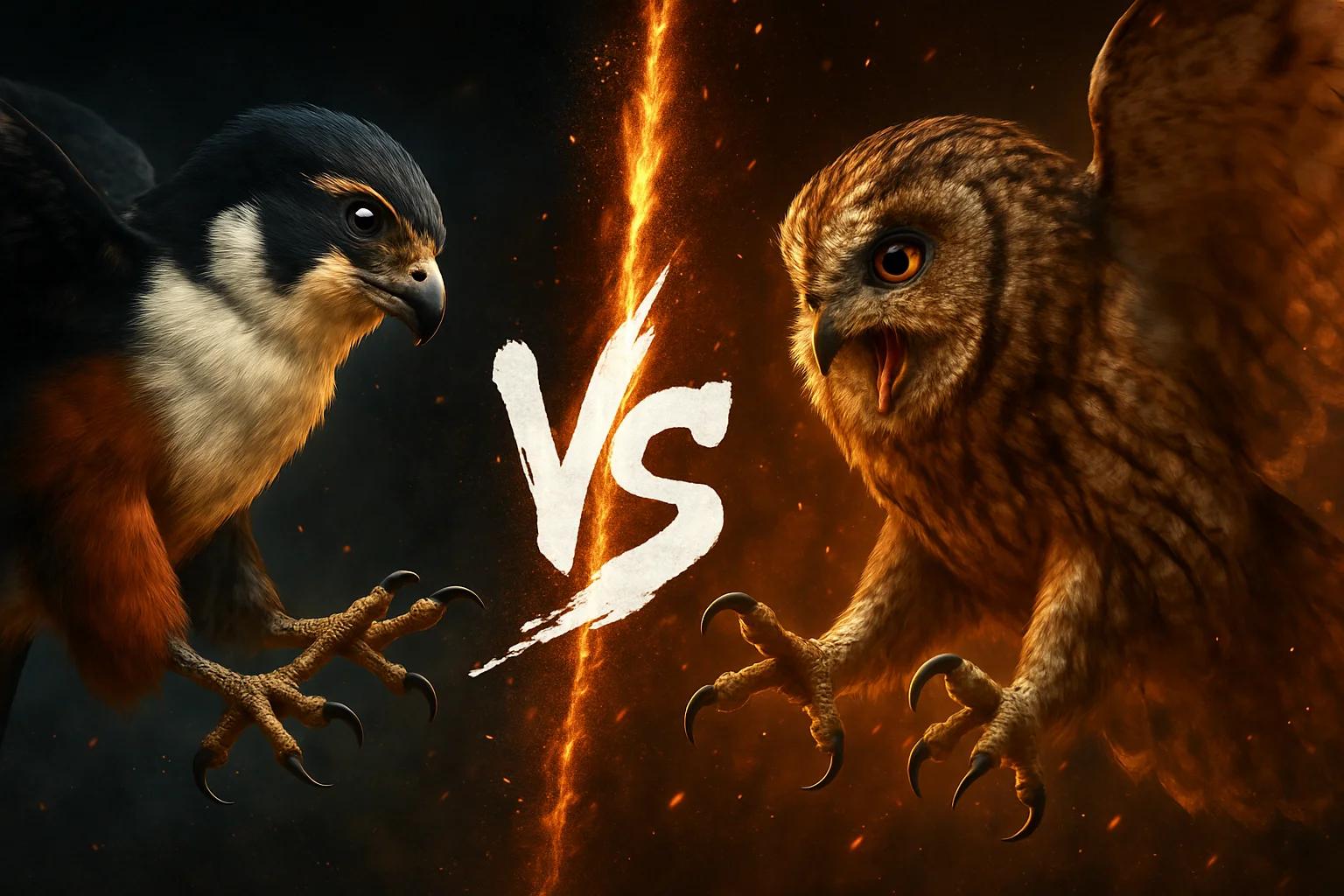
Collared Falconet vs Tawny Owl: Who Actually Wins?
Collared Falconet vs Tawny Owl: a sparrow-sized falcon against a stocky night owl. See who wins, the size gap, trait-by-trait stats, scenarios, and why the tiny falcon stays dangerous.
Collared Falconet vs Tawny Owl
Matchup winner
Tawny Owl
Quick verdict
Start with the direct answer, then use the structured comparison below to see what changes the outcome.
The Tawny Owl wins, and it is not close. A Collared Falconet is one of the smallest raptors on Earth, about 15–18 cm long and roughly 30–55 g, about the mass of a sparrow. A Tawny Owl is around 37–46 cm long and typically 400–800 g, so it outweighs the falconet by roughly ten to fifteen times. It also carries feathered, crushing feet built to kill rats, voles, and roosting birds, and silent flight that lets it close distance unseen. The falconet's real edge is daytime acceleration and tight aerial agility, which it uses to snatch dragonflies, butterflies, and the occasional small bird. That makes it hard to catch in bright, open air, but it gives it no realistic way to injure a bird this much larger. In any grappling contact, ambush at dusk, or contest at a roost or nest cavity, the owl's mass and grip end the encounter. The falconet's best outcome is a clean escape, not a win.
Read the full explanation
Tawny Owl wins: it is roughly 10–15x heavier with far stronger killing feet.
The falconet is a sparrow-sized insect hunter. Its talons are built for dragonflies, not owls.
The owl's silent, low-light ambush suits exactly the hours when a falconet is roosting and vulnerable.
The falconet's only edge is daytime agility, which helps it escape but does not let it win.
Reader vote
Who do you think wins?
Pick a side — no account needed. Results update live.
No votes yet — be the first to call it.
Editorial note
Why people disagree
'Falcons beat owls' is a real pattern among large species like Peregrines, but the Collared Falconet is the size of a sparrow, so the rule flips here.
Body mass & frame
Among raptors, mass decides almost every contact fight. The owl's weight lets it pin, crush, and hold a target the falconet cannot shift.
Killing grip
An owl's feet are its main weapon. The falconet's feet can hold a dragonfly or small bird but cannot penetrate or restrain an owl.
Aerial agility
This is the falconet's survival tool. In daylight it can out-turn the owl and avoid contact altogether.
Read the full explanation +
Speed stats can make the falconet look competitive, but speed in pursuit of insects is not the same as striking power against a bird ten times heavier.
These birds rarely, if ever, meet in the wild. Their ranges in the Himalayan foothills and southern Asia barely touch, and they are active at opposite ends of the day, so readers argue about a matchup nature almost never stages.
Comparison FAQ
Short, direct answers to the next questions readers usually ask after the headline verdict.
Would a Collared Falconet beat a Tawny Owl?+
No. The Tawny Owl is roughly 10–15 times heavier with far stronger feet. The falconet's best outcome is escaping in daylight.
Which bird is stronger?+
The Tawny Owl, by a wide margin. Its grip kills rats and voles, while the falconet's talons are built for insects and occasional small birds.
Aren't falcons supposed to beat owls?+
Large falcons can harass owls, but the Collared Falconet is sparrow-sized. At this scale, the owl's mass and grip win.
Why is the falconet still dangerous even though it loses?+
It is a fast, precise aerial hunter that can still deliver sharp grabs and pecks. In bright, open air its agility makes it very hard to catch, so a careless attacker can come away empty-handed.
Do they meet in the wild?+
Rarely, if at all. Their ranges barely touch in parts of southern Asia, and their active hours barely overlap. If they did meet, the most likely version would be an owl ambushing a roosting falconet.
Head-to-head species stats
These are the same core AnimalDex stat dimensions used on the dedicated animal pages, pulled side by side so the matchup is faster to scan.
Collared Falconet
Tier BTawny Owl
Tier CTrait-by-trait comparison
Only the categories that matter to this matchup are included. The goal is not filler stats, but the real design differences that change the result.
~30–55 g, sparrow-sized
Body mass & frame
Tawny Owl
~400–800 g, stocky and broad-headed
Body mass & frame
Tawny Owl
Small sharp talons tuned for insects
Killing grip
Tawny Owl
Powerful feathered feet that crush rodent skulls
Killing grip
Tawny Owl
Rapid dashes and tight sallies from a perch
Aerial agility
Collared Falconet
Buoyant, silent, less nimble in open pursuit
Aerial agility
Collared Falconet
Visible daytime perch-hunter
Ambush control
Tawny Owl
Silent flight, superb low-light hearing
Ambush control
Tawny Owl
Sharp falcon vision, alert in bright sun
Daylight awareness
Collared Falconet
Prefers to roost hidden by day
Daylight awareness
Collared Falconet
Fragile, minimal reserve
Close-range durability
Tawny Owl
Dense plumage, robust body
Close-range durability
Tawny Owl
How the verdict forms
Verdict timeline
01 · Body mass & frame
Tawny Owl
02 · Killing grip
Tawny Owl
03 · Aerial agility
Collared Falconet
04 · Ambush control
Tawny Owl
05 · Daylight awareness
Collared Falconet
06 · Close-range durability
Tawny Owl
Change the conditions
Scenario breakdown
This is where shallow battle content usually fails. Terrain, spacing, timing, and engagement style can change the answer.
Scenario lean
Tawny Owl
Verdict confidence
82%
Tawny Owl, decisively.
In dim, cluttered woodland the owl's strengths stack up. Silent flight hides its approach, its hearing pinpoints movement, and short attacking flights between branches suit its build. The falconet's dashing agility needs light and open space to work. Once the owl's feet close, a sparrow-sized bird has no counter.
AnimalDex field profiles
Explore these animals
Collared Falconet
Microhierax caerulescens
forest edge, open woodland, and village tree lines
Tawny Owl
Strix aluco
mixed woodland, parkland, and old forest edge
Systems Intelligence & Hidden Purpose
See the animals behind this comparison as engineered biological systems: what each one is built to do, where it gains leverage, and why the matchup changes by scenario.
Specialized Hardware
tiny falcon body, short hooked bill, and fast perch-and-dart attacks give the Collared Falconet a body plan tuned for its niche.
Systems Script
Collared Falconets operate through forest edge, open woodland, and village tree lines. Their design links movement, feeding, shelter, and timing into one workable survival system.
Strategic Insight
Dense environments reward precision, patience, and the ability to read layered cover.
Specialized Hardware
rounded head without ear tufts, soft barred brown plumage, and calm woodland perch hunting give the Tawny Owl a body plan tuned for its niche.
Systems Script
Tawny Owls operate through mixed woodland, parkland, and old forest edge. Their design links movement, feeding, shelter, and timing into one workable survival system.
Strategic Insight
Dense environments reward precision, patience, and the ability to read layered cover.
Final take
The Tawny Owl is the clear winner. It is a compact, heavy-footed night hunter roughly ten times or more the falconet's mass, and in any frame that involves contact, low light, or a confined space, it overwhelms the smallest falcon in Asia.
Read the full explanation
The Collared Falconet deserves respect on its own terms. It is a high-speed aerial specialist that turns sunlit forest edges into a hunting ground for insects. Its victory condition, though, is escape: in bright open air it can stay out of reach, but it has no weapon that changes the outcome of a real clash.
Collect both animals in AnimalDex
Track the species behind this matchup, compare their real traits, and build the rivalry into your AnimalDex collection.
Related comparisons
Continue with nearby matchups to compare more real-world animal traits without dropping into junky who-wins filler.
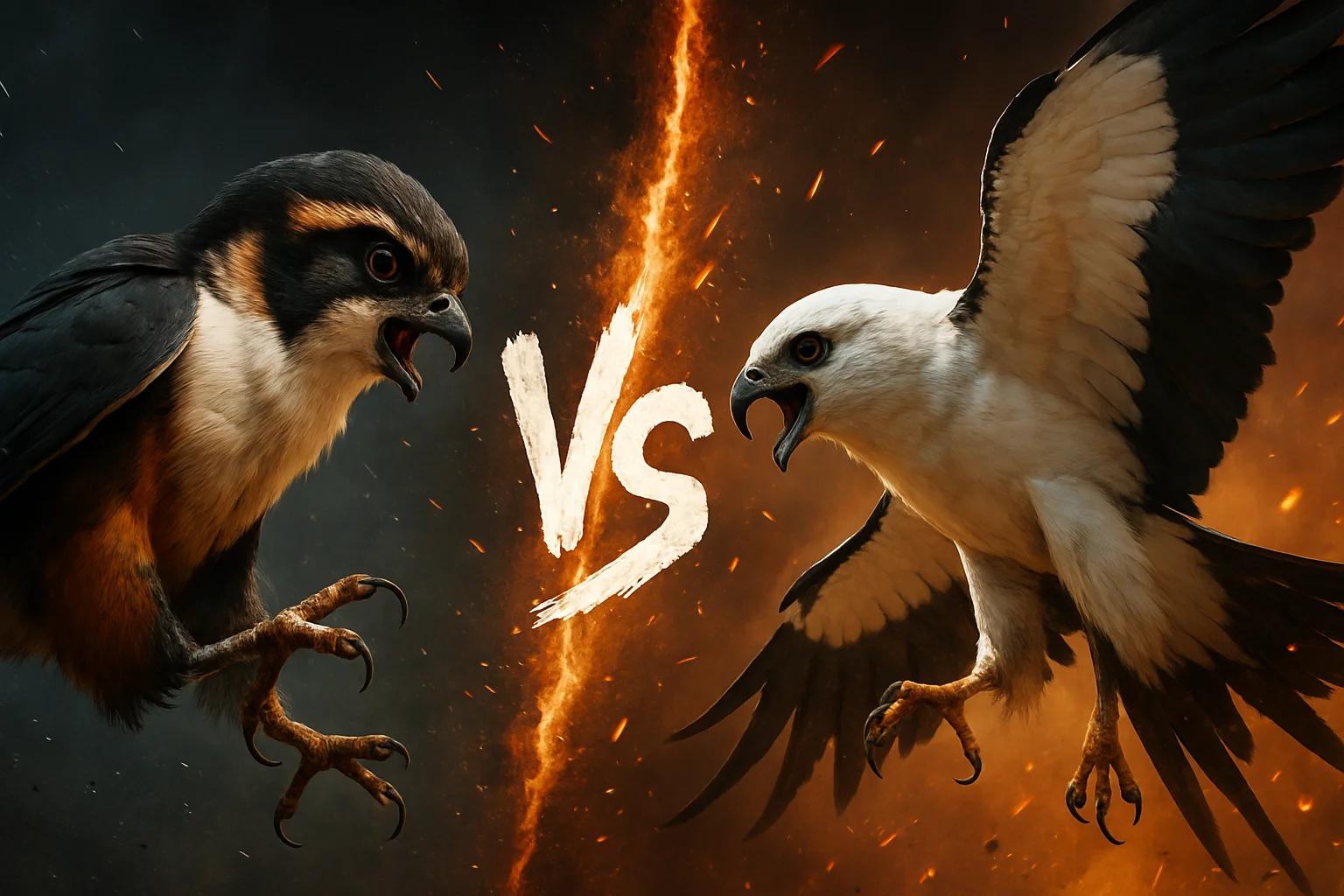
Collared Falconet vs Swallow-tailed Kite: Who Actually Wins?
The Swallow-tailed Kite wins this matchup, mainly because of size. A Collared Falconet is one of the smallest raptors on Earth, about 15–18 cm long and roughly 30–55 g. A Swallow-tailed Kite stretches 50–65 cm with a wingspan near 1.2–1.3 m and weighs around 350–600 g, close to ten times heavier. The falconet is the more aggressive bird. It is a true falcon with a notched, tomial-toothed bill and a habit of pouncing on dragonflies and small birds, so it has real weapons and real intent. The kite, though, is not a pushover. Its long wings and deeply forked tail give it great control at speed, and its sheer mass means the falconet's bites and grabs can't reach anything vital. The falconet can sting, harass, and escape, but it cannot pin, kill, or drive off a bird that large. In any frame where both commit, the kite's weight and reach settle it.
Read comparison
Discussion
What do you think?
Share your reasoning with other readers. Be civil and stick to the animals.
Sign in to join the discussion.
Sign inNo comments yet. Start the conversation.