

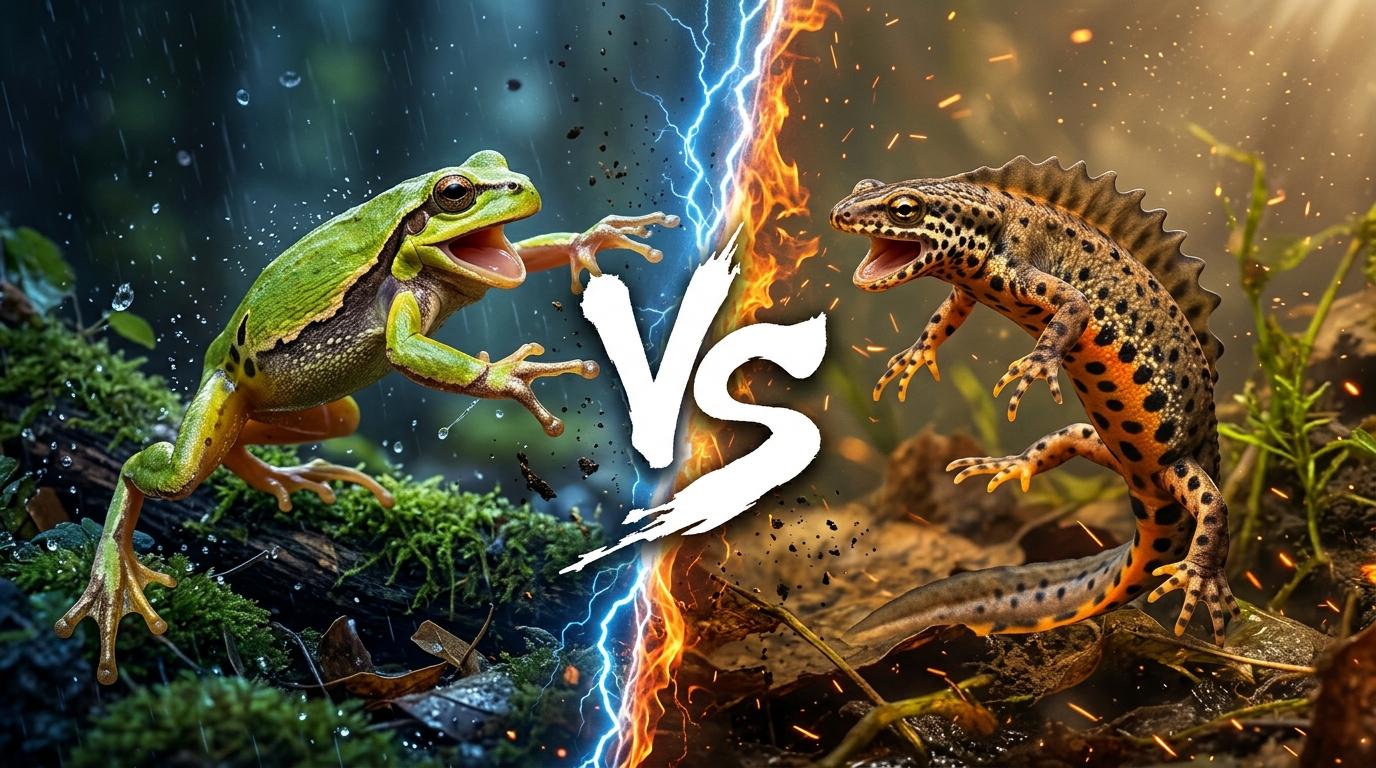
Common Tree Frog vs Smooth Newt: Who Actually Wins?
Common tree frog vs smooth newt: who would win? A biology-first comparison of size, skin defenses, habitat control, and the European pond rivalry that plays out between eggs, tadpoles and adults.
Common Tree Frog vs Smooth Newt
Matchup winner
Smooth Newt
Quick verdict
Start with the direct answer, then use the structured comparison below to see what changes the outcome.
The smooth newt wins this matchup overall. These two European amphibians would almost never fight as adults, but in the places they actually meet (shallow breeding ponds in spring), the newt holds the stronger position. An adult smooth newt typically measures about 7–11 cm including its tail, while a common tree frog is about 3.5–5 cm from snout to vent. The newt is a committed aquatic predator during the breeding season and regularly eats frog eggs and tadpoles, so it shapes the frog's next generation far more than the frog can touch the newt's. Inside the water, the newt's tail-driven swimming, persistence and mildly noxious skin let it control the space. The tree frog's real genius is leaving: sticky toe pads, a strong jump and life up in reeds and shrubs mean an adult frog rarely loses anything. It simply relocates. Contact favors the newt, escape favors the frog, and because the pond is the shared arena, the newt takes the verdict.
Read the full explanation
Smooth newt wins overall, mainly because it controls the shared breeding ponds.
The newt is longer and heavier-bodied, and it preys on frog eggs and tadpoles.
The common tree frog wins any contest that rewards escape, climbing or getting off the ground.
A true adult-vs-adult fight is unlikely. Neither species can realistically eat the other as an adult.
Reader vote
Who do you think wins?
Pick a side — no account needed. Results update live.
No votes yet — be the first to call it.
Editorial note
Why people disagree
Measuring the frog by its jump makes it look dominant, but jumping is an escape tool, not a way to control territory.
Body mass & reach
In close contact between small amphibians, length and mass decide who can push, grip and hold position.
Escape athletics
The frog can leave any bad situation vertically. That ability is what keeps it alive across most of its range.
Aquatic control
Ponds are where these species actually meet, and the newt is the one that is built to operate there.
Read the full explanation +
Many people judge adults only. The newt's real edge shows up at the egg and tadpole stage, where it is an active predator.
Both species have skin secretions, so the 'toxic' argument cancels out more than people expect. Neither is the classic highly poisonous newt or frog.
Comparison FAQ
Short, direct answers to the next questions readers usually ask after the headline verdict.
Would a smooth newt beat a common tree frog?+
Yes, overall. The newt is longer and heavier and controls the shared ponds. Real fights between adults are rare, though.
Which is stronger?+
The smooth newt has more body mass. The tree frog has the stronger legs for jumping, but it uses that power to escape rather than to grapple.
Can a newt eat a tree frog?+
Not an adult frog. Smooth newts do eat frog eggs and small tadpoles, which is where their real impact on frogs comes from.
Why is the tree frog still dangerous to beat?+
Its sticky toe pads, explosive jump and irritating skin mean it almost never stays in a losing position. It climbs out of reach first.
Head-to-head species stats
These are the same core AnimalDex stat dimensions used on the dedicated animal pages, pulled side by side so the matchup is faster to scan.
Common Tree Frog
Tier DSmooth Newt
Tier DTrait-by-trait comparison
Only the categories that matter to this matchup are included. The goal is not filler stats, but the real design differences that change the result.
Compact, ~3.5–5 cm body
Body mass & reach
Smooth Newt
Elongated, ~7–11 cm with tail
Body mass & reach
Smooth Newt
Powerful jumper, adhesive toe pads
Escape athletics
Common Tree Frog
Slow on land, agile swimmer
Escape athletics
Common Tree Frog
Visits water mainly to breed and call
Aquatic control
Smooth Newt
Tail-propelled hunter for months each spring
Aquatic control
Smooth Newt
Eats insects in vegetation
Predatory pressure
Smooth Newt
Eats invertebrates, plus frog eggs and tadpoles
Predatory pressure
Smooth Newt
Irritating skin secretions
Skin defense
Smooth Newt
Mildly noxious skin secretions
Skin defense
Smooth Newt
Reeds, shrubs, tree canopy
Vertical habitat range
Common Tree Frog
Ground litter and pond floor
Vertical habitat range
Common Tree Frog
How the verdict forms
Verdict timeline
01 · Body mass & reach
Smooth Newt
02 · Escape athletics
Common Tree Frog
03 · Aquatic control
Smooth Newt
04 · Predatory pressure
Smooth Newt
05 · Skin defense
Smooth Newt
06 · Vertical habitat range
Common Tree Frog
Change the conditions
Scenario breakdown
This is where shallow battle content usually fails. Terrain, spacing, timing, and engagement style can change the answer.
Scenario lean
Smooth Newt
Verdict confidence
82%
Newt dominates.
In shallow spring water the newt hunts efficiently, steers with its tail and patrols the vegetation where frog eggs and tadpoles sit. Adult frogs call and breed here, but they are visitors. The newt is the resident predator.
AnimalDex field profiles
Explore these animals
Common Tree Frog
Hyla arborea
pond edge, wet meadow, and shrubby wetland
Smooth Newt
Lissotriton vulgaris
pond, ditch, and damp grassland edge
Systems Intelligence & Hidden Purpose
See the animals behind this comparison as engineered biological systems: what each one is built to do, where it gains leverage, and why the matchup changes by scenario.
Specialized Hardware
adhesive toe pads, bright green skin, and reed-climbing night calling give the Common Tree Frog a body plan tuned for its niche.
Systems Script
Common Tree Frogs operate through pond edge, wet meadow, and shrubby wetland. Their design links movement, feeding, shelter, and timing into one workable survival system.
Strategic Insight
Where water controls movement, position and timing often matter more than speed.
Specialized Hardware
smooth olive breeding skin, orange belly with spots, and pond-to-land seasonal cycle give the Smooth Newt a body plan tuned for its niche.
Systems Script
Smooth Newts operate through pond, ditch, and damp grassland edge. Their design links movement, feeding, shelter, and timing into one workable survival system.
Strategic Insight
Open landscapes reward early detection, clean movement, and fast decisions once the space opens up.
Final take
The smooth newt is the winner because it controls the arena both species depend on: the breeding pond. It is larger, it is aquatic-capable, and it is a direct predator of the frog's eggs and young.
Read the full explanation
The common tree frog is far from beaten in its own space. It is a specialist in vertical escape, and an adult frog in vegetation is close to untouchable for any newt. It loses the contest for ground and water, but it rarely loses its life to this rival.
Collect both animals in AnimalDex
Track the species behind this matchup, compare their real traits, and build the rivalry into your AnimalDex collection.
Related comparisons
Continue with nearby matchups to compare more real-world animal traits without dropping into junky who-wins filler.
Common Tree Frog vs Marsh Frog: Who Actually Wins?
The Marsh Frog wins, and it is not close. Pelophylax ridibundus is Europe's largest native water frog. Big females reach about 15 cm and can weigh well over 100 g. The Common Tree Frog (Hyla arborea) is a 4–5 cm, single-digit-gram climber. That is roughly a 10–20x mass gap. Marsh Frogs are gape-limited opportunists that swallow insects, small fish, tadpoles and smaller frogs whole. A tree frog fits inside that prey window. Any contact on the water's edge, in open ground or around a shared pond ends with the tree frog being treated as food. The tree frog's real answer is not fighting. It escapes upward with adhesive toe pads into reeds and shrubs where the heavy, ground-and-water-bound Marsh Frog cannot follow. That makes the tree frog a survivor, never a winner.
Read comparison
Marsh Frog vs Smooth Newt: Who Actually Wins?
The Marsh Frog wins, and it is not especially close. As one of Europe's largest native frogs, Pelophylax ridibundus can reach about 15 cm and weigh several times more than a Smooth Newt, which usually measures 7–11 cm including its tail. That size gap matters most because of gape. A marsh frog is a sit-and-lunge predator with a wide mouth and a fast tongue-and-jaw strike, and it is documented eating small amphibians, including newts and tadpoles. The Smooth Newt has no bite worth fearing at this scale, and its main defenses are its slippery, mildly distasteful skin secretions, quick tail-driven swimming, and dense weed cover. Those tools can make a frog spit it out or lose track of it, but they cannot turn the newt into the aggressor. In any direct encounter, the frog controls the outcome, and the newt's realistic best result is escape.
Read comparison
Discussion
What do you think?
Share your reasoning with other readers. Be civil and stick to the animals.
Sign in to join the discussion.
Sign inNo comments yet. Start the conversation.