

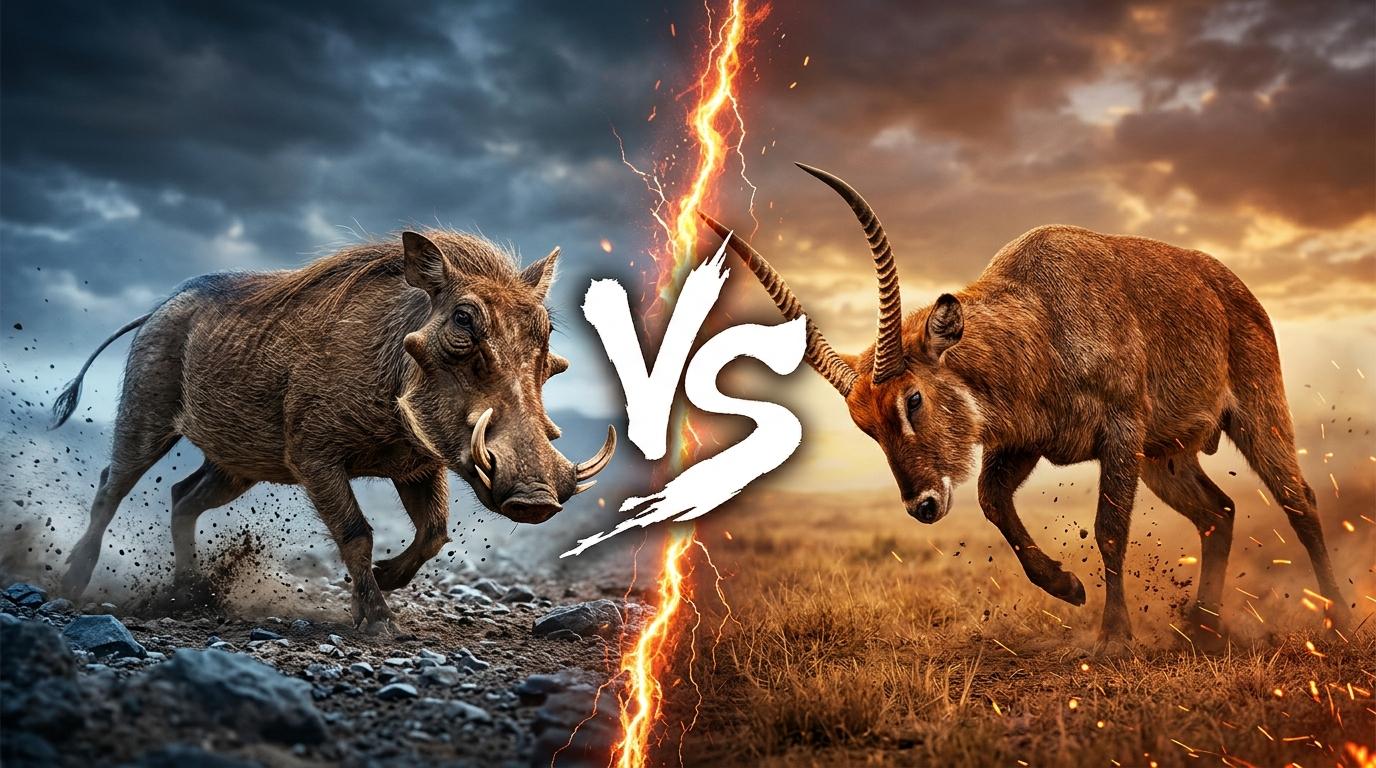
Common Warthog vs Waterbuck: Who Actually Wins?
Common Warthog vs Waterbuck: who would win a fight? A biology-first breakdown of size, horns versus tusks, burrow defense, and why the waterbuck bull usually comes out ahead.
Common Warthog vs Waterbuck
Matchup winner
Waterbuck
Quick verdict
Start with the direct answer, then use the structured comparison below to see what changes the outcome.
The Waterbuck wins most realistic confrontations. A mature waterbuck bull typically weighs around 200–250 kg, more than double a large warthog boar, and carries long, forward-curving ridged horns built for territorial combat that can turn deadly. That gives it a decisive reach and mass advantage. The Common Warthog is no pushover. It is compact, low-slung, and armed with sharp lower tusks and protective facial warts, and it fights with real ferocity when cornered. But its weapons work best at close quarters, and a waterbuck's horns meet it before it gets there. The warthog's best outcome is not victory. It is making the fight too costly and then escaping, ideally backing into a burrow tusks-first.
Read the full explanation
Overall winner: Waterbuck, mainly through size (roughly 2–3x the warthog's mass) and horn reach.
Waterbuck bulls fight other bulls for territory, so their horns are tested combat tools.
The warthog's sharp lower tusks and low center of gravity make it dangerous up close, but it struggles to close the distance.
A warthog defending a burrow entrance is the one scenario where it can hold off almost anything its size or larger.
Reader vote
Who do you think wins?
Pick a side — no account needed. Results update live.
No votes yet — be the first to call it.
Editorial note
Why people disagree
Warthogs have a viral reputation for toughness, since they sometimes face down lions and leopards. People mistake courage for winning power against a far heavier horned bull.
Mass and frame
In a shoving, goring contest, mass decides who controls footing and who gets driven backward.
Weapon reach
Horns strike first. The warthog must absorb a hit just to land one.
Close-range durability
Pound for pound, the warthog is built to survive brutal head-to-head contact.
Read the full explanation +
Waterbuck look placid and 'deer-like', so many readers underestimate how violent territorial bull fights can get.
Only male waterbuck carry horns. Matchups that use a female or a young animal flip the answer, which muddies online debates.
Comparison FAQ
Short, direct answers to the next questions readers usually ask after the headline verdict.
Would a warthog beat a waterbuck?+
Usually not. A mature waterbuck bull is much heavier and has long horns that outreach the warthog's tusks. The warthog's best realistic win is defending a burrow entrance.
Which is stronger, a warthog or a waterbuck?+
The waterbuck is stronger in absolute terms because of its far greater mass. The warthog is impressively strong and durable for its size.
Who wins a waterbuck vs warthog fight?+
The waterbuck wins most open fights, especially a territorial bull near water.
Why is the warthog still dangerous even if it loses?+
Its lower tusks are sharp enough to cause deep cuts. It fights aggressively when cornered, and its facial warts protect it during clashes. Even a winning waterbuck could be injured.
Do warthogs and waterbuck fight in the wild?+
Rarely. Both are grazers that often share water sources, and they usually avoid each other rather than fight.
Head-to-head species stats
These are the same core AnimalDex stat dimensions used on the dedicated animal pages, pulled side by side so the matchup is faster to scan.
Common Warthog
Tier CWaterbuck
Tier CTrait-by-trait comparison
Only the categories that matter to this matchup are included. The goal is not filler stats, but the real design differences that change the result.
Compact, ~60–100 kg boars (rarely heavier)
Mass and frame
Waterbuck
Heavy-bodied bulls ~200–250 kg
Mass and frame
Waterbuck
Short, razor-edged lower tusks
Weapon reach
Waterbuck
Long ridged horns, often 75–100 cm
Weapon reach
Waterbuck
Thick facial warts shield the eyes and jaw, dense build
Close-range durability
Common Warthog
Shaggy coat, large frame, less specialized head armor
Close-range durability
Common Warthog
Quick, low launch, about 48 km/h top speed
Explosive burst
Common Warthog
Powerful but heavier acceleration
Explosive burst
Common Warthog
Boars spar with tusks and snouts during the rut
Combat conditioning
Waterbuck
Territorial bulls fight hard with horns, sometimes fatally
Combat conditioning
Waterbuck
Backs into burrows tusks-first, tail-up alarm runs
Defensive tactics
Common Warthog
Retreats into water and relies on size and horns
Defensive tactics
Common Warthog
How the verdict forms
Verdict timeline
01 · Mass and frame
Waterbuck
02 · Weapon reach
Waterbuck
03 · Close-range durability
Common Warthog
04 · Explosive burst
Common Warthog
05 · Combat conditioning
Waterbuck
06 · Defensive tactics
Common Warthog
Change the conditions
Scenario breakdown
This is where shallow battle content usually fails. Terrain, spacing, timing, and engagement style can change the answer.
Scenario lean
Waterbuck
Verdict confidence
82%
Waterbuck dominates with reach and mass.
In open terrain the waterbuck can square up and use its horns at full extension. The warthog has to charge straight into the weapon zone, and the bull's weight advantage lets it pin, toss, or gore. Speed helps the warthog escape but not win.
AnimalDex field profiles
Explore these animals
Common Warthog
Phacochoerus africanus
savannah, open scrub, and dry grassland
Waterbuck
Kobus ellipsiprymnus
riverbank grassland, wet meadow, and reed-fringed savannah
Systems Intelligence & Hidden Purpose
See the animals behind this comparison as engineered biological systems: what each one is built to do, where it gains leverage, and why the matchup changes by scenario.
Specialized Hardware
upcurved facial tusks, kneeling grazing posture, and burrow-backward defense give the Common Warthog a body plan tuned for its niche.
Systems Script
Common Warthogs operate through savannah, open scrub, and dry grassland. Their design links movement, feeding, shelter, and timing into one workable survival system.
Strategic Insight
Harsh places reward efficiency, timing, and bodies that waste very little.
Specialized Hardware
shaggy water-shedding coat, ringed rump marking, and wetland-edge alertness give the Waterbuck a body plan tuned for its niche.
Systems Script
Waterbucks operate through riverbank grassland, wet meadow, and reed-fringed savannah Their design links movement, shelter, feeding, and survival into one workable system.
Strategic Insight
It is easier to stay calm when your escape route is built into the landscape.
Final take
The Waterbuck is the clear overall winner. A grown bull brings the size, reach, and territorial combat conditioning that a warthog simply cannot match head-on.
Read the full explanation
The Common Warthog earns respect anyway. Its warts, tusks, burst speed, and brilliant burrow defense make it a survival specialist, an animal designed to make any attack expensive. In the wild the two rarely fight at all, because both are grazers with little reason to risk injury over each other.
Collect both animals in AnimalDex
Track the species behind this matchup, compare their real traits, and build the rivalry into your AnimalDex collection.
Related comparisons
Continue with nearby matchups to compare more real-world animal traits without dropping into junky who-wins filler.
Spotted Hyena vs Waterbuck: Who Actually Wins?
The spotted hyena wins this matchup overall, but not easily and not everywhere. A healthy bull waterbuck weighs roughly 200–260 kg, about three to five times a hyena's 45–70 kg, and carries forward-curving horns that can approach a metre in length. In a cornered, stand-and-fight moment, the waterbuck can gore or throw a lone hyena. The hyena's edge is everything outside that moment. It has one of the strongest bites of any mammal relative to its size, a jaw built to crush bone, and endurance that lets it test, harass, and wear down prey over kilometres. Hyenas also kill waterbuck regularly in the wild, usually in clans and usually by targeting calves, females, or tired adults. The waterbuck is the bigger animal. The hyena is the system built to beat it.
Read comparison
Common Warthog vs Zorilla: Who Actually Wins?
The common warthog wins, and it isn't close on physical terms. An adult warthog weighs roughly 50–100 kg and carries curved tusks, thick facial warts that shield its head, and a low, charging build. The zorilla, Africa's striped polecat, weighs well under 1.5 kg. The zorilla's real weapon is not its bite. It is one of the most potent anal-gland sprays of any African mammal, a foul, eye-stinging chemical deterrent backed by bold black-and-white warning stripes. That spray can make a warthog break off contact and abandon a burrow, but it cannot injure the bigger animal or overpower it. In any frame where 'winning' means physical control of space, the warthog's mass, tusks and confidence carry the day. The zorilla's best outcome is a stink-soaked stalemate, not a victory.
Read comparison
Discussion
What do you think?
Share your reasoning with other readers. Be civil and stick to the animals.
Sign in to join the discussion.
Sign inNo comments yet. Start the conversation.