

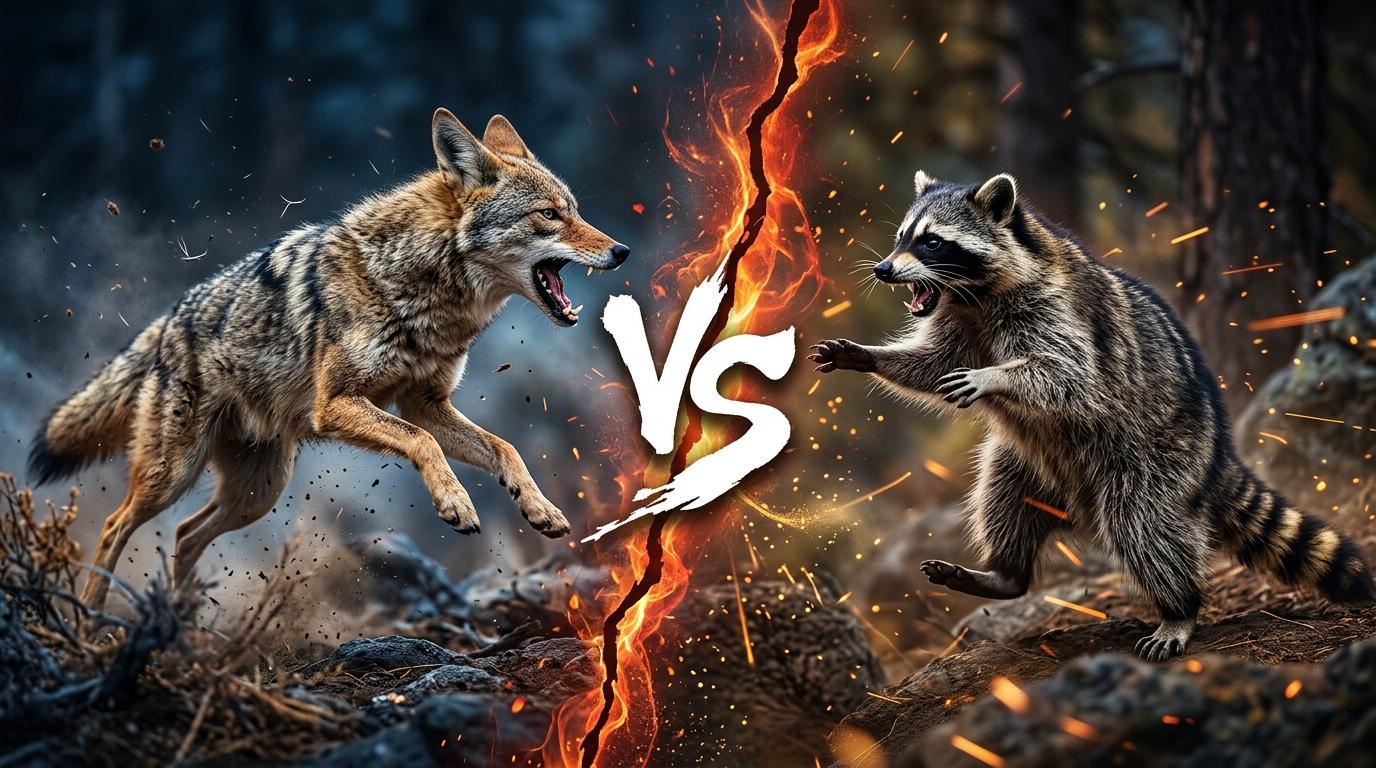
Coyote vs Raccoon: Who Actually Wins?
Coyote vs raccoon: who would win a fight? A biology-first look at size, bite, speed, armor-like fur, climbing and real-world encounters between Canis latrans and Procyon lotor.
Coyote vs North American Raccoon
Matchup winner
Coyote
Quick verdict
Start with the direct answer, then use the structured comparison below to see what changes the outcome.
The coyote wins. An adult coyote typically weighs 9–18 kg against a raccoon's 5–10 kg, and it brings a longer muzzle, a canid bite built to grab and shake, and far greater speed and stamina. Coyotes are documented predators of raccoons, especially juveniles and adults caught on open ground. Even so, the raccoon is no easy meal. Its dense fur, loose tough skin, sharp claws, surprising strength and willingness to roll onto its back and fight make a cornered adult a costly target. Many coyotes back off rather than risk a torn face. In any fair, open encounter, though, the canid's size, reach and endurance decide it.
Read the full explanation
Coyote wins most encounters: it is roughly 1.5–2x heavier, faster, and has a longer reach with its bite.
Coyotes do prey on raccoons, mostly young or isolated adults away from trees.
An adult raccoon backed against cover can injure a coyote badly with its claws and bite.
The raccoon's best 'win' is escape: a tree, a culvert or water ends the fight.
Reader vote
Who do you think wins?
Pick a side — no account needed. Results update live.
No votes yet — be the first to call it.
Editorial note
Why people disagree
People see raccoons rout pet dogs and assume they beat coyotes, but a wild coyote is a practiced hunter, not a house pet.
Body mass and frame
The weight gap lets the coyote pin, shake and control a smaller opponent.
Bite reach and grip
Reach lets the coyote strike the neck and flanks before the raccoon's claws come into play.
Speed and stamina
A raccoon caught away from cover cannot outrun a coyote.
Read the full explanation +
Raccoons punch above their weight. Ferocity and tough hide make fights messy, so 'coyote wins' doesn't mean 'coyote wins cleanly.'
Context swings everything. Near trees or water the raccoon often survives, while on open ground it is in real danger.
Comparison FAQ
Short, direct answers to the next questions readers usually ask after the headline verdict.
Would a coyote beat a raccoon in a fight?+
Yes, in most cases. The coyote's size, bite reach and stamina give it a decisive edge, though an adult raccoon can inflict serious injuries.
Is a coyote stronger than a raccoon?+
Overall, yes. A coyote is often twice the raccoon's weight. Pound for pound the raccoon is impressively strong in its forelimbs and grip, but absolute power favors the coyote.
Do coyotes eat raccoons?+
Yes. Coyotes prey on raccoons, mainly kits and lone adults caught away from cover, and they also scavenge raccoon carcasses.
Why is a raccoon still dangerous to a coyote?+
Raccoons have sharp claws, a strong bite, loose tough skin and a fierce defensive posture. A coyote that attacks carelessly risks torn lips and eye injuries, so many coyotes skip healthy adults.
Can a raccoon escape a coyote?+
Often, if a tree, water or burrow is close. Raccoons are excellent climbers and capable swimmers, and coyotes can do neither well.
Head-to-head species stats
These are the same core AnimalDex stat dimensions used on the dedicated animal pages, pulled side by side so the matchup is faster to scan.
Coyote
Tier CNorth American Raccoon
Tier CTrait-by-trait comparison
Only the categories that matter to this matchup are included. The goal is not filler stats, but the real design differences that change the result.
9–18 kg, long-legged
Body mass and frame
Coyote
5–10 kg, stocky
Body mass and frame
Coyote
Long muzzle, grab-and-shake canid bite
Bite reach and grip
Coyote
Short jaws, sharp but close-range
Bite reach and grip
Coyote
Up to ~65 km/h, tireless trotter
Speed and stamina
Coyote
~25 km/h bursts, low endurance
Speed and stamina
Coyote
Lean, thinner-skinned face
Close-range durability
North American Raccoon
Dense fur, loose tough hide
Close-range durability
North American Raccoon
Ground-bound runner
Escape toolkit
North American Raccoon
Expert climber and swimmer, dexterous paws
Escape toolkit
North American Raccoon
Pair hunting, patient stalking
Tactical adaptability
Coyote
Elite manipulation and memory
Tactical adaptability
Coyote
How the verdict forms
Verdict timeline
01 · Body mass and frame
Coyote
02 · Bite reach and grip
Coyote
03 · Speed and stamina
Coyote
04 · Close-range durability
North American Raccoon
05 · Escape toolkit
North American Raccoon
06 · Tactical adaptability
Coyote
Change the conditions
Scenario breakdown
This is where shallow battle content usually fails. Terrain, spacing, timing, and engagement style can change the answer.
Scenario lean
Coyote
Verdict confidence
82%
Clear coyote win.
With no tree nearby, the raccoon's escape plan collapses. The coyote's speed closes the gap, and its reach lets it strike and retreat until the smaller animal tires. This is how most real coyote predation on raccoons happens.
AnimalDex field profiles
Explore these animals
Coyote
Canis latrans
grassland, scrub, woodland edge, farmland, and suburb fringe
North American Raccoon
Procyon lotor
Woodland, wetlands, farmland, suburbs, and city green spaces.
Systems Intelligence & Hidden Purpose
See the animals behind this comparison as engineered biological systems: what each one is built to do, where it gains leverage, and why the matchup changes by scenario.
Specialized Hardware
Black mask around the eyes, ringed tail, and dexterous front paws give the North American Raccoon a body plan tuned for its niche.
Systems Script
North American Raccoons operate in woodland, wetlands, farmland, suburbs, and city green spaces. Their design helps them match food access, shelter, and timing inside that environment.
Strategic Insight
Adaptability grows when curiosity and usable hands stay connected.
Final take
Coyote over raccoon is a matter of physics and predator design. The coyote is bigger, longer-reaching, faster and built to run prey down, while the raccoon is built to forage, climb and slip away.
Read the full explanation
The raccoon's reputation as a scrappy fighter is earned, though. Tough hide, sharp claws and real ferocity mean it can make even a winning coyote bleed, and near trees or water it often escapes entirely.
Overall verdict: coyote, especially on open ground. The raccoon wins only by choosing where the encounter happens.
Collect both animals in AnimalDex
Track the species behind this matchup, compare their real traits, and build the rivalry into your AnimalDex collection.
Related comparisons
Continue with nearby matchups to compare more real-world animal traits without dropping into junky who-wins filler.
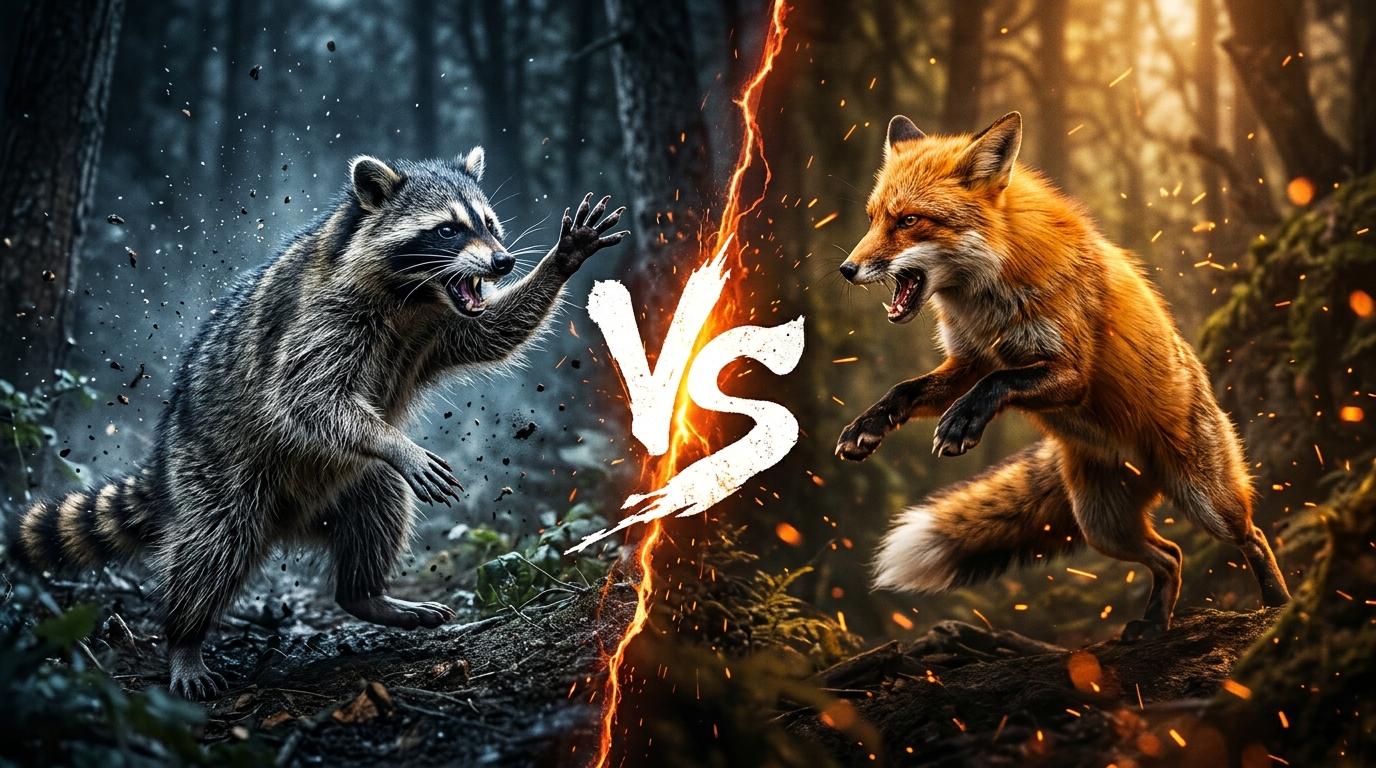
Raccoon vs Red Fox: Who Actually Wins?
The common raccoon wins most real confrontations with a red fox. Both animals share similar headline size scores, but the raccoon is built very differently. It is a dense, low-slung, heavily furred brawler that often outweighs a typical fox (roughly 5–12 kg vs 4–7 kg). It has grasping, clawed forepaws that can pin and pull, thick hide around the neck, and a famously ferocious temperament once it is cornered. The red fox is the faster, more agile animal, with a sharp, precise bite. But that bite is tuned for killing mice and rabbits, not for breaking down a stocky mammal that fights back with all four limbs. In the wild, foxes usually give adult raccoons a wide berth. That avoidance tells you a lot. The fox's real winning move is disengaging, not finishing.
Read comparison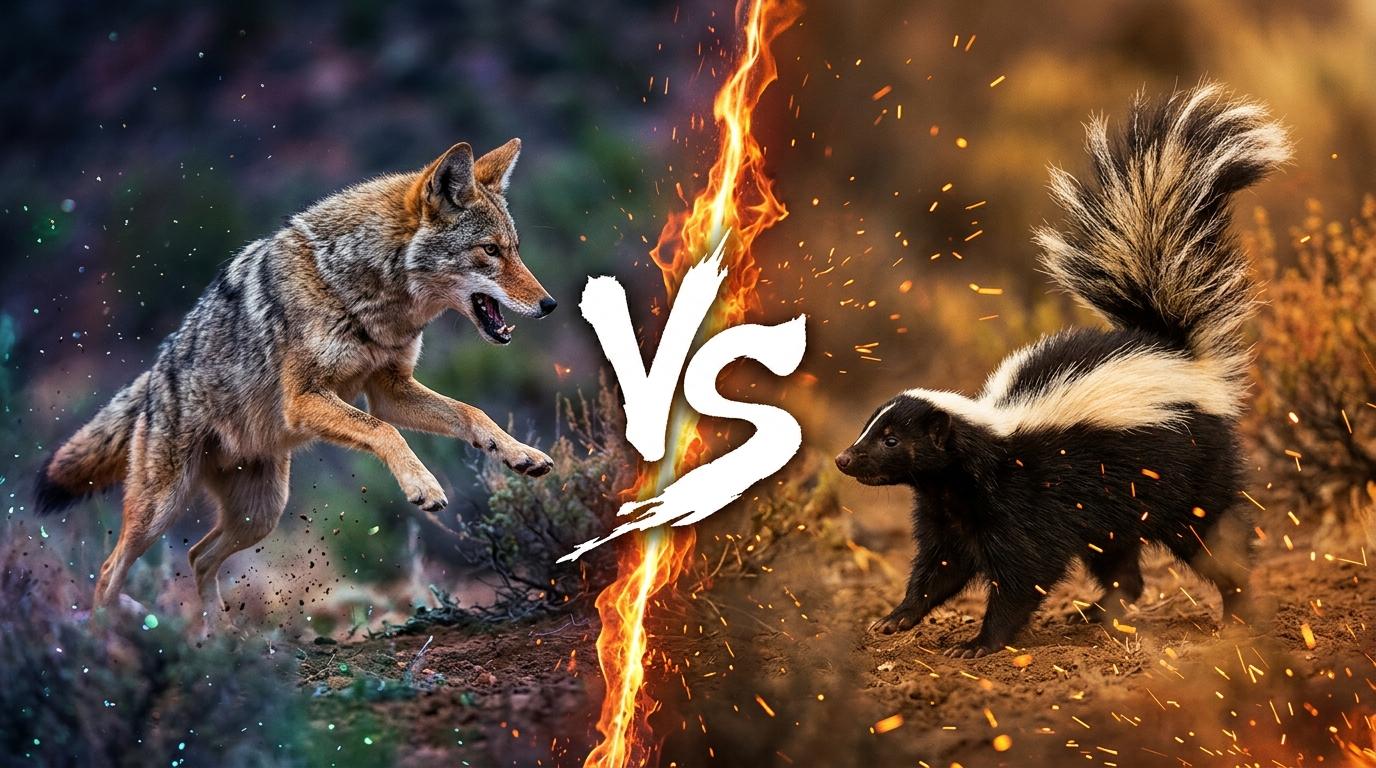
Coyote vs Striped Skunk: Who Actually Wins?
The coyote wins. At roughly 9–20 kg against a 2–4 kg skunk, with long jaws, a fast bite and much better speed and endurance, a committed coyote can overpower a striped skunk in a short physical contest. The catch is that the skunk rarely loses cleanly. Its musk is a sulfur-thiol spray aimed at the face. It can hit targets 3 meters away, and it causes stinging eyes, temporary blindness, gagging and a stench that clings for days. Coyotes do kill skunks, especially young, hungry or inexperienced coyotes in lean seasons. Experienced adults often read the warning display, back off, and save their energy for rabbits and rodents. So the coyote wins on physical capability, while the skunk wins the argument about whether the fight is worth starting.
Read comparison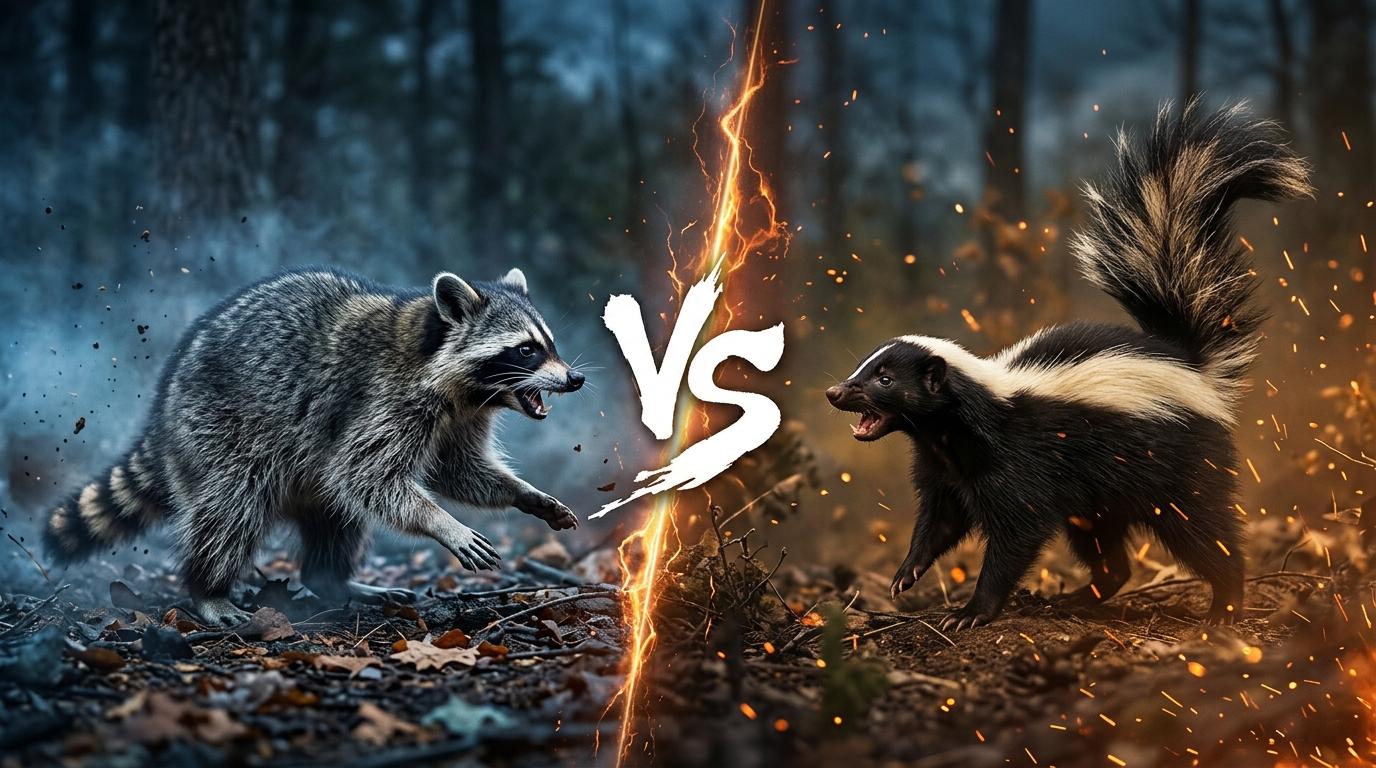
Raccoon vs Skunk: Who Actually Wins?
The common raccoon wins a committed fight. An adult raccoon often weighs about 5–9 kg, which is roughly two to three times a typical striped skunk (around 2–4.5 kg). It brings a stronger bite, grappling forelimbs with dexterous hands, and noticeably better problem-solving. Once contact happens, the skunk has little physical answer to that mass and control. The catch is that the skunk is built so that contact rarely happens. Its musk spray can reach roughly 3 meters, and the sulfur-based thiols in it sting the eyes, can blind temporarily, and make a predator rethink the whole encounter. A raccoon that gets sprayed may break off, so many real encounters end in a standoff or a retreat rather than a decisive fight. Put the two in a forced, close-range scrap, though, and the raccoon's size, strength, and tactical flexibility carry it.
Read comparison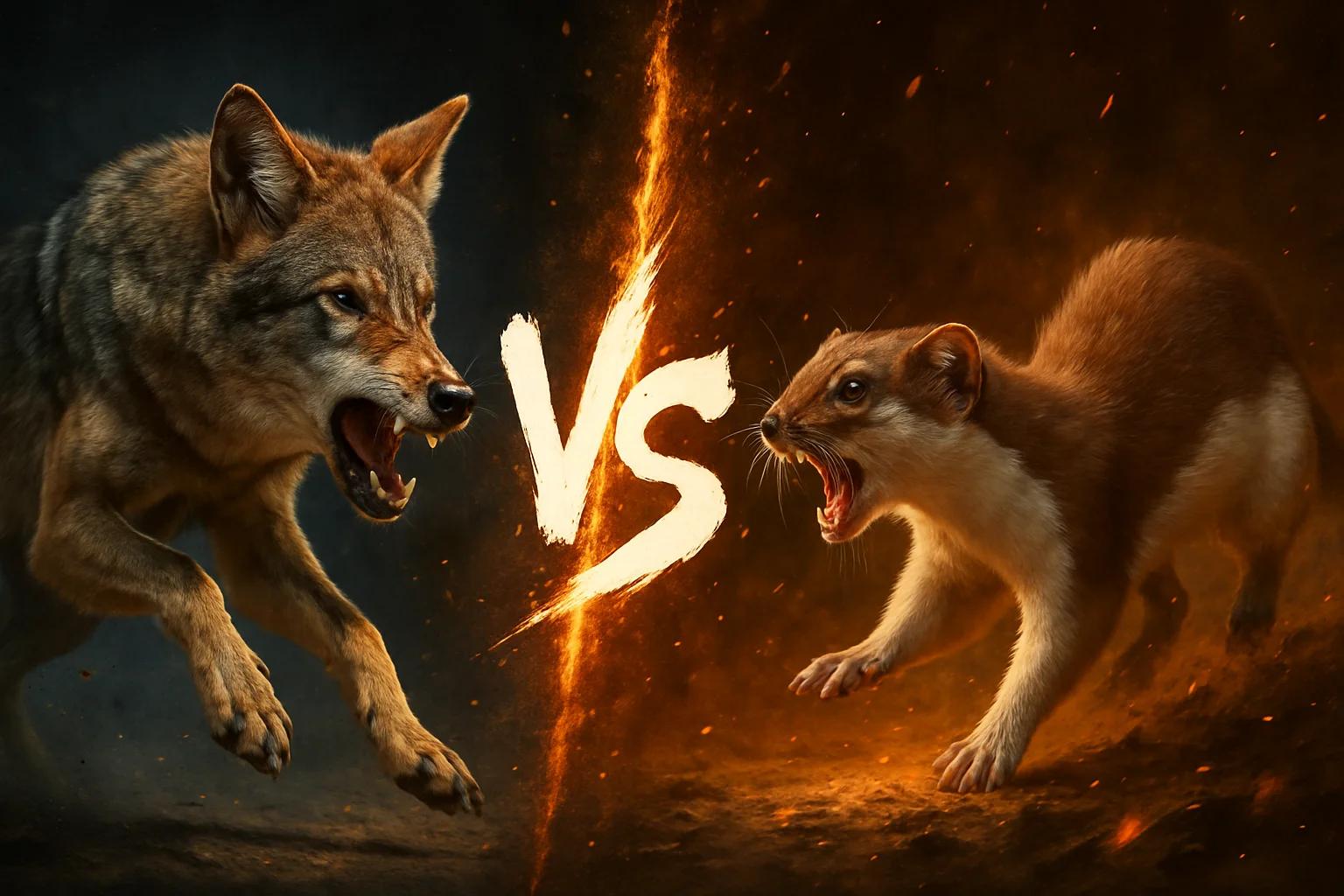
Coyote vs Stoat: Who Actually Wins?
The coyote wins, and it isn't close in a straight fight. An adult coyote weighs roughly 9–20 kg against a stoat's 80–350 g, a mass gap of about 40 to 100 times. The coyote has long jaws, a crushing bite, a head-shake that can kill small mammals, and the stamina to keep pressure on. Stoats are among the most ferocious predators for their size. They routinely kill rabbits many times their own weight with a precise bite to the back of the skull. But that technique depends on landing on prey that can't fight back at the same scale. A coyote can, and coyotes do kill and eat mustelids. The stoat's real win condition is escape: dense cover, burrows, rock piles, and speed through tight spaces. If it's a fight, the coyote wins. If it's a chase into a woodpile, the stoat lives to hunt another day.
Read comparison
Discussion
What do you think?
Share your reasoning with other readers. Be civil and stick to the animals.
Sign in to join the discussion.
Sign inNo comments yet. Start the conversation.