

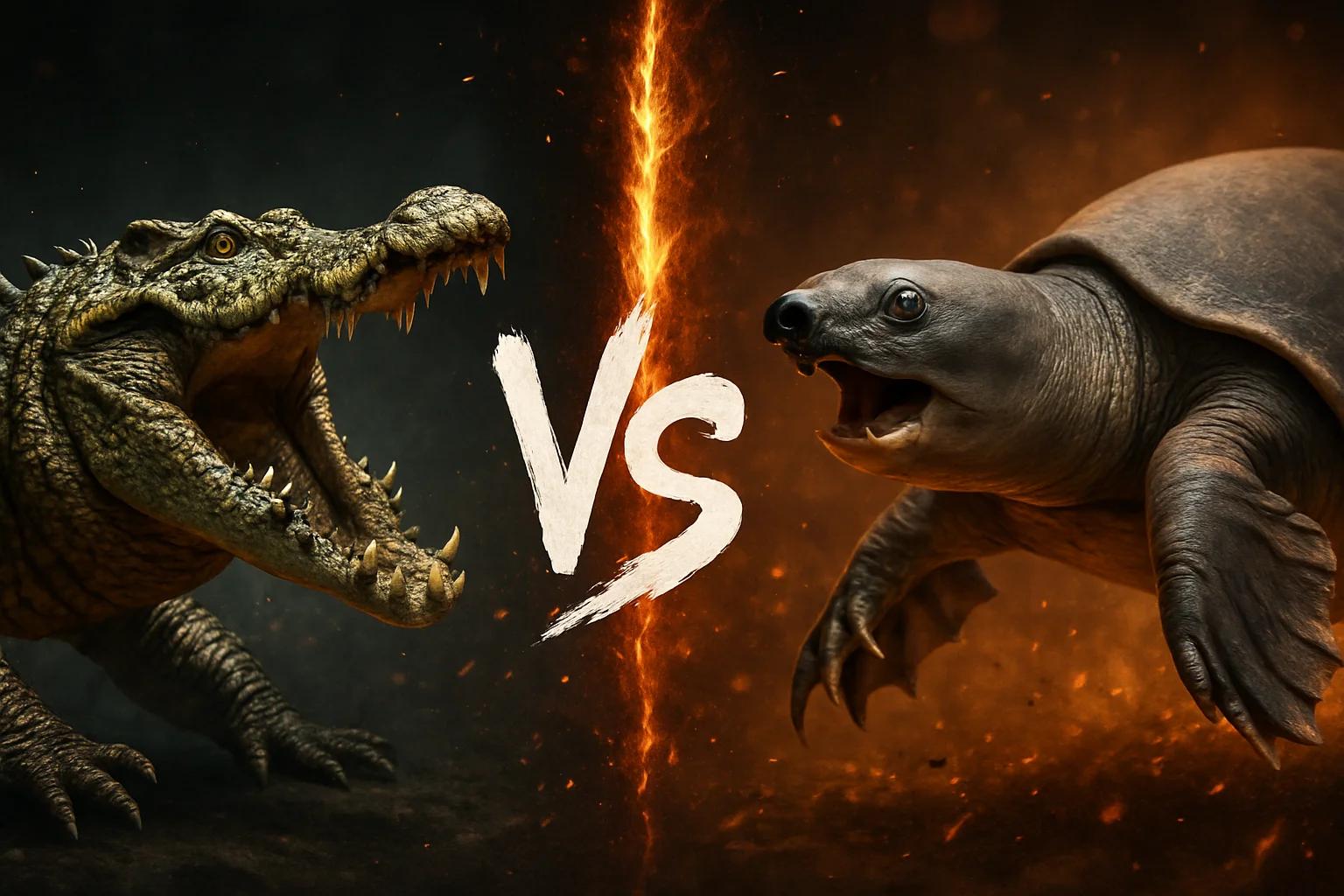
Cuban Crocodile vs Pig-nosed Turtle: Who Actually Wins?
Cuban crocodile vs pig-nosed turtle: a biology-first breakdown of bite force, armor, speed and habitat to find out who really wins.
Cuban Crocodile vs Pig-nosed Turtle
Matchup winner
Cuban Crocodile
Quick verdict
Start with the direct answer, then use the structured comparison below to see what changes the outcome.
The Cuban crocodile wins clearly. At roughly 2–3.5 m and up to about 100 kg or more, it outweighs a pig-nosed turtle (about 50–70 cm shell, typically 20–25 kg) several times over. It also has a bite built to crush hard-shelled prey. Cuban crocodiles are known for their broad rear teeth and appetite for turtles, so this matchup sits close to their real dietary specialty. The pig-nosed turtle's leathery, bone-backed carapace and flipper-driven agility let it escape and survive glancing strikes. But it has no weapon that can seriously threaten an adult crocodile. In almost any frame where they actually meet, the turtle's best outcome is escape, not victory.
Read the full explanation
Winner: Cuban crocodile. It is far bigger, has a crushing bite, and is evolutionarily tuned to eat turtles.
The pig-nosed turtle's armor buys time but cannot win the exchange.
The turtle's best tool is fast, flipper-powered retreat in open water.
A juvenile crocodile is the only version where the turtle has a real chance of walking away untouched.
Reader vote
Who do you think wins?
Pick a side — no account needed. Results update live.
No votes yet — be the first to call it.
Editorial note
Why people disagree
Shell myths: people overrate turtle armor. The pig-nosed turtle's shell is leathery-skinned and less domed than a tortoise's, which makes it a poor fortress against a crocodilian crush.
Crushing power
The crocodile's bite targets exactly the defense the turtle relies on.
Mass advantage
A several-fold weight gap lets the croc pin, roll and control the turtle.
Close-range durability
The turtle can shrug off a poorly angled bite, which is its only real buying power.
Read the full explanation +
Water advantage: the turtle is a superb swimmer with sea-turtle-like flippers, so some readers assume water flips the fight. In practice, water is also where crocodiles hunt best.
Size confusion: Cuban crocodiles are small for crocodiles, which makes some readers underestimate how lopsided the mass gap still is against a mid-sized turtle.
Comparison FAQ
Short, direct answers to the next questions readers usually ask after the headline verdict.
Would a Cuban crocodile beat a pig-nosed turtle?+
Yes. The Cuban crocodile wins nearly every realistic encounter thanks to its size, crushing bite and turtle-hunting specialization.
Which is stronger, a Cuban crocodile or a pig-nosed turtle?+
The Cuban crocodile, by a wide margin. It is several times heavier and has far greater bite force.
Can a pig-nosed turtle's shell stop a crocodile bite?+
It can deflect a glancing or poorly angled strike. It is unlikely to withstand a full, committed bite from an adult Cuban crocodile.
Why is the pig-nosed turtle still dangerous?+
Its sharp beak and strong jaws can give a painful bite to a hand or a small animal. Its speed and armor also make it a hard target to finish. Against a crocodile, though, that mostly translates into escape potential rather than real threat.
Do they live in the same place?+
No. Cuban crocodiles live in Cuba's Zapata Swamp and Isla de la Juventud, while pig-nosed turtles inhabit rivers in southern New Guinea and northern Australia. This matchup is hypothetical.
Head-to-head species stats
These are the same core AnimalDex stat dimensions used on the dedicated animal pages, pulled side by side so the matchup is faster to scan.
Cuban Crocodile
Tier BPig-nosed Turtle
Tier BTrait-by-trait comparison
Only the categories that matter to this matchup are included. The goal is not filler stats, but the real design differences that change the result.
Broad, blunt rear teeth built for hard prey
Crushing power
Cuban Crocodile
Beaked jaws suited to fruit, plants and invertebrates
Crushing power
Cuban Crocodile
Often 70–130 kg as an adult
Mass advantage
Cuban Crocodile
Roughly 20–25 kg
Mass advantage
Cuban Crocodile
Osteoderm-studded hide
Close-range durability
Pig-nosed Turtle
Bony carapace under leathery skin
Close-range durability
Pig-nosed Turtle
Tail-driven bursts, ambush-oriented
Open-water agility
Pig-nosed Turtle
Flipper-powered, agile cruiser
Open-water agility
Pig-nosed Turtle
Patient, low-profile strike from cover
Ambush control
Cuban Crocodile
No predatory ambush toolkit
Ambush control
Cuban Crocodile
Unusually agile on land for a crocodile
Terrestrial reach
Cuban Crocodile
Clumsy out of water; leaves it mainly to nest
Terrestrial reach
Cuban Crocodile
How the verdict forms
Verdict timeline
01 · Crushing power
Cuban Crocodile
02 · Mass advantage
Cuban Crocodile
03 · Close-range durability
Pig-nosed Turtle
04 · Open-water agility
Pig-nosed Turtle
05 · Ambush control
Cuban Crocodile
06 · Terrestrial reach
Cuban Crocodile
Change the conditions
Scenario breakdown
This is where shallow battle content usually fails. Terrain, spacing, timing, and engagement style can change the answer.
Scenario lean
Cuban Crocodile
Verdict confidence
82%
Crocodile ambush ends it fast.
Shallow, weedy water is ideal ambush habitat. The crocodile closes distance unseen, and the turtle has no room to build swimming speed. Once the croc gets a good grip, its crushing dentition and body mass overwhelm the carapace.
AnimalDex field profiles
Explore these animals
Cuban Crocodile
Crocodylus rhombifer
freshwater swamp, marsh, and wetland island habitat
Pig-nosed Turtle
Carettochelys insculpta
river channel, lagoon, and freshwater swamp
Systems Intelligence & Hidden Purpose
See the animals behind this comparison as engineered biological systems: what each one is built to do, where it gains leverage, and why the matchup changes by scenario.
Specialized Hardware
long-legged athletic build, broad powerful jaws, and restricted island swamp range give the Cuban Crocodile a body plan tuned for its niche.
Systems Script
Cuban Crocodiles operate through freshwater swamp, marsh, and wetland island habitat Their design links movement, shelter, and feeding into one workable survival system.
Strategic Insight
Even excellent systems fail when the room to operate keeps shrinking.
Specialized Hardware
flipper-like forelimbs, piglike snorkel snout, and strong river-swimming body give the Pig-nosed Turtle a body plan tuned for its niche.
Systems Script
Pig-nosed Turtles operate through river channel, lagoon, and freshwater swamp. Their design links movement, feeding, shelter, and timing into one workable survival system.
Strategic Insight
Where water controls movement, position and timing often matter more than speed.
Final take
The Cuban crocodile is the clear winner. It is not just bigger. It is a crocodilian with a documented taste for turtles and teeth shaped to crush them. The pig-nosed turtle's main defense, a hard carapace, is precisely what this predator is built to break.
Read the full explanation
The turtle earns respect as an escape artist. In open water, with a head start, it can outmaneuver a burst predator and live. But surviving is not the same as winning, and across most realistic encounters the crocodile controls the outcome.
Collect both animals in AnimalDex
Track the species behind this matchup, compare their real traits, and build the rivalry into your AnimalDex collection.
Related comparisons
Continue with nearby matchups to compare more real-world animal traits without dropping into junky who-wins filler.
Chinese Alligator vs Cuban Crocodile: Who Actually Wins?
The Cuban crocodile wins this matchup clearly. It is the larger animal, with adults commonly reaching 2.5–3.5 m against the Chinese alligator's typical 1.5–2 m. It is also one of the most aggressive and terrestrially agile crocodilians alive, with long, powerful legs, a high-walking gait, and a reputation for bold, explosive strikes. The Chinese alligator is a compact, cautious burrower. Its blunt, armored head and crushing jaws are built for snails, clams and fish, and its survival strategy centers on hiding, brumating in dens and avoiding conflict. When a heavier, faster and far more combative crocodylid meets a small, shy alligator, the size and temperament gap decides almost every realistic scenario.
Read comparison
Cuban Crocodile vs False Gharial: Who Actually Wins?
The false gharial wins overall. This is a matchup between a compact, famously aggressive brawler and a much larger, long-bodied water specialist. The Cuban crocodile has the sturdier skull, a broad heavy snout built for crushing, and unusual agility on land, so it would be favored on dry ground. But crocodilian contests are decided mostly by mass, reach and how well each animal handles water. Adult male false gharials commonly reach 4–5 m and can roughly double the weight of a large Cuban crocodile, which typically tops out around 3–3.5 m. In deep, slow water, where both animals naturally fight, that extra length and weight lets the false gharial pin, roll and outlast a smaller opponent. The Cuban crocodile's attitude is real, but it is spending energy against a body that simply has more of everything.
Read comparison
Discussion
What do you think?
Share your reasoning with other readers. Be civil and stick to the animals.
Sign in to join the discussion.
Sign inNo comments yet. Start the conversation.