

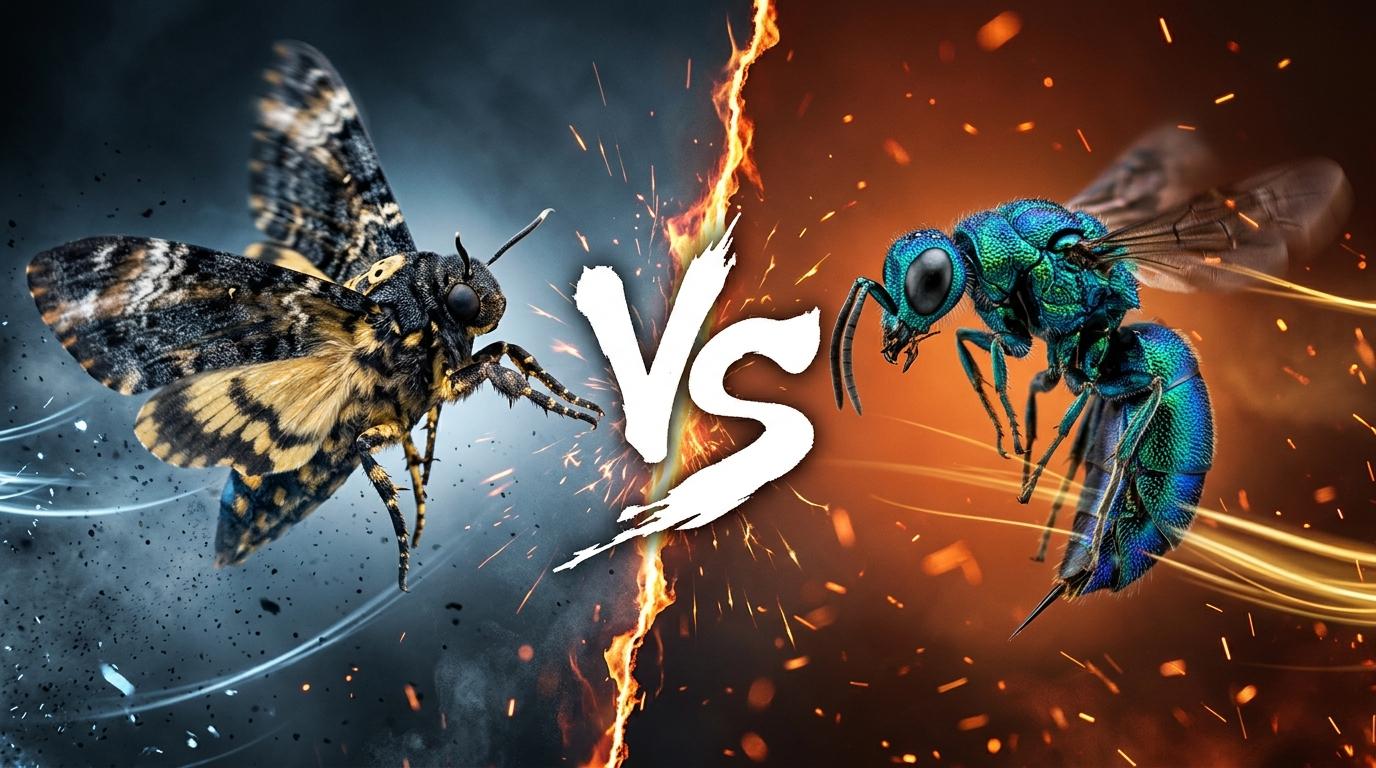
Death's-head Hawkmoth vs Cuckoo Wasp: Who Actually Wins?
Death's-head Hawkmoth vs Cuckoo Wasp: an armored brood parasite meets Europe's heaviest honey thief. See who wins on size, armor, speed and survival.
Death's-head Hawkmoth vs Cuckoo Wasp
Matchup winner
Death's-head Hawkmoth
Quick verdict
Start with the direct answer, then use the structured comparison below to see what changes the outcome.
The Death's-head Hawkmoth wins overall. It is a heavy, fast-flying sphinx moth with a wingspan of roughly 9–13 cm and a body many times the mass of a cuckoo wasp, which is usually under 1.5 cm long. The cuckoo wasp is a superb defensive specialist. Its pitted, metallic cuticle is extremely hard, and it can curl into a tight armored ball. But most cuckoo wasps have a reduced or non-functional sting, and their mouthparts are not built to hurt something the hawkmoth's size. Neither insect hunts the other, so a 'fight' here means a contest of displacement, endurance and escape. In that contest the hawkmoth's mass, thick scaled body, squeak-and-bluff defense and powerful flight let it dominate almost every encounter it chooses to stay in. The wasp's real victory condition is to not lose: armor up and survive.
Read the full explanation
Winner: Death's-head Hawkmoth, mainly on size, mass and flight power.
The cuckoo wasp has elite armor but almost no offensive weapon against a large moth.
The cuckoo wasp almost never 'loses' outright. It rolls into a ball and waits it out.
In real ecology they barely interact. The moth raids honeybee hives, while the wasp parasitizes solitary bee and wasp nests.
Reader vote
Who do you think wins?
Pick a side — no account needed. Results update live.
No votes yet — be the first to call it.
Editorial note
Why people disagree
'Wasp' sounds lethal, but cuckoo wasps are mostly stingless parasites whose sting is reduced into an egg-laying tube.
Sheer mass
At insect scale, mass decides who gets shoved off a perch or a flower. The moth outweighs the wasp by an order of magnitude.
Armor integrity
The cuckoo wasp's armor is built to shrug off stings from enraged host bees. Almost nothing either insect can do will breach it.
Offensive tools
Neither insect is a weapon platform. The moth's momentum is still a more meaningful force than the wasp's nibble.
Read the full explanation +
The cuckoo wasp's armor is so good that some readers count 'can't be hurt' as a win. Survival is not the same as dominance.
The hawkmoth looks sinister because of its skull mark and squeak, yet it is a nectar and honey feeder with no jaws for fighting.
Comparison FAQ
Short, direct answers to the next questions readers usually ask after the headline verdict.
Would a Death's-head Hawkmoth beat a Cuckoo Wasp?+
Yes, in most contexts. Its mass and flight let it displace the wasp and control the encounter.
Which is stronger?+
The hawkmoth, by a wide margin in mass and raw force. The wasp is far tougher per square millimeter thanks to its armor.
Can a cuckoo wasp sting?+
Most species have a reduced sting with little or no venom, used mainly for laying eggs. It is no real threat to a large moth.
Why is the cuckoo wasp still dangerous to beat?+
Its hard cuticle and roll-up defense make it nearly impossible to injure, so it survives encounters it cannot win.
Do they meet in the wild?+
Rarely in any meaningful way. The moth targets honeybee hives, while the wasp targets solitary bee and wasp nests.
Head-to-head species stats
These are the same core AnimalDex stat dimensions used on the dedicated animal pages, pulled side by side so the matchup is faster to scan.
Death's-head Hawkmoth
Tier DCuckoo Wasp
Tier CTrait-by-trait comparison
Only the categories that matter to this matchup are included. The goal is not filler stats, but the real design differences that change the result.
Heavyweight sphinx moth, roughly 9–13 cm wingspan
Sheer mass
Death's-head Hawkmoth
Tiny jewel wasp, usually under 1.5 cm long
Sheer mass
Death's-head Hawkmoth
Dense scales and a thick thorax, protective but soft
Armor integrity
Cuckoo Wasp
Hard, pitted metallic cuticle that rolls into a sealed ball
Armor integrity
Cuckoo Wasp
Short, stout proboscis that can pierce honeycomb cappings; body-slam momentum
Offensive tools
Death's-head Hawkmoth
Mandibles and a reduced, mostly non-venomous ovipositor
Offensive tools
Death's-head Hawkmoth
Fast, long-distance migrant flight
Flight power
Death's-head Hawkmoth
Quick, darting short-range flight
Flight power
Death's-head Hawkmoth
Squeaks loudly and flashes a skull-marked thorax
Bluff and deterrence
Death's-head Hawkmoth
Brilliant warning-like color and defensive curling
Bluff and deterrence
Death's-head Hawkmoth
Mimics hive scent to raid honeybee colonies
Infiltration skill
Cuckoo Wasp
Sneaks into host nests and survives guard attacks
Infiltration skill
Cuckoo Wasp
How the verdict forms
Verdict timeline
01 · Sheer mass
Death's-head Hawkmoth
02 · Armor integrity
Cuckoo Wasp
03 · Offensive tools
Death's-head Hawkmoth
04 · Flight power
Death's-head Hawkmoth
05 · Bluff and deterrence
Death's-head Hawkmoth
06 · Infiltration skill
Cuckoo Wasp
Change the conditions
Scenario breakdown
This is where shallow battle content usually fails. Terrain, spacing, timing, and engagement style can change the answer.
Scenario lean
Death's-head Hawkmoth
Verdict confidence
82%
The moth's bulk wins the perch.
On a tight flower cluster, the hawkmoth's weight and wingbeats physically displace the wasp. The wasp cannot deliver a damaging sting, so it either leaves or balls up. Either way, the moth holds the resource.
AnimalDex field profiles
Explore these animals
Death's-head Hawkmoth
Acherontia atropos
woodland edge, scrub, and cultivated landscape
Cuckoo Wasp
—
Habitat details are not published on a dedicated AnimalDex species page yet.
Species guide coming soon.
Systems Intelligence & Hidden Purpose
See the animals behind this comparison as engineered biological systems: what each one is built to do, where it gains leverage, and why the matchup changes by scenario.
Specialized Hardware
skull-like thorax marking, powerful night flight, and deep humming wingbeat give the Death's-head Hawkmoth a body plan tuned for its niche.
Systems Script
Death's-head Hawkmoths operate through woodland edge, scrub, and cultivated landscape. Their design links movement, feeding, shelter, and timing into one workable survival system.
Strategic Insight
Dense environments reward precision, patience, and the ability to read layered cover.
Final take
The Death's-head Hawkmoth wins this matchup because it brings the only meaningful offensive asset either insect has: overwhelming size and momentum, backed by fast, strong flight.
Read the full explanation
The cuckoo wasp is not a pushover. It is one of nature's best-armored small insects. It is designed to absorb attacks and endure, not to win fights against big animals. Expect it to survive almost any encounter, but not to control one.
Collect both animals in AnimalDex
Track the species behind this matchup, compare their real traits, and build the rivalry into your AnimalDex collection.
Related comparisons
Continue with nearby matchups to compare more real-world animal traits without dropping into junky who-wins filler.
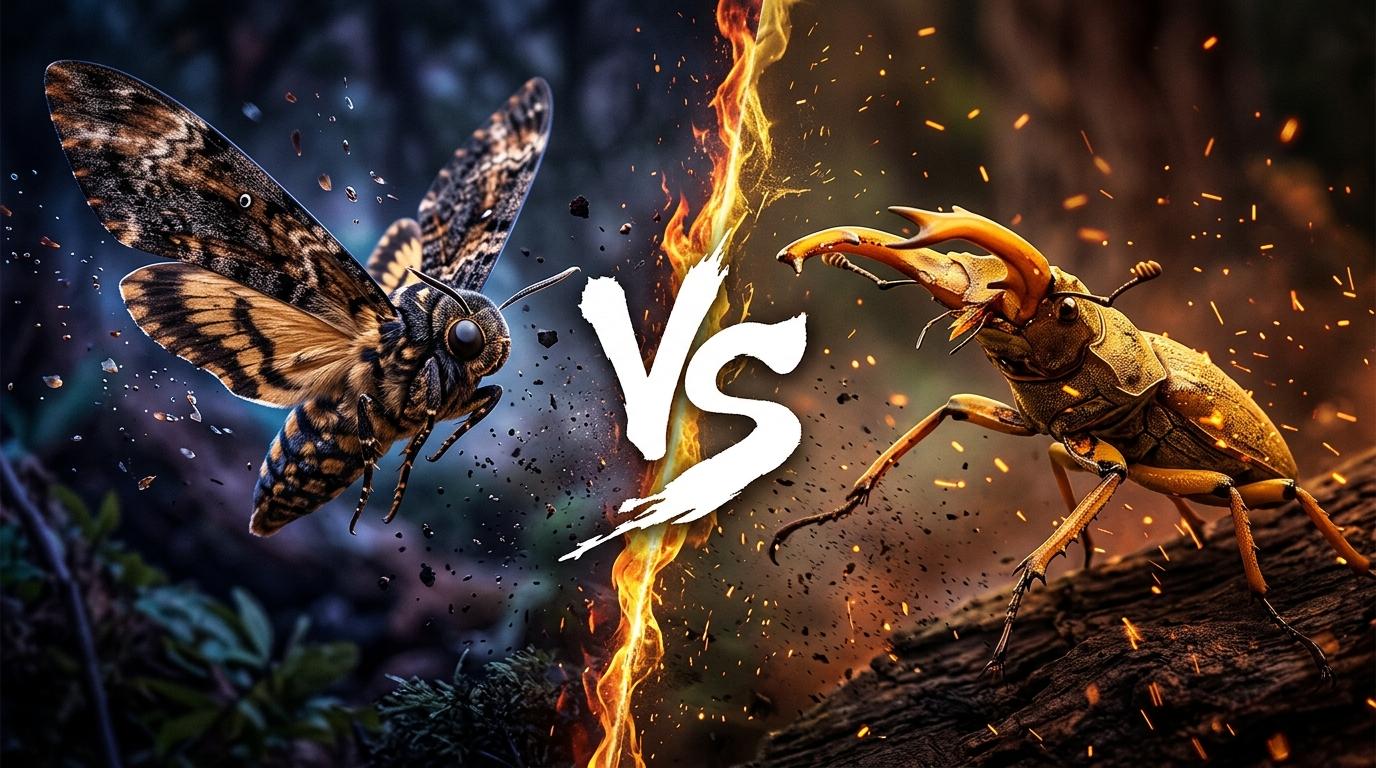
Death's-head Hawkmoth vs Golden Stag Beetle: Who Actually Wins?
The Golden Stag Beetle wins. In any contest that requires holding ground, the beetle's hardened elytra, armored body, and oversized male mandibles, built specifically for wrestling rivals off sap-flow branches, outclass anything the Death's-head Hawkmoth can bring to a physical exchange. The hawkmoth is the more remarkable animal in many ways. It is a fast, powerful flier, it squeaks when threatened, and it raids beehives while masked in chemical camouflage. But it has no biting weapon, only a short, stout proboscis built for piercing honeycomb, and its soft, scaled body is designed to slip away, not absorb a pinch. If the hawkmoth is forced to stay, it loses. Its real victory condition is leaving, and that is evasion, not winning.
Read comparison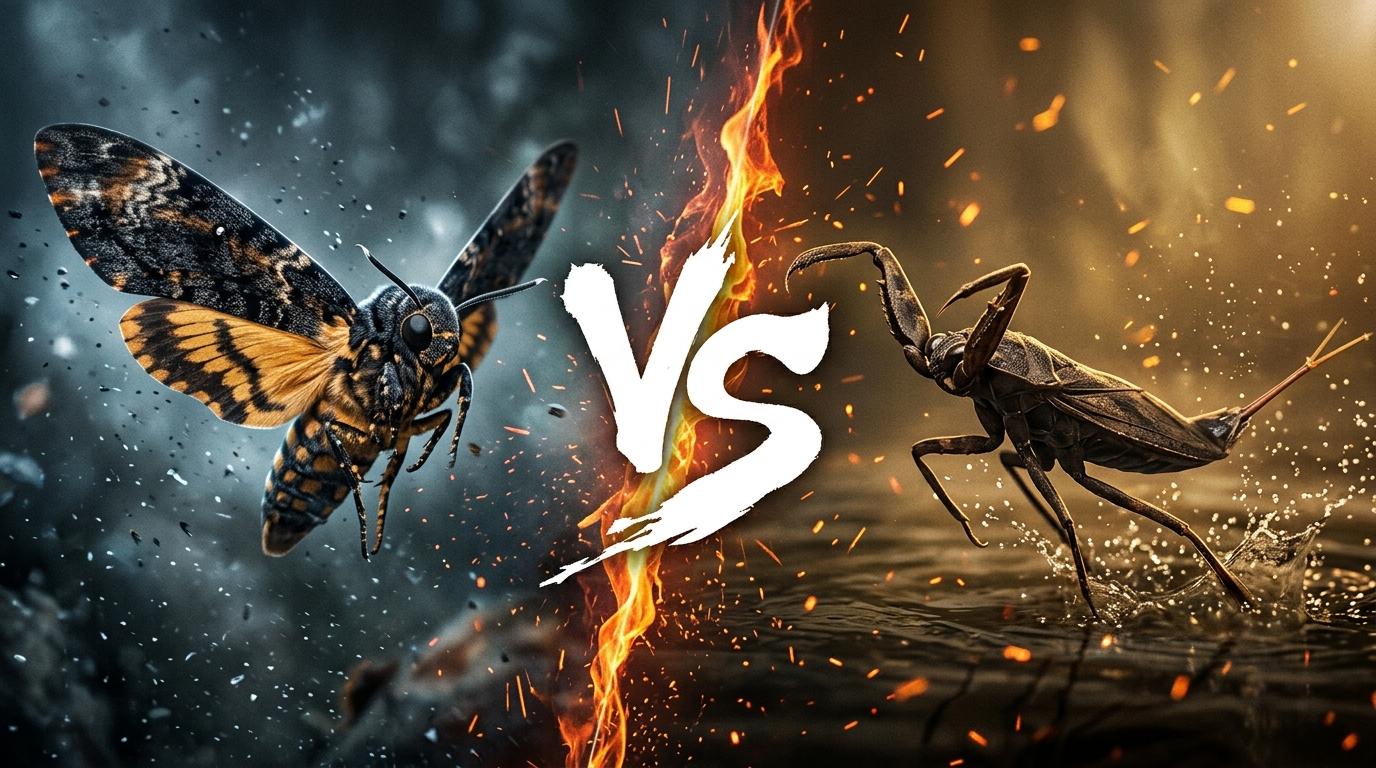
Death's-head Hawkmoth vs Water Scorpion: Who Actually Wins?
The Death's-head Hawkmoth wins overall. With a wingspan of roughly 9–13 cm and a heavy, armored body several times the mass of a 2 cm Water Scorpion, the moth simply outclasses Nepa cinerea in size, speed and escape options. It is not a predator, so it would never "beat" the bug in a hunting sense. But the Water Scorpion's raptorial forelegs and piercing beak are built for tadpoles, small fish and aquatic insects, not for subduing a thick-bodied, scale-covered, flight-capable moth that can squeak, thrash and leave. On land or in the air, the moth controls the encounter. Only in a submerged ambush does the little bug get a real chance.
Read comparison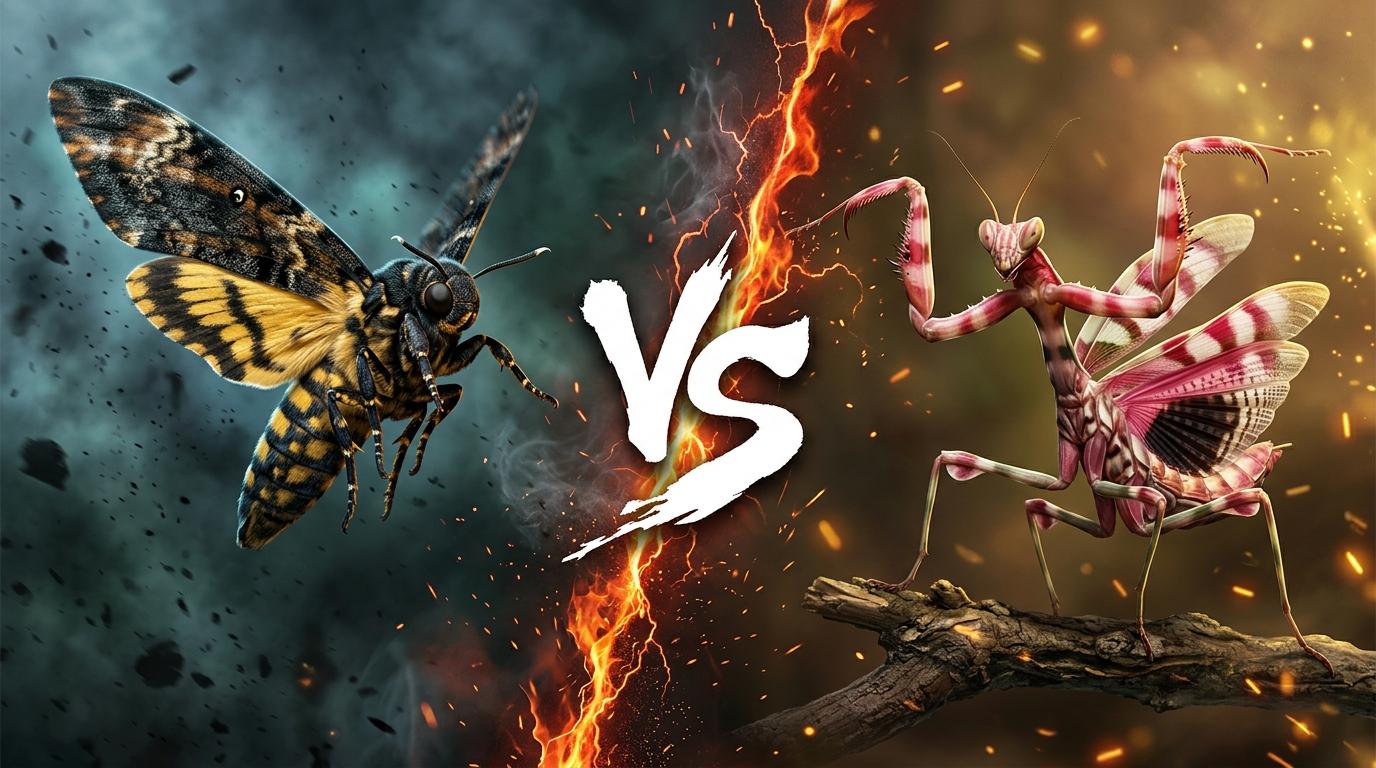
Death's-head Hawkmoth vs Devil's Flower Mantis: Who Actually Wins?
The Devil's Flower Mantis wins. It is a specialist predator built to catch flying insects. Its spined raptorial forelegs strike in a fraction of a second, its binocular vision judges distance precisely, and it hunts by sitting still until prey comes close. That is the exact setup in which a moth gets caught. The Death's-head Hawkmoth is one of the toughest moths alive. It has a heavy, scale-armored body, a thick cuticle that resists bee stings, a startling squeak, and fast, powerful flight. But it has no weapons at all. It feeds and fights by avoiding trouble, not by fighting back. If the moth stays airborne and keeps its distance, it simply leaves. Once it is within the mantis's strike range, its bulk and armor only slow the mantis down. They do not stop it. Mantids readily take large moths, and Idolomantis is big enough to handle one.
Read comparison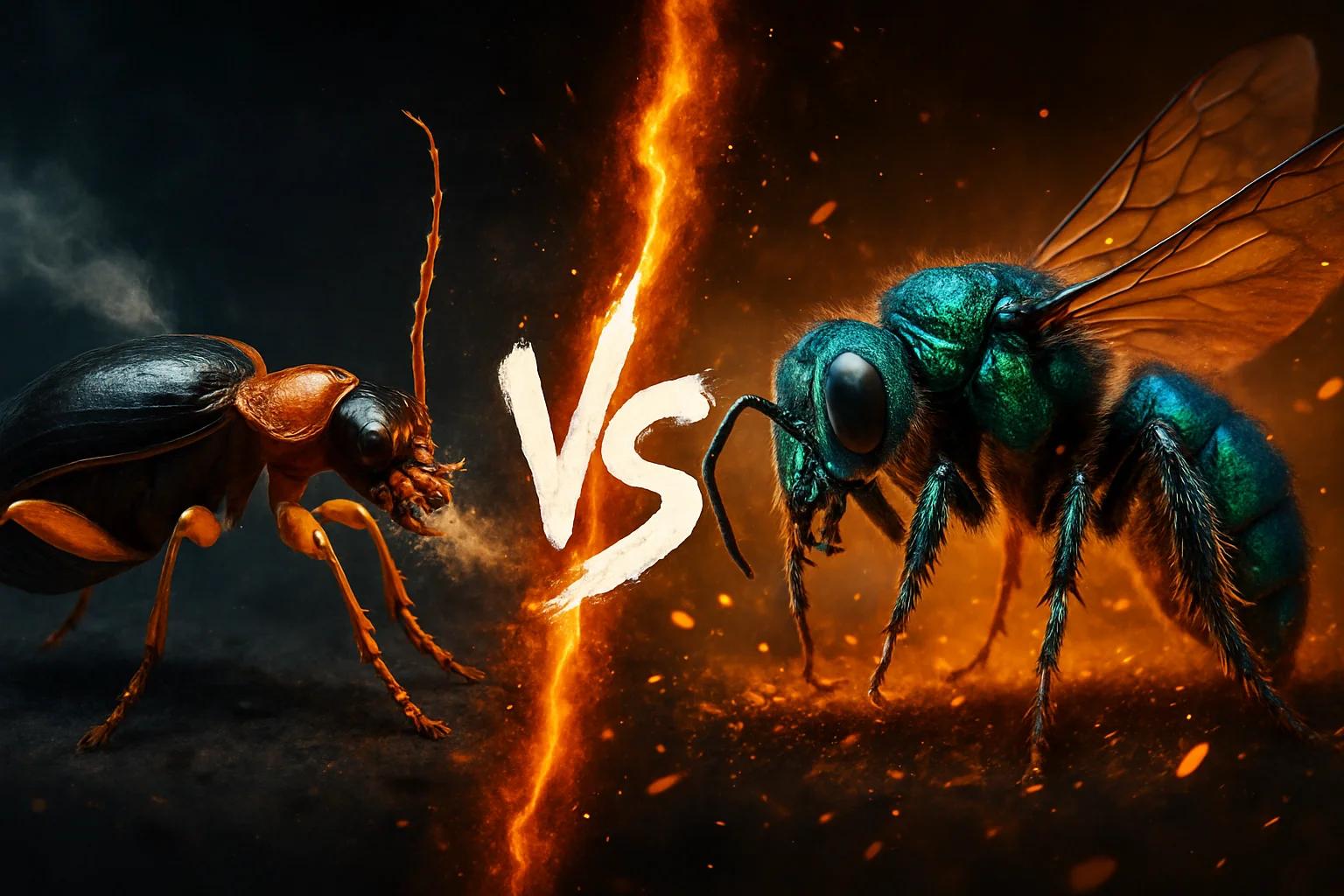
Bombardier Beetle vs Cuckoo Wasp: Who Actually Wins?
The Bombardier Beetle wins. Brachinus crepitans carries one of the most sophisticated defensive weapons in the insect world, a pulsed, aimable spray of benzoquinone-laced liquid that reaches about 100°C. The beetle can rotate its abdominal tip to hit an attacker almost anywhere around it. The Cuckoo Wasp (family Chrysididae) is a brilliant survivor, not a fighter. Its hard, deeply pitted metallic cuticle and its ability to curl into a tight armored ball are built to outlast angry host bees and wasps, not to kill. Most cuckoo wasps have a reduced, largely nonfunctional sting and no real way to hurt a beetle. In any forced encounter, the beetle controls the exchange and the wasp's best result is a fast exit. The wasp avoids defeat by fleeing, and that does not count as winning.
Read comparison
Discussion
What do you think?
Share your reasoning with other readers. Be civil and stick to the animals.
Sign in to join the discussion.
Sign inNo comments yet. Start the conversation.