

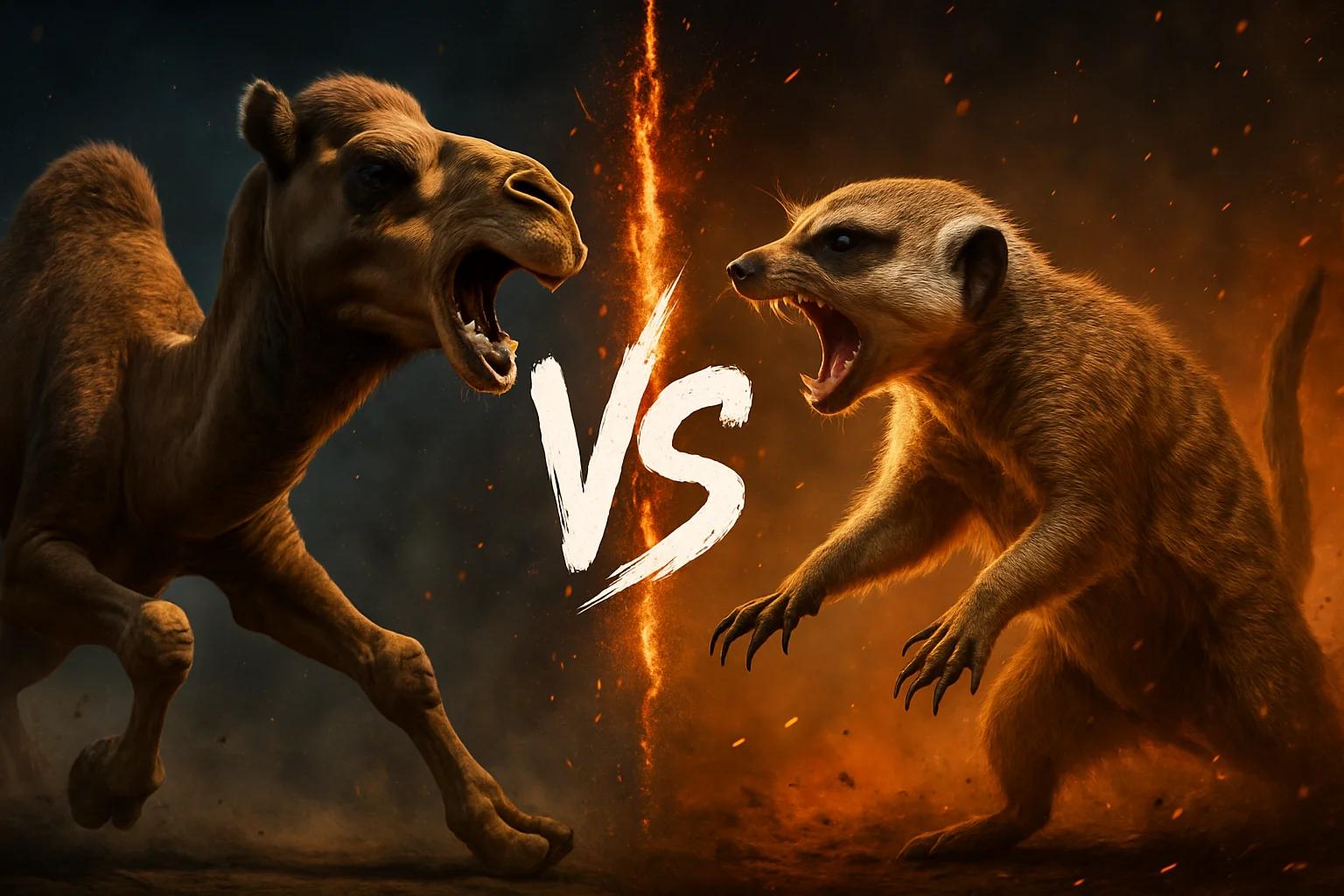
Dromedary Camel vs Meerkat: Who Actually Wins?
Dromedary camel vs meerkat: a biology-first breakdown of size, defense, burrow tactics and desert survival, and why the camel wins a direct confrontation.
Dromedary Camel vs Meerkat
Matchup winner
Dromedary Camel
Quick verdict
Start with the direct answer, then use the structured comparison below to see what changes the outcome.
The dromedary camel wins, and it isn't close in a direct confrontation. An adult dromedary weighs roughly 400–600 kg against a meerkat's 0.6–1 kg, a mass gap of several hundred to one. Camels defend themselves with heavy kicks that can reach in any direction, crushing body weight, and a bite strong enough to injure large mammals, especially rutting bulls. A meerkat's sharp teeth and claws are built for scorpions, beetles and burrow digging, not for harming an animal whose legs alone outweigh an entire mob. The meerkat's real strength is avoidance. Sentinel calls, burrow networks and group mobbing mean a camel would almost never catch one. But 'who would win' means who prevails if they clash, and on that question the camel's size and durability settle it.
Read the full explanation
Winner: Dromedary Camel, by overwhelming size and strength.
A camel outweighs a meerkat by roughly 500 to 1.
Meerkats win at escaping, not fighting. A burrow is their victory condition.
A mob of meerkats can harass a camel but cannot meaningfully injure it.
Reader vote
Who do you think wins?
Pick a side — no account needed. Results update live.
No votes yet — be the first to call it.
Editorial note
Why people disagree
Meerkats are famous for bravely mobbing snakes and jackals, so people overestimate how that courage scales against a giant herbivore.
Explosive power
One defensive kick from a camel carries more force than a meerkat could ever absorb or produce.
Close-range durability
Meerkat bites barely register on camel skin, while any camel contact is potentially fatal to a meerkat.
Threat detection
Meerkats almost always see trouble coming, which is why they so rarely get caught.
Read the full explanation +
Camels are seen as gentle pack animals, but bulls in rut are aggressive and genuinely dangerous kickers and biters.
Some readers treat 'the meerkat dives into a burrow and survives' as a win. Survival by retreat is not the same as winning a fight.
Comparison FAQ
Short, direct answers to the next questions readers usually ask after the headline verdict.
Would a camel beat a meerkat in a fight?+
Yes. The camel's massive size, kicks and bite make the outcome one-sided whenever they make contact.
Which is stronger, a camel or a meerkat?+
The camel, by an enormous margin. It can carry loads of around 200 kg or more, while a meerkat weighs under a kilogram.
Could a group of meerkats take down a camel?+
No. Mobbing deters snakes and small predators, but meerkat bites cannot seriously injure a camel.
Why is a meerkat still hard to beat?+
Because it rarely loses by being caught. Sentinels spot danger early, and burrows give it an instant refuge that a camel cannot breach. Its teeth and claws also make it a nasty handful for anything that does grab it.
Do camels and meerkats meet in the wild?+
Rarely, if at all. Meerkats live in the Kalahari and southern Africa, and dromedaries are mostly found in North Africa, the Middle East and Australia.
Head-to-head species stats
These are the same core AnimalDex stat dimensions used on the dedicated animal pages, pulled side by side so the matchup is faster to scan.
Dromedary Camel
Tier CMeerkat
Tier CTrait-by-trait comparison
Only the categories that matter to this matchup are included. The goal is not filler stats, but the real design differences that change the result.
Kicks that can reach in all directions, driven by half a tonne of mass
Explosive power
Dromedary Camel
Quick lunges and snaps sized for insects
Explosive power
Dromedary Camel
Thick hide, calloused pads, massive frame
Close-range durability
Dromedary Camel
Light body, relies on not being touched
Close-range durability
Dromedary Camel
Good eyesight and tall vantage, but often a solitary or loose herd watch
Threat detection
Meerkat
Rotating sentinels with distinct alarm calls for different threats
Threat detection
Meerkat
Can outpace on open sand but has no refuge
Escape architecture
Meerkat
Networks of bolt-holes within dashing distance
Escape architecture
Meerkat
Towers about 2 m at the hump, long neck for biting
Intimidation and reach
Dromedary Camel
Group puff-up display and mobbing
Intimidation and reach
Dromedary Camel
Can go many days without drinking and tolerates large body-temperature swings
Desert endurance
Dromedary Camel
Gets most water from food and shelters underground in the heat
Desert endurance
Dromedary Camel
How the verdict forms
Verdict timeline
01 · Explosive power
Dromedary Camel
02 · Close-range durability
Dromedary Camel
03 · Threat detection
Meerkat
04 · Escape architecture
Meerkat
05 · Intimidation and reach
Dromedary Camel
06 · Desert endurance
Dromedary Camel
Change the conditions
Scenario breakdown
This is where shallow battle content usually fails. Terrain, spacing, timing, and engagement style can change the answer.
Scenario lean
Dromedary Camel
Verdict confidence
82%
Camel dominates if contact happens.
On flat sand with no burrow close by, the meerkat has nothing to offset a mass gap of hundreds to one. A stomp or kick ends it instantly. The meerkat's best move is to flee, which concedes the ground.
AnimalDex field profiles
Explore these animals
Dromedary Camel
Camelus dromedarius
Desert, semi-desert, dry scrubland, and human-managed arid travel routes.
Meerkat
Suricata suricatta
Arid grassland, scrub, and semi-desert with burrow-friendly soil.
Systems Intelligence & Hidden Purpose
See the animals behind this comparison as engineered biological systems: what each one is built to do, where it gains leverage, and why the matchup changes by scenario.
Specialized Hardware
Single large hump on the back, long legs and broad padded feet, and long neck and narrow head give the Dromedary Camel a body plan tuned for its niche.
Systems Script
Dromedary Camels operate in desert, semi-desert, dry scrubland, and human-managed arid travel routes. Their design helps them match food access, shelter, and timing inside that environment.
Strategic Insight
Good design makes harsh places feel less impossible.
Specialized Hardware
Upright vigilance posture, coordinated alarm language, and digging-ready limbs make meerkats social detection hardware for open dry ground.
Systems Script
Meerkats reduce predation uncertainty by turning many small mammals into one shared warning network. They prove that survival at small body size depends on information quality as much as escape speed.
Strategic Insight
Small units become formidable when they pool watch duty instead of pretending every member can do everything alone.
Final take
The dromedary camel is the clear winner. This matchup is a lesson in scale: half a tonne of desert-built mass with dangerous kicks against an animal under a kilogram. Any real physical exchange ends in the camel's favor.
Read the full explanation
The meerkat's genius lies elsewhere. Its sentinels, alarm calls and burrows are designed so that fights never happen. In nature these two rarely conflict at all. A camel is not a meerkat predator, and a meerkat is no threat to a camel. If they did clash, though, size wins.
Collect both animals in AnimalDex
Track the species behind this matchup, compare their real traits, and build the rivalry into your AnimalDex collection.
Related comparisons
Continue with nearby matchups to compare more real-world animal traits without dropping into junky who-wins filler.
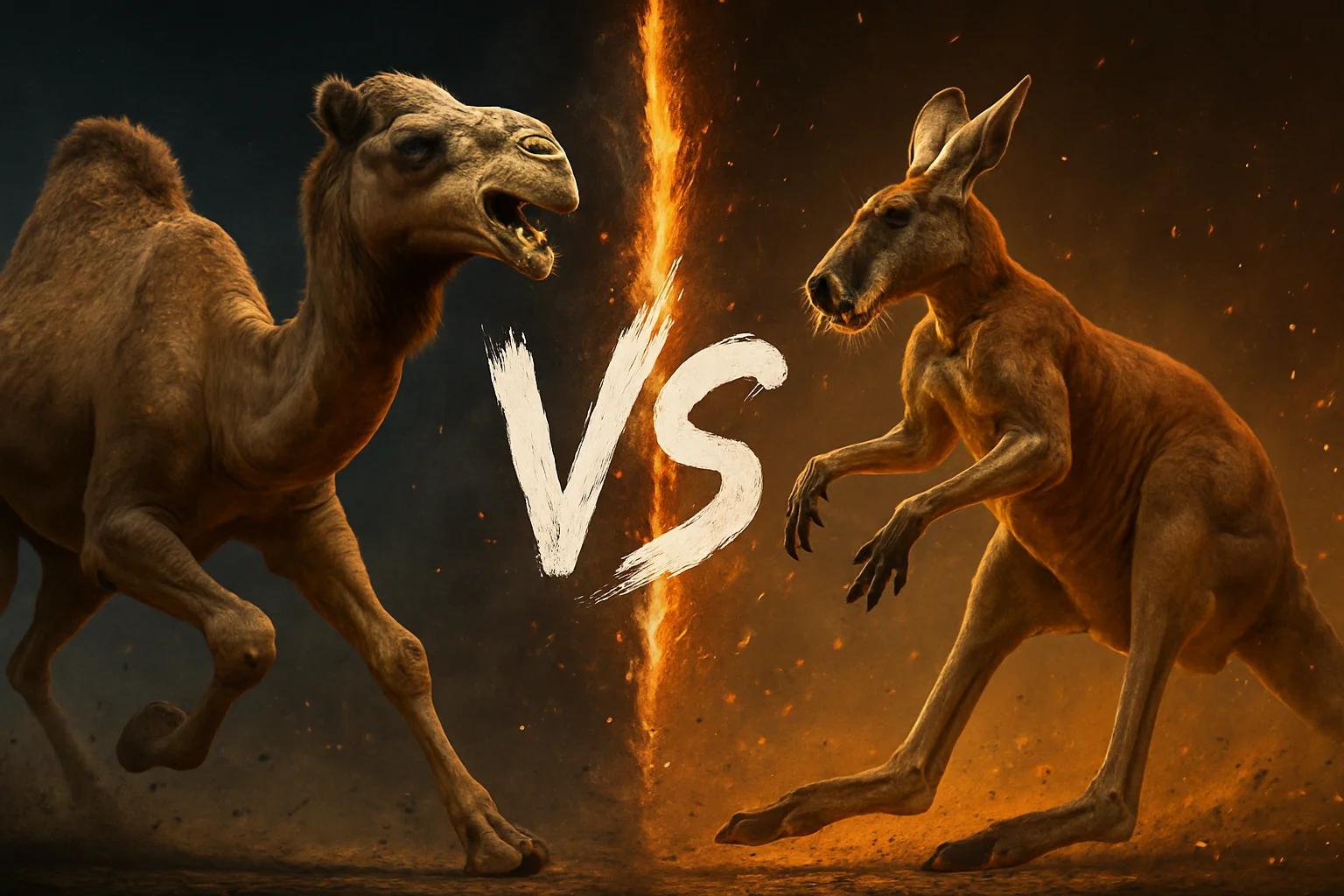
Dromedary Camel vs Red Kangaroo: Who Actually Wins?
The dromedary camel wins this matchup overall. A bull camel weighs roughly 400–600 kg against a big male red kangaroo's 55–90 kg, a mass gap of five to eight times. The kangaroo brings the more refined weapon: a tail-braced double kick with clawed hind feet that can open skin and break ribs on animals its own size. But those kicks were shaped by ritualized boxing between kangaroos and by defense against dingoes, not by contests with a half-tonne ungulate. A camel's thick hide, dense neck and chest, crushing bite and stamping forefeet let it absorb punishment and dish it out at a scale the kangaroo cannot match. The kangaroo's real edge is speed and evasion, so it wins any scenario where it can simply leave. In a committed, close-range confrontation, the camel's size settles it.
Read comparison
Discussion
What do you think?
Share your reasoning with other readers. Be civil and stick to the animals.
Sign in to join the discussion.
Sign inNo comments yet. Start the conversation.