

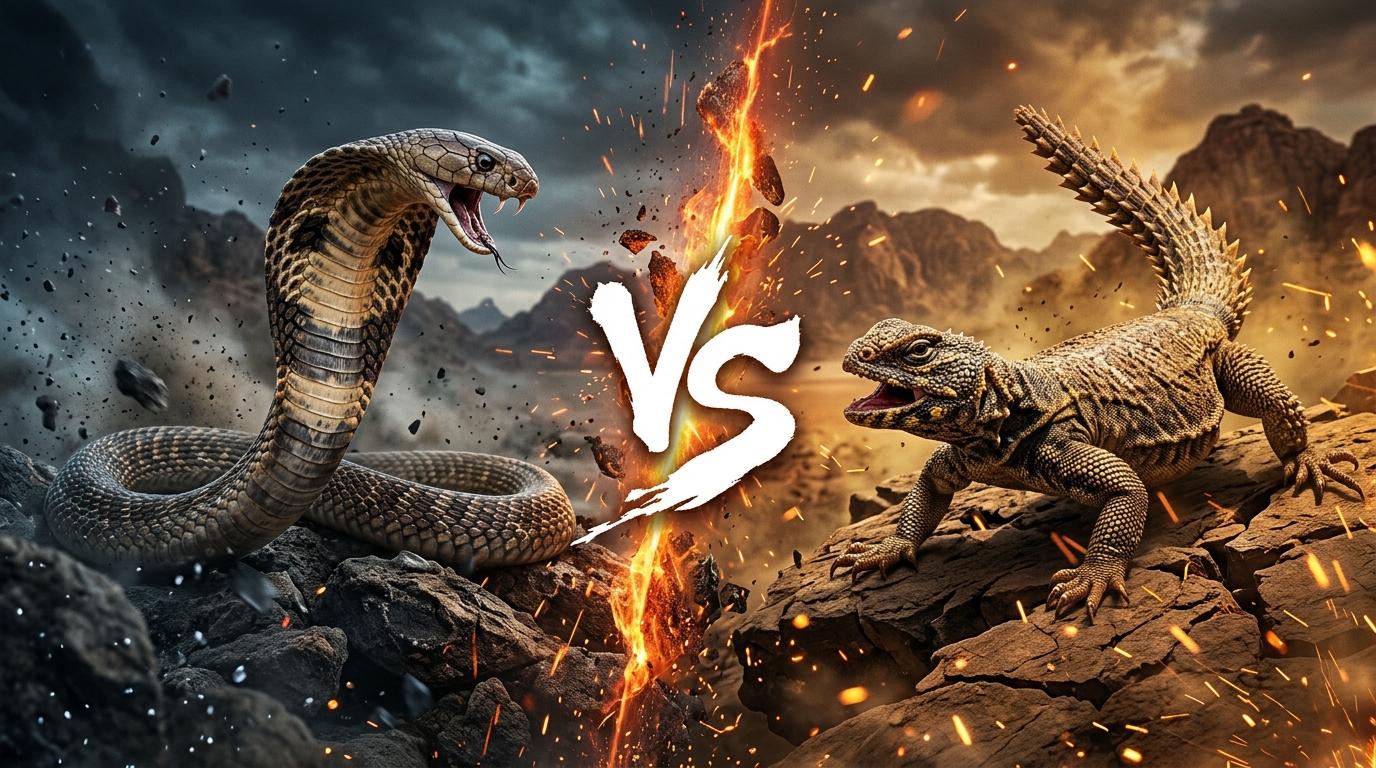
Egyptian Cobra vs Spiny-tailed Lizard: Who Actually Wins?
Egyptian cobra vs Egyptian spiny-tailed lizard (Uromastyx aegyptia): venom, armor, burrows and body mass compared to show who wins and why.
Egyptian Cobra vs Spiny-tailed Lizard
Matchup winner
Egyptian Cobra
Quick verdict
Start with the direct answer, then use the structured comparison below to see what changes the outcome.
The Egyptian Cobra wins. Naja haje is a venomous predator built to deliver potent neurotoxic venom through fixed front fangs. It is also a reach-and-retreat striker that can stay back from a lizard's jaws and tail. The Egyptian Spiny-tailed Lizard (Uromastyx aegyptia) is one of the largest uromastyx species. It is heavier per body length and protected by a club-like tail ringed with spiky scales, and its strong herbivore jaws can bite hard. But it has no venom, no reliable way to land a decisive blow, and its main defense is to shut itself inside a burrow and block the entrance with its tail. In the open, one effective bite from the cobra starts a clock the lizard cannot stop. Cobras in North Africa do take lizards and rodents. The uromastyx is a herbivore that fights to deter attackers, not to kill them. The lizard's best result is a stalemate at its burrow mouth. That is a reason it survives, not a way to win.
Read the full explanation
Winner: Egyptian Cobra. Its neurotoxic venom ends the contest, and the lizard has nothing equivalent.
The spiny-tailed lizard is bulkier and well armored, and its tail-whipping defense really works.
The lizard's best scenario is retreating into its burrow and plugging it with its spiked tail, which produces a draw rather than a win.
Venom plus strike reach beats armor plus bulk in most realistic encounters.
Reader vote
Who do you think wins?
Pick a side — no account needed. Results update live.
No votes yet — be the first to call it.
Editorial note
Why people disagree
People see the lizard's size and spiked tail and assume armor beats a slender snake. Most of a uromastyx's scales are not dense enough to reliably stop fangs, especially on the limbs and neck.
Lethal payload
Only one animal can end the fight with a single successful contact. That decides it.
Strike reach & range control
The cobra can attack from outside the lizard's effective tail arc and pull back before a counter.
Close-range durability
The lizard absorbs punishment better and makes a cobra's strikes less certain to land cleanly.
Read the full explanation +
Burrow footage shows cobras failing to pull a wedged uromastyx out of a hole. Fans read that as the lizard winning, when it is really the lizard refusing the fight.
Adult uromastyx are large for cobra prey, so some argue the cobra wouldn't bother. That's a question of motivation. If the fight happens, the cobra's tools are far more lethal.
Comparison FAQ
Short, direct answers to the next questions readers usually ask after the headline verdict.
Would an Egyptian Cobra beat a Spiny-tailed Lizard?+
Yes, in most encounters. The cobra's neurotoxic venom and strike reach let it finish a fight the lizard can only resist. The lizard's best outcome is escaping into a sealed burrow.
Which is stronger, the Egyptian Cobra or the Spiny-tailed Lizard?+
In raw physical terms the spiny-tailed lizard is sturdier: heavier for its length, more armored, and able to swing a powerful spiked tail. Fights aren't decided by bulk here, though. The cobra's venom outweighs the lizard's muscle.
Can a spiny-tailed lizard's armor stop a cobra bite?+
Only partly. Its dorsal and tail armor makes clean strikes harder, but the limbs, neck, and underside are vulnerable. A cobra only needs one good bite in a weak spot.
Why is the spiny-tailed lizard still dangerous to a cobra?+
Its tail is a spiked club that can bruise or injure a snake's head and body, and its jaws are strong enough to cause real wounds. A cobra that strikes carelessly or tries to dig a uromastyx out of its burrow risks injury. That cost is why predators often give up.
Do Egyptian Cobras eat Uromastyx lizards in the wild?+
Cobras do prey on lizards, and juvenile or smaller uromastyx are vulnerable. Large adults are tough, awkward prey, and their burrow defense often makes them more trouble than they're worth.
Is the Spiny-tailed Lizard venomous?+
No. Uromastyx aegyptia is a herbivore with no venom. It relies on armor, tail strikes, a strong bite, and burrows for defense.
Head-to-head species stats
These are the same core AnimalDex stat dimensions used on the dedicated animal pages, pulled side by side so the matchup is faster to scan.
Egyptian Cobra
Tier CSpiny-tailed Lizard
Tier DTrait-by-trait comparison
Only the categories that matter to this matchup are included. The goal is not filler stats, but the real design differences that change the result.
Potent neurotoxic venom via fixed front fangs
Lethal payload
Egyptian Cobra
No venom; strong crushing herbivore bite
Lethal payload
Egyptian Cobra
Raised hood posture, fast forward strike from coiled stance
Strike reach & range control
Egyptian Cobra
Short-range tail swipes, slow forward lunges
Strike reach & range control
Egyptian Cobra
Smooth scales, vulnerable body if pinned or bitten
Close-range durability
Spiny-tailed Lizard
Stocky body, spiny tail rings, thick dorsal skin
Close-range durability
Spiny-tailed Lizard
Long but slender; mass spread along length
Mass & leverage
Spiny-tailed Lizard
Compact and heavy-bodied for its length
Mass & leverage
Spiny-tailed Lizard
Uses burrows and crevices, but doesn't seal them
Fortress defense
Spiny-tailed Lizard
Digs deep burrows and blocks the entrance with its armored tail
Fortress defense
Spiny-tailed Lizard
Active hunter of rodents, lizards, birds, toads
Predatory intent
Egyptian Cobra
Herbivore; fights only to deter
Predatory intent
Egyptian Cobra
How the verdict forms
Verdict timeline
01 · Lethal payload
Egyptian Cobra
02 · Strike reach & range control
Egyptian Cobra
03 · Close-range durability
Spiny-tailed Lizard
04 · Mass & leverage
Spiny-tailed Lizard
05 · Fortress defense
Spiny-tailed Lizard
06 · Predatory intent
Egyptian Cobra
Change the conditions
Scenario breakdown
This is where shallow battle content usually fails. Terrain, spacing, timing, and engagement style can change the answer.
Scenario lean
Egyptian Cobra
Verdict confidence
82%
Cobra wins clearly.
On flat gravel with no burrow nearby, the lizard can only tail-whip and bite. The cobra keeps its head out of the tail's arc and strikes the forelimbs or neck, where scales are thinner. Envenomation slows the lizard, and the cobra simply waits. Armor delays the outcome but does not prevent it.
AnimalDex field profiles
Explore these animals
Egyptian Cobra
Naja haje
desert fringe, rocky scrub, farmland edge, and river valley
Spiny-tailed Lizard
Uromastyx aegyptia
rocky desert, arid plain, and semi-desert scrub
Systems Intelligence & Hidden Purpose
See the animals behind this comparison as engineered biological systems: what each one is built to do, where it gains leverage, and why the matchup changes by scenario.
Specialized Hardware
hood-raising display, venomous strike system, and desert-and-river-edge adaptability give the Egyptian Cobra a body plan tuned for its niche.
Systems Script
Egyptian Cobras operate through desert fringe, rocky scrub, farmland edge, and river valley Their design links movement, shelter, and feeding into one workable survival system.
Strategic Insight
A clear warning can shift the fight before contact begins.
Specialized Hardware
clubby spined tail, stocky desert body, and burrow-based basking life give the Spiny-tailed Lizard a body plan tuned for its niche.
Systems Script
Spiny-tailed Lizards operate through rocky desert, arid plain, and semi-desert scrub. Their design links movement, feeding, shelter, and timing into one workable survival system.
Strategic Insight
Harsh places reward efficiency, timing, and bodies that waste very little.
Final take
The Egyptian Cobra is the overall winner. It's a matchup of a predator against a fortress. The cobra brings a fatal payload delivered from a safe range. The spiny-tailed lizard brings armor, bulk, and an excellent burrow defense, all designed to make predators give up rather than to defeat them.
Read the full explanation
The lizard deserves respect. Its spiked tail can injure a snake that strikes carelessly, and a uromastyx dug into its burrow is close to untouchable. But a fortress only protects an animal that reaches it. Away from cover, venom beats armor.
Final call: Egyptian Cobra, with high confidence. The lizard's best realistic outcome is surviving, not winning.
Collect both animals in AnimalDex
Track the species behind this matchup, compare their real traits, and build the rivalry into your AnimalDex collection.
Related comparisons
Continue with nearby matchups to compare more real-world animal traits without dropping into junky who-wins filler.
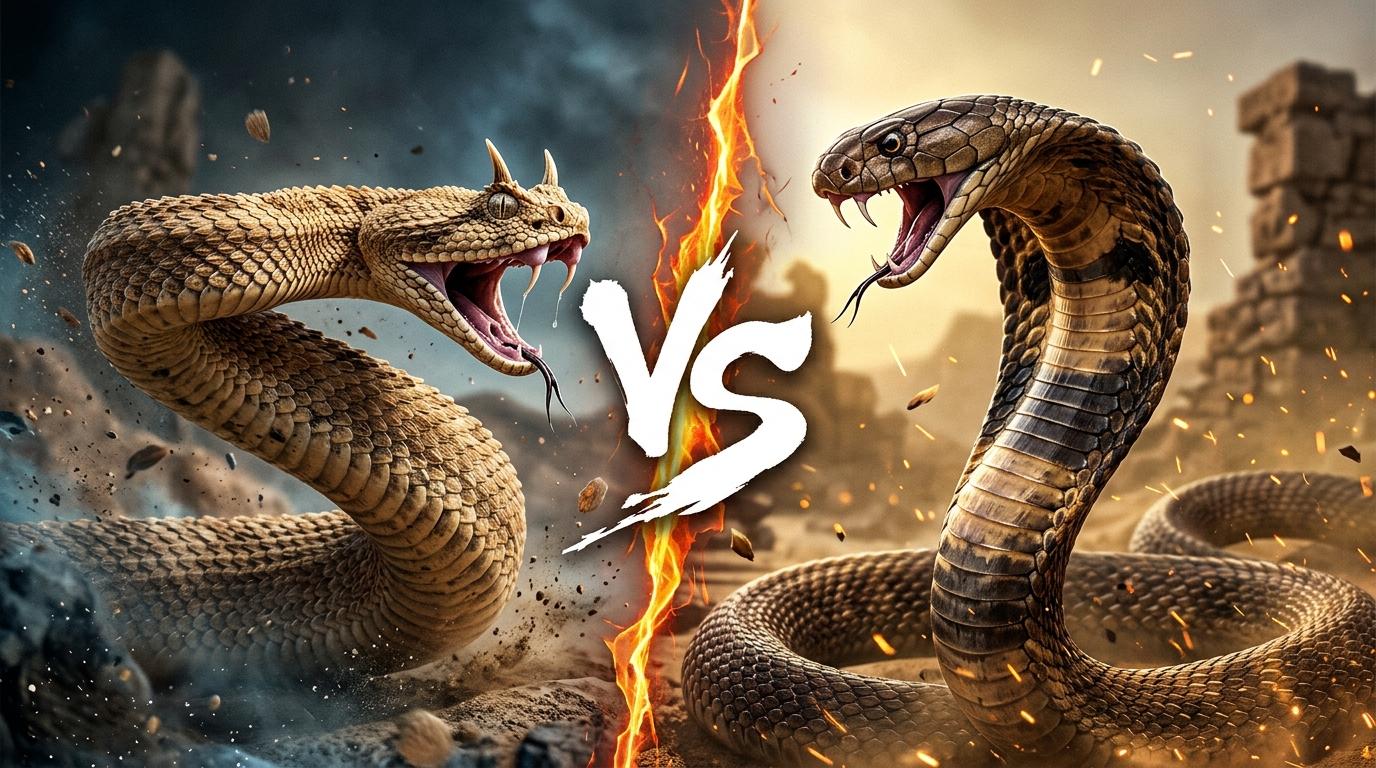
Desert Horned Viper vs Egyptian Cobra: Who Actually Wins?
The Egyptian Cobra wins this matchup clearly. A typical adult Naja haje is roughly 1.5–2 m long, about three times the length of a desert horned viper (usually 50–70 cm). It is also far heavier and carries a potent neurotoxic venom. Cobras in the genus Naja sometimes eat other snakes, so a small viper sits inside the cobra's prey range. The reverse is not true. The horned viper is a superb sand-burying ambusher with a fast strike and tissue-damaging venom. Its toolkit is built for lizards, rodents and birds, not for subduing a long, muscular elapid that can rear, track and pin. The viper's real chance is a lucky early bite from cover. Even then, its smaller venom dose acts more slowly than the cobra's ability to grab and envenomate.
Read comparison
Discussion
What do you think?
Share your reasoning with other readers. Be civil and stick to the animals.
Sign in to join the discussion.
Sign inNo comments yet. Start the conversation.