

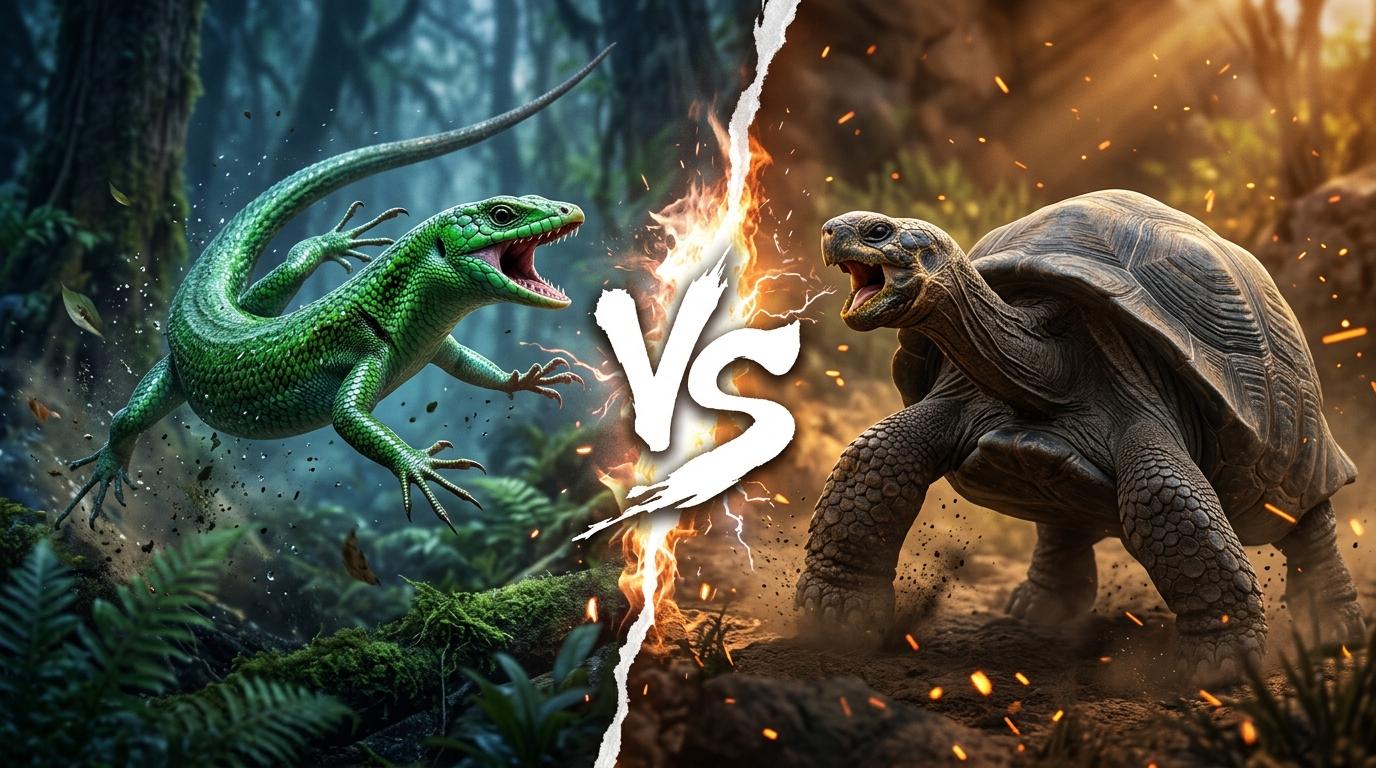
Emerald Tree Skink vs Giant Tortoise: Who Actually Wins?
Emerald tree skink vs giant tortoise: a biology-first look at size, armor, speed, and behavior to explain why the giant tortoise wins any real confrontation.
Emerald Tree Skink vs Giant Tortoise
Matchup winner
Giant Tortoise
Quick verdict
Start with the direct answer, then use the structured comparison below to see what changes the outcome.
The giant tortoise wins, and it is not close. A Galápagos or Aldabra giant tortoise can weigh 150–300+ kg and carries a fused bony shell, while the emerald tree skink is a slender arboreal lizard around 20–25 cm long, most of it tail, weighing a few dozen grams. The skink's bite cannot damage tortoise armor, and the tortoise's sheer mass, crushing beak, and pushing power can injure the skink by accident. The skink's real strength is not fighting at all. It is a fast, agile climber that would simply leave. In any frame where the two are forced to contest space, the tortoise holds the ground. In any frame where escape is allowed, the skink survives but does not win.
Read the full explanation
Winner: Giant Tortoise, by overwhelming size and armor (roughly 5,000x the skink's body mass).
The skink's bite cannot penetrate the shell or the scaled limbs.
The skink's best move is escape up a tree, which is survival, not victory.
These species never meet in the wild: the skink lives in Southeast Asia and the Pacific, the tortoises on Galápagos and Aldabra.
Reader vote
Who do you think wins?
Pick a side — no account needed. Results update live.
No votes yet — be the first to call it.
Editorial note
Why people disagree
Some readers count 'the skink just climbs away' as a win. In an evergreen battle comparison, avoiding contact is a survival result, not a victory.
Body mass and presence
At this size gap, any contact the tortoise makes is decisive, and nothing the skink does registers.
Close-range durability
The tortoise's shell turns the encounter into a contest the skink cannot score in.
Damage delivery
Only one side has tools that can cause injury at this scale.
Read the full explanation +
Tortoises are slow, so people assume they're harmless. Males ram, shove, and bite in dominance contests, and their mass is a real hazard to small animals.
Agility looks decisive in videos, but agility only matters if it can deliver damage, and the skink has no way to hurt an armored giant.
Comparison FAQ
Short, direct answers to the next questions readers usually ask after the headline verdict.
Would an emerald tree skink beat a giant tortoise?+
No. The giant tortoise wins any forced confrontation. The skink's best outcome is escaping into a tree.
Which is stronger, the emerald tree skink or the giant tortoise?+
The giant tortoise, by an enormous margin. It weighs hundreds of kilograms and can shove rivals and carry its own heavy shell, while the skink weighs only grams.
Can a skink hurt a giant tortoise?+
Not meaningfully. Its small jaws are built for insects and cannot damage the shell or the scaled limbs.
Why does the emerald tree skink stay dangerous to beat?+
It is extremely hard to catch. Its speed, climbing, and camouflage mean a tortoise can almost never force contact, so the skink survives even though it can't win.
Do they meet in the wild?+
No. Emerald tree skinks live in Southeast Asia and western Pacific islands, while giant tortoises live on the Galápagos and Aldabra.
Head-to-head species stats
These are the same core AnimalDex stat dimensions used on the dedicated animal pages, pulled side by side so the matchup is faster to scan.
Emerald Tree Skink
Tier CGiant Tortoise
Tier ATrait-by-trait comparison
Only the categories that matter to this matchup are included. The goal is not filler stats, but the real design differences that change the result.
Tens of grams, slender build
Body mass and presence
Giant Tortoise
150–300+ kg, domed or saddleback shell
Body mass and presence
Giant Tortoise
Smooth scales, autotomy tail
Close-range durability
Giant Tortoise
Fused bony carapace and plastron, armored limbs
Close-range durability
Giant Tortoise
Small insect-crushing jaws
Damage delivery
Giant Tortoise
Powerful keratin beak, crushing weight, ramming shell
Damage delivery
Giant Tortoise
Quick, nimble climber with clinging toes
Agility and burst movement
Emerald Tree Skink
Slow, deliberate walker at well under 1 km/h
Agility and burst movement
Emerald Tree Skink
Lives on trunks and branches
Vertical escape
Emerald Tree Skink
Ground-bound
Vertical escape
Emerald Tree Skink
Displays toward rival skinks
Territorial dominance
Giant Tortoise
Males rise up in neck-stretching height contests and shove rivals
Territorial dominance
Giant Tortoise
How the verdict forms
Verdict timeline
01 · Body mass and presence
Giant Tortoise
02 · Close-range durability
Giant Tortoise
03 · Damage delivery
Giant Tortoise
04 · Agility and burst movement
Emerald Tree Skink
05 · Vertical escape
Emerald Tree Skink
06 · Territorial dominance
Giant Tortoise
Change the conditions
Scenario breakdown
This is where shallow battle content usually fails. Terrain, spacing, timing, and engagement style can change the answer.
Scenario lean
Emerald Tree Skink
Verdict confidence
82%
The skink escapes and wins the space it cares about.
With trunks nearby, the skink climbs out of reach within seconds. The tortoise cannot pursue vertically, so the skink keeps its perch. Strictly, this is the skink controlling the encounter rather than defeating the tortoise, but within this frame it is the only scenario the skink takes.
AnimalDex field profiles
Explore these animals
Emerald Tree Skink
Lamprolepis smaragdina
coastal forest, coconut grove, and island woodland
Giant Tortoise
Chelonoidis spp. and Aldabrachelys gigantea
island scrub, grassland, dry lowland, and coastal woodland
Systems Intelligence & Hidden Purpose
See the animals behind this comparison as engineered biological systems: what each one is built to do, where it gains leverage, and why the matchup changes by scenario.
Specialized Hardware
glossy green scales, communal branch basking, and smooth arboreal sprint give the Emerald Tree Skink a body plan tuned for its niche.
Systems Script
Emerald Tree Skinks operate through coastal forest, coconut grove, and island woodland. Their design links movement, feeding, shelter, and timing into one workable survival system.
Strategic Insight
Dense environments reward precision, patience, and the ability to read layered cover.
Final take
The giant tortoise wins this matchup decisively. It brings massive armor, crushing weight, and dominance behavior shaped by fighting rival males. The emerald tree skink has no weapon that can register against that.
Read the full explanation
The skink's brilliance is its avoidance strategy: speed, climbing, and a vivid green body that blends into the canopy. That keeps it alive, but alive is not the same as winning. On ground or over a resource, the tortoise owns the outcome.
Collect both animals in AnimalDex
Track the species behind this matchup, compare their real traits, and build the rivalry into your AnimalDex collection.
Related comparisons
Continue with nearby matchups to compare more real-world animal traits without dropping into junky who-wins filler.
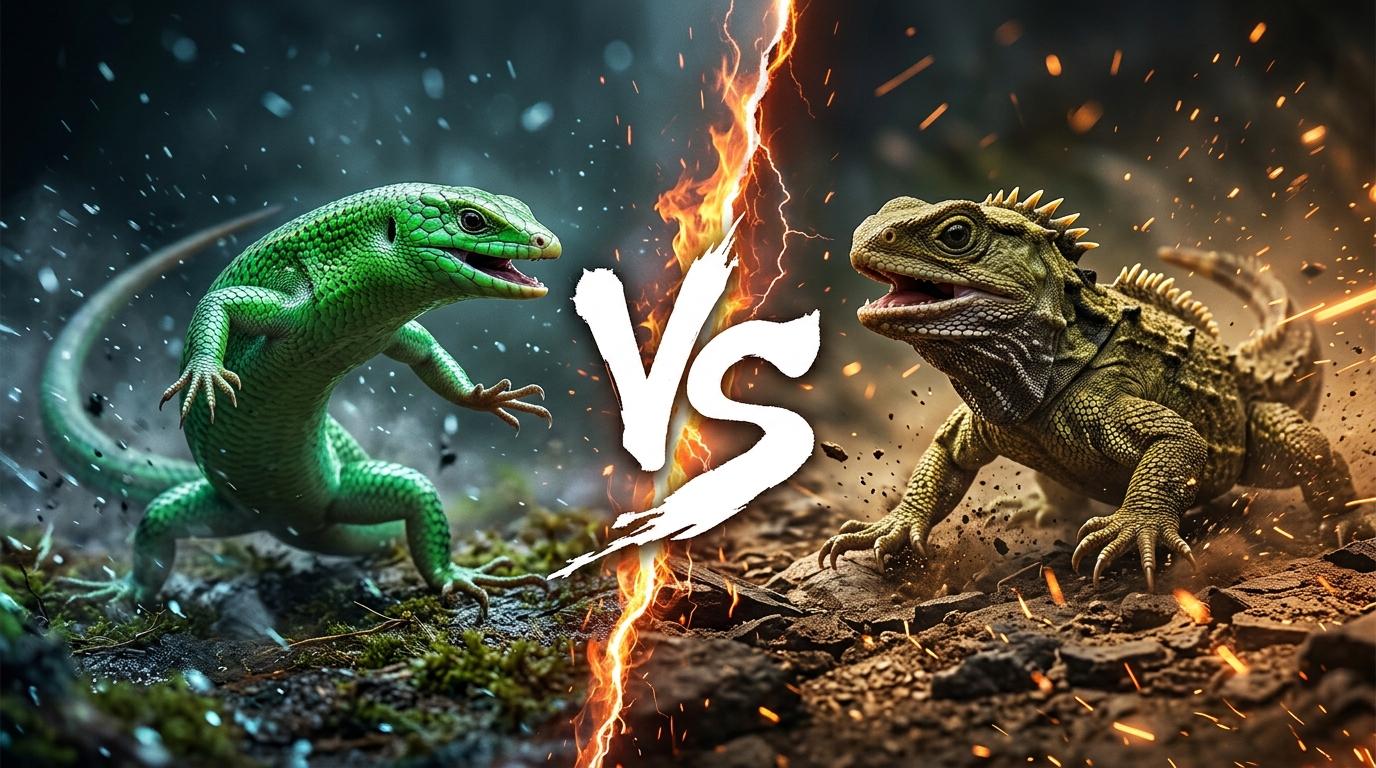
Emerald Tree Skink vs Tuatara: Who Actually Wins?
The tuatara wins clearly. New Zealand's living relic is roughly two to three times longer than the emerald tree skink and many times heavier. Adults reach about 50–80 cm and up to around 1 kg, against a slender skink of roughly 20–25 cm. The tuatara also has a shearing bite built on fused, wedge-like teeth, and it already eats small lizards, seabird chicks, and large invertebrates. A bright green skink sits comfortably inside its prey range. The emerald tree skink's real edge is evasion. It is quicker, highly arboreal, and alert by day, so if it sees the tuatara coming and has a branch to climb, it simply leaves. Once the two are in contact on the ground, though, size, jaw power, and the tuatara's patient sit-and-wait strike decide it fast.
Read comparison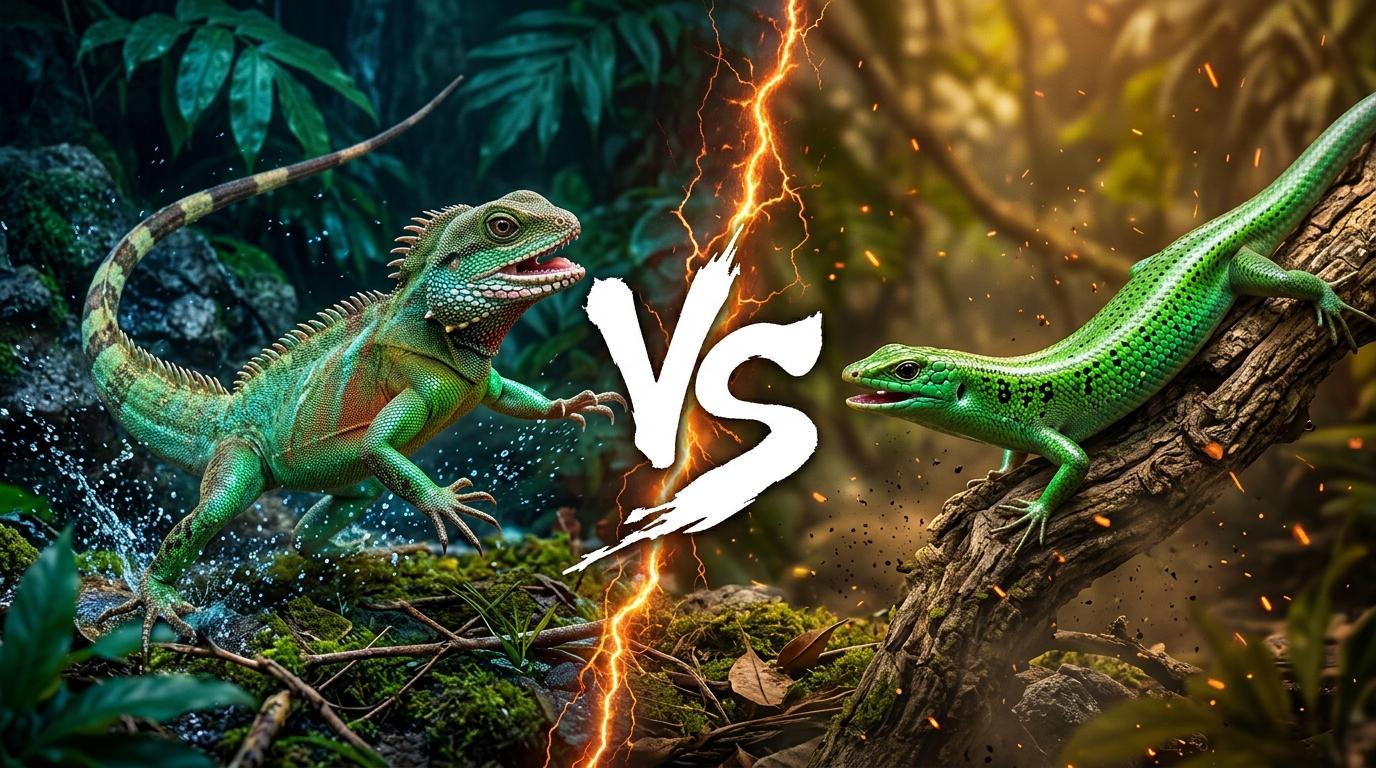
Chinese Water Dragon vs Emerald Tree Skink: Who Actually Wins?
The Chinese water dragon wins, and it isn't close in a straight confrontation. A big male dragon can reach about 90 cm long and outweighs an emerald tree skink many times over. The skink is a slim canopy lizard of roughly 20–25 cm. The dragon has a broad head, strong jaws, sturdy limbs, and a crested, muscular frame built for riverbank scrambles, swimming, and seizing live prey, including small vertebrates. The skink is a sleek, smooth-scaled insect hunter whose real strengths are agility, grip on bark, and getting away fast. Wherever the two meet on the ground, on the riverbank, or over a shared basking spot, the dragon's size and bite decide it. The skink's one dependable result is not losing: in a tangle of thin branches it can climb, dodge, and drop its tail to escape.
Read comparison
Discussion
What do you think?
Share your reasoning with other readers. Be civil and stick to the animals.
Sign in to join the discussion.
Sign inNo comments yet. Start the conversation.