

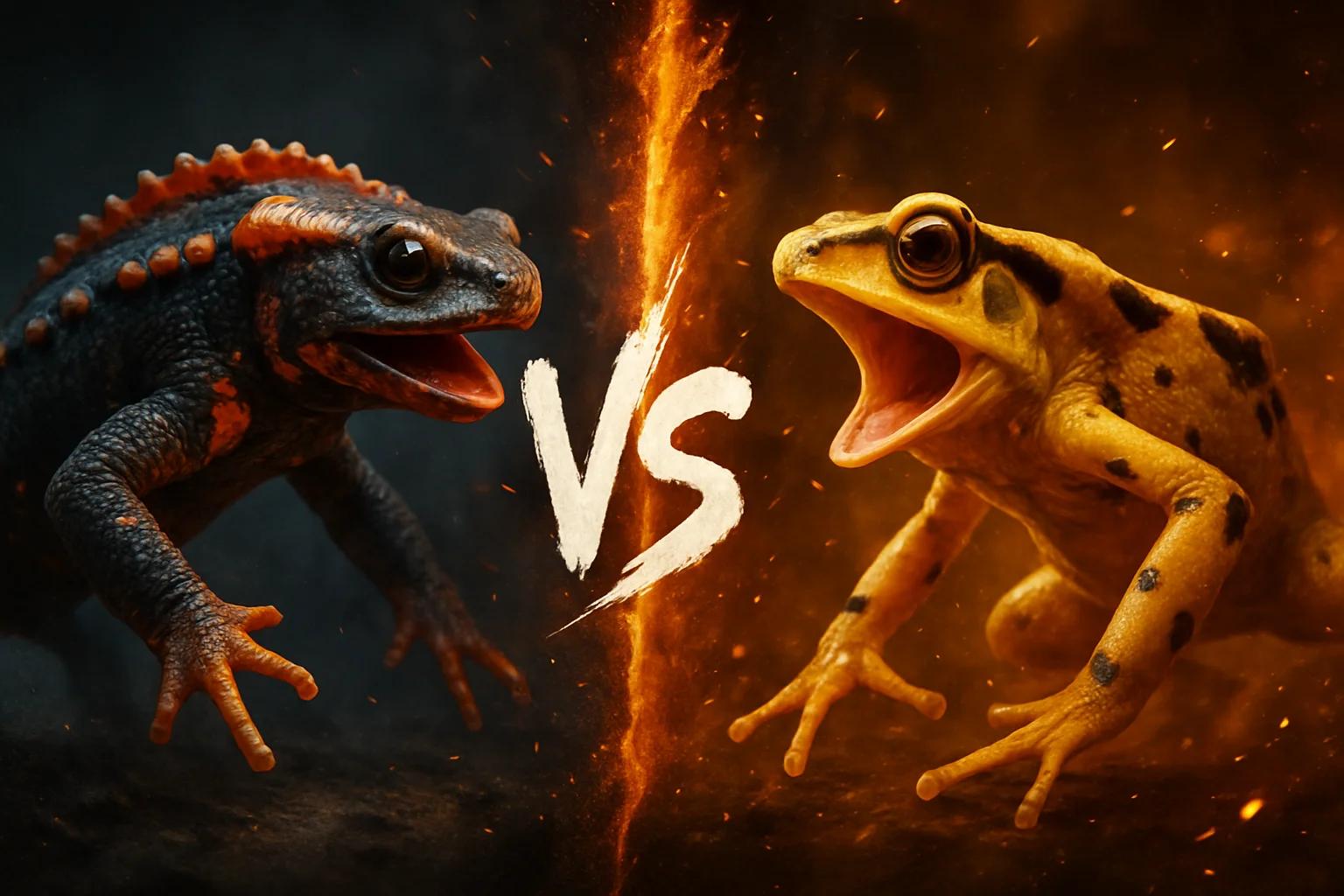
Emperor Newt vs Panamanian Golden Frog: Who Actually Wins?
Emperor newt vs Panamanian golden frog: which toxic amphibian comes out ahead? A biology-first look at size, armor, toxins, and behavior.
Emperor Newt vs Panamanian Golden Frog
Matchup winner
Emperor Newt
Quick verdict
Start with the direct answer, then use the structured comparison below to see what changes the outcome.
The Emperor Newt wins. Neither animal is built to fight, but a clash between them comes down to mass, armor, and staying power, and the newt has all three. At roughly 15–17 cm long with a bony, warty skull ridge and rib tips that can press against poison glands along its flanks, Tylototriton shanjing outweighs a 3.5–6 cm Panamanian golden frog many times over. The golden frog's skin carries zetekitoxin and related compounds, and its bright yellow is an honest warning. But the newt is also chemically defended, its slow, deliberate body tolerates contact well, and a frog that size has no way to physically move it. The likely outcome is not a kill. The frog gives way, and the newt holds the space.
Read the full explanation
Overall winner: Emperor Newt, mainly through a large size and mass advantage.
Both are toxic, so neither is an easy target. The fight is decided by bulk and armor, not by venom.
The golden frog is quicker in short bursts and better at displaying, but it can't push back against a heavier animal.
Realistically, the frog retreats and the newt keeps the ground.
Reader vote
Who do you think wins?
Pick a side — no account needed. Results update live.
No votes yet — be the first to call it.
Editorial note
Why people disagree
People see a frog with a famously potent toxin and assume it beats a newt. Neither animal injects its toxin, though, so in a direct contest it works as a deterrent, not a weapon.
Body mass & presence
At this scale, mass decides who gets moved and who does the moving.
Chemical deterrence
The frog's toxin is world-class, but it works passively, by punishing predators that bite.
Close-range durability
The newt can take contact that would seriously stress a small frog.
Read the full explanation +
The golden frog's wave signaling and alert posture look assertive, but that is a communication system, not a combat system.
The newt's slowness reads as weakness. In practice its armored, glandular build makes it one of the hardest amphibians in its range to deal with.
Comparison FAQ
Short, direct answers to the next questions readers usually ask after the headline verdict.
Would an Emperor Newt beat a Panamanian Golden Frog?+
Yes, in most realistic encounters. The newt's much larger size and armored, glandular body let it hold ground, and the frog would retreat.
Which is stronger, the emperor newt or the golden frog?+
The emperor newt. It is several times heavier and more robust, with bony ridges along its head and back.
Which is more poisonous?+
The Panamanian golden frog's zetekitoxin is exceptionally potent. The newt is also toxic, though, so neither animal can safely be eaten.
Why is the golden frog still dangerous even if it loses?+
Its skin toxins can seriously harm or kill a predator that bites it. Losing a contest over space doesn't make it safe to attack.
Do they meet in the wild?+
No. The emperor newt lives in Yunnan, China, and the golden frog in Panama, so this is a hypothetical matchup.
Head-to-head species stats
These are the same core AnimalDex stat dimensions used on the dedicated animal pages, pulled side by side so the matchup is faster to scan.
Emperor Newt
Tier CPanamanian Golden Frog
Tier ATrait-by-trait comparison
Only the categories that matter to this matchup are included. The goal is not filler stats, but the real design differences that change the result.
Up to ~17 cm, robust
Body mass & presence
Emperor Newt
~3.5–6 cm, slight
Body mass & presence
Emperor Newt
Tetrodotoxin-type gland ridges
Chemical deterrence
Panamanian Golden Frog
Zetekitoxin, extremely potent
Chemical deterrence
Panamanian Golden Frog
Bony skull ridges, warty dorsal glands
Close-range durability
Emperor Newt
Thin, smooth skin
Close-range durability
Emperor Newt
Slow, deliberate walker
Burst mobility
Panamanian Golden Frog
Quick hops on stream rocks
Burst mobility
Panamanian Golden Frog
Orange-on-black aposematism
Warning & signaling
Panamanian Golden Frog
Gold coloration plus hand-waving
Warning & signaling
Panamanian Golden Frog
Stubborn, low-energy holder
Territorial staying power
Emperor Newt
Defends perch, yields to bulk
Territorial staying power
Emperor Newt
How the verdict forms
Verdict timeline
01 · Body mass & presence
Emperor Newt
02 · Chemical deterrence
Panamanian Golden Frog
03 · Close-range durability
Emperor Newt
04 · Burst mobility
Panamanian Golden Frog
05 · Warning & signaling
Panamanian Golden Frog
06 · Territorial staying power
Emperor Newt
Change the conditions
Scenario breakdown
This is where shallow battle content usually fails. Terrain, spacing, timing, and engagement style can change the answer.
Scenario lean
Emperor Newt
Verdict confidence
82%
Newt holds the cover.
In damp leaf litter, the newt's home terrain, its slow walking costs it nothing and its body fills the refuge. The frog's speed has no open path to use, and its visual signals are hidden in the clutter. Physical bulk decides who keeps the hiding spot.
AnimalDex field profiles
Explore these animals
Emperor Newt
Tylototriton shanjing
mountain forest, shaded pond, and clear brook edge
Panamanian Golden Frog
Atelopus zeteki
cloud forest, spray zone, and mountain stream
Systems Intelligence & Hidden Purpose
See the animals behind this comparison as engineered biological systems: what each one is built to do, where it gains leverage, and why the matchup changes by scenario.
Specialized Hardware
bright orange dorsal ridge, rough black skin, and streamside forest life give the Emperor Newt a body plan tuned for its niche.
Systems Script
Emperor Newts operate through mountain forest, shaded pond, and clear brook edge. Their design links movement, feeding, shelter, and timing into one workable survival system.
Strategic Insight
In steep terrain, balance and route control matter more than brute force.
Specialized Hardware
bright yellow body, semaphore foot-waving signals, and fast mountain-stream life give the Panamanian Golden Frog a body plan tuned for its niche.
Systems Script
Panamanian Golden Frogs operate through cloud forest, spray zone, and mountain stream. Their design links movement, feeding, shelter, and timing into one workable survival system.
Strategic Insight
In steep terrain, balance and route control matter more than brute force.
Final take
The Emperor Newt wins because, at amphibian scale, bulk and body armor beat agility once contact actually happens. Both species advertise toxicity, so their chemical defenses largely cancel out, and what remains is the physical matchup.
Read the full explanation
The Panamanian golden frog isn't a pushover. Its toxin is among the most potent in amphibians, and it handles open terrain well. Its strategy is built around avoiding conflict, though, not winning it. Both species are also threatened in the wild: the golden frog is considered possibly extinct in the wild due to chytrid fungus, and the emperor newt is pressured by the pet trade.
Collect both animals in AnimalDex
Track the species behind this matchup, compare their real traits, and build the rivalry into your AnimalDex collection.
Related comparisons
Continue with nearby matchups to compare more real-world animal traits without dropping into junky who-wins filler.
Alpine Salamander vs Panamanian Golden Frog: Who Actually Wins?
The Alpine Salamander wins this one, though not by a knockout. Both animals are small, slow, toxic amphibians built to discourage attackers rather than defeat them, so the real question is which defensive system holds up better at close range. The salamander's advantages decide it. It is roughly two to three times the frog's body length and several times its mass. It has a long, low, tough-skinned frame. Its parotoid glands are loaded with samandarine-type alkaloids that act as a dense chemical wall. The Panamanian Golden Frog carries zetekitoxin, one of the most potent amphibian toxins known, and advertises it with blazing yellow warning colors. But its toxin is purely a deterrent. It cannot push, pin, or outlast a heavier opponent. In a cool, damp encounter where neither side runs, the salamander's mass, grip and staying power tip the outcome. The frog remains far more dangerous to anything that bites it.
Read comparison
Discussion
What do you think?
Share your reasoning with other readers. Be civil and stick to the animals.
Sign in to join the discussion.
Sign inNo comments yet. Start the conversation.