

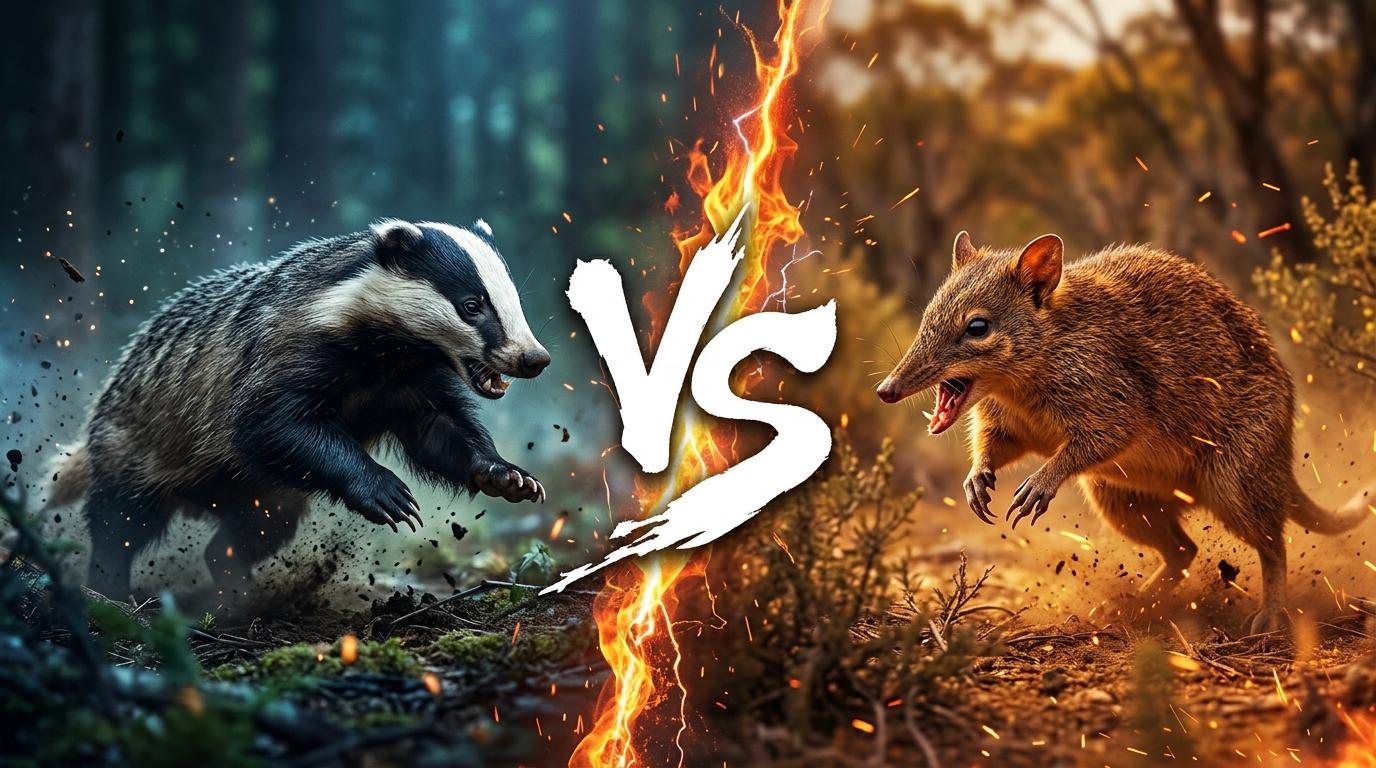
European Badger vs Quenda: Who Actually Wins?
European badger vs quenda: a biology-first look at size, digging power, bite force and escape skill, and why the badger wins almost every realistic matchup.
European Badger vs Quenda
Matchup winner
European Badger
Quick verdict
Start with the direct answer, then use the structured comparison below to see what changes the outcome.
The European badger wins, and it isn't close. An adult Meles meles typically weighs 8–14 kg, roughly six to ten times the mass of a quenda (about 0.5–2 kg). The badger also brings a heavy, low-slung frame, thick loose skin, powerful forelimbs built for excavating sett tunnels, and a strong bite anchored by a sagittal crest. The quenda, Western Australia's southern brown bandicoot, is a fast, nervous ground forager whose real defense is speed through dense understory and a quick sprint to cover, not combat. If the two ever met, the quenda's best outcome would be escaping, not winning.
Read the full explanation
European badger wins: far heavier, stronger bite, armored-feeling hide.
Quenda is built to forage and flee, not to fight a mustelid.
In thick scrub the quenda can escape, but escape is not victory.
Size gap: roughly 6–10x in the badger's favor.
Reader vote
Who do you think wins?
Pick a side — no account needed. Results update live.
No votes yet — be the first to call it.
Editorial note
Why people disagree
Both animals are 'diggers,' so people assume they're comparable. Badger digging is powerlifting. Quenda digging is quick snout-and-claw probing.
Raw mass
Mass decides small-mammal contests. The badger can pin, crush and outlast an animal a fraction of its size.
Bite and jaw control
The badger's jaw is built to grip hard. The quenda's is built for grubs and fungi.
Close-range durability
Loose, thick skin lets a badger twist inside a grip and shrug off bites.
Read the full explanation +
The quenda's sprint speed and erratic dodging make it look slippery, and some readers mistake avoiding a fight for winning one.
Badgers are often pictured as gentle woodland animals, which hides how tough a cornered mustelid really is.
Comparison FAQ
Short, direct answers to the next questions readers usually ask after the headline verdict.
Would a European badger beat a quenda in a fight?+
Yes. The badger is many times heavier, has a far stronger bite and tougher skin, and would win nearly any direct confrontation.
Which animal is stronger?+
The European badger. Its forelimbs move large volumes of soil, and its body mass dwarfs the quenda's.
Is the quenda dangerous at all?+
In its own way. It can scratch with sharp foraging claws, and its speed and dodging in dense cover make it very hard to catch. Its danger is in escaping, not attacking.
Do badgers and quendas ever meet in the wild?+
No. Badgers live across Europe and quendas are native to southwestern Australia. This is a hypothetical comparison.
Could a quenda outrun a badger?+
Over short bursts through scrub, very likely. Escape is the quenda's best and only real strategy.
Head-to-head species stats
These are the same core AnimalDex stat dimensions used on the dedicated animal pages, pulled side by side so the matchup is faster to scan.
European Badger
Tier CQuenda
Tier CTrait-by-trait comparison
Only the categories that matter to this matchup are included. The goal is not filler stats, but the real design differences that change the result.
8–14 kg, dense and stocky
Raw mass
European Badger
~0.5–2 kg, light and compact
Raw mass
European Badger
Strong crushing bite, locking jaw articulation
Bite and jaw control
European Badger
Small insectivore-style jaws
Bite and jaw control
European Badger
Thick loose skin, heavy fur, tough neck
Close-range durability
European Badger
Thin-skinned, delicate frame
Close-range durability
European Badger
Steady trot, short bursts
Escape agility
Quenda
Quick zigzag sprints into dense cover
Escape agility
Quenda
Industrial forelimbs, multi-generation setts
Excavation force
European Badger
Shallow conical foraging pits
Excavation force
European Badger
Stubborn, escalates when cornered
Defensive temperament
European Badger
Flight-first, avoids confrontation
Defensive temperament
European Badger
How the verdict forms
Verdict timeline
01 · Raw mass
European Badger
02 · Bite and jaw control
European Badger
03 · Close-range durability
European Badger
04 · Escape agility
Quenda
05 · Excavation force
European Badger
06 · Defensive temperament
European Badger
Change the conditions
Scenario breakdown
This is where shallow battle content usually fails. Terrain, spacing, timing, and engagement style can change the answer.
Scenario lean
Quenda
Verdict confidence
82%
The quenda escapes.
Thick heath and understory are the quenda's home terrain. It can slip through gaps and vanish while the heavier badger pushes through vegetation. No fight happens, and the quenda survives. That makes this a tactical win for the smaller animal, not a combat win.
AnimalDex field profiles
Explore these animals
European Badger
Meles meles
woodland, pasture edge, hedgerow country, and scrub
Quenda
Isoodon fusciventer
coastal scrub, woodland, and wet shrubland
Systems Intelligence & Hidden Purpose
See the animals behind this comparison as engineered biological systems: what each one is built to do, where it gains leverage, and why the matchup changes by scenario.
Specialized Hardware
powerful digging limbs, black-and-white face mask, and large burrow networks give the European Badger a body plan tuned for its niche.
Systems Script
European Badgers operate through woodland, pasture edge, hedgerow country, and scrub Their design links movement, shelter, feeding, and survival into one workable system.
Strategic Insight
Long-term shelter changes how confidently a system can use the surface.
Specialized Hardware
short rounded ears, powerful digging foreclaws, and leaf-litter rooting behavior give the Quenda a body plan tuned for its niche.
Systems Script
Quendas operate through coastal scrub, woodland, and wet shrubland. Their design links movement, feeding, shelter, and timing into one workable survival system.
Strategic Insight
Dense environments reward precision, patience, and the ability to read layered cover.
Final take
The European badger is the clear winner. This is a matchup between a compact mustelid built like a digging tank and a small marsupial forager built to run. In any scenario where contact actually happens, size, bite and toughness all point to the badger.
Read the full explanation
The quenda's success story is evasion. Its survival in Australian heathland comes from vigilance, speed and cover, and that strategy is exactly right for an animal its size. These two species never meet in the wild, but the biology makes the verdict clear: badger by a wide margin.
Collect both animals in AnimalDex
Track the species behind this matchup, compare their real traits, and build the rivalry into your AnimalDex collection.
Related comparisons
Continue with nearby matchups to compare more real-world animal traits without dropping into junky who-wins filler.
Eastern Bettong vs Quenda: Who Actually Wins?
The Eastern Bettong wins a narrow decision. This Tasmanian rat-kangaroo usually weighs about 1.2–2.25 kg. Most Quenda sit around 0.5–1.5 kg, and only big males approach 2 kg. That weight edge sits on spring-loaded kangaroo-style hind legs, which give the bettong explosive bounding speed, kicking thrust and the ability to break contact at will. The Quenda is no pushover. It is a stocky, short-tempered bandicoot with strong digging claws, a quick snapping bite, and males that fight readily over space. In a tight scrap it can land the sharper hits. But real encounters between small marsupials are shoving, kicking and chasing contests, not fights to the death. Mass, leg drive and control over distance decide who holds the ground, and those factors favor the bettong more often than not.
Read comparison
Discussion
What do you think?
Share your reasoning with other readers. Be civil and stick to the animals.
Sign in to join the discussion.
Sign inNo comments yet. Start the conversation.