

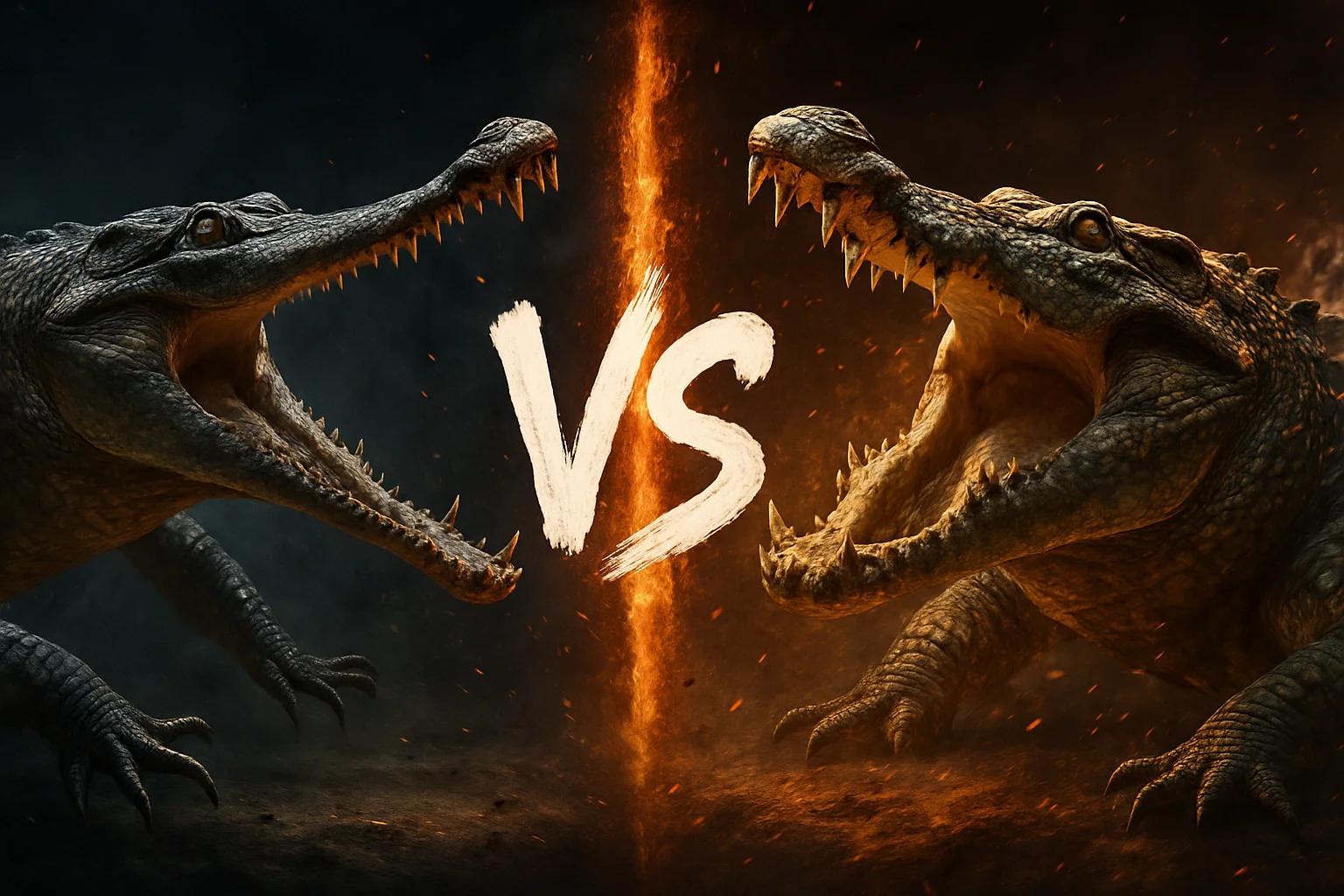
False Gharial vs Siamese Crocodile: Who Actually Wins?
False gharial vs Siamese crocodile: who would win? We compare size, bite mechanics, skull build, and habitat to give a clear, biology-based verdict.
False Gharial vs Siamese Crocodile
Matchup winner
False Gharial
Quick verdict
Start with the direct answer, then use the structured comparison below to see what changes the outcome.
The false gharial wins more often than not. A big male false gharial commonly reaches about 4 to 5 meters, and much of that length is a heavy, muscular body and tail rather than just snout. Most adult Siamese crocodiles run about 2.5 to 3.5 meters and carry less total mass. In deep, slow, tannin-dark water, where the false gharial lives, that extra length gives it real advantages. It has more reach, more momentum in a lunge, and more weight to drive an opponent under. The Siamese crocodile is not a pushover. Its broad, reinforced skull is better built for twisting, crushing, and close-quarters wrestling, and a smaller or mid-sized false gharial could lose to a determined adult. But between typical large adults, size and aquatic leverage give the false gharial the edge.
Read the full explanation
Overall winner: False Gharial, mainly through larger size, longer reach, and comfort in deep water.
The Siamese crocodile has the sturdier skull and is the more versatile close-range wrestler.
In shallow water, on mud, or against a smaller false gharial, the Siamese crocodile can win.
This is a moderate-confidence call, not a mismatch.
Reader vote
Who do you think wins?
Pick a side — no account needed. Results update live.
No votes yet — be the first to call it.
Editorial note
Why people disagree
Slender snout looks fragile: many readers assume the false gharial is a fish specialist like the true gharial. Its snout is actually sturdier, and it is known to take mammals.
Body mass and length
In crocodilian disputes, the larger animal usually controls the grapple and the roll.
Skull robustness
A broad skull resists twisting forces better and applies crushing bites to limbs and the head.
Reach and strike range
Reach lets the false gharial land the first bite before the Siamese crocodile closes the gap.
Read the full explanation +
Bite force reputation: broad-snouted Crocodylus species have a reputation for raw crushing power, so people underrate how much body size decides crocodilian contests.
Habitat bias: the Siamese crocodile is the more adaptable generalist, so people picture the fight on its terms rather than in deep peat-swamp rivers.
Comparison FAQ
Short, direct answers to the next questions readers usually ask after the headline verdict.
Would a false gharial beat a Siamese crocodile?+
Usually, yes. A large adult false gharial's size and reach give it the edge, especially in deep water. The Siamese crocodile can win in shallow, close-range fights or against a smaller false gharial.
Which is stronger, the false gharial or the Siamese crocodile?+
The false gharial is larger and heavier overall. The Siamese crocodile's broad skull is better built for crushing and twisting, so it has a stronger bite for its size.
Why does the Siamese crocodile stay dangerous even as the loser?+
Its reinforced broad skull, compact armored body, and crushing bite make it very effective in a clinch. One good hold on the false gharial's snout or limb could turn the fight.
Is the false gharial just a fish eater?+
No. It eats a lot of fish but also takes mammals, birds, and reptiles, and its snout is sturdier than the true gharial's.
Do false gharials and Siamese crocodiles meet in the wild?+
Rarely. Their ranges overlap in only limited parts of Southeast Asia, and both are threatened. Habitat loss affects them far more than any rivalry does.
Head-to-head species stats
These are the same core AnimalDex stat dimensions used on the dedicated animal pages, pulled side by side so the matchup is faster to scan.
False Gharial
Tier ASiamese Crocodile
Tier ATrait-by-trait comparison
Only the categories that matter to this matchup are included. The goal is not filler stats, but the real design differences that change the result.
Large males ~4–5 m, heavy-bodied
Body mass and length
False Gharial
Typically ~2.5–3.5 m, compact
Body mass and length
False Gharial
Long, narrow but reinforced snout
Skull robustness
Siamese Crocodile
Broad, deep, crush-ready skull
Skull robustness
Siamese Crocodile
Long jaws snap from distance
Reach and strike range
False Gharial
Shorter, more committed bites
Reach and strike range
False Gharial
Specialist of deep, slow black-water rivers
Deep-water leverage
False Gharial
Prefers shallower marshes and oxbows
Deep-water leverage
False Gharial
Long snout is a target in a clinch
Close-range durability
Siamese Crocodile
Compact, armored, hard to pry apart
Close-range durability
Siamese Crocodile
Habitat-restricted swamp specialist
Ecological flexibility
Siamese Crocodile
Generalist across varied freshwater habitats
Ecological flexibility
Siamese Crocodile
How the verdict forms
Verdict timeline
01 · Body mass and length
False Gharial
02 · Skull robustness
Siamese Crocodile
03 · Reach and strike range
False Gharial
04 · Deep-water leverage
False Gharial
05 · Close-range durability
Siamese Crocodile
06 · Ecological flexibility
Siamese Crocodile
Change the conditions
Scenario breakdown
This is where shallow battle content usually fails. Terrain, spacing, timing, and engagement style can change the answer.
Scenario lean
False Gharial
Verdict confidence
82%
False gharial in its element.
In deep, dark water the false gharial's length and mass work together. It can lunge from range, seize, and use its body weight to force the smaller crocodile down. The Siamese crocodile loses the footing it needs for its preferred close wrestle.
AnimalDex field profiles
Explore these animals
False Gharial
Tomistoma schlegelii
swamp forest, peatland river, and flooded lowland wetland
Siamese Crocodile
Crocodylus siamensis
river, marsh, and forest swamp
Systems Intelligence & Hidden Purpose
See the animals behind this comparison as engineered biological systems: what each one is built to do, where it gains leverage, and why the matchup changes by scenario.
Specialized Hardware
long narrow fish-catching snout, river-specialist crocodilian body, and quiet blackwater ambush give the False Gharial a body plan tuned for its niche.
Systems Script
False Gharials operate through swamp forest, peatland river, and flooded lowland wetland. Their design links movement, feeding, shelter, and timing into one workable survival system.
Strategic Insight
Dense environments reward precision, patience, and the ability to read layered cover.
Specialized Hardware
narrow armored snout, olive ridged body, and freshwater ambush stillness give the Siamese Crocodile a body plan tuned for its niche.
Systems Script
Siamese Crocodiles operate through river, marsh, and forest swamp. Their design links movement, feeding, shelter, and timing into one workable survival system.
Strategic Insight
Dense environments reward precision, patience, and the ability to read layered cover.
Final take
The false gharial is the better pick for an overall winner. It is not stronger point for point; it is bigger, and crocodilian conflict rewards mass, reach, and control of deep water. A large male can be roughly a meter or more longer than a typical adult Siamese crocodile.
Read the full explanation
The Siamese crocodile remains a serious opponent. Its broad skull and compact build make it the better close-range wrestler, and in shallow water or at equal size it can win. In nature, both species are heavily threatened, their ranges overlap only in limited areas, and a real fight would more likely end in a display than a death roll.
Collect both animals in AnimalDex
Track the species behind this matchup, compare their real traits, and build the rivalry into your AnimalDex collection.
Related comparisons
Continue with nearby matchups to compare more real-world animal traits without dropping into junky who-wins filler.

Reticulated Python vs Siamese Crocodile: Who Actually Wins?
The Siamese crocodile wins most realistic encounters against the reticulated python. The python is longer, and a big one can be as heavy or heavier, with one of the most efficient constriction systems on Earth. But constriction works by preventing breathing and blood flow, and it needs time and a secure coil. The crocodile is built to defeat exactly that. Its armored, bone-studded back and thick neck resist coils, and its bite force, among the strongest of any living animal group, can do serious damage to a snake's body within seconds. Crocodiles can also slow their heart rate and hold their breath for long periods, which buys time inside a coil. The rotational 'death roll' can tear free from or injure a wrapped attacker. A huge python that ambushes a small or juvenile Siamese crocodile on land can win. Give a healthy adult crocodile water, or simply a frontal start, and its jaws decide the fight long before suffocation can.
Read comparison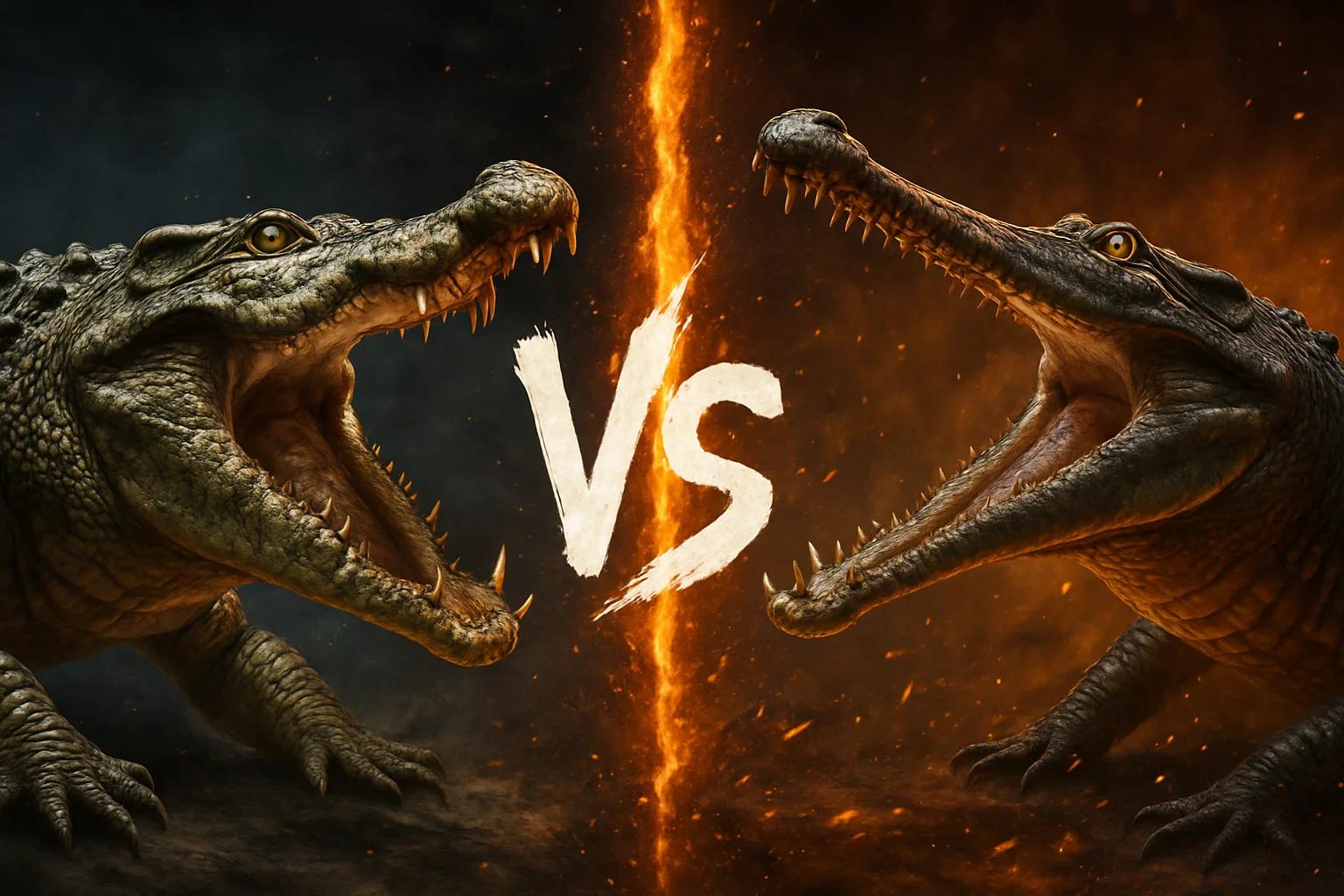
Cuban Crocodile vs False Gharial: Who Actually Wins?
The false gharial wins overall. This is a matchup between a compact, famously aggressive brawler and a much larger, long-bodied water specialist. The Cuban crocodile has the sturdier skull, a broad heavy snout built for crushing, and unusual agility on land, so it would be favored on dry ground. But crocodilian contests are decided mostly by mass, reach and how well each animal handles water. Adult male false gharials commonly reach 4–5 m and can roughly double the weight of a large Cuban crocodile, which typically tops out around 3–3.5 m. In deep, slow water, where both animals naturally fight, that extra length and weight lets the false gharial pin, roll and outlast a smaller opponent. The Cuban crocodile's attitude is real, but it is spending energy against a body that simply has more of everything.
Read comparison
Discussion
What do you think?
Share your reasoning with other readers. Be civil and stick to the animals.
Sign in to join the discussion.
Sign inNo comments yet. Start the conversation.