


Firefly vs Jumping Spider: Who Actually Wins?
Firefly vs jumping spider: a sharp-eyed, high-IQ hunter faces a glowing beetle full of defensive toxins. See who wins, why chemistry beats agility, and how each scenario plays out.
Firefly vs Jumping Spider
Matchup winner
Firefly
Quick verdict
Start with the direct answer, then use the structured comparison below to see what changes the outcome.
The firefly wins this matchup, but not by fighting. The tan jumping spider (Platycryptus undatus) has every hunting advantage: excellent eyesight, a precise pounce, venom, and problem-solving that is remarkable for an animal its size. Many fireflies, however, carry lucibufagins, bitter defensive steroids. When grabbed, they can also reflex-bleed foul-tasting hemolymph. In feeding studies, jumping spiders such as Phidippus often bite fireflies and then reject them, and some learn to avoid them altogether. Here, 'winning' means the firefly survives the encounter and the spider gives up the meal. Most realistic encounters end that way: the spider's intelligence works against it, because a smart predator learns quickly that this glowing beetle isn't worth eating.
Read the full explanation
Firefly wins overall by surviving through chemical defense, not by overpowering the spider.
Jumping spider wins on speed, vision, ambush skill, and raw predatory ability.
Many fireflies contain lucibufagins, bitter toxins that make predators drop them and avoid them later.
A firefly that is a toxin-poor species, or that gets bitten fatally before the taste registers, can still lose.
Reader vote
Who do you think wins?
Pick a side — no account needed. Results update live.
No votes yet — be the first to call it.
Editorial note
Why people disagree
Some readers define winning as killing the opponent. In that frame, the spider looks dominant because the firefly has no way to hurt it.
Explosive power
The spider controls when and how contact happens.
Ambush control
The spider will almost always make first contact.
Chemical deterrence
This is the decisive trait. A bitter bite ends the hunt before the venom finishes the job.
Read the full explanation +
Firefly chemistry varies. Some species are well defended, while others, like certain Photuris females, get their toxins by eating other fireflies, so results depend on which species shows up.
Jumping spiders are famously clever. People assume intelligence guarantees a meal, but here intelligence often means learning to avoid the prey.
Comparison FAQ
Short, direct answers to the next questions readers usually ask after the headline verdict.
Would a firefly beat a jumping spider?+
Usually yes, in the sense that it survives. Its defensive toxins make the spider drop it. It does not kill the spider.
Which is stronger, a firefly or a jumping spider?+
Physically, the jumping spider is stronger. It is faster, better armed, and much better at hunting.
Do jumping spiders eat fireflies?+
They sometimes attack them, but feeding studies show many reject defended fireflies and learn to avoid them.
Why is the jumping spider still dangerous to fireflies?+
A quick, well-placed venomous bite can kill a firefly before the spider reacts to the taste, especially if the firefly belongs to a lightly defended species.
Head-to-head species stats
These are the same core AnimalDex stat dimensions used on the dedicated animal pages, pulled side by side so the matchup is faster to scan.
Firefly
Tier DJumping Spider
Tier DTrait-by-trait comparison
Only the categories that matter to this matchup are included. The goal is not filler stats, but the real design differences that change the result.
Clumsy takeoff, slow flight
Explosive power
Jumping Spider
Hydraulic leap many body lengths
Explosive power
Jumping Spider
Visible glow advertises location
Ambush control
Jumping Spider
Stalks with high-acuity front eyes
Ambush control
Jumping Spider
Lucibufagins plus reflex bleeding
Chemical deterrence
Firefly
Venom effective on small insects
Chemical deterrence
Firefly
Hardened elytra over a soft body
Close-range durability
Firefly
Agile but fragile
Close-range durability
Firefly
Signal-based, hardwired behavior
Tactical intelligence
Jumping Spider
Plans detours, learns prey types
Tactical intelligence
Jumping Spider
Bioluminescence doubles as a warning
Warning signal
Firefly
Cryptic bark-colored camouflage
Warning signal
Firefly
How the verdict forms
Verdict timeline
01 · Explosive power
Jumping Spider
02 · Ambush control
Jumping Spider
03 · Chemical deterrence
Firefly
04 · Close-range durability
Firefly
05 · Tactical intelligence
Jumping Spider
06 · Warning signal
Firefly
Change the conditions
Scenario breakdown
This is where shallow battle content usually fails. Terrain, spacing, timing, and engagement style can change the answer.
Scenario lean
Jumping Spider
Verdict confidence
82%
The spider gets the strike and may win against a weakly defended firefly.
On a tree trunk, the spider's camouflage and stalking skill are at their best, so it lands a clean bite. If the firefly is a weakly defended species, the venom can work before the taste puts the spider off. This is the spider's best scenario.
AnimalDex field profiles
Explore these animals
Firefly
Lampyridae
Moist grassland, woodland edges, wetlands, gardens, and stream corridors with low nighttime disturbance.
Jumping Spider
Salticidae
Walls, bark, shrubs, leaf litter, grass stems, and sunny edges with abundant small insects.
Systems Intelligence & Hidden Purpose
See the animals behind this comparison as engineered biological systems: what each one is built to do, where it gains leverage, and why the matchup changes by scenario.
Specialized Hardware
Luciferin-based light production, species-specific flash timing, and low-light visual sensitivity make fireflies highly efficient communication hardware for dark environments.
Systems Script
Fireflies turn mating, territory, and species recognition into precise light code. They show that even small organisms can coordinate behavior cleanly when signals are cheap, legible, and well-timed.
Strategic Insight
A strong signal is not necessarily a loud one. The best signals are energy-efficient, hard to confuse, and tuned to the right audience.
Specialized Hardware
Large forward-facing eyes, sharp depth judgment, and hydraulically powered jumps make jumping spiders unusually accurate visual hunters without the need for capture webs.
Systems Script
Jumping spiders regulate insect traffic at a tiny scale across leaves, bark, walls, and understory surfaces. They show how precision predation can emerge from compact hardware and strong sensory computation.
Strategic Insight
Accuracy compounds. At small scales, the cleanest win usually comes from better targeting, not more force.
Final take
The jumping spider is the better hunter by almost every measure. It has sharper eyes, a faster strike, and more behavioral flexibility. The firefly, though, does not need to win a fight. It needs to taste bad, and that defense usually works.
Read the full explanation
The overall verdict goes to the firefly: it survives the encounter and keeps surviving. The spider stays dangerous to toxin-poor or unlucky fireflies, but in the typical matchup the beetle's chemistry beats the spider's skill.
Collect both animals in AnimalDex
Track the species behind this matchup, compare their real traits, and build the rivalry into your AnimalDex collection.
Related comparisons
Continue with nearby matchups to compare more real-world animal traits without dropping into junky who-wins filler.
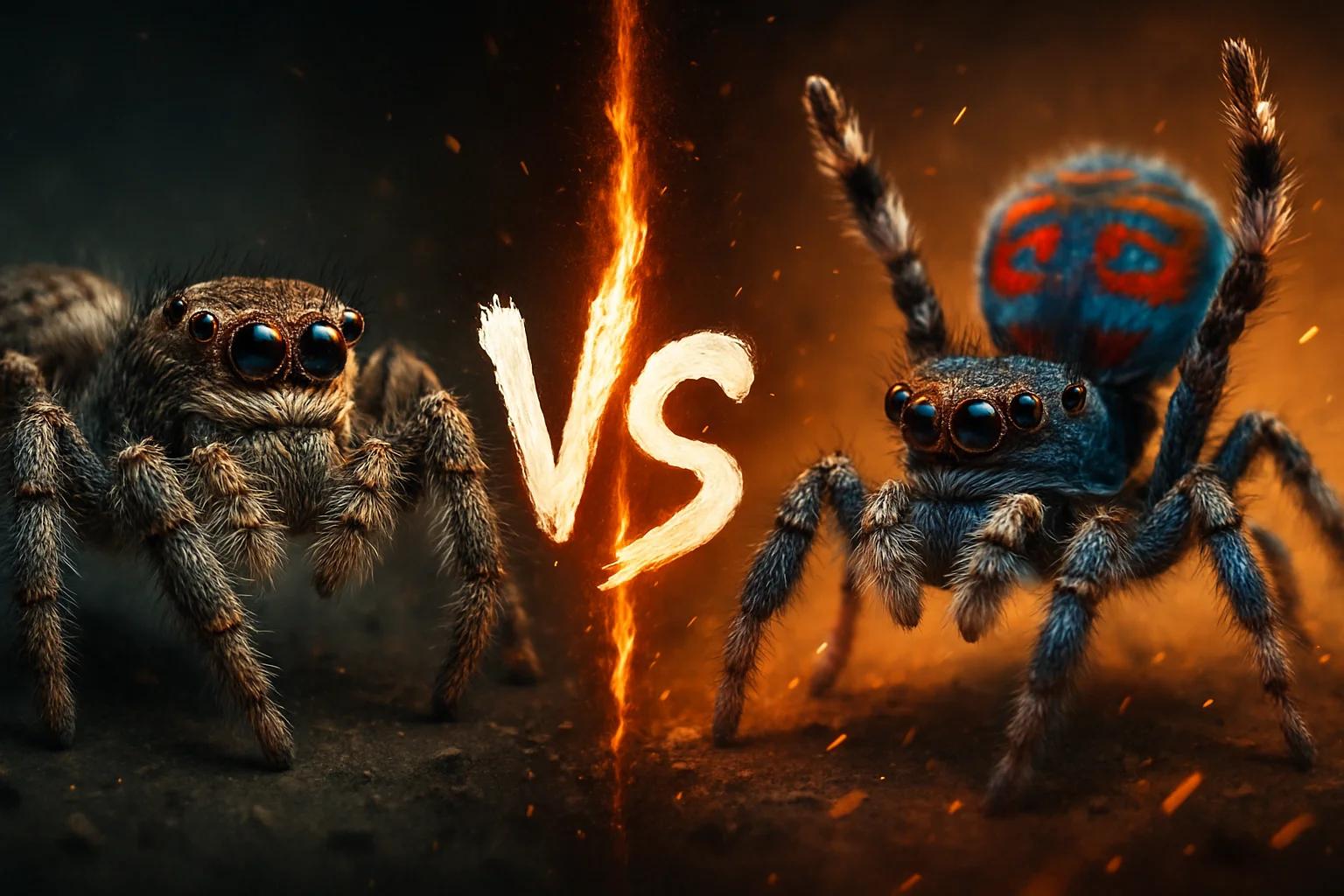
Jumping Spider vs Peacock Spider: Who Actually Wins?
The tan jumping spider (Platycryptus undatus) wins clearly. Both are salticids: daylight hunters with superb forward-facing eyes, silk safety lines and a pounce instead of a web. The gap is size. An adult tan jumper runs roughly 8–13 mm, while a peacock spider is about 4–5 mm. That gives Platycryptus several times the body mass, longer reach, stronger chelicerae and a bigger venom load. Peacock spiders are not wired for this kind of contest either. Their most striking hardware, the male's iridescent fan and his leg-waving dance, evolved to win over females, not to win fights. Small salticids also sit squarely inside the prey range of larger jumping spiders, and salticids readily eat other spiders. In most realistic encounters, the tan jumper treats the peacock spider as a meal.
Read comparison
Discussion
What do you think?
Share your reasoning with other readers. Be civil and stick to the animals.
Sign in to join the discussion.
Sign inNo comments yet. Start the conversation.