

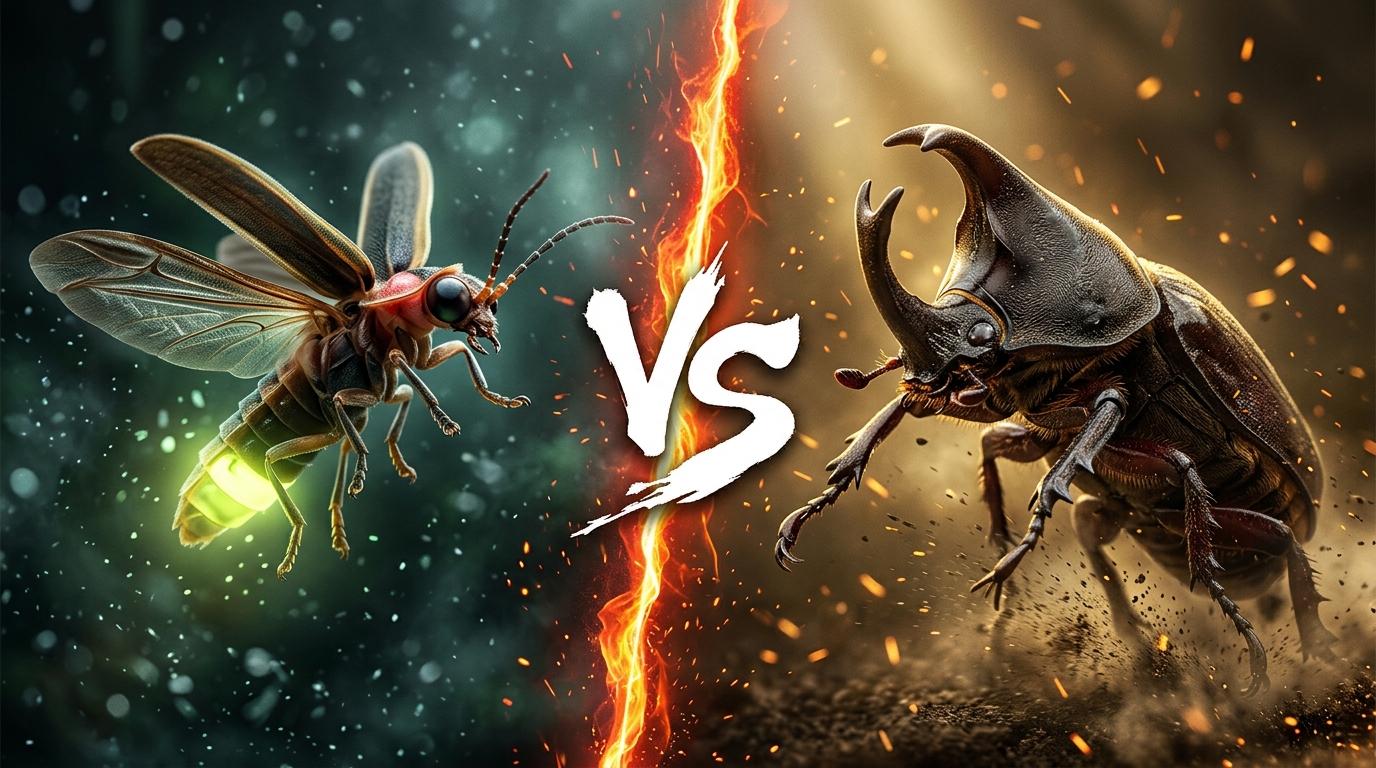
Firefly vs Rhinoceros Beetle: Who Actually Wins?
Firefly vs rhinoceros beetle: a biology-first look at size, armor, chemical defense and horn power to settle who wins this backyard beetle showdown.
Firefly vs Rhinoceros Beetle
Matchup winner
Rhinoceros Beetle
Quick verdict
Start with the direct answer, then use the structured comparison below to see what changes the outcome.
The rhinoceros beetle wins clearly. Both are beetles, but they sit at opposite ends of the order. A firefly is a soft-bodied, lightweight signaler that weighs a fraction of a gram. Its leathery wing covers are built for courtship flights, not combat. A rhinoceros beetle is a heavily armored scarab with thick, rigid elytra and a horn system evolved specifically for prying, lifting and flipping rivals. It also outweighs a firefly many times over. The firefly's real weapon is chemical. Many species carry bitter lucibufagins that make predators drop them. But a rhinoceros beetle is a plant-sap and fruit feeder, not a predator, so that toxic defense barely matters in a physical shove contest. In any forced confrontation over a branch, a sap flow or a piece of rotting fruit, the rhinoceros beetle simply levers the firefly off and keeps the spot.
Read the full explanation
Winner: the rhinoceros beetle, by a wide margin in mass, armor and leverage.
The firefly's armor is soft and flexible. The rhinoceros beetle's is rigid and built for horn combat.
Firefly toxins deter predators, but a fruit-feeding rhino beetle isn't trying to eat it.
The firefly's best move is to fly away, and it often can.
Reader vote
Who do you think wins?
Pick a side — no account needed. Results update live.
No votes yet — be the first to call it.
Editorial note
Why people disagree
Fireflies' chemical defenses are real. Some readers assume 'toxic' means 'dangerous in a fight', but toxins only work on animals that bite or eat.
Explosive power
Rhino beetle contests are decided by prying an opponent off a surface, and the firefly has no counterforce.
Close-range durability
The firefly's body is built for weight savings and signaling, so it can't absorb a horn strike.
Chemical deterrence
This is the firefly's one true edge, but it works on predators, not on a plant-eating rival.
Read the full explanation +
Rhinoceros beetles are famous as some of the strongest insects relative to their size. Those strength claims are usually exaggerated, but the real gap is still huge against a firefly.
Neither insect is aggressive toward other species. A 'fight' really means competition for space, so the outcome is about shoving power rather than kills.
Comparison FAQ
Short, direct answers to the next questions readers usually ask after the headline verdict.
Would a firefly beat a rhinoceros beetle?+
No. The rhinoceros beetle is much heavier, heavily armored and equipped with a horn designed for flipping rivals. The firefly has no way to push it off a spot.
Which is stronger, a firefly or a rhinoceros beetle?+
The rhinoceros beetle by far. It is famous for lifting heavy loads relative to its body weight. Fireflies are built for light flight, not force.
Can a rhinoceros beetle kill a firefly?+
It isn't a predator and wouldn't hunt one. In a contest it would simply shove or flip the firefly away.
Why is a firefly still dangerous?+
Many fireflies carry bitter defensive steroids called lucibufagins. These can sicken or deter predators like birds, lizards and even pet lizards that eat them.
Are fireflies and rhinoceros beetles related?+
Yes. Both are beetles (order Coleoptera), but they belong to very different families with opposite survival strategies.
Head-to-head species stats
These are the same core AnimalDex stat dimensions used on the dedicated animal pages, pulled side by side so the matchup is faster to scan.
Firefly
Tier DRhinoceros Beetle
Tier DTrait-by-trait comparison
Only the categories that matter to this matchup are included. The goal is not filler stats, but the real design differences that change the result.
Light flight burst, no pushing force
Explosive power
Rhinoceros Beetle
Horn lever with huge relative lifting strength
Explosive power
Rhinoceros Beetle
Soft, leathery elytra
Close-range durability
Rhinoceros Beetle
Thick, rigid scarab armor
Close-range durability
Rhinoceros Beetle
Bitter lucibufagins and reflex bleeding in many species
Chemical deterrence
Firefly
Minimal chemical defense
Chemical deterrence
Firefly
Tiny and featherweight
Mass and grip
Rhinoceros Beetle
Many times heavier, with clawed tarsi
Mass and grip
Rhinoceros Beetle
Agile, frequent flier
Disengage ability
Firefly
Clumsy, slow takeoff
Disengage ability
Firefly
How the verdict forms
Verdict timeline
01 · Explosive power
Rhinoceros Beetle
02 · Close-range durability
Rhinoceros Beetle
03 · Chemical deterrence
Firefly
04 · Mass and grip
Rhinoceros Beetle
05 · Disengage ability
Firefly
Change the conditions
Scenario breakdown
This is where shallow battle content usually fails. Terrain, spacing, timing, and engagement style can change the answer.
Scenario lean
Rhinoceros Beetle
Verdict confidence
82%
Rhino beetle pries the firefly off.
In tight cover, the firefly can't use flight to reposition. The rhino beetle's horn-under-and-lift technique is evolved for branch contests. It easily dislodges a lightweight, soft-bodied insect.
AnimalDex field profiles
Explore these animals
Firefly
Lampyridae
Moist grassland, woodland edges, wetlands, gardens, and stream corridors with low nighttime disturbance.
Rhinoceros Beetle
Dynastinae
Forest, plantation edge, gardens, and areas with decaying wood or composting plant material.
Systems Intelligence & Hidden Purpose
See the animals behind this comparison as engineered biological systems: what each one is built to do, where it gains leverage, and why the matchup changes by scenario.
Specialized Hardware
Luciferin-based light production, species-specific flash timing, and low-light visual sensitivity make fireflies highly efficient communication hardware for dark environments.
Systems Script
Fireflies turn mating, territory, and species recognition into precise light code. They show that even small organisms can coordinate behavior cleanly when signals are cheap, legible, and well-timed.
Strategic Insight
A strong signal is not necessarily a loud one. The best signals are energy-efficient, hard to confuse, and tuned to the right audience.
Specialized Hardware
Horn-based lifting geometry, armored exoskeleton, and powerful thoracic muscles make rhinoceros beetles close-quarters contest hardware.
Systems Script
They turn decomposer-rich habitats into arenas where strength and leverage decide access to mates and resources. Their lesson is mechanical: shape can convert force into dominance efficiently.
Strategic Insight
Raw power matters less than where your structure lets you apply it.
Final take
This is a mismatch inside one insect order. The rhinoceros beetle is a living pry bar wrapped in armor. The firefly is a lightweight lantern optimized for finding mates in the dark.
Read the full explanation
The firefly isn't helpless. Its chemical defenses and quick flight keep it alive in a world full of predators. But in a direct physical contest, the rhinoceros beetle wins decisively.
Collect both animals in AnimalDex
Track the species behind this matchup, compare their real traits, and build the rivalry into your AnimalDex collection.
Related comparisons
Continue with nearby matchups to compare more real-world animal traits without dropping into junky who-wins filler.

Dung Beetle vs Firefly: Who Actually Wins?
The dung beetle wins, and it is not especially close. Both insects are beetles (order Coleoptera), but they are built for opposite jobs. Dung beetles are compact, heavily armored excavators. Many species have digging forelegs, a shovel-like head, and in some species horns that males use in shoving contests inside tunnels. The horned dung beetle Onthophagus taurus has been measured pulling roughly 1,141 times its own body weight, one of the strongest ratios recorded in any animal. Fireflies belong to a soft-bodied lineage. Their wing covers are leathery rather than hard, their bodies are lightly built, and most adults barely feed at all. Their real defense is chemical: bitter, toxic steroids called lucibufagins and reflex bleeding of distasteful blood. Those defenses deter birds and spiders far better than they stop another armored beetle with no interest in eating them. In a shoving, grappling, pinning contest, the dung beetle's armor, leverage, and raw pulling power decide it. The firefly's best outcome is a stalemate it escapes by flying away.
Read comparison
Firefly vs Jumping Spider: Who Actually Wins?
The firefly wins this matchup, but not by fighting. The tan jumping spider (Platycryptus undatus) has every hunting advantage: excellent eyesight, a precise pounce, venom, and problem-solving that is remarkable for an animal its size. Many fireflies, however, carry lucibufagins, bitter defensive steroids. When grabbed, they can also reflex-bleed foul-tasting hemolymph. In feeding studies, jumping spiders such as Phidippus often bite fireflies and then reject them, and some learn to avoid them altogether. Here, 'winning' means the firefly survives the encounter and the spider gives up the meal. Most realistic encounters end that way: the spider's intelligence works against it, because a smart predator learns quickly that this glowing beetle isn't worth eating.
Read comparison
Discussion
What do you think?
Share your reasoning with other readers. Be civil and stick to the animals.
Sign in to join the discussion.
Sign inNo comments yet. Start the conversation.