

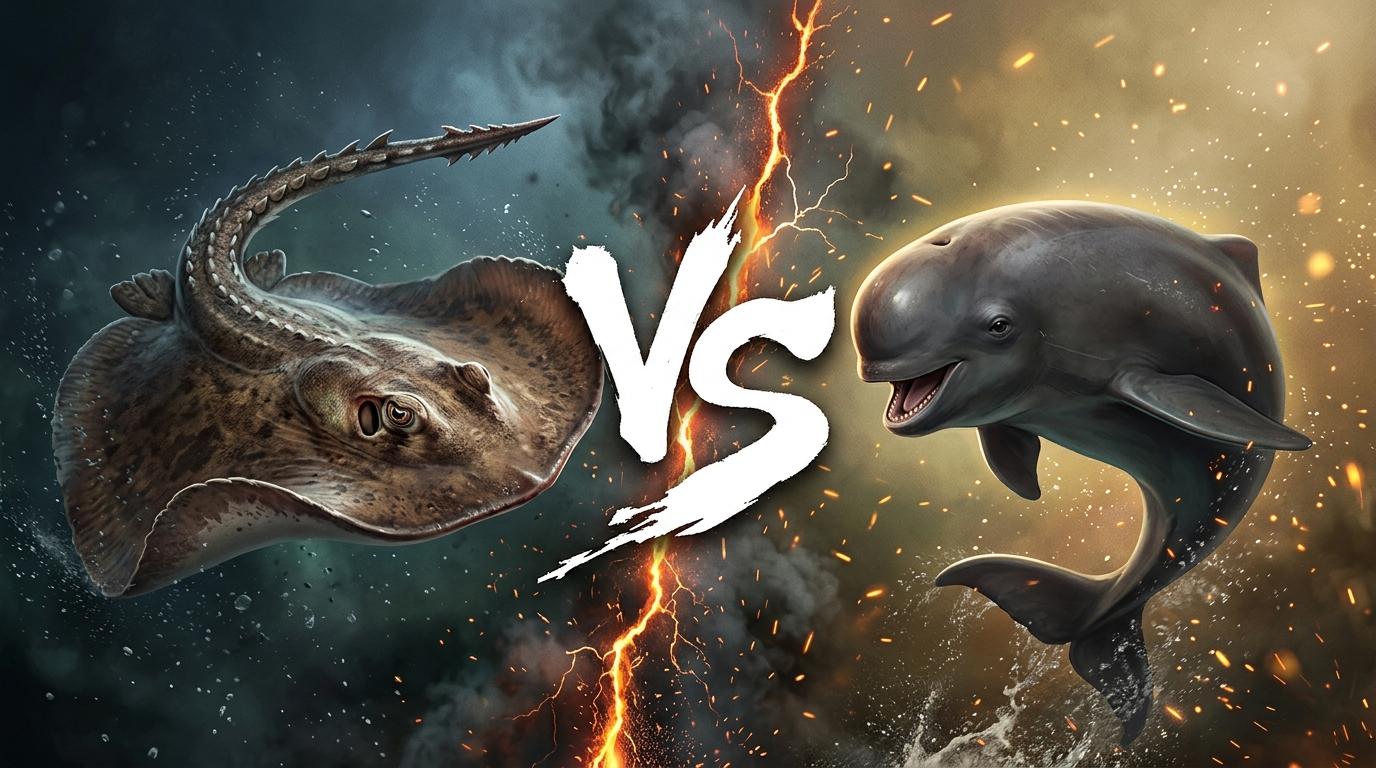
Giant Freshwater Stingray vs Yangtze Finless Porpoise: Who Actually Wins?
Giant freshwater stingray vs Yangtze finless porpoise: a biology-first look at size, venom, speed and smarts to settle who would win in a river showdown.
Giant Freshwater Stingray vs Yangtze Finless Porpoise
Matchup winner
Giant Freshwater Stingray
Quick verdict
Start with the direct answer, then use the structured comparison below to see what changes the outcome.
The Giant Freshwater Stingray wins. This is a mismatch of mass and weaponry. Urogymnus polylepis can reach 2 m across and is often estimated at 300 kg or more, though weights above roughly 300 kg rest on few verified specimens. It also carries a serrated, venom-coated tail spine up to 30–38 cm long that can puncture flesh and bone. The Yangtze finless porpoise is quick, highly intelligent and steers well with echolocation, but it tops out around 1.5–2 m long and only about 40–70 kg. It has no armor, no weapon beyond its jaws, and it must surface to breathe. In any frame where the two actually make contact, the ray's bulk, its habit of pinning itself to the bottom and its spine decide the result. The porpoise's realistic 'win' is refusing to engage at all, and refusing to fight is not the same as winning one.
Read the full explanation
The Giant Freshwater Stingray wins most realistic encounters on size and its venomous spine.
The ray can weigh four to six times as much as the porpoise and defends from the riverbed.
The porpoise is faster, smarter and more agile, but it has no tool that can hurt a ray that size.
The porpoise's best outcome is detecting the ray early and avoiding it entirely.
Reader vote
Who do you think wins?
Pick a side — no account needed. Results update live.
No votes yet — be the first to call it.
Editorial note
Why people disagree
People see 'mammal' and 'intelligent' and assume the porpoise dominates. Brains do not penetrate cartilage, and they do not neutralize a 30 cm barb.
Body mass & bulk
In close contact, mass sets who controls the space. The porpoise simply cannot move or pressure the ray.
Defensive weaponry
Only one side carries a tool that can cause disabling wounds. Porpoise teeth are made for small prey, not combat.
Agility & burst speed
Agility lets the porpoise choose whether to engage. That is its main survival card.
Read the full explanation +
Many readers picture the ray as a passive pancake. It is a powerful, defensive animal whose spine has caused serious injuries to large animals and people.
Speed fans point to the porpoise's mobility. Mobility helps it escape or win access to resources, but it does not let the porpoise beat a ray in an actual fight.
Comparison FAQ
Short, direct answers to the next questions readers usually ask after the headline verdict.
Would a Giant Freshwater Stingray beat a Yangtze Finless Porpoise?+
Yes. In any real contact the ray's size, tough body and venomous tail spine give it a decisive edge.
Which is stronger, the stingray or the porpoise?+
The stingray. It can outweigh the porpoise four to six times over and has far more raw mass and staying power.
Could the porpoise's intelligence help it win?+
It helps the porpoise avoid the fight, not win it. Echolocation lets it spot the ray early and keep clear.
Why is the porpoise still dangerous?+
It is fast, coordinated and can deliver ramming strikes. Dolphins and porpoises use ramming against threats, and it can harass or outlast slower animals in open water. It is mainly a danger to fish its own size or smaller, though.
Do these two animals actually meet in the wild?+
No. The giant freshwater stingray lives in Southeast Asian rivers like the Mekong, and the Yangtze finless porpoise lives only in China's Yangtze system.
Head-to-head species stats
These are the same core AnimalDex stat dimensions used on the dedicated animal pages, pulled side by side so the matchup is faster to scan.
Giant Freshwater Stingray
Tier AYangtze Finless Porpoise
Tier BTrait-by-trait comparison
Only the categories that matter to this matchup are included. The goal is not filler stats, but the real design differences that change the result.
Up to ~2 m wide, often estimated at 300+ kg
Body mass & bulk
Giant Freshwater Stingray
~1.5–2 m long, 40–70 kg
Body mass & bulk
Giant Freshwater Stingray
Serrated venomous tail spine, up to ~38 cm
Defensive weaponry
Giant Freshwater Stingray
Small peg-like teeth built for gripping fish
Defensive weaponry
Giant Freshwater Stingray
Steady, bottom-oriented glide
Agility & burst speed
Yangtze Finless Porpoise
Quick turns, fast bursts
Agility & burst speed
Yangtze Finless Porpoise
Electroreception to detect buried prey
Sensory intelligence
Yangtze Finless Porpoise
Echolocation plus strong problem-solving ability
Sensory intelligence
Yangtze Finless Porpoise
Thick, broad disc with tough skin
Close-range durability
Giant Freshwater Stingray
Soft-skinned, small mammal that needs air
Close-range durability
Giant Freshwater Stingray
Settles into sediment, nearly invisible
Positional control
Giant Freshwater Stingray
Must keep moving and surfacing
Positional control
Giant Freshwater Stingray
How the verdict forms
Verdict timeline
01 · Body mass & bulk
Giant Freshwater Stingray
02 · Defensive weaponry
Giant Freshwater Stingray
03 · Agility & burst speed
Yangtze Finless Porpoise
04 · Sensory intelligence
Yangtze Finless Porpoise
05 · Close-range durability
Giant Freshwater Stingray
06 · Positional control
Giant Freshwater Stingray
Change the conditions
Scenario breakdown
This is where shallow battle content usually fails. Terrain, spacing, timing, and engagement style can change the answer.
Scenario lean
Giant Freshwater Stingray
Verdict confidence
82%
The ray dominates decisively.
On sandy or muddy bottoms the ray is at home. It can bury itself, react to disturbance and whip its tail spine upward. A porpoise probing for fish near the bottom risks a puncture wound that could become infected or even fatal. Nothing in the porpoise's toolkit can threaten the ray's broad, tough disc.
AnimalDex field profiles
Explore these animals
Giant Freshwater Stingray
Urogymnus polylepis
large muddy river, estuary, and deep tropical freshwater channel
Yangtze Finless Porpoise
Neophocaena asiaeorientalis asiaeorientalis
broad river channel, oxbow edge, and freshwater floodplain corridor
Systems Intelligence & Hidden Purpose
See the animals behind this comparison as engineered biological systems: what each one is built to do, where it gains leverage, and why the matchup changes by scenario.
Specialized Hardware
huge river-floor disc body, long whip-like tail, and bottom-hugging camouflage give the Giant Freshwater Stingray a body plan tuned for its niche.
Systems Script
Giant Freshwater Stingrays operate through large muddy river, estuary, and deep tropical freshwater channel. Their design links movement, feeding, shelter, and timing into one workable survival system.
Strategic Insight
Where water controls movement, position and timing often matter more than speed.
Final take
The Giant Freshwater Stingray takes this matchup clearly. It is among the heaviest freshwater fish on Earth, and it carries one of the most dangerous defensive spines in any river. The Yangtze finless porpoise is a marvel of sensing and agility, but those traits are built for catching small fish and avoiding danger, not for fighting something many times its weight.
Read the full explanation
Both animals face real survival threats. The Yangtze finless porpoise is critically endangered, and the giant freshwater stingray is endangered. These two do not share a home river: the ray lives in the Mekong and other Southeast Asian systems, while the porpoise is confined to the Yangtze. Comparing them is a thought experiment that shows how size, armament and positional control beat intelligence in direct contact.
Collect both animals in AnimalDex
Track the species behind this matchup, compare their real traits, and build the rivalry into your AnimalDex collection.
Related comparisons
Continue with nearby matchups to compare more real-world animal traits without dropping into junky who-wins filler.
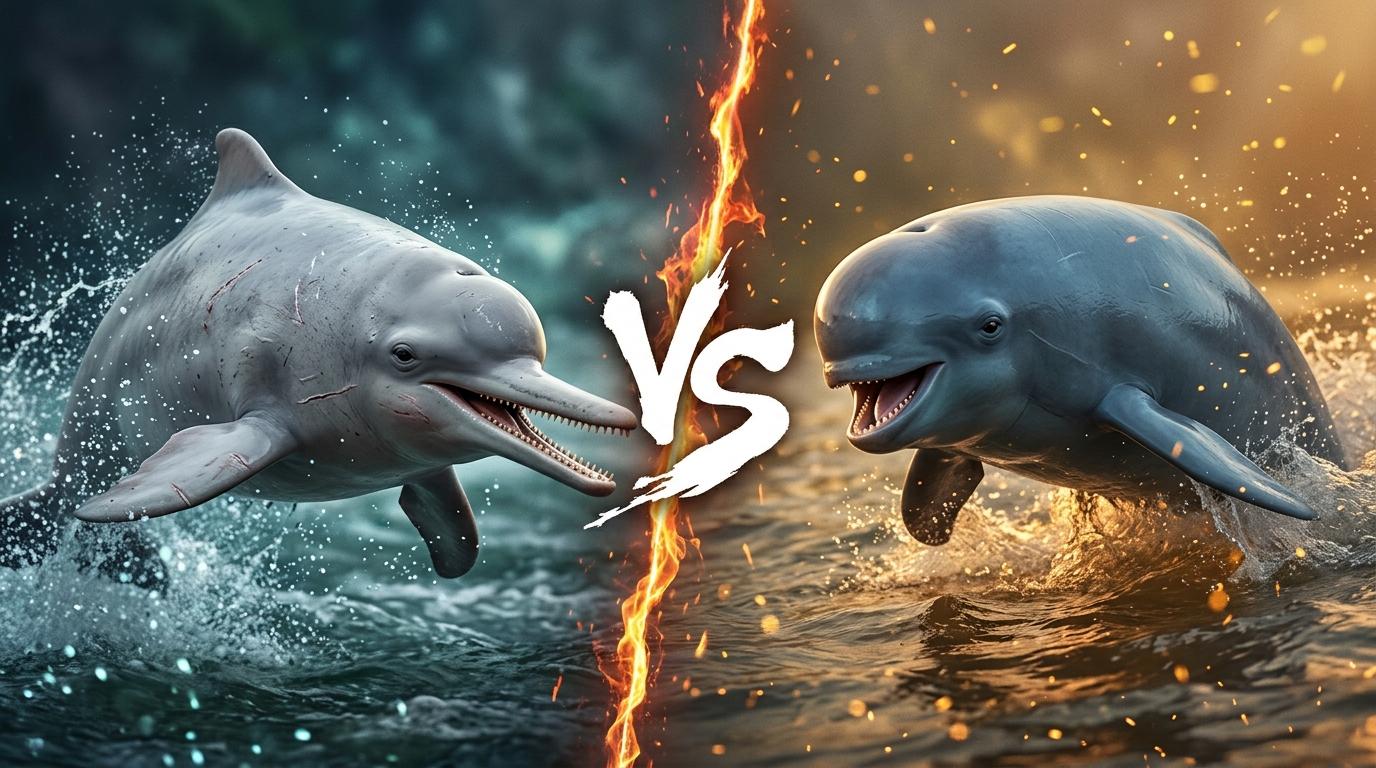
Indus River Dolphin vs Yangtze Finless Porpoise: Who Actually Wins?
The Indus River Dolphin wins this hypothetical matchup, with roughly 68% confidence. It is the longer animal, reaching about 2 to 2.5 m against the porpoise's typical 1.5 to 1.8 m. It also carries a weapon the porpoise lacks: a long, narrow beak lined with dozens of sharp, interlocking teeth on each side. That beak is built to snap at fish in muddy water, and it gives the dolphin reach, a precise strike and a clear first-contact advantage. The Yangtze Finless Porpoise is compact, agile and socially sophisticated, but its small spade-shaped teeth suit gripping prey, not inflicting damage, and it has no reach to match. These two never meet in the wild. One lives in Pakistan's Indus River system and the other in China's Yangtze. Both are among the rarest cetaceans on Earth, so this is a thought experiment about body design, not a real rivalry.
Read comparison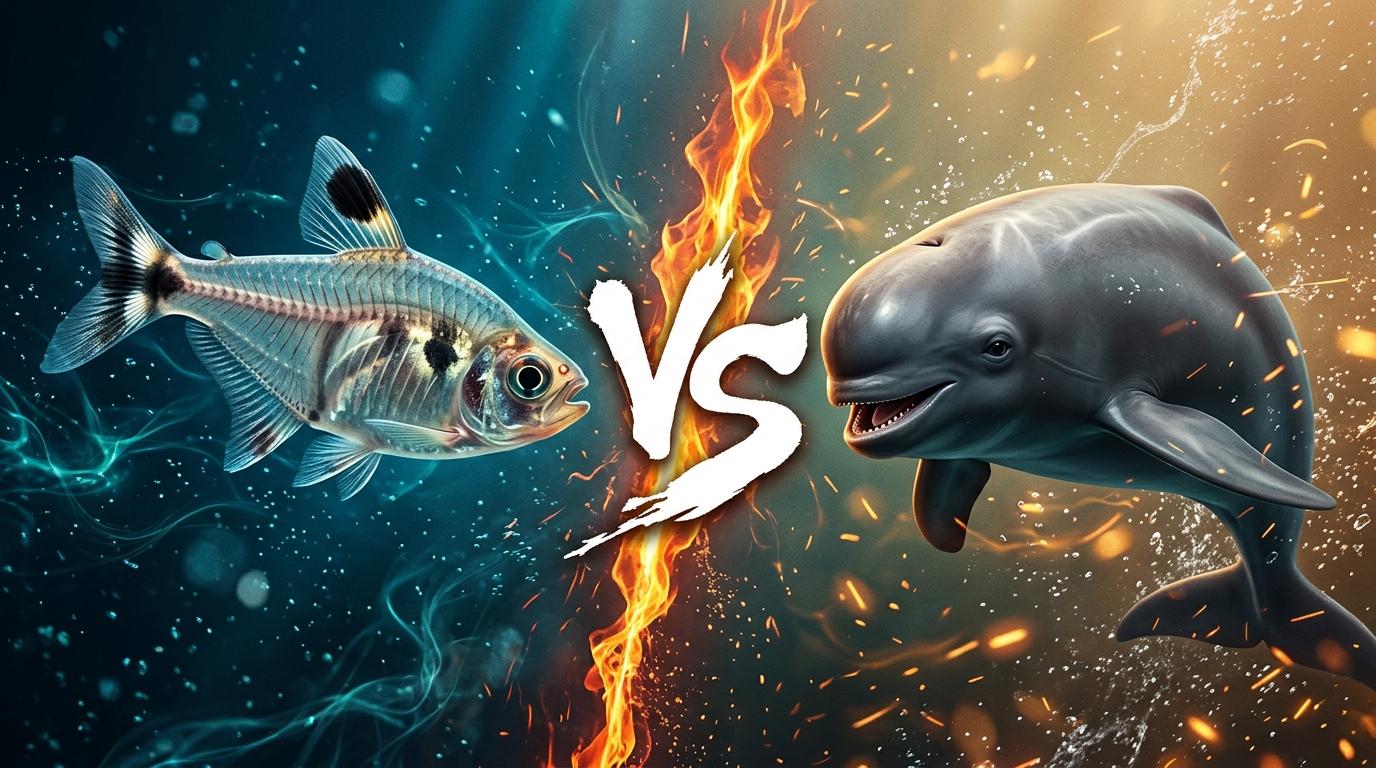
X-ray Tetra vs Yangtze Finless Porpoise: Who Actually Wins?
The Yangtze finless porpoise wins decisively. This is not a fight between rivals. It is a predator-prey relationship. The porpoise is a roughly 1.5 to 1.8 meter, 40 to 70 kg air-breathing mammal that echolocates its way to small fish in murky river water. The X-ray tetra is a roughly 4 to 5 cm schooling characin from South American rivers. In a direct encounter the tetra has no offensive tools that matter, while the porpoise has the mass, sonar, and suction-and-snap feeding style to treat it as a snack. The tetra's only real game is survival. Its translucent body, tight schooling, and quick darting can buy escapes, but they cannot reverse a size gap of more than a thousand to one by mass.
Read comparison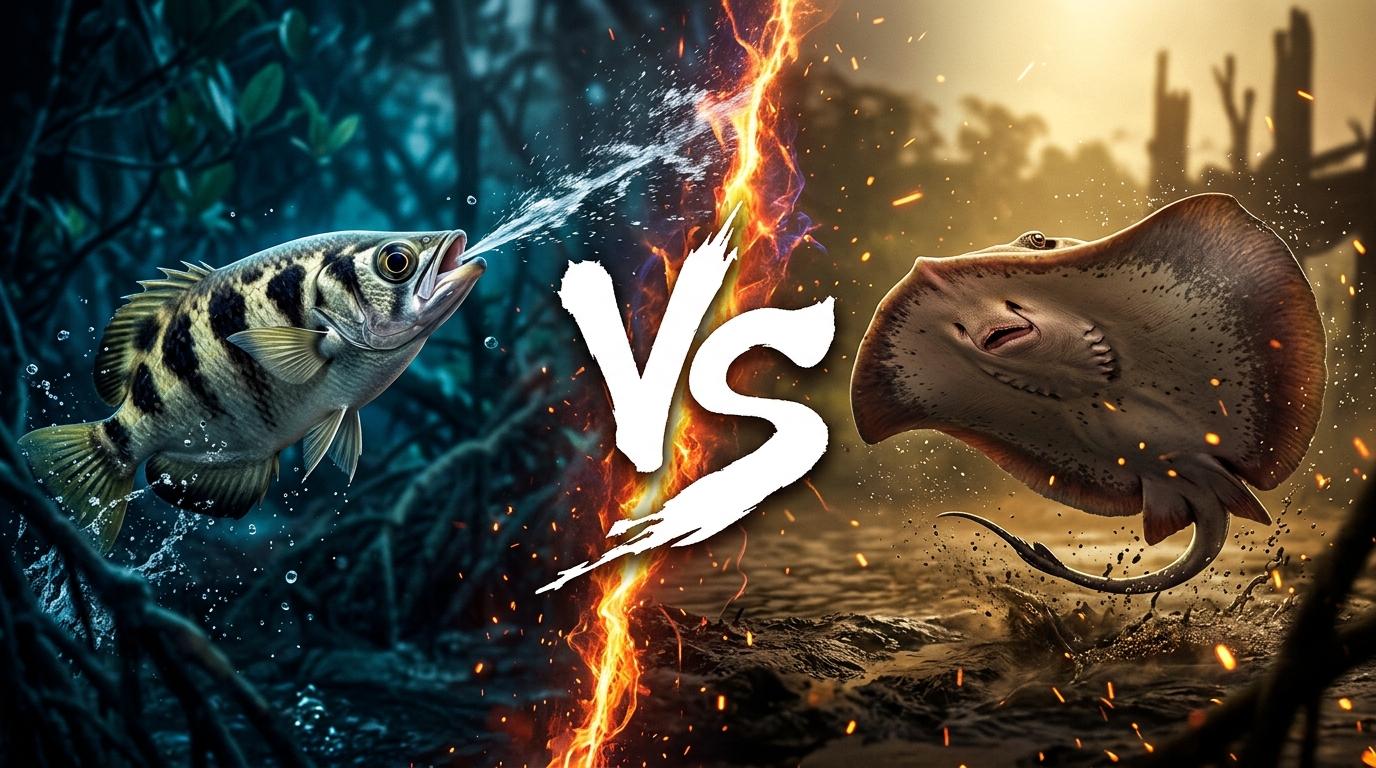
Banded Archerfish vs Giant Freshwater Stingray: Who Actually Wins?
The Giant Freshwater Stingray wins, and it is not close. This river giant can reach about 2 meters across and weigh around 300 kg. It carries a serrated, venomous tail spine and lives on the bottom of big tropical rivers. The Banded Archerfish is usually about 15–25 cm long and weighs a few hundred grams. Its famous weapon is a precise jet of water that knocks insects off leaves above the surface. That makes it a brilliant hunter of tiny prey, but useless against a fish thousands of times heavier. The archerfish's real strengths are its eyes and its aim. The ray's strengths are mass, armor, sensing and a defensive weapon. In any real meeting, the ray controls the outcome. The archerfish's best result is to avoid notice entirely.
Read comparison
Discussion
What do you think?
Share your reasoning with other readers. Be civil and stick to the animals.
Sign in to join the discussion.
Sign inNo comments yet. Start the conversation.