

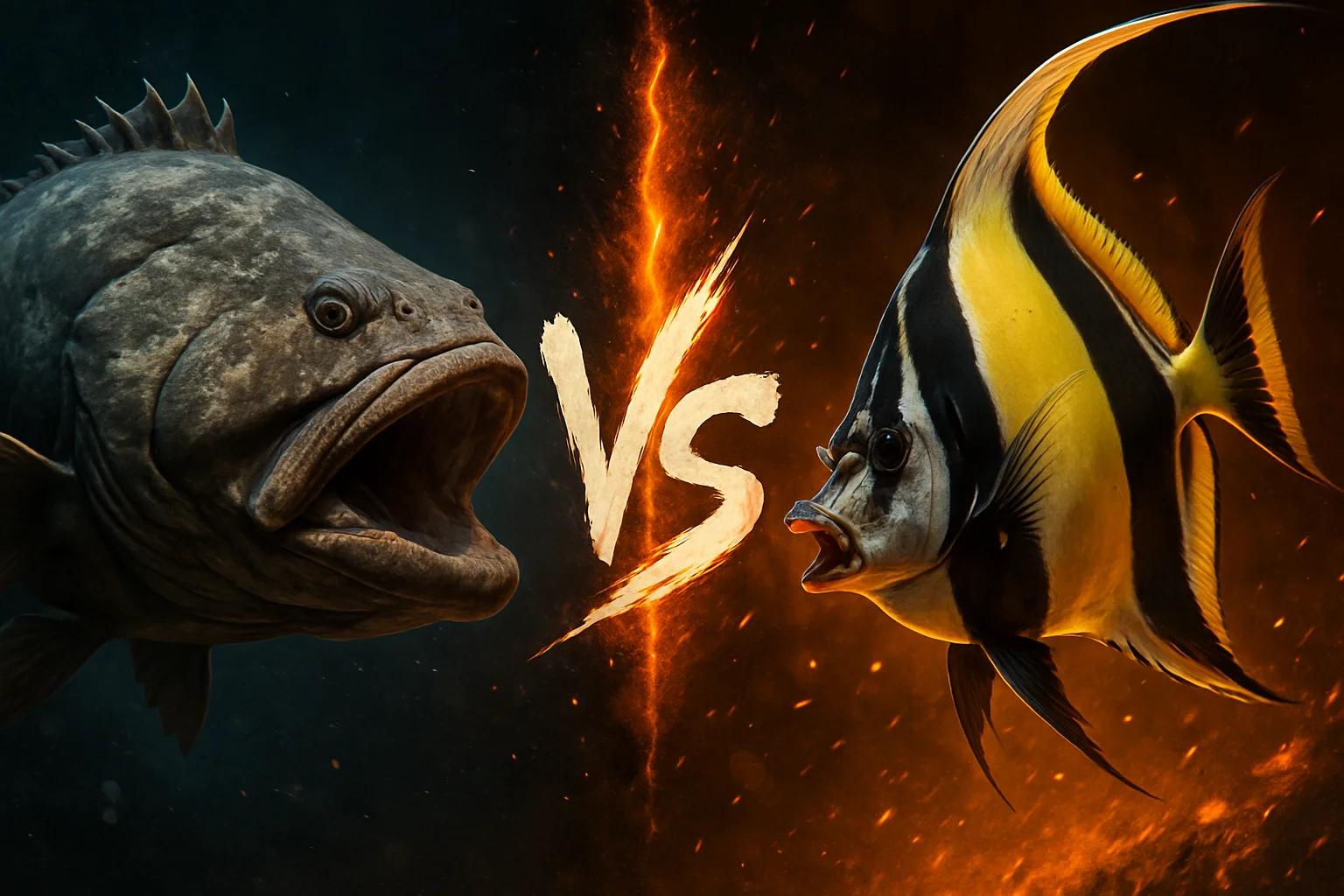
Giant Grouper vs Moorish Idol: Who Actually Wins?
Giant grouper vs Moorish idol: a biology-first look at size, suction feeding, agility, and reef tactics, and why the giant grouper wins almost every contest.
Giant Grouper vs Moorish Idol
Matchup winner
Giant Grouper
Quick verdict
Start with the direct answer, then use the structured comparison below to see what changes the outcome.
The giant grouper wins, and it isn't close. Epinephelus lanceolatus is one of the largest bony reef fishes on Earth. It can top 2.5 m and 300+ kg, and it feeds by opening a cavernous mouth that pulls in water and prey in a fraction of a second. The Moorish idol is a slender, disc-shaped reef grazer around 20 cm long, built for picking sponges and slipping through coral, not for confrontation. Its only real edges are maneuverability, a tall dorsal profile that makes it awkward to swallow, and the habit of staying close to reef structure. Those traits help it avoid an encounter, but they can't overturn a mass difference of roughly a thousandfold once the grouper commits.
Read the full explanation
Giant grouper wins decisively on size, bite, and suction-feeding power.
The Moorish idol's best defense is avoidance: tight coral cover, agility, and an awkward, deep-bodied shape.
In open water or at a grouper's ambush station, the idol has almost no answer.
The idol survives only in contexts where the grouper never gets a clean strike.
Reader vote
Who do you think wins?
Pick a side — no account needed. Results update live.
No votes yet — be the first to call it.
Editorial note
Why people disagree
Some readers treat the Moorish idol's striking banner fin and disc shape as armor. It discourages small predators, but it barely matters to a mouth this large.
Explosive power
The grouper converts mouth expansion into an inescapable vacuum at close range, and the idol has nothing comparable.
Body mass and size
Mass decides nearly every underwater contact, and here the gap is extreme.
Ambush control
The grouper controls the timing of any encounter. The idol can only react.
Read the full explanation +
Groupers look slow and lazy, which hides how violent their suction strike is over short distances.
The idol is common and the giant grouper is rare on most reefs, so many divers have never seen the two share space and assume they rarely interact.
Comparison FAQ
Short, direct answers to the next questions readers usually ask after the headline verdict.
Would a giant grouper beat a Moorish idol?+
Yes. In almost any direct encounter the giant grouper wins easily, thanks to its enormous size advantage and powerful suction feeding.
Which is stronger, a giant grouper or a Moorish idol?+
The giant grouper, by a huge margin. It can outweigh the idol by hundreds of times and has a far more powerful jaw and body.
Do giant groupers eat Moorish idols?+
Giant groupers eat a wide range of fish, crustaceans, and even small sharks and turtles. A Moorish idol is well within their prey range, though its deep body and reef-hugging habits make it a less convenient target than many other fish.
Why is the Moorish idol still hard to catch?+
Its thin, deep body slips into coral gaps, it turns quickly, and its tall fin makes it awkward to swallow. Inside dense reef structure, it can deny a big predator any clean strike.
Is the Moorish idol dangerous at all?+
Not to large predators. Its danger is defensive: it is hard to corner, which wastes a predator's time and energy.
Head-to-head species stats
These are the same core AnimalDex stat dimensions used on the dedicated animal pages, pulled side by side so the matchup is faster to scan.
Giant Grouper
Tier AMoorish Idol
Tier CTrait-by-trait comparison
Only the categories that matter to this matchup are included. The goal is not filler stats, but the real design differences that change the result.
Short-burst lunge plus massive suction
Explosive power
Giant Grouper
Quick darting turns, little thrust
Explosive power
Giant Grouper
Up to ~2.7 m, 300+ kg
Body mass and size
Giant Grouper
~20–23 cm, well under 1 kg
Body mass and size
Giant Grouper
Patient cave and wreck sit-and-wait hunter
Ambush control
Giant Grouper
Not a predator of fish
Ambush control
Giant Grouper
Ponderous turns, heavy body
Reef agility
Moorish Idol
Laterally compressed, slips through coral gaps
Reef agility
Moorish Idol
Thick body, tough skin, heavy jaw
Close-range durability
Giant Grouper
Fragile, thin-bodied grazer
Close-range durability
Giant Grouper
Gape swallows most reef fish whole
Swallow resistance
Moorish Idol
Deep body and tall fin make it awkward to engulf
Swallow resistance
Moorish Idol
How the verdict forms
Verdict timeline
01 · Explosive power
Giant Grouper
02 · Body mass and size
Giant Grouper
03 · Ambush control
Giant Grouper
04 · Reef agility
Moorish Idol
05 · Close-range durability
Giant Grouper
06 · Swallow resistance
Moorish Idol
Change the conditions
Scenario breakdown
This is where shallow battle content usually fails. Terrain, spacing, timing, and engagement style can change the answer.
Scenario lean
Moorish Idol
Verdict confidence
82%
The idol escapes if it's already inside tight coral.
In dense branching coral, the Moorish idol's compressed body lets it thread gaps the grouper's bulk can't enter. A predator that relies on short-range suction needs open access to the target. Here, structure overrides strength, and the idol survives by denial rather than force.
AnimalDex field profiles
Explore these animals
Giant Grouper
Epinephelus lanceolatus
coral reef, wreck, and tropical rocky seafloor
Moorish Idol
Zanclus cornutus
coral reef, lagoon, and tropical rocky coast
Systems Intelligence & Hidden Purpose
See the animals behind this comparison as engineered biological systems: what each one is built to do, where it gains leverage, and why the matchup changes by scenario.
Specialized Hardware
massive heavy reef body, huge suction-feeding mouth, and slow ambush cave patrol give the Giant Grouper a body plan tuned for its niche.
Systems Script
Giant Groupers operate through coral reef, wreck, and tropical rocky seafloor. Their design links movement, feeding, shelter, and timing into one workable survival system.
Strategic Insight
In moving water, the best systems use flow, visibility, and depth instead of fighting every current.
Specialized Hardware
long trailing dorsal filament, bold black-yellow-white pattern, and reef-face grazing behavior give the Moorish Idol a body plan tuned for its niche.
Systems Script
Moorish Idols operate through coral reef, lagoon, and tropical rocky coast. Their design links movement, feeding, shelter, and timing into one workable survival system.
Strategic Insight
In moving water, the best systems use flow, visibility, and depth instead of fighting every current.
Final take
The giant grouper is the overall winner. It has overwhelming mass, a suction strike few reef fish can survive, and the patience to make encounters happen on its own terms.
Read the full explanation
The Moorish idol's lesson is that small reef fish win by avoiding contests, not by fighting them. Coral cover, an awkward body shape, and constant vigilance keep it alive, but none of these beat the grouper in a straight encounter.
Collect both animals in AnimalDex
Track the species behind this matchup, compare their real traits, and build the rivalry into your AnimalDex collection.
Related comparisons
Continue with nearby matchups to compare more real-world animal traits without dropping into junky who-wins filler.
Moorish Idol vs Redcoat Squirrelfish: Who Actually Wins?
The Redcoat Squirrelfish wins this matchup clearly. It is the heavier, more muscular reef fish, typically reaching around 25–30 cm against the Moorish Idol's lighter, disc-thin build, and it carries the more serious defensive hardware: a stout, spiny dorsal fin and a sharp spine on each gill cover. It also brings faster burst acceleration from cave mouths and a more combative temperament around shelter. The Moorish Idol is a graceful, specialized grazer built for picking sponges from crevices. Its tall body and long dorsal streamer are designed for display and maneuvering, not for trading blows. In any contest over a ledge, hole, or overhang, the squirrelfish's mass, spines, and willingness to hold ground decide it.
Read comparison
Discussion
What do you think?
Share your reasoning with other readers. Be civil and stick to the animals.
Sign in to join the discussion.
Sign inNo comments yet. Start the conversation.