

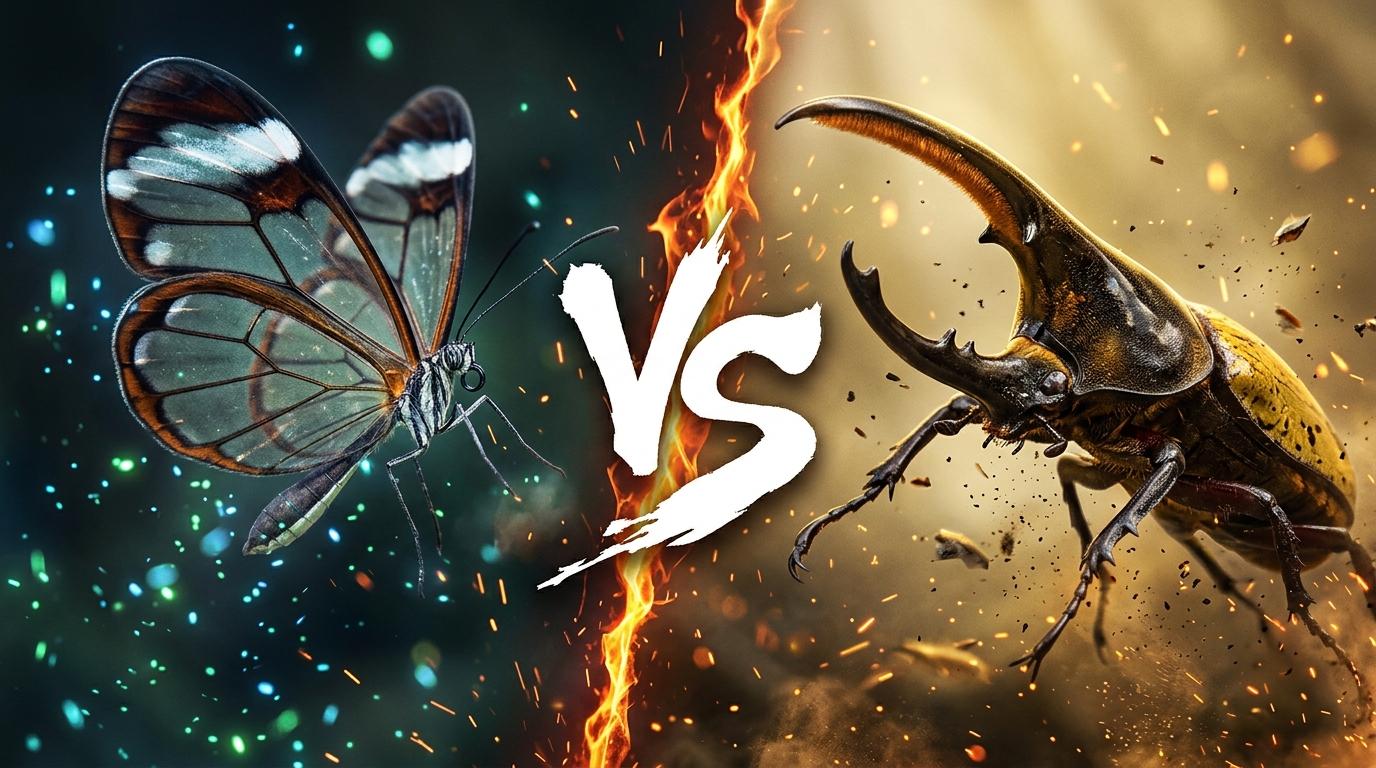
Glasswing Butterfly vs Hercules Beetle: Who Actually Wins?
Glasswing butterfly vs Hercules beetle: a biology-first breakdown of armor, strength, flight, and toxicity, and why the beetle wins any real contest.
Glasswing Butterfly vs Hercules Beetle
Matchup winner
Hercules Beetle
Quick verdict
Start with the direct answer, then use the structured comparison below to see what changes the outcome.
The Hercules beetle wins clearly. It is one of the largest beetles on Earth, with males reaching about 17 cm including the horn. It carries a hardened exoskeleton and elytra that act like a chassis, and its thoracic and cephalic horns evolved specifically for grappling, prying, and flipping rival males. The glasswing butterfly is a delicate nectar-feeder. Its transparent wings span roughly 5–6 cm, and it has no biting mouthparts, no armor, and no means of physically harming another insect. Its real defenses are escape and chemistry: near-invisible wings and alkaloids sequestered from nightshade-family plants as a caterpillar, which make it distasteful to predators. Those tools deter birds, but they do nothing against a herbivorous beetle that does not want to eat it. In any physical contest, the beetle's mass, armor, and grappling hardware decide the outcome, while the butterfly's only winning move is to leave.
Read the full explanation
The Hercules beetle wins any physical contest decisively.
The beetle has armor, mass, and horns built for wrestling. The butterfly has none of these.
The glasswing's defenses are camouflage and toxicity, which are aimed at predators, not rivals.
The butterfly 'wins' only by flying away before contact.
Reader vote
Who do you think wins?
Pick a side — no account needed. Results update live.
No votes yet — be the first to call it.
Editorial note
Why people disagree
Some readers count successful escape as a win. The glasswing is far better at not being touched than at fighting.
Explosive power
Hercules males pry up and throw opponents in duels. That raw leverage has no counterpart in a butterfly.
Close-range durability
One pinch damages a butterfly wing permanently. The beetle can absorb crushing contact.
Evasion and invisibility
The glasswing's whole strategy is to avoid being seen or grabbed, and it does this superbly.
Read the full explanation +
The glasswing's toxicity sounds like a weapon, but it only matters to something that tries to eat it, and Hercules beetles eat rotting fruit, not butterflies.
Neither animal is a predator, so 'who wins' is really a question about which body plan survives a forced encounter. That favors armor.
Comparison FAQ
Short, direct answers to the next questions readers usually ask after the headline verdict.
Would a glasswing butterfly beat a Hercules beetle?+
No. The butterfly has no weapons or armor. Its only success would be escaping before contact.
Which is stronger, the Hercules beetle or the glasswing butterfly?+
The Hercules beetle, by a huge margin. It is among the strongest insects relative to body size, while the butterfly is built for lightness.
Who wins a fight between them?+
The Hercules beetle wins any fight that actually happens.
Why is the glasswing butterfly still dangerous?+
Its sequestered alkaloids make it distasteful to predators like birds, and its transparent wings make it hard to track. It is dangerous to eat, not to fight.
Is the Hercules beetle aggressive?+
Mostly toward rival males. It is a fruit-feeder and does not hunt other insects.
Head-to-head species stats
These are the same core AnimalDex stat dimensions used on the dedicated animal pages, pulled side by side so the matchup is faster to scan.
Glasswing Butterfly
Tier DHercules Beetle
Tier CTrait-by-trait comparison
Only the categories that matter to this matchup are included. The goal is not filler stats, but the real design differences that change the result.
Light wingbeats, no striking force
Explosive power
Hercules Beetle
Horn-lift capable of flipping rivals
Explosive power
Hercules Beetle
Membranous wings, soft body
Close-range durability
Hercules Beetle
Hardened elytra and exoskeleton
Close-range durability
Hercules Beetle
Transparent wings, erratic flight
Evasion and invisibility
Glasswing Butterfly
Heavy, clumsy flyer
Evasion and invisibility
Glasswing Butterfly
Sequestered plant alkaloids
Chemical deterrence
Glasswing Butterfly
No notable toxins
Chemical deterrence
Glasswing Butterfly
None
Grappling control
Hercules Beetle
Pincer-like horn pair
Grappling control
Hercules Beetle
How the verdict forms
Verdict timeline
01 · Explosive power
Hercules Beetle
02 · Close-range durability
Hercules Beetle
03 · Evasion and invisibility
Glasswing Butterfly
04 · Chemical deterrence
Glasswing Butterfly
05 · Grappling control
Hercules Beetle
Change the conditions
Scenario breakdown
This is where shallow battle content usually fails. Terrain, spacing, timing, and engagement style can change the answer.
Scenario lean
Hercules Beetle
Verdict confidence
82%
The beetle dominates any contact.
Leaf litter and branches restrict the butterfly's flight paths. If the two are forced together, the beetle's armor and horn leverage overwhelm a body with no offensive tools. The glasswing's camouflage helps it avoid an encounter but cannot win one.
AnimalDex field profiles
Explore these animals
Glasswing Butterfly
Greta oto
cloud forest, rainforest edge, and humid understory
Hercules Beetle
Dynastes hercules
rainforest canopy, humid forest floor, and tropical woodland
Systems Intelligence & Hidden Purpose
See the animals behind this comparison as engineered biological systems: what each one is built to do, where it gains leverage, and why the matchup changes by scenario.
Specialized Hardware
transparent wing panels, slow floating forest flight, and thin dark wing borders give the Glasswing Butterfly a body plan tuned for its niche.
Systems Script
Glasswing Butterflys operate through cloud forest, rainforest edge, and humid understory. Their design links movement, feeding, shelter, and timing into one workable survival system.
Strategic Insight
Dense environments reward precision, patience, and the ability to read layered cover.
Specialized Hardware
enormous horned male body, heavy lifting strength, and rainforest night activity give the Hercules Beetle a body plan tuned for its niche.
Systems Script
Hercules Beetles operate through rainforest canopy, humid forest floor, and tropical woodland. Their design links movement, feeding, shelter, and timing into one workable survival system.
Strategic Insight
Dense environments reward precision, patience, and the ability to read layered cover.
Final take
The Hercules beetle is the overall winner, and it is not close. It is an armored grappler shaped by sexual selection for wrestling. The glasswing butterfly is shaped by predation pressure for invisibility and distastefulness.
Read the full explanation
The glasswing stays genuinely formidable on its own terms. It is among the best insects in the rainforest at never being caught. In a contest of contact, though, the beetle's body plan answers every question.
Collect both animals in AnimalDex
Track the species behind this matchup, compare their real traits, and build the rivalry into your AnimalDex collection.
Related comparisons
Continue with nearby matchups to compare more real-world animal traits without dropping into junky who-wins filler.
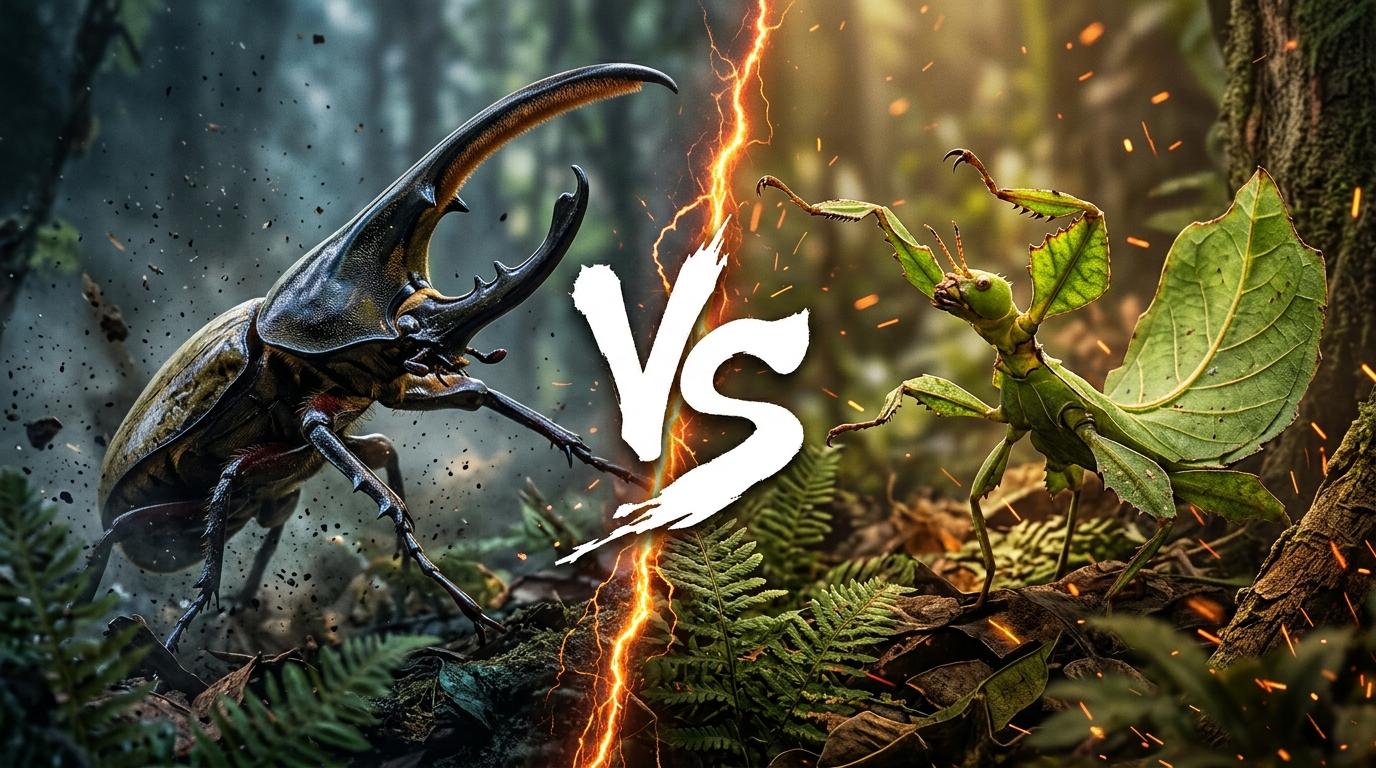
Hercules Beetle vs Philippine Leaf Insect: Who Actually Wins?
The Hercules beetle wins, and it is not close. Dynastes hercules is one of the largest beetles on Earth. It carries a hardened exoskeleton, powerful legs built for gripping, and, in males, a long pincer-like horn evolved specifically for wrestling and flipping rivals. The Philippine leaf insect (Phyllium philippinicum) is a soft-bodied herbivore. It has no weapons and no fighting behavior, and its whole survival strategy is to never be noticed. Once the two are in direct contact, armor and leverage beat camouflage. The leaf insect's real victory condition is avoiding the encounter entirely, and in a dense canopy it often does exactly that.
Read comparison
Bullet Ant vs Hercules Beetle: Who Actually Wins?
The Hercules beetle wins a one-on-one fight. A bullet ant ranks near the very top of the Schmidt sting pain index, and its poneratoxin works on insects as well as vertebrates. To matter, though, that venom has to get inside the target. A male Hercules beetle can reach roughly 15–17 cm including its horn, against the ant's roughly 2.5 cm, and it is wrapped in thick, overlapping armor with very few open seams. The beetle does not need to hunt or kill. It only needs to shove, pin, or flip the ant, then walk away, and it holds every structural advantage for doing that: mass, leg leverage, armor, and a horn built for prying rivals off branches. The ant's best chance is a precise sting into a leg joint or neck membrane. That is possible but unlikely against a body this armored and this much larger. Bring the ant's colony into the picture and the story changes, but in a solo matchup armor and mass beat chemistry.
Read comparison
Hercules Beetle vs Leafcutter Ant: Who Actually Wins?
The Hercules beetle wins this matchup clearly. A male Dynastes hercules can reach about 17 cm including its horn, and a single leafcutter ant is a few millimeters to about 2 cm long. Even the largest Atta cephalotes soldier is outweighed by hundreds of times. The beetle's thick, domed elytra and armored thorax give leafcutter mandibles almost nothing to grip. Its pincer-like horns are built to pry, lift, and fling rivals much heavier than any ant. Leafcutter ants also lack a functional sting, so they cannot inject venom. The ant's real power is the colony: millions of workers, a soldier caste whose jaws can slice skin, and coordinated mass defense. That makes a nest raid the one context where the beetle should back off. In any fair, individual-scale battle, or in the open forest where the beetle can simply walk or fly away, the beetle's armor and mass decide it.
Read comparison
Hercules Beetle vs Green Orchid Bee: Who Actually Wins?
The Hercules beetle wins, and it is not especially close. Dynastes hercules is one of the largest beetles on Earth. Big males reach about 17 cm including the horn, and the whole body sits inside thick, chitin-reinforced elytra built for horn-to-horn wrestling. The green orchid bee (Euglossa dilemma) is a fast, metallic, roughly 1.3 cm pollinator whose sting is mild by bee standards. It struggles to get through beetle armor, and its tiny mandibles cannot pry the shell. The bee holds the edge in speed, agility and flight endurance, so it controls whether contact happens at all. But if the question is who comes out on top when they actually clash, the beetle's size, armor and gripping horns make the outcome lopsided.
Read comparison
Discussion
What do you think?
Share your reasoning with other readers. Be civil and stick to the animals.
Sign in to join the discussion.
Sign inNo comments yet. Start the conversation.