

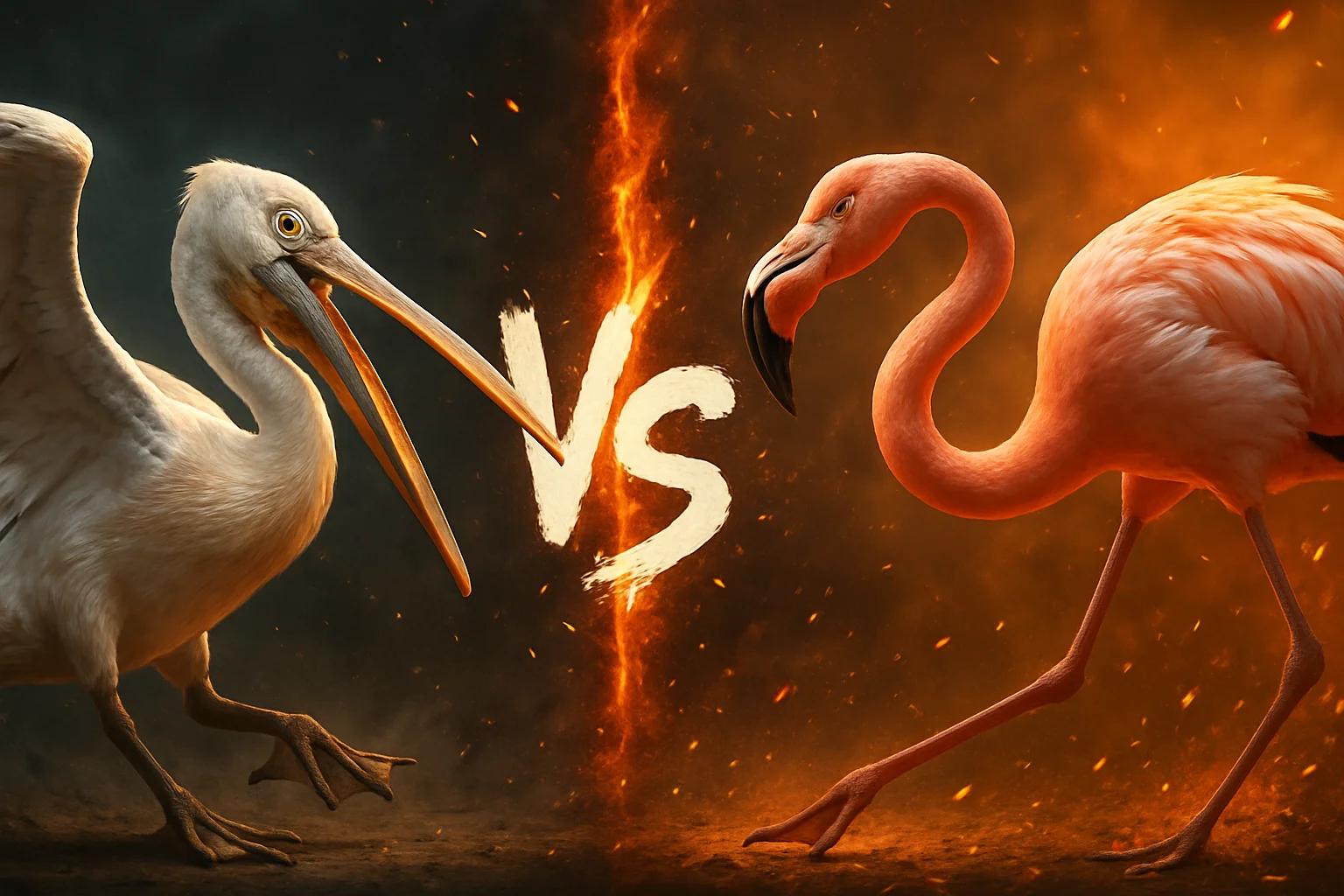
Great White Pelican vs Greater Flamingo: Who Actually Wins?
Great White Pelican vs Greater Flamingo: a biology-first look at size, beak power, reach, and wetland behavior to settle who would win.
Great White Pelican vs Greater Flamingo
Matchup winner
Great White Pelican
Quick verdict
Start with the direct answer, then use the structured comparison below to see what changes the outcome.
The Great White Pelican wins this matchup clearly. It is the heavier bird, typically 9–15 kg against the flamingo's 2–4 kg. It has one of the largest wingspans of any flying bird, up to about 3.6 m, and it carries a long, hooked-tip bill built to grab, pin, and shove. The Greater Flamingo is taller and leggier, but its bill is a specialized filter-feeding sieve, not a weapon. Its slender legs and neck are built for wading and display, not for absorbing body checks. In any close contest over space, a pelican's mass, wing buffeting, and bill strikes overpower a flamingo. The flamingo's real edge is avoidance: it can run, take off, and vanish into a dense flock. It wins by leaving, not by fighting.
Read the full explanation
The Great White Pelican wins: it is roughly three to four times heavier with a longer, stronger bill.
The flamingo's height and long legs help it watch and escape, not fight.
A flamingo's bill filters tiny food; a pelican's bill grabs and pins.
Real encounters are rare and almost always end with the flamingo moving away.
Reader vote
Who do you think wins?
Pick a side — no account needed. Results update live.
No votes yet — be the first to call it.
Editorial note
Why people disagree
Flamingos look taller in photos, so people assume they are the bigger bird, but standing height is not body mass.
Body mass and shove
In bird contests, weight decides who moves whom. The pelican can physically displace a flamingo.
Bill as a weapon
The pelican's bill is built to seize struggling prey. The flamingo's is a delicate food strainer.
Wing buffeting
Wing blows and spread-wing intimidation are core waterbird fighting tools, and the pelican's are enormous.
Read the full explanation +
Both are 'gentle' colony birds, so some argue neither really fights. Pelicans do routinely jostle, bill-snap, and wing-buffet over fishing spots, though.
Flamingo flocks number in the thousands, and crowd behavior can make a lone pelican look outmatched even when no single flamingo could push it around.
Comparison FAQ
Short, direct answers to the next questions readers usually ask after the headline verdict.
Would a Great White Pelican beat a Greater Flamingo in a fight?+
Yes. The pelican's weight advantage, powerful wings, and grabbing bill make it the clear winner in a close-range contest.
Which is stronger, a pelican or a flamingo?+
The Great White Pelican is much stronger. It is several times heavier, with a far larger wingspan and a bill built to handle struggling fish.
Is a flamingo bigger than a pelican?+
A flamingo can stand taller, but the Great White Pelican is far heavier and has a much bigger wingspan.
Why does the flamingo stay dangerous?+
It is less a danger than a hard target. Its height spots threats early and its fast takeoff denies contact. A cornered flamingo can still deliver sharp bill jabs and leg kicks.
Do pelicans and flamingos actually fight in the wild?+
They share wetlands in Africa and southern Eurasia, but real fights are rare. Encounters usually end with one bird, typically the flamingo, moving off.
Head-to-head species stats
These are the same core AnimalDex stat dimensions used on the dedicated animal pages, pulled side by side so the matchup is faster to scan.
Great White Pelican
Tier CGreater Flamingo
Tier CTrait-by-trait comparison
Only the categories that matter to this matchup are included. The goal is not filler stats, but the real design differences that change the result.
About 9–15 kg, barrel-bodied
Body mass and shove
Great White Pelican
About 2–4 kg, slender frame
Body mass and shove
Great White Pelican
Long bill with hooked tip and throat pouch
Bill as a weapon
Great White Pelican
Bent filter bill with lamellae for sieving
Bill as a weapon
Great White Pelican
Huge wings, up to about 3.6 m span
Wing buffeting
Great White Pelican
Roughly 1.4–1.7 m span
Wing buffeting
Great White Pelican
Low-slung on water, floats high
Vigilance and lookout height
Greater Flamingo
Tall stance, long neck
Vigilance and lookout height
Greater Flamingo
Heavy takeoff, needs a run-up
Escape agility
Greater Flamingo
Fast wading run into quick takeoff
Escape agility
Greater Flamingo
Thick plumage over a sturdy body
Close-range durability
Great White Pelican
Thin legs and neck that are easy to hurt
Close-range durability
Great White Pelican
How the verdict forms
Verdict timeline
01 · Body mass and shove
Great White Pelican
02 · Bill as a weapon
Great White Pelican
03 · Wing buffeting
Great White Pelican
04 · Vigilance and lookout height
Greater Flamingo
05 · Escape agility
Greater Flamingo
06 · Close-range durability
Great White Pelican
Change the conditions
Scenario breakdown
This is where shallow battle content usually fails. Terrain, spacing, timing, and engagement style can change the answer.
Scenario lean
Great White Pelican
Verdict confidence
82%
Pelican dominates at close quarters.
In knee-deep water, the flamingo's long legs lose their escape advantage once it is cornered. The pelican can close the distance by swimming, then use mass, wing blows, and bill grabs. The flamingo has no effective offensive tool, so the contest quickly becomes displacement.
AnimalDex field profiles
Explore these animals
Great White Pelican
Pelecanus onocrotalus
Large lakes, lagoons, wetlands, estuaries, and coastal shallows.
Greater Flamingo
Phoenicopterus roseus
Salt pans, lagoons, estuaries, alkaline lakes, and shallow coastal wetlands.
Systems Intelligence & Hidden Purpose
See the animals behind this comparison as engineered biological systems: what each one is built to do, where it gains leverage, and why the matchup changes by scenario.
Specialized Hardware
Large pale body and broad wings, huge bill with throat pouch, and often fishes in cooperative groups give the Great White Pelican a body plan tuned for its niche.
Systems Script
Great White Pelicans operate in large lakes, lagoons, wetlands, estuaries, and coastal shallows. Their design helps them match food access, shelter, and timing inside that environment.
Strategic Insight
Shared positioning can make a hard catch easier for everyone.
Specialized Hardware
Long legs, downturned filter-feeding bill, and flock-scale movement make flamingos wetland processing hardware for shallow nutrient-rich water.
Systems Script
Flamingos convert microscopic productivity into visible biomass and signal whether a saline wetland is still functioning at scale. Their abundance is often a readout of the whole water chemistry story.
Strategic Insight
Do not ignore low-level input streams. Tiny resources, processed well, can support very large systems.
Final take
The Great White Pelican is the stronger, heavier, better-armed bird. In any situation where the two must physically settle a dispute, it wins decisively. Its biology is built for seizing and controlling: a big body, huge wings, and a gripping bill.
Read the full explanation
The Greater Flamingo's design answers a different question: how to feed safely in harsh wetlands. It relies on early warning, quick escape, and safety in numbers. Those tools keep it alive, but none of them win a fight.
Final verdict: Great White Pelican wins, with the flamingo's best outcome being a clean getaway.
Collect both animals in AnimalDex
Track the species behind this matchup, compare their real traits, and build the rivalry into your AnimalDex collection.
Related comparisons
Continue with nearby matchups to compare more real-world animal traits without dropping into junky who-wins filler.
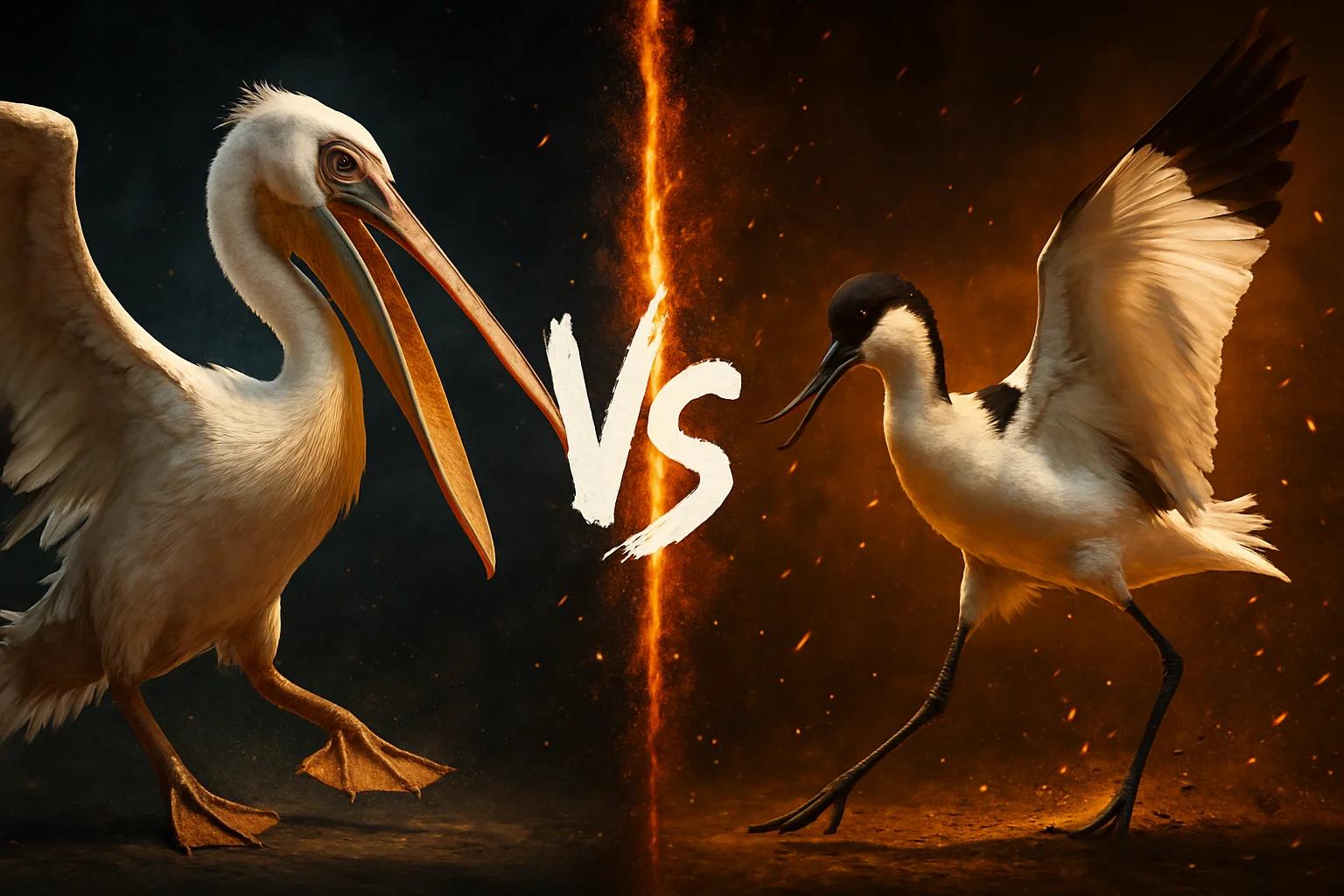
Great White Pelican vs Pied Avocet: Who Actually Wins?
The Great White Pelican wins this matchup clearly. At roughly 9–11 kg with a wingspan near 3 meters, it outweighs a 300-gram Pied Avocet by about thirty to one, and its long hooked bill and heavy body make it physically untouchable for the smaller wader. The avocet has real tools: it is quicker on the wing and more agile, and it is famous for loud, swooping mob attacks that drive gulls, crows and even people away from its nests. But mobbing is built to harass and distract, not to injure something pelican-sized. In any direct contest the pelican simply absorbs the noise and holds its ground. The avocet's best result is to make the pelican leave, never to beat it.
Read comparison
Discussion
What do you think?
Share your reasoning with other readers. Be civil and stick to the animals.
Sign in to join the discussion.
Sign inNo comments yet. Start the conversation.