

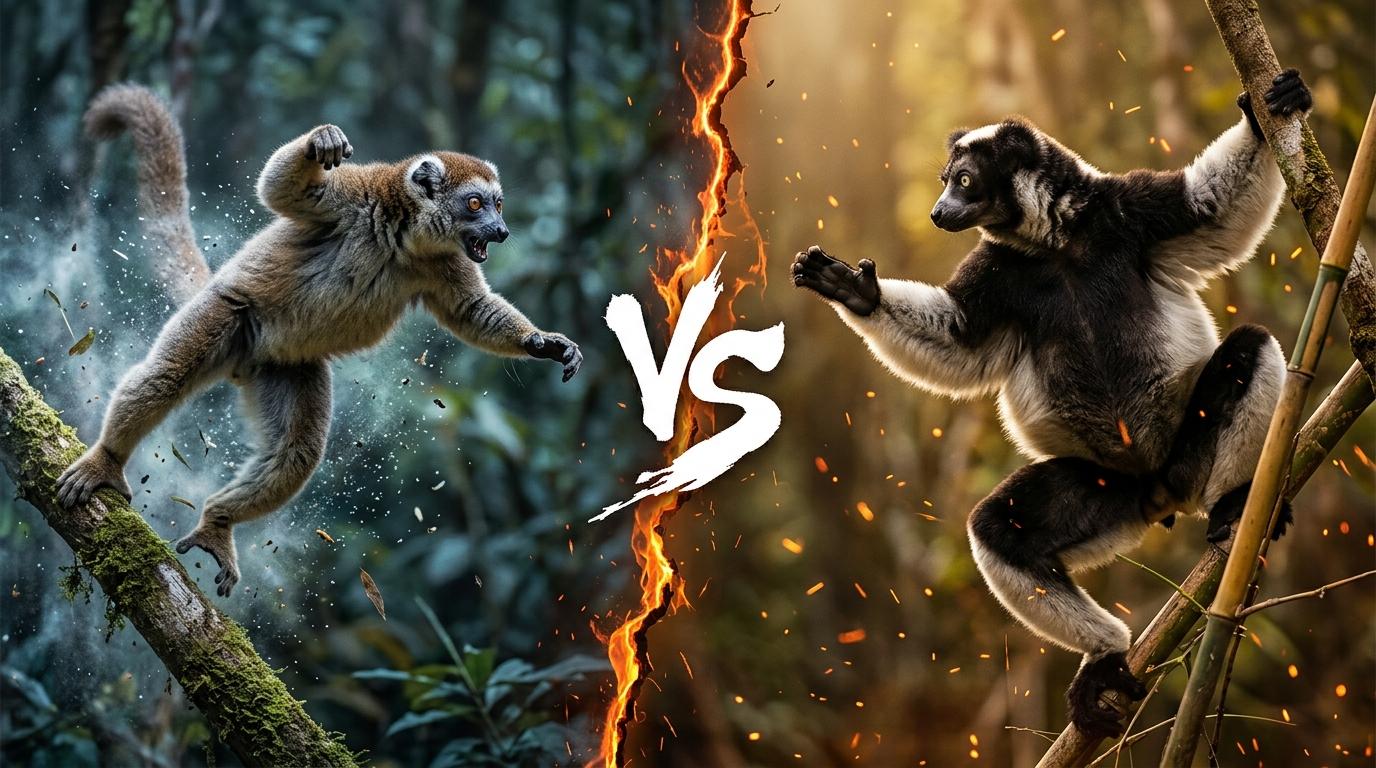
Greater Bamboo Lemur vs Indri: Who Actually Wins?
Greater bamboo lemur vs indri: which Madagascar lemur would win a confrontation? A biology-first look at size, power, agility and behavior, with a clear winner.
Greater Bamboo Lemur vs Indri
Matchup winner
Indri
Quick verdict
Start with the direct answer, then use the structured comparison below to see what changes the outcome.
The indri wins. As the largest living lemur, at roughly 6–9.5 kg against the greater bamboo lemur's 2–2.5 kg, the indri brings about three times the body mass. It also has long, powerful hind legs built for explosive vertical leaps between trunks, and long arms with a strong grip. The greater bamboo lemur is no pushover. Its jaw is specialized to shred tough giant bamboo culms, so its bite is surprisingly strong for its size, and it is quick and compact in dense thickets. But mass, reach and leg-driven launch power decide most physical contests between primates of the same general type, and the indri holds all three. In practice neither species is aggressive across species lines: both are threatened herbivores that avoid fights. As a size-and-hardware matchup, though, the indri is the clear favorite.
Read the full explanation
Indri wins overall, mainly because it is about 3x heavier with far longer limbs.
Bamboo lemur has the more specialized bite and stronger jaw leverage for its size.
Bamboo lemur's best chance is a short scuffle inside dense bamboo where reach matters less.
In the wild they would almost never fight. Both are gentle, critically endangered herbivores.
Reader vote
Who do you think wins?
Pick a side — no account needed. Results update live.
No votes yet — be the first to call it.
Editorial note
Why people disagree
Bite vs bulk: the bamboo lemur's bamboo-crushing jaws sound fearsome, but jaw strength rarely overcomes a 3x size gap.
Body mass advantage
Weight drives shoving, grappling and the ability to absorb hits, so the indri starts far ahead.
Bite hardware
This is the bamboo lemur's real weapon and the reason it stays dangerous up close.
Explosive power
Leg-driven power translates into fast repositioning and forceful contact.
Read the full explanation +
Agility confusion: the bamboo lemur is nimble in thickets, but the indri's vertical clinging-and-leaping is elite canopy athleticism.
Rarity bias: the greater bamboo lemur is one of the world's rarest primates, and people sometimes read 'rare' as 'formidable.'
Comparison FAQ
Short, direct answers to the next questions readers usually ask after the headline verdict.
Would an indri beat a greater bamboo lemur in a fight?+
Yes, in most scenarios. The indri's size, reach and leaping power give it a clear edge, although a fight in dense bamboo would favor the smaller lemur.
Which is stronger, the indri or the greater bamboo lemur?+
The indri is stronger overall because of its much larger body and powerful legs. The bamboo lemur has the stronger bite for its size.
Why is the greater bamboo lemur still dangerous?+
Its jaws are built to split tough bamboo, so a bite can do real damage. In tight cover it is agile enough to use that bite while the indri struggles to maneuver.
Do indris and bamboo lemurs meet in the wild?+
Their ranges overlap in parts of eastern Madagascar's rainforest. They eat different foods and have no reason to fight, so direct conflict is very unlikely.
Which lemur is bigger?+
The indri, which is the largest living lemur at up to about 9.5 kg. The greater bamboo lemur weighs only about 2–2.5 kg.
Head-to-head species stats
These are the same core AnimalDex stat dimensions used on the dedicated animal pages, pulled side by side so the matchup is faster to scan.
Greater Bamboo Lemur
Tier BIndri
Tier BTrait-by-trait comparison
Only the categories that matter to this matchup are included. The goal is not filler stats, but the real design differences that change the result.
~2–2.5 kg, compact
Body mass advantage
Indri
~6–9.5 kg, largest living lemur
Body mass advantage
Indri
Robust jaw specialized to split giant bamboo
Bite hardware
Greater Bamboo Lemur
Leaf-processing teeth, less crushing force
Bite hardware
Greater Bamboo Lemur
Quick hops through stems
Explosive power
Indri
Massive hind-leg launches of up to ~10 m
Explosive power
Indri
Short limbs
Reach and grip
Indri
Long arms, powerful clinging grip
Reach and grip
Indri
Built for dense bamboo stands
Thicket maneuvering
Greater Bamboo Lemur
Built for open trunks, awkward in tangles
Thicket maneuvering
Greater Bamboo Lemur
Contact calls, modest displays
Intimidation and signaling
Indri
Loud, far-carrying songs used in territorial defense
Intimidation and signaling
Indri
How the verdict forms
Verdict timeline
01 · Body mass advantage
Indri
02 · Bite hardware
Greater Bamboo Lemur
03 · Explosive power
Indri
04 · Reach and grip
Indri
05 · Thicket maneuvering
Greater Bamboo Lemur
06 · Intimidation and signaling
Indri
Change the conditions
Scenario breakdown
This is where shallow battle content usually fails. Terrain, spacing, timing, and engagement style can change the answer.
Scenario lean
Greater Bamboo Lemur
Verdict confidence
82%
Bamboo lemur's best ground.
In tight bamboo, the indri's long limbs and leaping style are hampered while the compact bamboo lemur can dart, brace and bite. Clutter cancels reach, and here a strong jaw in a small, agile body can win a short exchange.
AnimalDex field profiles
Explore these animals
Greater Bamboo Lemur
Prolemur simus
bamboo forest and humid montane woodland
Indri
Indri indri
humid rainforest and montane forest
Systems Intelligence & Hidden Purpose
See the animals behind this comparison as engineered biological systems: what each one is built to do, where it gains leverage, and why the matchup changes by scenario.
Specialized Hardware
powerful bamboo-chewing jaws, gray-brown lemur coat, and tall-culm climbing give the Greater Bamboo Lemur a body plan tuned for its niche.
Systems Script
Greater Bamboo Lemurs operate through bamboo forest and humid montane woodland. Their design links movement, feeding, shelter, and timing into one workable survival system.
Strategic Insight
Dense environments reward precision, patience, and the ability to read layered cover.
Specialized Hardware
black-and-white upright body, long carrying forest calls, and vertical trunk-clinging leaps give the Indri a body plan tuned for its niche.
Systems Script
Indris operate through humid rainforest and montane forest. Their design links movement, feeding, shelter, and timing into one workable survival system.
Strategic Insight
Dense environments reward precision, patience, and the ability to read layered cover.
Final take
The indri is the overall winner. It is the biggest lemur alive, with roughly three times the greater bamboo lemur's mass, longer reach and explosive leaping power. In three of four realistic settings, those advantages decide the outcome.
Read the full explanation
The greater bamboo lemur's case rests on its remarkable jaw, evolved to crack open giant bamboo, and on its agility in dense stands. Inside a thicket it could win a short scrap. Outside that niche, it is outsized.
The honest biological answer is that these two would almost never fight. Both are critically endangered herbivores whose survival depends on intact Malagasy forest, not on combat.
Collect both animals in AnimalDex
Track the species behind this matchup, compare their real traits, and build the rivalry into your AnimalDex collection.
Related comparisons
Continue with nearby matchups to compare more real-world animal traits without dropping into junky who-wins filler.

Black-and-white Ruffed Lemur vs Indri: Who Actually Wins?
The indri wins this matchup. As the largest living lemur, an adult indri weighs roughly 6–9.5 kg, about twice the 3–4.5 kg of a black-and-white ruffed lemur. Its long, heavily muscled hind legs launch vertical leaps of up to about 10 m between trunks. In a canopy standoff, that mass and leg-driven power let the indri displace, shove and outlast the smaller lemur. The ruffed lemur is no pushover. It is the quicker, more flexible four-limbed climber, and it can reverse direction along branches faster than the trunk-bound indri. That agility helps it escape or harass. It does not give it the leverage to dislodge an animal twice its weight. In reality, both are critically endangered plant-eaters that settle conflicts with calls, posturing and brief chases rather than real fights.
Read comparison
Bongo vs Indri: Who Actually Wins?
The bongo wins, and it is not close on the ground. It is a heavyset forest antelope weighing roughly 200 to 400 kg, with spiraled horns carried by both sexes and a neck and shoulders built for shoving through dense undergrowth. The indri is the largest living lemur, but it still weighs only about 6 to 9.5 kg. It is a leaf-eating, tree-bound vertical clinger with no weapons designed for combat. In any encounter that forces contact, the bongo's mass and horns end it quickly. The indri's real strength is that it rarely has to fight. Powerful leaps of up to about 10 m carry it between trunks and keep it out of reach. That makes the indri hard to catch, but it cannot beat the bongo, so the overall verdict goes to the bongo.
Read comparison
Discussion
What do you think?
Share your reasoning with other readers. Be civil and stick to the animals.
Sign in to join the discussion.
Sign inNo comments yet. Start the conversation.