

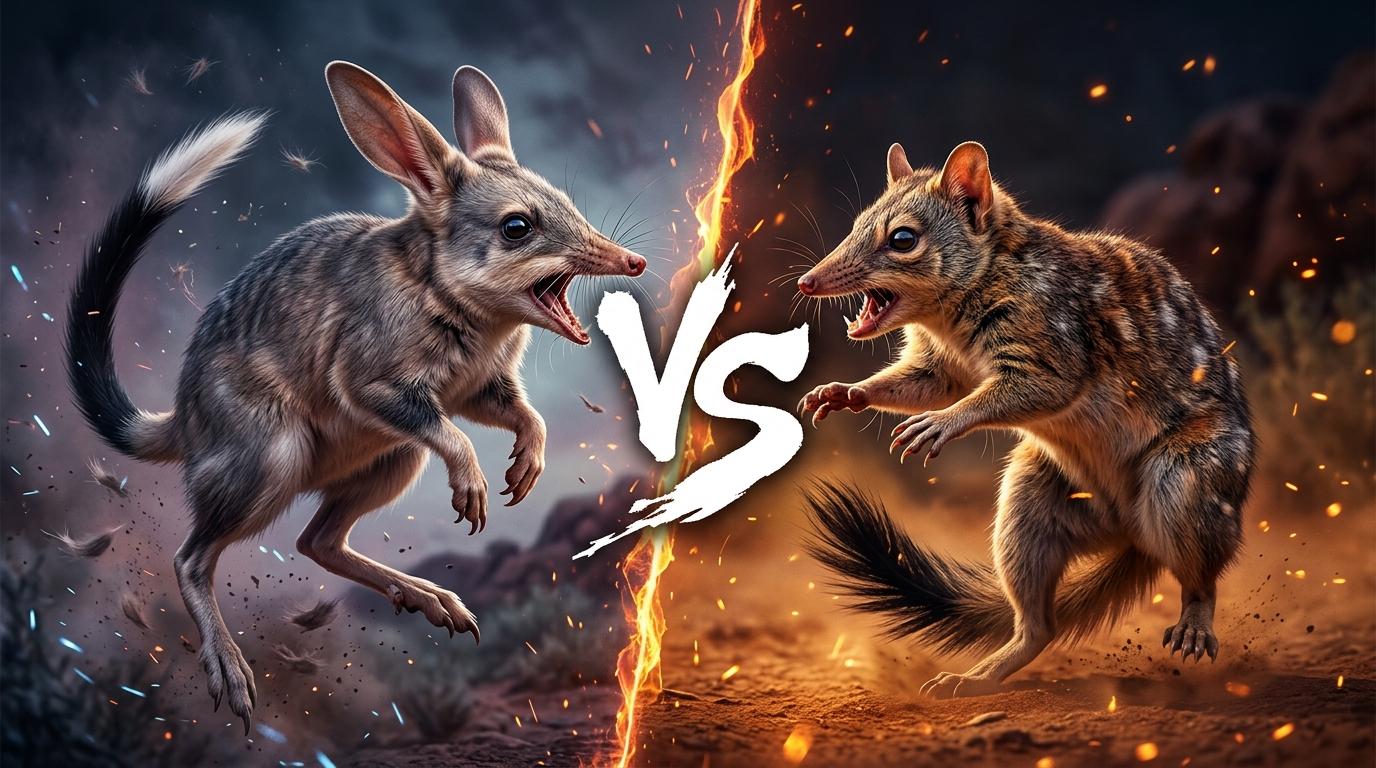
Greater Bilby vs Kowari: Who Actually Wins?
Greater bilby vs kowari: an outback marsupial matchup weighing size, digging power, speed and the kowari's carnivore bite. See who wins and why.
Greater Bilby vs Kowari
Matchup winner
Greater Bilby
Quick verdict
Start with the direct answer, then use the structured comparison below to see what changes the outcome.
The greater bilby wins this matchup most of the time, and the main reason is size. An adult bilby weighs roughly 0.8–2.5 kg, while a kowari is usually 70–175 g. That makes the bilby around ten times heavier. It also has strong, heavily clawed forelimbs built to dig deep spiral burrows, plus a long-legged bounding gait that lets it disengage at will. The kowari is the more aggressive animal. It is a true dasyurid carnivore with sharp teeth, quick reflexes and a hunter's commitment to the bite. It kills insects, spiders, lizards and small rodents with ruthless efficiency, but a full-grown bilby is far outside its prey range. In most realistic encounters the bilby either shoves the smaller marsupial aside with its body and claws or simply leaves. The kowari's real edge exists only against juvenile bilbies or in cramped burrow entrances where speed and bite placement count more than mass.
Read the full explanation
Greater bilby wins overall, mainly because it is about ten times heavier than a kowari.
Bilby forelimb claws are digging tools that double as powerful defensive strikes.
The kowari is the fiercer predator, with a sharp carnivore bite and fast, committed attacks.
A kowari is only a real threat to young bilbies or in tight burrow spaces.
Reader vote
Who do you think wins?
Pick a side — no account needed. Results update live.
No votes yet — be the first to call it.
Editorial note
Why people disagree
Kowaris look and act like miniature hunters, so people assume attitude beats bulk. Across a tenfold weight gap, it rarely does.
Body mass advantage
In small-mammal clashes, mass decides who controls the contact. The bilby can absorb bites and overpower a rival a fraction of its weight.
Strike hardware
The kowari's bite is precise, but bilby claws reach farther and land with leverage from heavily muscled shoulders.
Predatory commitment
The kowari starts fights decisively and will not hesitate. That matters in an ambush and against smaller targets.
Read the full explanation +
Bilbies are omnivores that eat seeds, bulbs, insects and fungi, which makes them seem soft. Their digging arms are anything but.
Both species are rare and rarely filmed, so most opinions come from temperament stereotypes rather than direct observation.
Comparison FAQ
Short, direct answers to the next questions readers usually ask after the headline verdict.
Would a greater bilby beat a kowari?+
Yes, in most cases. An adult bilby's much greater size and powerful clawed forelimbs give it a decisive edge over a kowari.
Which is stronger, a bilby or a kowari?+
The bilby is far stronger in absolute terms. Its digging forelimbs and roughly tenfold weight advantage outclass the kowari's small frame.
Why is the kowari still dangerous?+
It is a true carnivore with sharp teeth, fast reflexes and full commitment to its attacks. In tight burrows or against juvenile bilbies, those strengths can win.
Do bilbies and kowaris actually meet in the wild?+
Their historical ranges overlapped in Australia's arid interior. Today both species are rare and patchily distributed, so encounters are uncommon.
Is the kowari more aggressive than the bilby?+
Yes. Kowaris hunt actively, while bilbies are foragers that usually avoid fights or escape from them.
Head-to-head species stats
These are the same core AnimalDex stat dimensions used on the dedicated animal pages, pulled side by side so the matchup is faster to scan.
Greater Bilby
Tier CKowari
Tier BTrait-by-trait comparison
Only the categories that matter to this matchup are included. The goal is not filler stats, but the real design differences that change the result.
Roughly 0.8–2.5 kg
Body mass advantage
Greater Bilby
Roughly 70–175 g
Body mass advantage
Greater Bilby
Strong clawed forelimbs built for digging
Strike hardware
Greater Bilby
Sharp carnivore teeth and quick bites
Strike hardware
Greater Bilby
Forager that defends and flees
Predatory commitment
Kowari
Active hunter that presses attacks
Predatory commitment
Kowari
Long-legged bounding, quick bursts
Escape and repositioning
Greater Bilby
Agile scurrying, tail-flagging alertness
Escape and repositioning
Greater Bilby
Good, but larger and less twitchy
Close-range reflexes
Kowari
Very fast, hunter-tuned reactions
Close-range reflexes
Kowari
Larger frame that tolerates nips
Close-range durability
Greater Bilby
Small body that is vulnerable to one solid strike
Close-range durability
Greater Bilby
How the verdict forms
Verdict timeline
01 · Body mass advantage
Greater Bilby
02 · Strike hardware
Greater Bilby
03 · Predatory commitment
Kowari
04 · Escape and repositioning
Greater Bilby
05 · Close-range reflexes
Kowari
06 · Close-range durability
Greater Bilby
Change the conditions
Scenario breakdown
This is where shallow battle content usually fails. Terrain, spacing, timing, and engagement style can change the answer.
Scenario lean
Greater Bilby
Verdict confidence
82%
The bilby controls the space or leaves
In open country the kowari has no ambush advantage. The bilby can see it coming, turn to meet it with its forelimbs, or bound away. Mass and choice of engagement both favor the bilby.
AnimalDex field profiles
Explore these animals
Greater Bilby
Macrotis lagotis
arid grassland, dune field, and dry shrubland
Kowari
Dasyuroides byrnei
stony desert, gibber plain, and arid grassland
Systems Intelligence & Hidden Purpose
See the animals behind this comparison as engineered biological systems: what each one is built to do, where it gains leverage, and why the matchup changes by scenario.
Specialized Hardware
very long rabbit-like ears, powerful digging claws, and desert-night burrowing give the Greater Bilby a body plan tuned for its niche.
Systems Script
Greater Bilbys operate through arid grassland, dune field, and dry shrubland. Their design links movement, feeding, shelter, and timing into one workable survival system.
Strategic Insight
Harsh places reward efficiency, timing, and bodies that waste very little.
Specialized Hardware
brush-tipped tail, big insect-hunting eyes, and sand-burrow desert sprint give the Kowari a body plan tuned for its niche.
Systems Script
Kowaris operate through stony desert, gibber plain, and arid grassland. Their design links movement, feeding, shelter, and timing into one workable survival system.
Strategic Insight
Harsh places reward efficiency, timing, and bodies that waste very little.
Final take
The greater bilby is the clear overall winner. It is not the more aggressive animal, but it brings a far larger body, digging claws that work as weapons, and the freedom to walk away. In the arid interior, an animal that can dig through hard soil can certainly drive off a creature the size of a large mouse.
Read the full explanation
The kowari deserves respect anyway. It is one of the most committed small hunters in Australia, and it wins wherever space shrinks or the opponent is young. It simply comes to this particular fight in the wrong weight class.
Collect both animals in AnimalDex
Track the species behind this matchup, compare their real traits, and build the rivalry into your AnimalDex collection.
Related comparisons
Continue with nearby matchups to compare more real-world animal traits without dropping into junky who-wins filler.

Beira vs Kowari: Who Actually Wins?
The beira wins clearly. This small Horn of Africa antelope weighs roughly 9–11 kg, while the kowari, a crest-tailed carnivorous marsupial from Australia's gibber deserts, usually weighs about 70–140 g. That is a mass gap of nearly a hundredfold. The beira also brings hard hooves, a sure-footed rock-hopping frame, and, in males, short spike horns. The kowari is a genuine predator, fast-biting, aggressive for its size, and skilled at killing insects, lizards, and small rodents. But its toolkit is built for prey a fraction of its own weight, not a hoofed animal sixty centimeters at the shoulder. In almost any realistic encounter the beira either bolts out of range or delivers a kick or horn jab the kowari cannot absorb. The kowari's only real 'win' is refusing to be caught by retreating into a burrow.
Read comparison
Kowari vs Red Kangaroo: Who Actually Wins?
The red kangaroo wins, and it isn't close. An adult male red kangaroo can stand around 1.5 m tall and weigh 55–85 kg. It is the largest living marsupial. The kowari is a crest-tailed carnivorous marsupial of about 70–175 g, roughly the weight of a large hamster. The kangaroo's hind-leg kicks, delivered while it balances on its muscular tail, are built to hurt rival males, and its claws can tear skin. The kowari is a fierce, fast-biting predator of insects, lizards and small rodents, but its jaws have nothing big enough to grip on a 400-times-heavier opponent. The kowari's best outcome is not a win. It is escaping into a burrow or a crack in the gibber plain before it gets stepped on or kicked.
Read comparison
Discussion
What do you think?
Share your reasoning with other readers. Be civil and stick to the animals.
Sign in to join the discussion.
Sign inNo comments yet. Start the conversation.