


Kowari vs Red Kangaroo: Who Actually Wins?
Kowari vs red kangaroo: a biology-first look at size, kicking power, speed and grit to show why the red kangaroo wins this desert mismatch, and where the tiny kowari still bites back.
Kowari vs Red Kangaroo
Matchup winner
Red Kangaroo
Quick verdict
Start with the direct answer, then use the structured comparison below to see what changes the outcome.
The red kangaroo wins, and it isn't close. An adult male red kangaroo can stand around 1.5 m tall and weigh 55–85 kg. It is the largest living marsupial. The kowari is a crest-tailed carnivorous marsupial of about 70–175 g, roughly the weight of a large hamster. The kangaroo's hind-leg kicks, delivered while it balances on its muscular tail, are built to hurt rival males, and its claws can tear skin. The kowari is a fierce, fast-biting predator of insects, lizards and small rodents, but its jaws have nothing big enough to grip on a 400-times-heavier opponent. The kowari's best outcome is not a win. It is escaping into a burrow or a crack in the gibber plain before it gets stepped on or kicked.
Read the full explanation
Red kangaroo wins overall, through overwhelming size and kick power.
Kowari weighs under 200 g; a big male red kangaroo can top 80 kg.
The kowari only 'wins' by hiding underground, never by fighting.
Both are Australian desert marsupials, but they occupy completely different weight classes.
Reader vote
Who do you think wins?
Pick a side — no account needed. Results update live.
No votes yet — be the first to call it.
Editorial note
Why people disagree
Kowaris are famously ferocious for their size, so people overrate how far that attitude scales.
Explosive power
Kangaroo kicks deliver force on a scale the kowari's frame cannot absorb.
Mass advantage
A weight gap of several hundred times decides contact before skill matters.
Ambush control
The kowari is the true hunter here, but its prey model tops out far below kangaroo size.
Read the full explanation +
Red kangaroos are grazers, which leads some to assume they are passive, but males fight hard and kick dangerously.
A burrow-bound kowari can outlast a kangaroo's interest, and people sometimes mistake survival for victory.
Comparison FAQ
Short, direct answers to the next questions readers usually ask after the headline verdict.
Would a kowari beat a red kangaroo?+
No. The red kangaroo would win easily because of its enormous size and powerful kicks. A kowari's only realistic outcome is escape.
Which is stronger, a kowari or a red kangaroo?+
The red kangaroo, by a huge margin. Its hind legs generate kicks strong enough to injure rival males, while the kowari weighs under 200 g.
Why is the kowari still dangerous despite losing?+
It is an aggressive carnivore with sharp teeth and fast reactions. It is deadly to insects, lizards and small rodents, and it can deliver a painful bite to anything that grabs it.
Do kowaris and red kangaroos live in the same places?+
Their ranges overlap in parts of the arid interior of central Australia, including gibber plains, though they rarely interact directly.
Are kowaris endangered?+
Kowaris are considered threatened, with a restricted and patchy distribution. That rarity is part of why few people know them.
Head-to-head species stats
These are the same core AnimalDex stat dimensions used on the dedicated animal pages, pulled side by side so the matchup is faster to scan.
Kowari
Tier BRed Kangaroo
Tier CTrait-by-trait comparison
Only the categories that matter to this matchup are included. The goal is not filler stats, but the real design differences that change the result.
Quick lunges and snapping bites
Explosive power
Red Kangaroo
Tail-braced double hind-leg kicks
Explosive power
Red Kangaroo
About 70–175 g
Mass advantage
Red Kangaroo
Up to about 85 kg in large males
Mass advantage
Red Kangaroo
Nocturnal hunter, quick strike on small prey
Ambush control
Kowari
No predatory ambush instinct
Ambush control
Kowari
Fast scurrying over short bursts
Open-ground speed
Red Kangaroo
Hops at 50+ km/h, with huge stride
Open-ground speed
Red Kangaroo
Small body, easily injured by one blow
Close-range durability
Red Kangaroo
Thick muscle, built to absorb rival kicks
Close-range durability
Red Kangaroo
Uses burrows and cracks; disappears fast
Refuge tactics
Kowari
Relies on flight and vigilance
Refuge tactics
Kowari
How the verdict forms
Verdict timeline
01 · Explosive power
Red Kangaroo
02 · Mass advantage
Red Kangaroo
03 · Ambush control
Kowari
04 · Open-ground speed
Red Kangaroo
05 · Close-range durability
Red Kangaroo
06 · Refuge tactics
Kowari
Change the conditions
Scenario breakdown
This is where shallow battle content usually fails. Terrain, spacing, timing, and engagement style can change the answer.
Scenario lean
Red Kangaroo
Verdict confidence
82%
Kangaroo dominates.
With no cover, the kowari has nowhere to retreat. The kangaroo's reach, mass and kicking ability make any contact one-sided. The kowari's speed only helps it flee, and on bare ground fleeing is hard.
AnimalDex field profiles
Explore these animals
Kowari
Dasyuroides byrnei
stony desert, gibber plain, and arid grassland
Red Kangaroo
Osphranter rufus
Arid grassland, desert scrub, and open semi-arid plains with scattered cover.
Systems Intelligence & Hidden Purpose
See the animals behind this comparison as engineered biological systems: what each one is built to do, where it gains leverage, and why the matchup changes by scenario.
Specialized Hardware
brush-tipped tail, big insect-hunting eyes, and sand-burrow desert sprint give the Kowari a body plan tuned for its niche.
Systems Script
Kowaris operate through stony desert, gibber plain, and arid grassland. Their design links movement, feeding, shelter, and timing into one workable survival system.
Strategic Insight
Harsh places reward efficiency, timing, and bodies that waste very little.
Specialized Hardware
Massive hind limbs, spring-loaded tendons, and a balancing tail make the red kangaroo low-cost locomotion hardware for sparse arid landscapes.
Systems Script
Red kangaroos track rain-driven productivity across desert systems and turn brief green windows into usable population gain. They are built to exploit pulses, not pretend the desert is stable.
Strategic Insight
In volatile systems, efficiency beats bravado. Save energy until the good window opens.
Final take
The red kangaroo is the clear winner. This is a heavyweight against a creature you could hold in one hand, and the kangaroo's kick-and-tail fighting system is far beyond anything the kowari can counter.
Read the full explanation
The kowari deserves respect anyway. It is a rare, fierce little dasyurid that hunts relentlessly on harsh inland plains. Its winning strategy is never confrontation. It reads the terrain and is gone before trouble arrives.
Collect both animals in AnimalDex
Track the species behind this matchup, compare their real traits, and build the rivalry into your AnimalDex collection.
Related comparisons
Continue with nearby matchups to compare more real-world animal traits without dropping into junky who-wins filler.
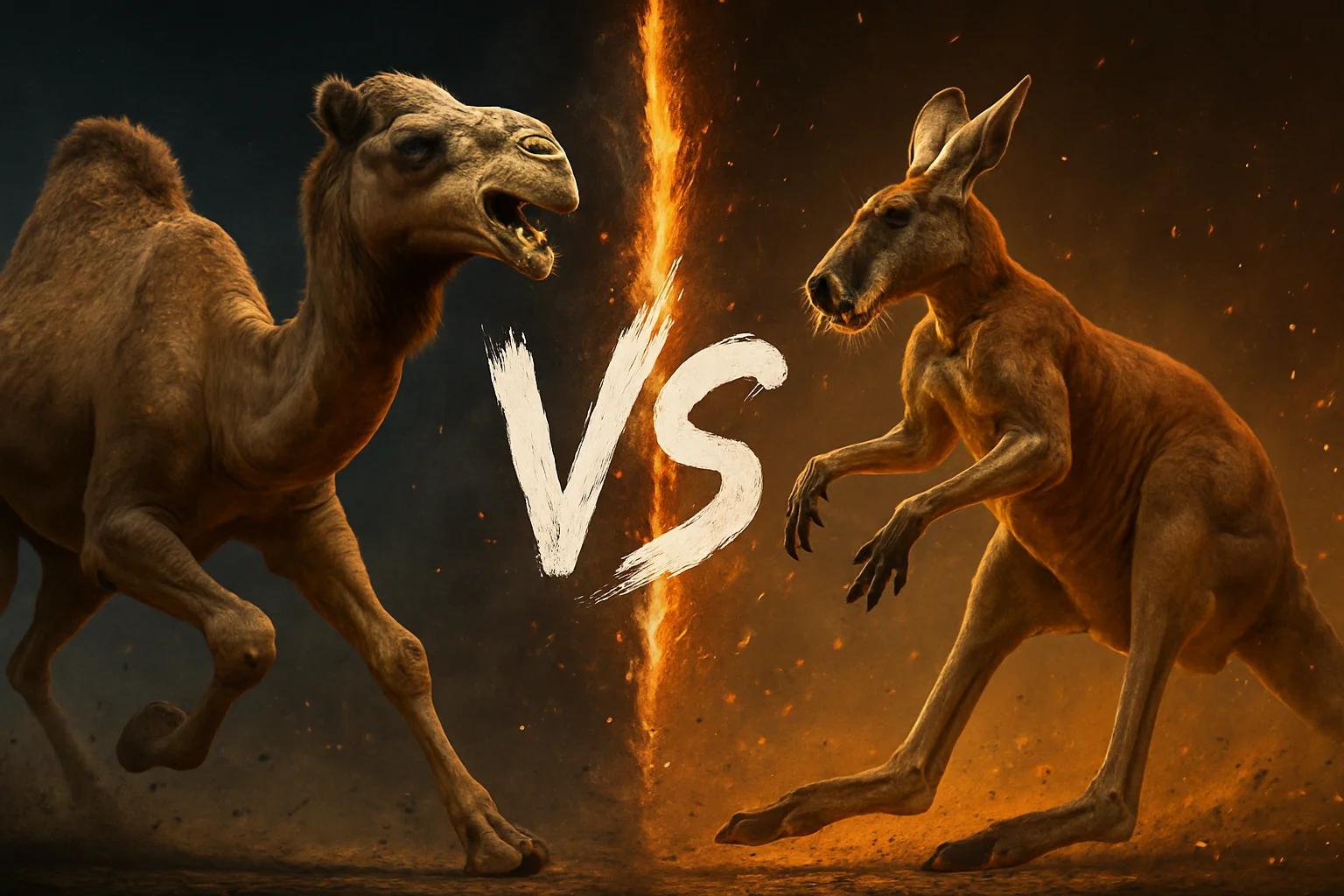
Dromedary Camel vs Red Kangaroo: Who Actually Wins?
The dromedary camel wins this matchup overall. A bull camel weighs roughly 400–600 kg against a big male red kangaroo's 55–90 kg, a mass gap of five to eight times. The kangaroo brings the more refined weapon: a tail-braced double kick with clawed hind feet that can open skin and break ribs on animals its own size. But those kicks were shaped by ritualized boxing between kangaroos and by defense against dingoes, not by contests with a half-tonne ungulate. A camel's thick hide, dense neck and chest, crushing bite and stamping forefeet let it absorb punishment and dish it out at a scale the kangaroo cannot match. The kangaroo's real edge is speed and evasion, so it wins any scenario where it can simply leave. In a committed, close-range confrontation, the camel's size settles it.
Read comparison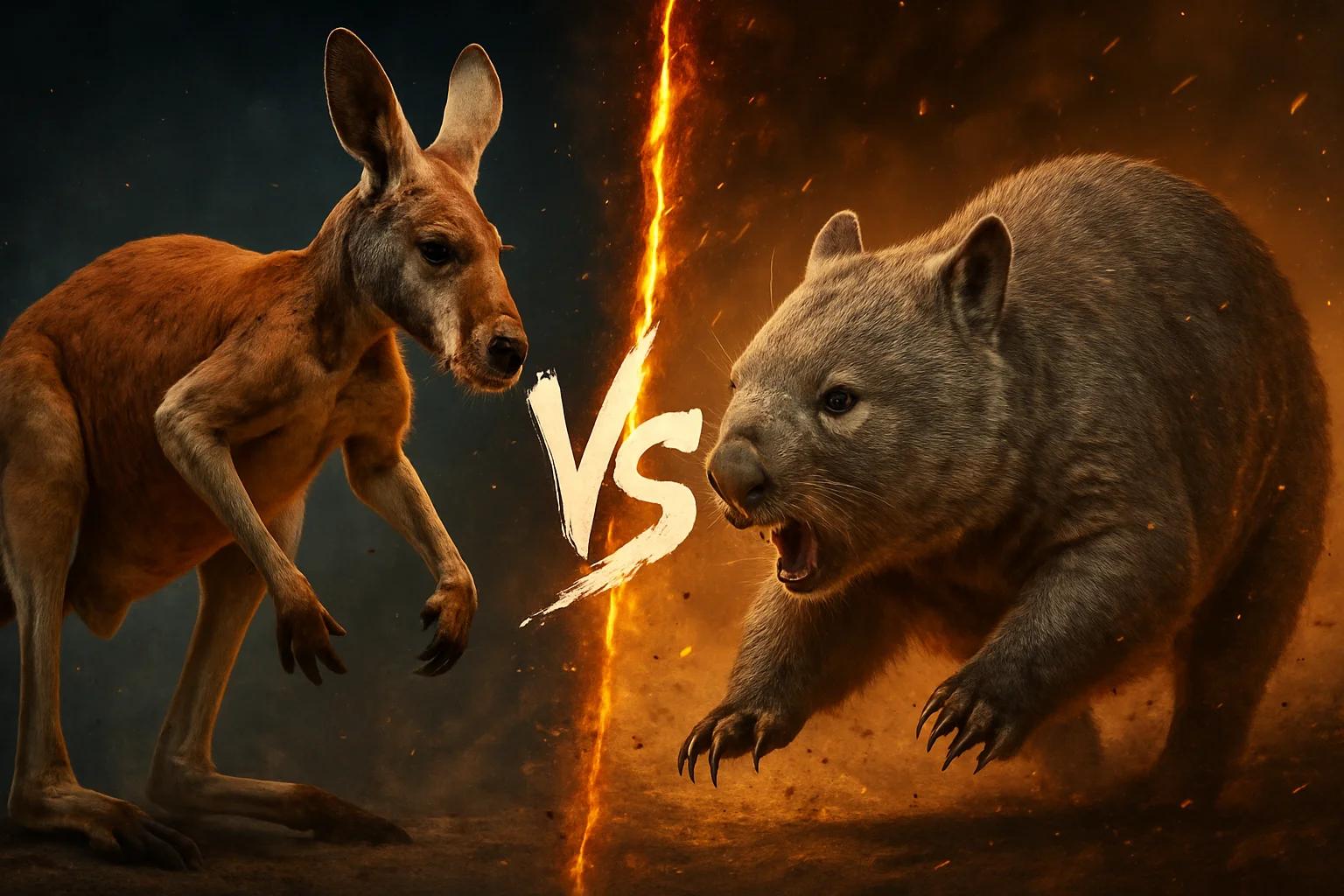
Red Kangaroo vs Southern Hairy-nosed Wombat: Who Actually Wins?
The red kangaroo wins this matchup overall. A large male red kangaroo can weigh around 85 kg and stand taller than most people, against a southern hairy-nosed wombat of roughly 19–32 kg. That size gap is decisive. The kangaroo also brings tail-braced double kicks with clawed hind feet, gripping forearms and serious speed. The wombat is no pushover. It is a dense, low-slung digging machine with a tough rump and powerful forelimbs. Next to its burrow it can make any intruder pay. But in open terrain it has no real way to stop a bigger, faster animal that can strike from range and leave whenever it wants. The kangaroo controls distance and timing. The wombat can only control its doorway.
Read comparison
Discussion
What do you think?
Share your reasoning with other readers. Be civil and stick to the animals.
Sign in to join the discussion.
Sign inNo comments yet. Start the conversation.