

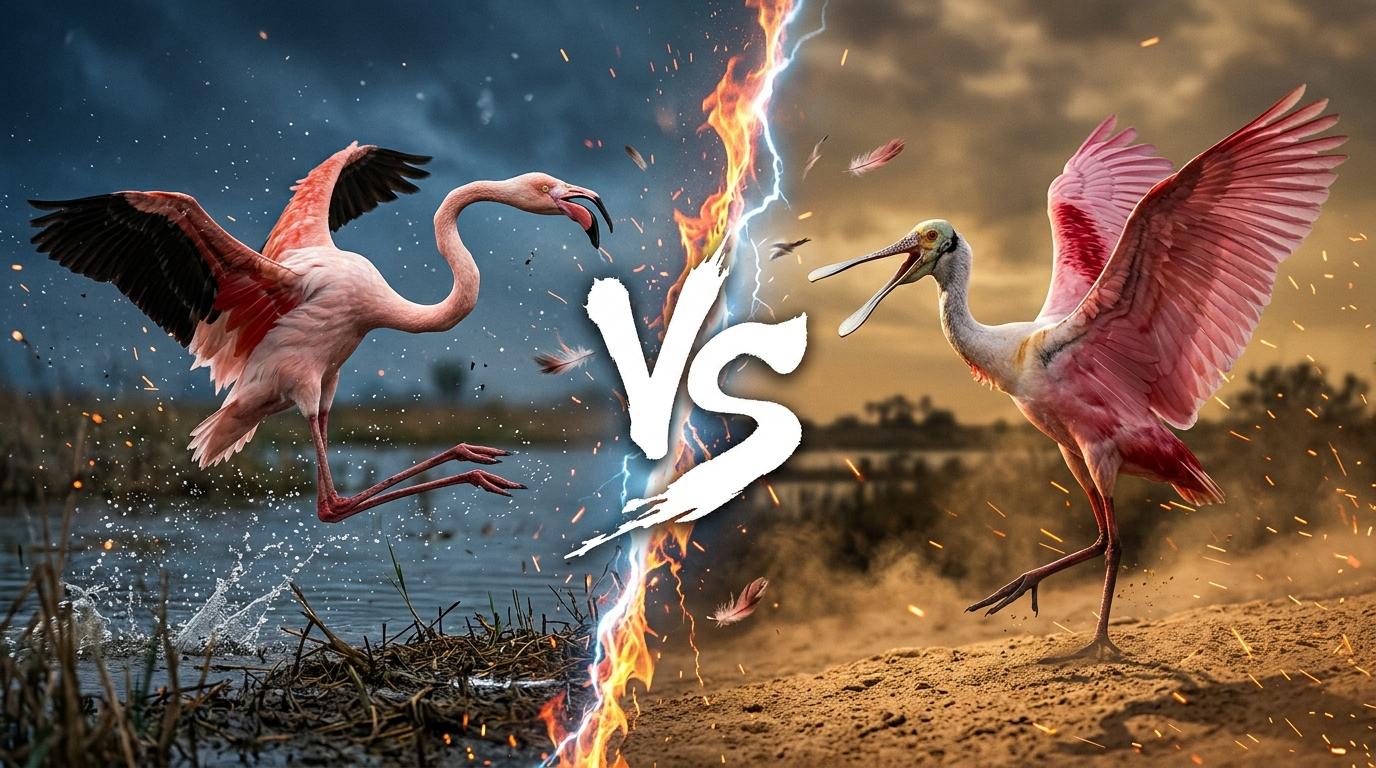
Greater Flamingo vs Roseate Spoonbill: Who Actually Wins?
Greater Flamingo vs Roseate Spoonbill: which wading bird would win a confrontation? We compare size, reach, beak design, flock behavior, and real-world aggression to pick a clear winner.
Greater Flamingo vs Roseate Spoonbill
Matchup winner
Greater Flamingo
Quick verdict
Start with the direct answer, then use the structured comparison below to see what changes the outcome.
The Greater Flamingo wins this matchup in most realistic encounters. It is the largest flamingo species, standing up to about 1.5 m tall and weighing roughly 2–4 kg. A Roseate Spoonbill is about 70–85 cm long and weighs around 1.2–1.8 kg. That gives the flamingo a big lead in height, neck reach and body mass. Its stiff, downward-bent bill works well for jabbing, and its long legs let it hold ground in deeper water. Flamingos also live in huge, noisy colonies where neck-stretching threat displays and pecking over space are routine, so pushing other birds around is part of daily life. The spoonbill is quick and agile and spars readily with its broad bill, but its spatula-shaped beak is built for sweeping and grabbing prey, not for delivering force. In a shoving and pecking contest over mud or water, the flamingo's leverage usually decides it.
Read the full explanation
Greater Flamingo wins most encounters thanks to roughly double the body mass and much greater height and reach.
The spoonbill is nimble and quick to spar, but its flat spoon bill is a poor weapon.
Real disputes between these birds are posturing and pecking over space, not lethal fights.
The spoonbill's best chance is in tight, cluttered cover where agility beats leverage.
Reader vote
Who do you think wins?
Pick a side — no account needed. Results update live.
No votes yet — be the first to call it.
Editorial note
Why people disagree
Spoonbills look tougher because of their heavier-looking bills and hunting habits, while flamingos seem delicate. In reality the flamingo's size and reach dominate.
Size and reach
In bird disputes, height and reach decide who strikes first and who has to back off. The flamingo towers over the spoonbill.
Beak as a weapon
Neither beak evolved for fighting. The flamingo's is narrower at the tip and delivered from height, which makes it the more effective pecking tool.
Close-quarters agility
Agility lets the spoonbill dodge and counter-jab, especially among roots and branches.
Read the full explanation +
Spoonbills eat fish, crustaceans and insects, so people assume they are more aggressive. But catching small prey is not the same as winning fights with bigger birds.
Flamingo aggression is easy to miss because it happens inside huge colonies. In fact, flamingos spend a lot of time threatening and pecking neighbors over nest and feeding space.
Comparison FAQ
Short, direct answers to the next questions readers usually ask after the headline verdict.
Would a Greater Flamingo beat a Roseate Spoonbill in a fight?+
Yes, in most cases. The flamingo's height, reach and greater weight usually make the spoonbill retreat after a short pecking exchange.
Which bird is stronger, the flamingo or the spoonbill?+
The Greater Flamingo. It typically weighs about twice as much as the spoonbill and has much more leg and neck leverage.
Why is the Roseate Spoonbill still dangerous?+
It is quick and maneuverable, and it defends its nest hard. In cluttered cover, a spoonbill can jab and dodge effectively against a larger bird.
Do flamingos and spoonbills actually fight in the wild?+
Their ranges overlap only in limited areas, mainly where American Flamingos meet spoonbills. When wading birds do clash, it is mostly threat displays and brief pecking over space, and serious injuries are rare.
Head-to-head species stats
These are the same core AnimalDex stat dimensions used on the dedicated animal pages, pulled side by side so the matchup is faster to scan.
Greater Flamingo
Tier CRoseate Spoonbill
Tier CTrait-by-trait comparison
Only the categories that matter to this matchup are included. The goal is not filler stats, but the real design differences that change the result.
Up to ~1.5 m tall, 2–4 kg, very long neck
Size and reach
Greater Flamingo
~70–85 cm long, 1.2–1.8 kg
Size and reach
Greater Flamingo
Stiff, bent filter bill that works for downward jabs
Beak as a weapon
Greater Flamingo
Flat spatula tip built for tactile sweeping
Beak as a weapon
Greater Flamingo
Long-limbed and a bit awkward in tight spaces
Close-quarters agility
Roseate Spoonbill
Compact, quick to turn and reposition
Close-quarters agility
Roseate Spoonbill
Constant jostling in colonies that can number in the thousands
Territorial conditioning
Greater Flamingo
Defends nests in mixed colonies and spars over feeding spots
Territorial conditioning
Greater Flamingo
Comfortable wading and feeding in deeper water
Footing in deep water
Greater Flamingo
Best in shallow water
Footing in deep water
Greater Flamingo
How the verdict forms
Verdict timeline
01 · Size and reach
Greater Flamingo
02 · Beak as a weapon
Greater Flamingo
03 · Close-quarters agility
Roseate Spoonbill
04 · Territorial conditioning
Greater Flamingo
05 · Footing in deep water
Greater Flamingo
Change the conditions
Scenario breakdown
This is where shallow battle content usually fails. Terrain, spacing, timing, and engagement style can change the answer.
Scenario lean
Greater Flamingo
Verdict confidence
82%
Flamingo wins clearly
In open water with nowhere to hide, size and reach are everything. The flamingo can stretch its neck, flare its wings, and peck downward before the spoonbill gets close. The spoonbill will usually retreat after a few exchanges.
AnimalDex field profiles
Explore these animals
Greater Flamingo
Phoenicopterus roseus
Salt pans, lagoons, estuaries, alkaline lakes, and shallow coastal wetlands.
Roseate Spoonbill
Platalea ajaja
Shallow wetlands, marshes, mangroves, lagoons, and estuaries.
Systems Intelligence & Hidden Purpose
See the animals behind this comparison as engineered biological systems: what each one is built to do, where it gains leverage, and why the matchup changes by scenario.
Specialized Hardware
Long legs, downturned filter-feeding bill, and flock-scale movement make flamingos wetland processing hardware for shallow nutrient-rich water.
Systems Script
Flamingos convert microscopic productivity into visible biomass and signal whether a saline wetland is still functioning at scale. Their abundance is often a readout of the whole water chemistry story.
Strategic Insight
Do not ignore low-level input streams. Tiny resources, processed well, can support very large systems.
Specialized Hardware
Bright pink plumage, long flat spoon-shaped bill, and long legs for wading give the Roseate Spoonbill a body plan tuned for its niche.
Systems Script
Roseate Spoonbills operate in shallow wetlands, marshes, mangroves, lagoons, and estuaries. Their design helps them match food access, shelter, and timing inside that environment.
Strategic Insight
A small change in tool shape can completely change how food is gathered.
Final take
The Greater Flamingo is the clear overall winner. It is bigger and taller, and it is used to defending space inside large colonies. The pink coloring fools people. This is a large bird that handles conflict regularly.
Read the full explanation
The Roseate Spoonbill is not helpless. It is agile and confident, and in mangrove thickets it can outmaneuver the flamingo. But most realistic encounters happen on open water and mudflats, and in those places size and reach decide the outcome.
Collect both animals in AnimalDex
Track the species behind this matchup, compare their real traits, and build the rivalry into your AnimalDex collection.
Related comparisons
Continue with nearby matchups to compare more real-world animal traits without dropping into junky who-wins filler.

Greater Flamingo vs Pied Avocet: Who Actually Wins?
The Greater Flamingo wins. At roughly 2–4 kg and up to about 1.5 m tall, it outweighs the Pied Avocet (about 250–400 g) by close to ten to one. It also brings a long, muscular neck and a heavy, down-bent bill that it already uses in jabbing, neck-jousting colony squabbles. The avocet is one of Europe's most combative waders. It will dive-bomb gulls, harriers, and even people near its nest, and it is quicker and more agile in the air. But its slender, upturned bill is a precision sweeping tool, not a weapon, and its light frame cannot absorb a solid shove or strike from a bird that big. In any sustained contact the flamingo's mass and reach decide it. The avocet's best result is harassment, not victory.
Read comparison
Great White Pelican vs Greater Flamingo: Who Actually Wins?
The Great White Pelican wins this matchup clearly. It is the heavier bird, typically 9–15 kg against the flamingo's 2–4 kg. It has one of the largest wingspans of any flying bird, up to about 3.6 m, and it carries a long, hooked-tip bill built to grab, pin, and shove. The Greater Flamingo is taller and leggier, but its bill is a specialized filter-feeding sieve, not a weapon. Its slender legs and neck are built for wading and display, not for absorbing body checks. In any close contest over space, a pelican's mass, wing buffeting, and bill strikes overpower a flamingo. The flamingo's real edge is avoidance: it can run, take off, and vanish into a dense flock. It wins by leaving, not by fighting.
Read comparison
Discussion
What do you think?
Share your reasoning with other readers. Be civil and stick to the animals.
Sign in to join the discussion.
Sign inNo comments yet. Start the conversation.