

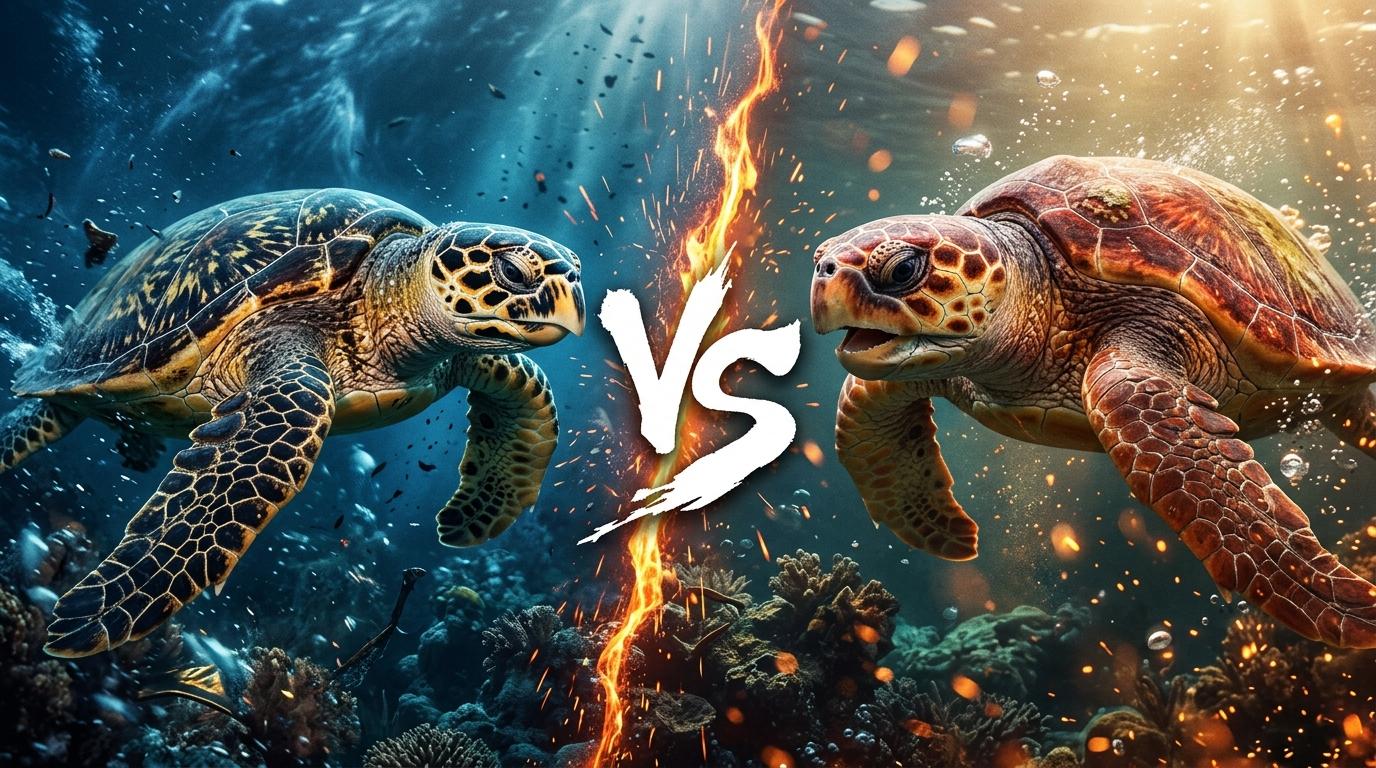
Hawksbill Sea Turtle vs Loggerhead Sea Turtle: Who Actually Wins?
Hawksbill vs loggerhead sea turtle: who would win? We compare size, bite force, shell armor, and behavior to name a clear winner and explain why.
Hawksbill Sea Turtle vs Loggerhead Sea Turtle
Matchup winner
Loggerhead Sea Turtle
Quick verdict
Start with the direct answer, then use the structured comparison below to see what changes the outcome.
The loggerhead sea turtle wins. Adult loggerheads typically weigh around 80–140 kg against roughly 45–70 kg for a hawksbill, and they carry one of the strongest bites of any sea turtle. Their oversized head and heavy jaw muscles evolved to crush conch, whelks, and crabs. A hawksbill is no pushover. Its narrow, beak-like jaw is a precision tool for tearing sponges out of reef crevices, and its overlapping scutes make tough armor. But in a shoving, biting contest between two armored reptiles, mass and crushing power decide the outcome. The loggerhead can displace the smaller turtle, bite harder, and absorb more punishment. The hawksbill's real edge is reef agility, which lets it escape a fight rather than win one.
Read the full explanation
Loggerhead wins: it is often roughly double the hawksbill's weight.
The loggerhead's bite is built to crush mollusk shells. The hawksbill's beak is built to pick sponges out of reef cracks.
The hawksbill is more maneuverable in tight coral and can usually disengage.
Real encounters are rare and almost never lethal. This is a shoving and biting contest, not a death match.
Reader vote
Who do you think wins?
Pick a side — no account needed. Results update live.
No votes yet — be the first to call it.
Editorial note
Why people disagree
The hawksbill's sharp, hooked beak looks more dangerous, but beak shape is not the same as bite power.
Mass and frame
In a pushing contest between armored animals, weight decides who gets displaced.
Crushing bite
The loggerhead's jaw muscles are tuned for exactly the force needed to damage armor and flippers.
Precision strike
The hawksbill can target flipper edges and soft tissue more surgically.
Read the full explanation +
Both species are endangered reef and coastal grazers, so many readers assume they never conflict. In reality, adult turtles do compete over resting spots and feeding ledges.
Hawksbill shells look thicker because of their overlapping scutes, which leads some people to overrate its defense against a crushing bite.
Comparison FAQ
Short, direct answers to the next questions readers usually ask after the headline verdict.
Would a loggerhead sea turtle beat a hawksbill sea turtle?+
Yes. In most realistic encounters the loggerhead wins. It is often around twice the hawksbill's weight and has a much stronger crushing bite.
Which sea turtle is stronger, hawksbill or loggerhead?+
The loggerhead. Its oversized head houses powerful jaw muscles built to crush conch and crab shells, and its larger body gives it more pushing power.
Why is the hawksbill still dangerous even if it loses?+
Its hooked, razor-edged beak can deliver precise, painful bites to flippers and soft tissue. Its reef agility also lets it strike and retreat before the loggerhead can respond.
Do hawksbill and loggerhead sea turtles actually fight?+
Rarely, and almost never to serious injury. Most conflicts are brief shoving or biting disputes over resting spots or feeding areas, usually ending with the smaller turtle leaving.
Where would a hawksbill have the best chance?+
In tight coral reef structure, where it can out-turn the bulkier loggerhead and avoid being pinned.
Head-to-head species stats
These are the same core AnimalDex stat dimensions used on the dedicated animal pages, pulled side by side so the matchup is faster to scan.
Hawksbill Sea Turtle
Tier BLoggerhead Sea Turtle
Tier CTrait-by-trait comparison
Only the categories that matter to this matchup are included. The goal is not filler stats, but the real design differences that change the result.
~45–70 kg, compact reef body
Mass and frame
Loggerhead Sea Turtle
~80–140 kg, broad heavy carapace
Mass and frame
Loggerhead Sea Turtle
Narrow beak for precise tearing
Crushing bite
Loggerhead Sea Turtle
Massive head, shell-cracking jaws
Crushing bite
Loggerhead Sea Turtle
Hooked beak reaches crevices and edges
Precision strike
Hawksbill Sea Turtle
Blunt, powerful but less precise
Precision strike
Hawksbill Sea Turtle
Tight turns through coral
Reef agility
Hawksbill Sea Turtle
Steadier, less nimble in clutter
Reef agility
Hawksbill Sea Turtle
Overlapping scutes, smaller reserves
Close-range durability
Loggerhead Sea Turtle
Thick shell, larger body reserves
Close-range durability
Loggerhead Sea Turtle
Holds sponge patches, tends to yield
Territorial assertiveness
Loggerhead Sea Turtle
Known to bite and shove rivals
Territorial assertiveness
Loggerhead Sea Turtle
How the verdict forms
Verdict timeline
01 · Mass and frame
Loggerhead Sea Turtle
02 · Crushing bite
Loggerhead Sea Turtle
03 · Precision strike
Hawksbill Sea Turtle
04 · Reef agility
Hawksbill Sea Turtle
05 · Close-range durability
Loggerhead Sea Turtle
06 · Territorial assertiveness
Loggerhead Sea Turtle
Change the conditions
Scenario breakdown
This is where shallow battle content usually fails. Terrain, spacing, timing, and engagement style can change the answer.
Scenario lean
Hawksbill Sea Turtle
Verdict confidence
82%
The hawksbill escapes or holds its ground.
Among coral heads and overhangs, the loggerhead's bulk becomes a liability. The hawksbill can slip into gaps, keep structure between itself and its rival, and nip at exposed flippers. It still does not overpower the loggerhead. It simply denies it a clean engagement, which counts as a local win.
AnimalDex field profiles
Explore these animals
Hawksbill Sea Turtle
Eretmochelys imbricata
coral reef, lagoon, and tropical nesting beach
Loggerhead Sea Turtle
Caretta caretta
open ocean, coastal shelf, and sandy nesting beach
Systems Intelligence & Hidden Purpose
See the animals behind this comparison as engineered biological systems: what each one is built to do, where it gains leverage, and why the matchup changes by scenario.
Specialized Hardware
narrow hawk-like beak, reef-feeding specialization, and beautiful overlapping shell scutes give the Hawksbill Sea Turtle a body plan tuned for its niche.
Systems Script
Hawksbill Sea Turtles operate through coral reef, lagoon, and tropical nesting beach Their design links movement, shelter, and feeding into one workable survival system.
Strategic Insight
Specialization becomes fragile when the complex system it depends on begins to break.
Specialized Hardware
large blocky head, powerful shell-crushing jaws, and long-distance ocean migration give the Loggerhead Sea Turtle a body plan tuned for its niche.
Systems Script
Loggerhead Sea Turtles operate through open ocean, coastal shelf, and sandy nesting beach Their design links movement, shelter, and feeding into one workable survival system.
Strategic Insight
A system can range widely and still depend on one exact place to restart.
Final take
The loggerhead sea turtle is the clear winner. It is a heavier, harder-biting reptile whose jaws evolved to crack armored prey, and those are exactly the tools that matter in a turtle-on-turtle confrontation.
Read the full explanation
The hawksbill's strength is precision and agility. In dense reef it can deny the loggerhead a fight and land sharp nips, but denying a fight is not the same as winning one. Across open water, resource disputes, and drawn-out clashes, size and bite force carry the result for the loggerhead.
Collect both animals in AnimalDex
Track the species behind this matchup, compare their real traits, and build the rivalry into your AnimalDex collection.
Related comparisons
Continue with nearby matchups to compare more real-world animal traits without dropping into junky who-wins filler.
Leatherback Sea Turtle vs Loggerhead Sea Turtle: Who Actually Wins?
The leatherback sea turtle wins, and it isn't especially close. Adult leatherbacks commonly weigh 300–600 kg, with exceptional individuals approaching 900 kg. That makes them roughly three to five times heavier than a typical 80–180 kg loggerhead. Their front flippers can span over 2.5 m, among the most powerful swimming engines of any reptile. In a pushing, shoving, displacement contest, which is how turtle conflicts actually play out, mass and thrust decide the outcome. The loggerhead has real weapons: a massive head and crushing jaws built to crack conch shells and crab armor, plus a hard keratin-plated carapace that the leatherback lacks. Those tools make it a dangerous nuisance, but they cannot overcome a size gap that lets the leatherback simply muscle it aside and outlast it.
Read comparison
Discussion
What do you think?
Share your reasoning with other readers. Be civil and stick to the animals.
Sign in to join the discussion.
Sign inNo comments yet. Start the conversation.