

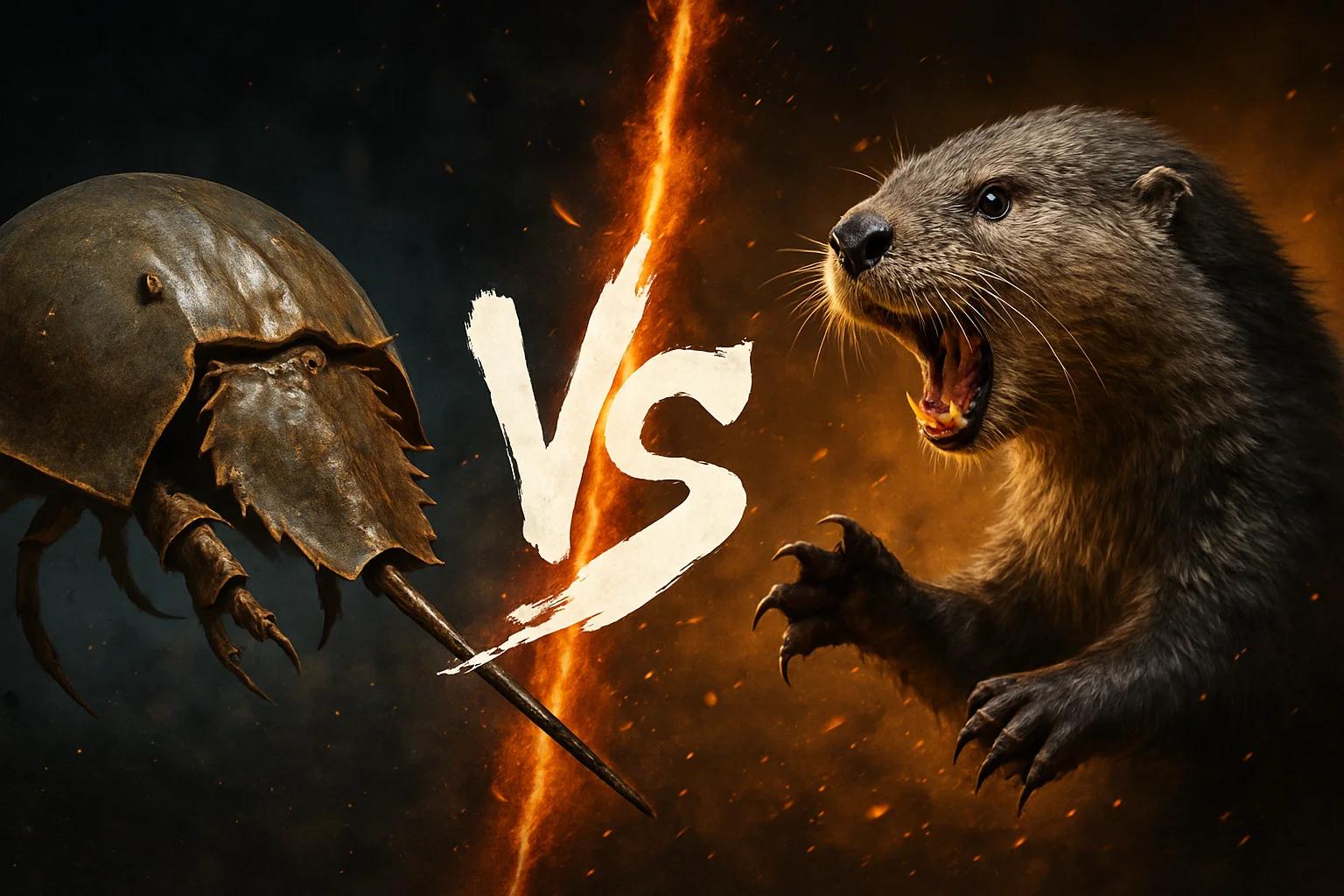
Horseshoe Crab vs Sea Otter: Who Actually Wins?
Horseshoe crab vs sea otter: who would win? A biology-first breakdown of armor, intelligence, and why the sea otter, a tool-using shell-cracker, takes this matchup.
Horseshoe Crab vs Sea Otter
Matchup winner
Sea Otter
Quick verdict
Start with the direct answer, then use the structured comparison below to see what changes the outcome.
The sea otter wins, and it isn't close. This matchup pits a 450-million-year-old armored bottom-dweller against one of the ocean's most skilled shell-breakers. Sea otters (Enhydra lutris) make their living opening hard-shelled prey such as crabs, urchins, clams, and abalone. They use dexterous forepaws, crushing molars, and sometimes rocks as anvils or hammers. The horseshoe crab (Limulus polyphemus) has a tough domed carapace and a spiky edge. But it has no venom, no pinching claws strong enough to hurt a mammal, and a tail spine (telson) used mainly to steer and to flip itself upright, not to stab. Armor buys time, and the otter has plenty of time, problem-solving ability, and a jaw built for exactly this job. One caveat: the two never meet in the wild. Horseshoe crabs live on the Atlantic coast of North America, and sea otters live in the North Pacific. So this is a hypothetical matchup based on body design and behavior.
Read the full explanation
Sea otter wins: it is a specialist at breaking into armored prey.
The horseshoe crab's defense is armor and patience, not attack.
The otter's intelligence and tool use turn the crab's main asset into a solvable puzzle.
The two species' ranges never overlap, so this is a hypothetical matchup.
Reader vote
Who do you think wins?
Pick a side — no account needed. Results update live.
No votes yet — be the first to call it.
Editorial note
Why people disagree
The horseshoe crab looks dangerous because of its spiky tail, but the telson is a steering and righting lever, not a weapon.
Armored endurance
The crab's shell is its only real edge. It forces the otter to work rather than strike quickly.
Shell-breaking power
Otter teeth are designed to break hard shells, which directly counters the crab's only defense.
Tactical problem-solving
An otter can flip the crab onto its back to reach the softer underside, which neutralizes the armor.
Read the full explanation +
Many people assume a hard shell means victory. In nature, shells mostly slow predators down rather than stopping them.
Some readers expect a cute otter to be harmless, but sea otters have powerful bites and are seasoned predators of armored animals.
Comparison FAQ
Short, direct answers to the next questions readers usually ask after the headline verdict.
Would a horseshoe crab beat a sea otter?+
No. The sea otter would win almost every time, because it is built to break into armored prey.
Which is stronger, a horseshoe crab or a sea otter?+
The sea otter. It is heavier, has a powerful crushing bite, and has strong forelimbs. The horseshoe crab's strength is mostly passive armor.
Is the horseshoe crab dangerous at all?+
Only mildly. Its spiny shell edges and tail can poke or scratch, which makes it awkward to grab. It has no venom and does not sting. Its tail is used to flip itself over, not to attack.
Why does the horseshoe crab still matter?+
Its eggs feed migrating shorebirds like red knots. Its blood supplies limulus amebocyte lysate (LAL), which is used to test medical products for bacterial contamination.
Do sea otters and horseshoe crabs meet in the wild?+
No. Atlantic horseshoe crabs live along the North American Atlantic coast, while sea otters live in the North Pacific.
Head-to-head species stats
These are the same core AnimalDex stat dimensions used on the dedicated animal pages, pulled side by side so the matchup is faster to scan.
Horseshoe Crab
Tier DSea Otter
Tier ATrait-by-trait comparison
Only the categories that matter to this matchup are included. The goal is not filler stats, but the real design differences that change the result.
Domed chitin carapace with spiny margins
Armored endurance
Horseshoe Crab
Dense fur, no armor
Armored endurance
Horseshoe Crab
Weak pincers built for handling food, not fighting
Shell-breaking power
Sea Otter
Blunt crushing molars and a strong bite
Shell-breaking power
Sea Otter
Simple, instinct-driven behavior
Tactical problem-solving
Sea Otter
Tool use, flipping and manipulating prey
Tactical problem-solving
Sea Otter
Slow crawler and awkward upside-down swimmer
Mobility in water
Sea Otter
Agile swimmer and diver
Mobility in water
Sea Otter
Edge spines; the telson is not a weapon
Offensive weaponry
Sea Otter
Bite, claws, and grip
Offensive weaponry
Sea Otter
How the verdict forms
Verdict timeline
01 · Armored endurance
Horseshoe Crab
02 · Shell-breaking power
Sea Otter
03 · Tactical problem-solving
Sea Otter
04 · Mobility in water
Sea Otter
05 · Offensive weaponry
Sea Otter
Change the conditions
Scenario breakdown
This is where shallow battle content usually fails. Terrain, spacing, timing, and engagement style can change the answer.
Scenario lean
Sea Otter
Verdict confidence
82%
The otter dominates.
Swimming upside-down, the horseshoe crab exposes its underside and moves slowly. The otter's speed and grip mean it can seize and manipulate the crab at will.
AnimalDex field profiles
Explore these animals
Horseshoe Crab
Limulus polyphemus
Shallow coastal water, sandy or muddy seafloor, and tidal beaches.
Sea Otter
Enhydra lutris
Cold coastal seas, kelp forests, rocky shores, and sheltered nearshore marine habitat.
Systems Intelligence & Hidden Purpose
See the animals behind this comparison as engineered biological systems: what each one is built to do, where it gains leverage, and why the matchup changes by scenario.
Specialized Hardware
Helmet-shaped hard shell, long pointed tail spine, and many legs hidden beneath the body give the Horseshoe Crab a body plan tuned for its niche.
Systems Script
Horseshoe Crabs operate in shallow coastal water, sandy or muddy seafloor, and tidal beaches. Their design helps them match food access, shelter, and timing inside that environment.
Strategic Insight
A design can last for ages when it fits one job exceptionally well.
Specialized Hardware
Often floats on the back, very dense brown fur, and uses paws to handle food and tools give the Sea Otter a body plan tuned for its niche.
Systems Script
Sea Otters operate in cold coastal seas, kelp forests, rocky shores, and sheltered nearshore marine habitat. Their design helps them match food access, shelter, and timing inside that environment.
Strategic Insight
A small specialist can hold an entire habitat together when its feeding changes the whole food web.
Final take
Sea otter, decisively. The horseshoe crab is a survival masterpiece, and its body plan has outlasted mass extinctions. But it survived by avoiding predators like the otter, not by defeating them.
Read the full explanation
The otter's whole toolkit, from crushing teeth and dexterous paws to rock tools and learned foraging, exists to defeat shells. In any realistic frame, armor only lengthens the encounter.
Collect both animals in AnimalDex
Track the species behind this matchup, compare their real traits, and build the rivalry into your AnimalDex collection.
Related comparisons
Continue with nearby matchups to compare more real-world animal traits without dropping into junky who-wins filler.
Sea Otter vs Walrus: Who Actually Wins?
The walrus wins, and it isn't close. An adult male walrus can weigh 800–1,700 kg (1,800–3,700 lb) against a sea otter's 14–45 kg (30–100 lb), a mass gap of roughly 30 to 1 or more. The walrus brings tusks up to a meter long, skin several centimeters thick over a deep blubber layer, and a neck and shoulder build forged in brutal male-on-male tusk fights. The sea otter has real strengths: it is quick, clever, dexterous, and has a bite strong enough to crack urchins and clams. But nothing in its toolkit can get through a walrus's armor. Its best play is speed and retreat, not victory.
Read comparison
Discussion
What do you think?
Share your reasoning with other readers. Be civil and stick to the animals.
Sign in to join the discussion.
Sign inNo comments yet. Start the conversation.