

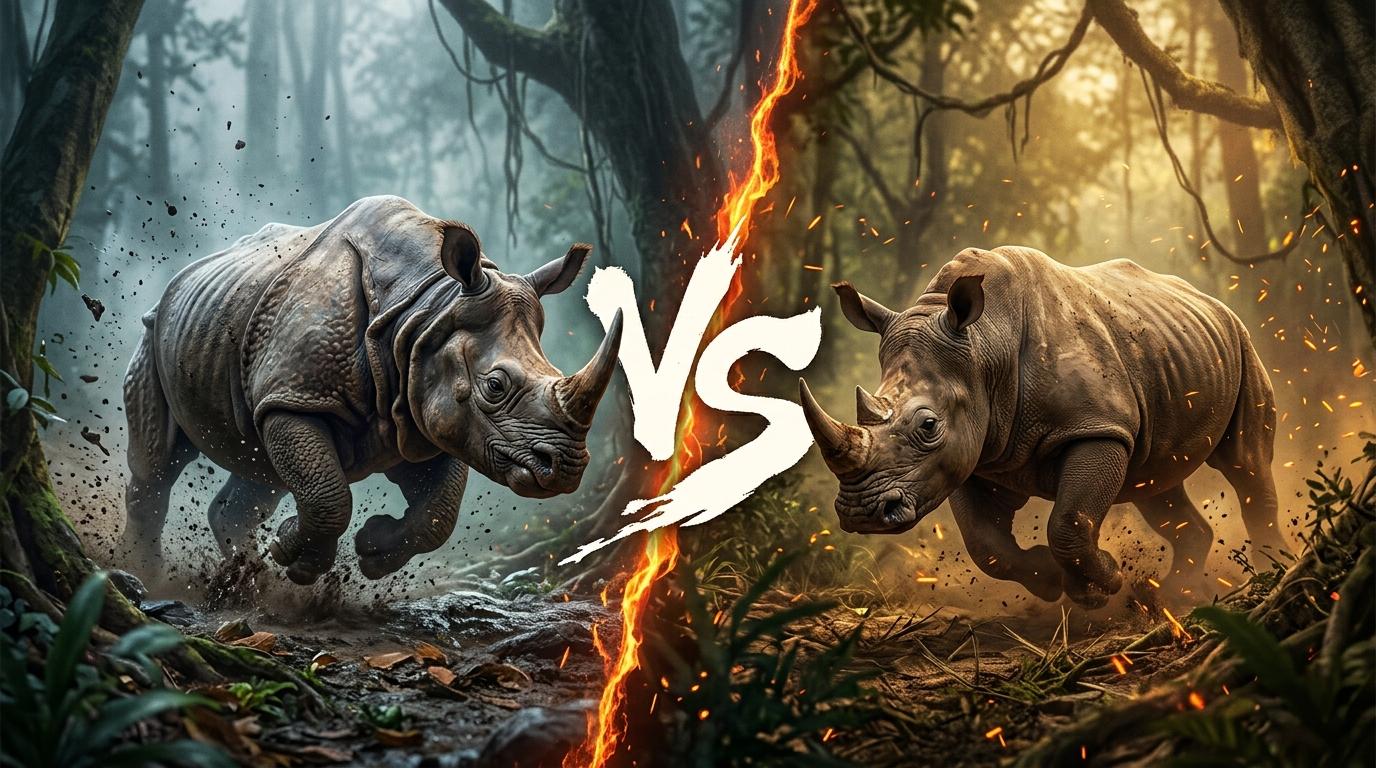
Indian Rhinoceros vs Javan Rhinoceros: Who Actually Wins?
Indian rhino vs Javan rhino: a biology-first breakdown of size, armor, tusk-like incisors, and temperament to settle which one-horned rhino wins a fight.
Indian Rhinoceros vs Javan Rhinoceros
Matchup winner
Indian Rhinoceros
Quick verdict
Start with the direct answer, then use the structured comparison below to see what changes the outcome.
The Indian rhinoceros wins. Both are one-horned Asian rhinos of the genus Rhinoceros and share the same fighting kit: armor-like skin folds, a modest horn, and razor-edged lower incisor tusks that do the real damage. The Indian rhino brings more of it. Large bulls reach about 2,200–2,700 kg and roughly 1.8 m at the shoulder. Javan rhinos are generally estimated at about 1,200–2,300 kg and are somewhat shorter. Indian bulls also fight often in dense grassland populations, where they slash rivals with their incisors and carry thick scar tissue to prove it. The Javan rhino is a secretive forest browser shaped by a sparse, low-contact lifestyle. It is no pushover, but in a straight contest of mass, momentum, and tusk-fighting experience, the bigger and more practiced Indian rhino holds the edge.
Read the full explanation
Indian rhino wins most matchups through greater body mass and shoulder height.
Both fight mainly with sharp lower incisor tusks, not their horns.
Indian bulls live at higher densities and fight rivals more often, which gives them more combat practice.
The Javan rhino's best chance is dense forest cover where it can avoid a committed clash.
Reader vote
Who do you think wins?
Pick a side — no account needed. Results update live.
No votes yet — be the first to call it.
Editorial note
Why people disagree
They look nearly identical, so many people assume a coin flip. The difference in size and fighting frequency is real but subtle.
Explosive power
Between two armored tanks, extra mass at the moment of impact decides who gets knocked off balance.
Close-range durability
Both are built to absorb incisor slashes, but more body armor buys the Indian rhino more time to keep fighting.
Tusk weaponry
The incisors are the real weapon. Regular use in rival fights sharpens both technique and willingness to commit.
Read the full explanation +
The Javan rhino is so rare and so little studied that its weight and temperament data are thin. That fuels speculation that it is underrated.
Some fans picture horn-goring duels, but Asian rhinos actually fight with their incisors. That shifts the argument toward bite reach and mass.
Comparison FAQ
Short, direct answers to the next questions readers usually ask after the headline verdict.
Would an Indian rhino beat a Javan rhino?+
Yes, in most scenarios. The Indian rhino is generally heavier and taller and fights rivals more often. That gives it the edge in a head-on clash.
Which rhino is stronger, Indian or Javan?+
The Indian rhinoceros is typically stronger because of its greater body mass. Large bulls can exceed 2,500 kg, while Javan rhinos are generally estimated to be somewhat lighter.
Do these rhinos fight with their horns?+
Mostly no. Asian one-horned rhinos fight mainly with sharp lower incisor tusks, slashing at rivals. The horn plays a smaller role.
Why is the Javan rhino still dangerous even if it loses?+
It carries the same armored hide and razor-sharp incisors and weighs well over a tonne. In dense cover it can land serious slashes and escape. Any fight with it would be costly for the Indian rhino.
Could they ever actually meet in the wild?+
Not today. The Javan rhino survives only in Ujung Kulon National Park in Java, while Indian rhinos live in India and Nepal. Their historical ranges may have come close or overlapped in parts of mainland South Asia, but modern encounters do not happen.
Head-to-head species stats
These are the same core AnimalDex stat dimensions used on the dedicated animal pages, pulled side by side so the matchup is faster to scan.
Indian Rhinoceros
Tier BJavan Rhinoceros
Tier ATrait-by-trait comparison
Only the categories that matter to this matchup are included. The goal is not filler stats, but the real design differences that change the result.
Heavier charge with more momentum
Explosive power
Indian Rhinoceros
Solid but lighter shove
Explosive power
Indian Rhinoceros
Thick folded plates, heavy scar tissue
Close-range durability
Indian Rhinoceros
Similar plated skin, slightly thinner build
Close-range durability
Indian Rhinoceros
Long, sharp lower incisors used often
Tusk weaponry
Indian Rhinoceros
Comparable incisors, less documented combat use
Tusk weaponry
Indian Rhinoceros
Frequent bull clashes in dense herds
Rival-fight experience
Indian Rhinoceros
Sparse, solitary, rare encounters
Rival-fight experience
Indian Rhinoceros
Grassland and floodplain specialist
Cover craft
Javan Rhinoceros
Dense lowland rainforest expert
Cover craft
Javan Rhinoceros
Surprisingly quick bursts, around 40+ km/h
Mobility
Indian Rhinoceros
Nimble in tight terrain, slower in the open
Mobility
Indian Rhinoceros
How the verdict forms
Verdict timeline
01 · Explosive power
Indian Rhinoceros
02 · Close-range durability
Indian Rhinoceros
03 · Tusk weaponry
Indian Rhinoceros
04 · Rival-fight experience
Indian Rhinoceros
05 · Cover craft
Javan Rhinoceros
06 · Mobility
Indian Rhinoceros
Change the conditions
Scenario breakdown
This is where shallow battle content usually fails. Terrain, spacing, timing, and engagement style can change the answer.
Scenario lean
Javan Rhinoceros
Verdict confidence
82%
Javan rhino can steal it in dense forest.
Thick rainforest breaks up charges and limits how much momentum either animal can build. The Javan rhino knows this terrain, can angle its body and slash at close range, and can escape before the Indian rhino's size advantage takes over. This is the one setting where home-field skill outweighs mass.
AnimalDex field profiles
Explore these animals
Indian Rhinoceros
Rhinoceros unicornis
riverine grassland, swamp forest, and floodplain
Javan Rhinoceros
Rhinoceros sondaicus
lowland rainforest, swamp forest, and thick riverine thicket
Systems Intelligence & Hidden Purpose
See the animals behind this comparison as engineered biological systems: what each one is built to do, where it gains leverage, and why the matchup changes by scenario.
Specialized Hardware
Riveted-looking skin folds, about 2+ tonne frame, sharp lower incisor tusks, and a single thick horn for display and digging.
Systems Script
A heavy grazer that shapes the grasslands of the Brahmaputra and Terai. It trims tall grass, keeps wallows open, and spreads seeds through its dung latrines.
Strategic Insight
When competitors share the same tools, scale and repeated practice become the deciding advantage. Train where conflict actually happens.
Specialized Hardware
A compact armored body with fine skin mosaic, a small horn in males, a prehensile lip for browsing, and incisor tusks for defense.
Systems Script
A rare lowland rainforest browser that opens understory gaps and disperses seeds. Its survival in a single park makes each animal ecologically and genetically critical.
Strategic Insight
Choosing your terrain can be worth more than raw power. Avoiding the fight you would lose is also a strategy.
Final take
This is a close-cousin matchup, and closeness favors the bigger, more practiced fighter. The Indian rhinoceros carries more mass, more height, and far more experience fighting rivals, all built around the same incisor-slashing weapon system.
Read the full explanation
The Javan rhinoceros is not outclassed in design, only in scale and practice. In its own dense forest it can make the fight messy and survivable. In most realistic frames, though, the Indian rhino wins clearly. Our call: Indian rhinoceros, around 70% confidence.
Collect both animals in AnimalDex
Track the species behind this matchup, compare their real traits, and build the rivalry into your AnimalDex collection.
Related comparisons
Continue with nearby matchups to compare more real-world animal traits without dropping into junky who-wins filler.
African Forest Elephant vs Javan Rhinoceros: Who Actually Wins?
The African forest elephant wins this matchup clearly. Bulls typically weigh about 2.5–6 tonnes and carry straight, dense, downward-pointing tusks. They also have a muscular trunk that can grab, shove, and pin. A Javan rhino usually weighs 1.4–2.3 tonnes and has a small horn, often under 25 cm, that is barely more than a knob on females. Its folded, armor-like skin and its sharp lower incisors are its real weapons, and it is a heavy, determined charger at short range. But it gives up mass, reach, and leverage. The elephant can strike from above and outside the rhino's effective range, and it can use tusks and trunk together. Its problem-solving brain also helps it read and avoid a bad angle. Neither species would normally seek this fight, and the two have never shared a range. In a forced confrontation, though, the elephant's size and reach advantage is decisive.
Read comparison
Javan Rhinoceros vs Sumatran Tiger: Who Actually Wins?
The Javan rhinoceros wins, and it isn't close in a fair fight between healthy adults. An adult Javan rhino weighs roughly 900–2,300 kg, often ten times or more the mass of a male Sumatran tiger (about 100–140 kg, the smallest living tiger population). The rhino's thick, folded hide and sheer bulk shrug off the bite-and-hold technique tigers use to subdue deer and wild pigs. Its sharp lower incisors and battering charge can injure a cat badly. The Sumatran tiger is the better hunter by every measure of speed, stealth and tactical intelligence, and it would win only where biology lets it: against an unguarded calf. Against a grown rhino, the tiger's smartest move is the one real tigers make: walk away.
Read comparison
Discussion
What do you think?
Share your reasoning with other readers. Be civil and stick to the animals.
Sign in to join the discussion.
Sign inNo comments yet. Start the conversation.