

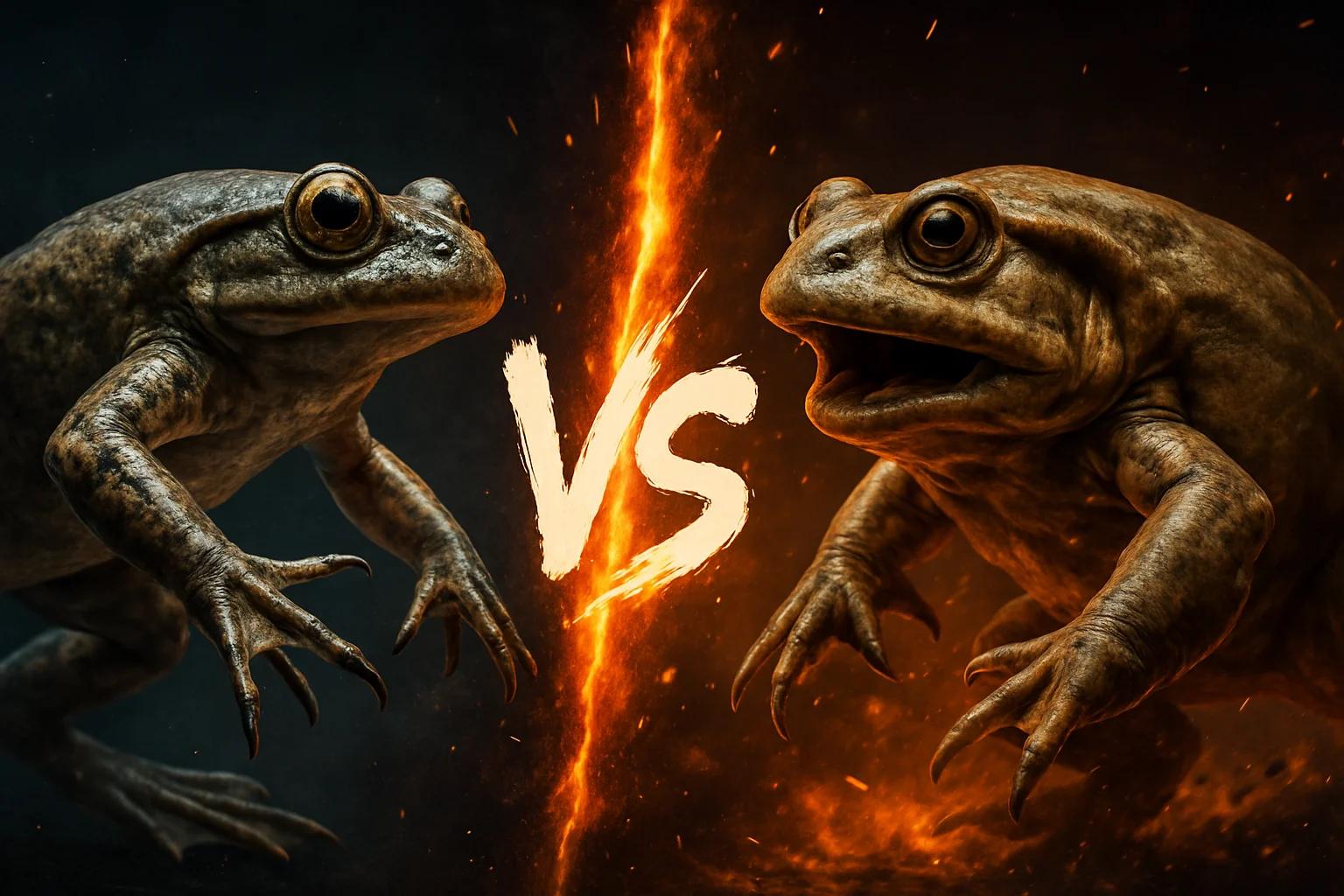
Lake Oku Clawed Frog vs Titicaca Water Frog: Who Actually Wins?
Lake Oku Clawed Frog vs Titicaca Water Frog: a biology-first look at size, speed, and lake-bottom survival, with a clear verdict on which aquatic frog wins.
Lake Oku Clawed Frog vs Titicaca Water Frog
Matchup winner
Titicaca Water Frog
Quick verdict
Start with the direct answer, then use the structured comparison below to see what changes the outcome.
The Titicaca Water Frog wins, and size decides it. Telmatobius culeus is one of the largest fully aquatic frogs on Earth. Its snout-to-vent length can reach about 14 cm, and its loose, heavily folded skin gives it real bulk. The Lake Oku Clawed Frog (Xenopus longipes) is a tiny specialist at roughly 3 to 4 cm. The clawed frog is quicker and carries sharp keratinized toe tips and a lateral-line sense that reads water movement. Those tools help it escape and forage, not overpower a frog several times its length and many times its mass. The Titicaca frog is a gape-driven bottom predator that eats amphipods, snails, and small fish. In any sustained encounter, that much size and mouth simply outclass anything the clawed frog can do. The smaller frog's best outcome is a clean getaway, not a win.
Read the full explanation
Titicaca Water Frog wins on size, mass, and gape: an overwhelming physical mismatch.
Lake Oku Clawed Frog is faster and more agile, so it can escape and survive the encounter.
In clutter or murky cover, the clawed frog's speed and lateral-line sense make it hard to pin down.
Both are critically endangered lake endemics, so a real meeting is impossible: one lives in Cameroon, the other in the Andes.
Reader vote
Who do you think wins?
Pick a side — no account needed. Results update live.
No votes yet — be the first to call it.
Editorial note
Why people disagree
Speed vs. mass: the clawed frog is clearly quicker, and some readers overrate agility against a frog this much bigger.
Body size & mass
In amphibian encounters, size is close to destiny. A frog several times longer can engulf, pin, or simply outlast a smaller one.
Explosive power
Xenopus-style hind legs fire fast escape strokes. That is the clawed frog's main survival card.
Ambush control
The Titicaca frog waits on the substrate and strikes at anything that fits in its mouth. A small frog fits.
Read the full explanation +
The word 'clawed' sounds dangerous, but Xenopus claws are small keratin tips used for tearing food and gripping, not real weapons.
The Titicaca frog's baggy skin and slow 'push-up' breathing behavior make it look sluggish, which hides how efficiently it strikes at prey on the lakebed.
Comparison FAQ
Short, direct answers to the next questions readers usually ask after the headline verdict.
Would a Lake Oku Clawed Frog beat a Titicaca Water Frog?+
No. The Titicaca Water Frog is several times longer and far heavier. The clawed frog's best realistic outcome is escaping.
Which frog is stronger?+
The Titicaca Water Frog. Its larger, bulkier body and wide gape give it far more physical force than the tiny Lake Oku Clawed Frog.
Why is the Lake Oku Clawed Frog still dangerous?+
To prey its own size, it is a capable forager. It uses keratinized toe claws to shred food and a lateral line to locate movement. Against the Titicaca frog, its speed and sensing make it hard to catch in cover.
Are clawed frog claws real weapons?+
Not really. They are small keratin tips used for tearing food and gripping surfaces, not for fighting larger animals.
Could these frogs ever meet in the wild?+
No. Lake Oku is in Cameroon, and Lake Titicaca sits in the Andes between Peru and Bolivia.
Head-to-head species stats
These are the same core AnimalDex stat dimensions used on the dedicated animal pages, pulled side by side so the matchup is faster to scan.
Lake Oku Clawed Frog
Tier CTiticaca Water Frog
Tier CTrait-by-trait comparison
Only the categories that matter to this matchup are included. The goal is not filler stats, but the real design differences that change the result.
About 3–4 cm, very light
Body size & mass
Titicaca Water Frog
Up to about 14 cm, heavy-bodied
Body size & mass
Titicaca Water Frog
Quick, kick-driven bursts
Explosive power
Lake Oku Clawed Frog
Short lunges from rest
Explosive power
Lake Oku Clawed Frog
Active forager, scavenges by touch
Ambush control
Titicaca Water Frog
Patient bottom-sitter with a wide gape
Ambush control
Titicaca Water Frog
Lateral-line system reads water movement
Sensory reach
Lake Oku Clawed Frog
Vision and touch in cold, clear water
Sensory reach
Lake Oku Clawed Frog
Small, smooth, fragile frame
Close-range durability
Titicaca Water Frog
Thick, loose, folded skin over a heavy body
Close-range durability
Titicaca Water Frog
Tuned to one small crater lake
Environmental toughness
Titicaca Water Frog
Breathes through its skin in cold, low-oxygen high-altitude water
Environmental toughness
Titicaca Water Frog
How the verdict forms
Verdict timeline
01 · Body size & mass
Titicaca Water Frog
02 · Explosive power
Lake Oku Clawed Frog
03 · Ambush control
Titicaca Water Frog
04 · Sensory reach
Lake Oku Clawed Frog
05 · Close-range durability
Titicaca Water Frog
06 · Environmental toughness
Titicaca Water Frog
Change the conditions
Scenario breakdown
This is where shallow battle content usually fails. Terrain, spacing, timing, and engagement style can change the answer.
Scenario lean
Lake Oku Clawed Frog
Verdict confidence
82%
The clawed frog slips away.
In dense cover, the encounter turns into a chase rather than a contest. The clawed frog's lateral line detects the bigger frog's approach, and fast kicks carry it into gaps too tight to follow. It cannot hurt its rival, but it can make sure it is never caught. That counts as a survival win in this context.
AnimalDex field profiles
Explore these animals
Lake Oku Clawed Frog
Xenopus longipes
deep crater lake habitat
Titicaca Water Frog
Telmatobius culeus
high-altitude lake and reedbed shallows
Systems Intelligence & Hidden Purpose
See the animals behind this comparison as engineered biological systems: what each one is built to do, where it gains leverage, and why the matchup changes by scenario.
Specialized Hardware
fully aquatic clawed feet, smooth dark lake body, and high-altitude crater-lake life give the Lake Oku Clawed Frog a body plan tuned for its niche.
Systems Script
Lake Oku Clawed Frogs operate through deep crater lake habitat. Their design links movement, feeding, shelter, and timing into one workable survival system.
Strategic Insight
Good design turns a difficult habitat into usable ground.
Specialized Hardware
deeply wrinkled water-breathing skin, large lake-dwelling body, and cold high-altitude aquatic life give the Titicaca Water Frog a body plan tuned for its niche.
Systems Script
Titicaca Water Frogs operate through high-altitude lake and reedbed shallows. Their design links movement, feeding, shelter, and timing into one workable survival system.
Strategic Insight
Good design turns a difficult habitat into usable ground.
Final take
The Titicaca Water Frog is the clear winner. This is not a close tactical duel; it is a biological weight-class mismatch. A heavy, wide-mouthed bottom predator against a few-centimeter forager ends one way whenever contact is made.
Read the full explanation
The Lake Oku Clawed Frog still earns respect. Its speed, sensitivity to water movement, and grip-ready toe claws are excellent survival tools, and in cluttered water it can avoid losing entirely. Escaping is its version of winning.
Both species are critically endangered, each found essentially in a single lake system. The real fight both are losing is against habitat loss, pollution, disease, and overharvest.
Collect both animals in AnimalDex
Track the species behind this matchup, compare their real traits, and build the rivalry into your AnimalDex collection.
Related comparisons
Continue with nearby matchups to compare more real-world animal traits without dropping into junky who-wins filler.
Chinese Giant Salamander vs Lake Oku Clawed Frog: Who Actually Wins?
The Chinese giant salamander wins decisively. It can reach well over a meter long and tens of kilograms, while the Lake Oku clawed frog is a fully aquatic frog only a few centimeters long. The salamander is a patient ambush predator. It sits motionless in rocky stream pools, senses vibrations through sensory nodes along its head and body, and engulfs prey with a fast suction gape that easily fits frogs, fish, crabs, and insects. The Lake Oku clawed frog has sharp water senses, a slippery body, and quick kicks, so it can escape when it detects danger early and has open water. Once it is within strike range, though, it has no weapon that can hurt a salamander that weighs thousands of times more. This is really a predator-and-prey outcome, not an even fight.
Read comparison
Axolotl vs Titicaca Water Frog: Who Actually Wins?
The axolotl wins, but only narrowly. This is a contest between two critically endangered aquatic oddballs built for still, cold water rather than combat, and neither one would normally pick a fight. The axolotl's edge comes from three things. It has a longer, more muscular body that commonly reaches 23–30 cm, while the frog's typical body runs well under that. It has a wide suction-gape that snaps shut fast on anything mouth-sized. And it can regenerate limbs, gills and even parts of organs, so nips that would cripple most amphibians barely slow it down. The Titicaca water frog is no pushover. Its powerful hind legs deliver real kicks, and heavyweight individuals can outweigh a small axolotl. But it is a slow, low-energy specialist that breathes mostly through its loose skin folds. That skin is a huge, fragile surface that suffers in any prolonged scuffle, especially in warmer or less oxygenated water. Over a sustained encounter, the axolotl's reach, grip and recovery tip the outcome.
Read comparison
Discussion
What do you think?
Share your reasoning with other readers. Be civil and stick to the animals.
Sign in to join the discussion.
Sign inNo comments yet. Start the conversation.