

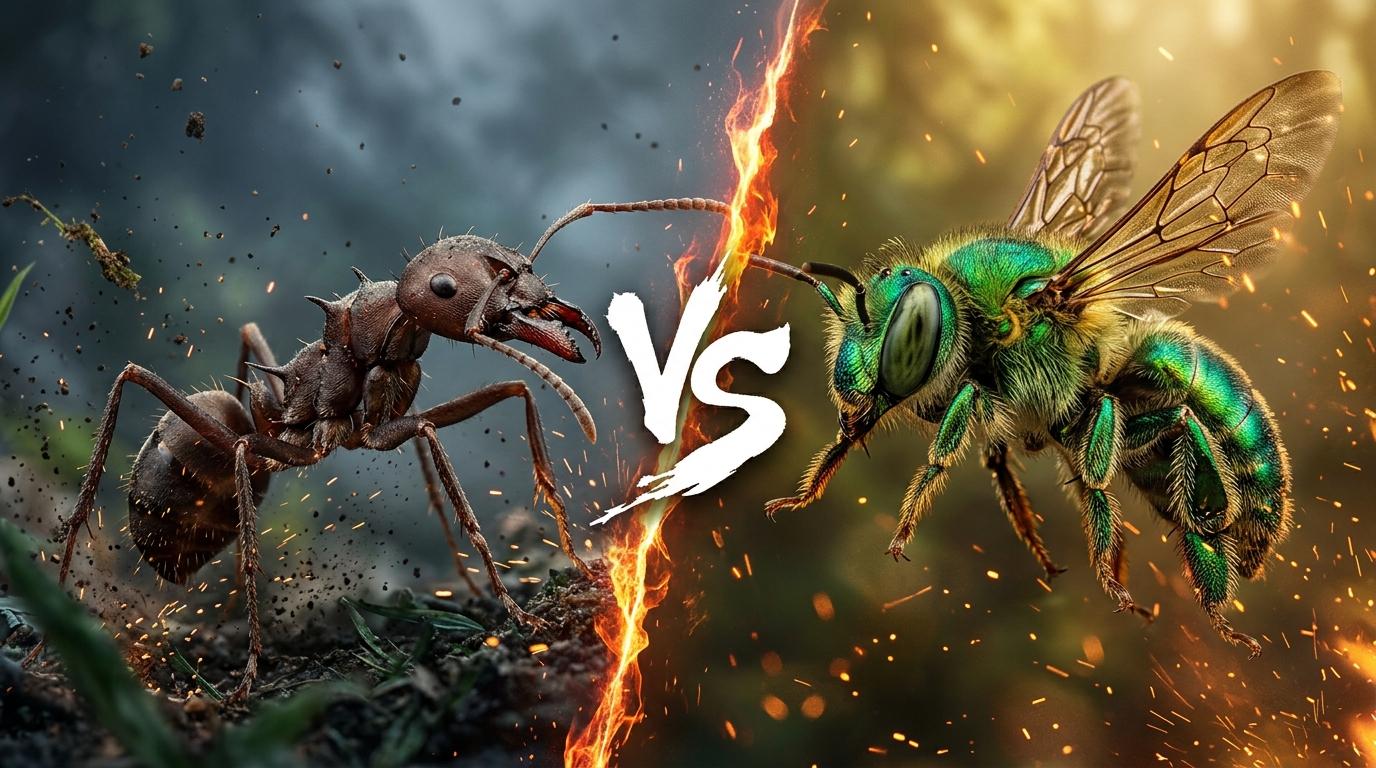
Leafcutter Ant vs Green Orchid Bee: Who Actually Wins?
Leafcutter ant vs green orchid bee: blade-jawed colony soldier or metallic flying perfume collector? See who wins on the ground, in the air, and at the nest.
Leafcutter Ant vs Orchid Bee
Matchup winner
Leafcutter Ant
Quick verdict
Start with the direct answer, then use the structured comparison below to see what changes the outcome.
The Leafcutter Ant (Atta cephalotes) wins this matchup, though only once the fight touches the ground. The Green Orchid Bee (Euglossa dilemma) is faster, airborne, and roughly as long as a large ant major. Only females carry a sting, and it is relatively mild. The ant's case rests on three things: scissor-like mandibles built to slice tough leaves all day, a caste system that sends heavily armored majors to the front, and a colony that answers threats with numbers rather than one-on-one courage. If the bee is grabbed, pinned, or caught near a trail or nest, those mandibles can shear a wing or a leg, and nearby workers can dogpile within seconds. The bee's real weapon is refusing the fight. In open air it simply leaves, which is why it stays dangerous to rank but loses the decisive contact frame.
Read the full explanation
Overall winner: Leafcutter Ant, through cutting mandibles, armored major workers, and colony backup.
The orchid bee wins any fight that stays airborne, because it can always choose to disengage.
On the ground or near a nest, the ant's grip-and-cut toolkit decides the outcome fast.
Colony scale tips the result: one bee never faces just one Atta for long.
Reader vote
Who do you think wins?
Pick a side — no account needed. Results update live.
No votes yet — be the first to call it.
Editorial note
Why people disagree
Bee fans count the sting, but the sting is mild and only females have one. Male Euglossa, the famous fragrance collectors, have no sting at all.
Cutting power
Insect fights are often decided at the limbs and wings. A jaw built to cut tough leaf tissue can disable a flier in a single clamp.
Escape velocity
The bee controls whether contact happens at all, and that is its entire survival strategy.
Close-range durability
Wings are a liability in a grapple. Once the bee is pinned, damage to a wing ends the contest.
Read the full explanation +
Ant fans picture a giant soldier, but most foragers on an Atta trail are mid-sized workers that a bee could outmuscle briefly.
Many people treat 'can escape' as 'wins'. Flight avoids losing, but it doesn't defeat the other animal.
Comparison FAQ
Short, direct answers to the next questions readers usually ask after the headline verdict.
Would a leafcutter ant beat a green orchid bee?+
Yes, in any fight that reaches the ground. Its mandibles and armor beat the bee up close, and colony backup seals the result.
Which is stronger, a leafcutter ant or an orchid bee?+
For its size, the leafcutter ant is stronger. It can carry leaf fragments many times its own body weight and slice tough plant tissue with its jaws.
Can an orchid bee sting a leafcutter ant?+
Only females have a sting, and it is mild. It might slow a small worker, but it is unlikely to stop an armored major.
Why is the orchid bee still dangerous in this matchup?+
Its speed and vision let it avoid nearly every encounter. A female can also sting and bite briefly if grabbed, so a lone small ant can lose the exchange.
Do leafcutter ants and orchid bees actually fight in the wild?+
Rarely. Both live in Neotropical forests, but they use different resources. Conflicts mostly happen when leafcutters strip a plant the bee was visiting.
Head-to-head species stats
These are the same core AnimalDex stat dimensions used on the dedicated animal pages, pulled side by side so the matchup is faster to scan.
Leafcutter Ant
Tier DOrchid Bee
Tier DTrait-by-trait comparison
Only the categories that matter to this matchup are included. The goal is not filler stats, but the real design differences that change the result.
Vibrating mandibles that slice leaves; majors can pierce skin
Cutting power
Leafcutter Ant
Small chewing mandibles, not built as weapons
Cutting power
Leafcutter Ant
Walking forager, fast on trails but grounded
Escape velocity
Orchid Bee
Agile hovering flier with long foraging range
Escape velocity
Orchid Bee
Spiny, thick cuticle, especially on majors
Close-range durability
Leafcutter Ant
Robust metallic body, but exposed wings
Close-range durability
Leafcutter Ant
Alarm pheromones that recruit nestmates
Chemical and venom tools
Leafcutter Ant
Mild sting in females only
Chemical and venom tools
Leafcutter Ant
Colonies can number in the millions
Swarm leverage
Leafcutter Ant
Largely solitary or loosely communal
Swarm leverage
Leafcutter Ant
Chemical trail sense, limited vision
Situational awareness
Orchid Bee
Strong vision and long-distance navigation
Situational awareness
Orchid Bee
How the verdict forms
Verdict timeline
01 · Cutting power
Leafcutter Ant
02 · Escape velocity
Orchid Bee
03 · Close-range durability
Leafcutter Ant
04 · Chemical and venom tools
Leafcutter Ant
05 · Swarm leverage
Leafcutter Ant
06 · Situational awareness
Orchid Bee
Change the conditions
Scenario breakdown
This is where shallow battle content usually fails. Terrain, spacing, timing, and engagement style can change the answer.
Scenario lean
Leafcutter Ant
Verdict confidence
82%
Ant wins decisively once mandibles lock.
On a leaf or the forest floor the bee loses its speed advantage. A major Atta worker's mandibles close on a leg or wing base with leaf-cutting force. A female bee might land a sting, but the ant's armor and small size make it a poor venom target. The bee's best hope is breaking free before the ant gets a clean grip.
AnimalDex field profiles
Explore these animals
Leafcutter Ant
Atta and Acromyrmex spp.
Tropical forest, secondary growth, savannah woodland, and agricultural edges in the Neotropics.
Orchid Bee
Euglossa dilemma
tropical forest, garden edge, and flowering woodland
Systems Intelligence & Hidden Purpose
See the animals behind this comparison as engineered biological systems: what each one is built to do, where it gains leverage, and why the matchup changes by scenario.
Specialized Hardware
Mandible cutting tools, caste-based labor, and fungus cultivation behavior make leafcutter ants farm hardware running at colony scale.
Systems Script
Leafcutter ants move plant material into underground fungal production systems, effectively outsourcing digestion to a cultivated partner. They demonstrate what happens when logistics and biology merge into one supply chain.
Strategic Insight
Scale becomes durable when you stop doing every task yourself and start designing symbiotic infrastructure.
Specialized Hardware
metallic jewel-green body, long nectar tongue, and fragrance-collecting male behavior give the Orchid Bee a body plan tuned for its niche.
Systems Script
Orchid Bees operate through tropical forest, garden edge, and flowering woodland. Their design links movement, feeding, shelter, and timing into one workable survival system.
Strategic Insight
Dense environments reward precision, patience, and the ability to read layered cover.
Final take
The Leafcutter Ant wins because its design turns any contact into its kind of fight. It grips, cuts, and calls in reinforcements. The Green Orchid Bee is no pushover: it is quick, sharp-eyed, and in females armed with a sting. But its whole strategy depends on contact never happening.
Read the full explanation
Ask 'who would win' and the honest answer is that the ant wins the fight, while the bee usually wins the argument about whether a fight happens. Settled on the ground, the result is not close.
Collect both animals in AnimalDex
Track the species behind this matchup, compare their real traits, and build the rivalry into your AnimalDex collection.
Related comparisons
Continue with nearby matchups to compare more real-world animal traits without dropping into junky who-wins filler.

Hercules Beetle vs Leafcutter Ant: Who Actually Wins?
The Hercules beetle wins this matchup clearly. A male Dynastes hercules can reach about 17 cm including its horn, and a single leafcutter ant is a few millimeters to about 2 cm long. Even the largest Atta cephalotes soldier is outweighed by hundreds of times. The beetle's thick, domed elytra and armored thorax give leafcutter mandibles almost nothing to grip. Its pincer-like horns are built to pry, lift, and fling rivals much heavier than any ant. Leafcutter ants also lack a functional sting, so they cannot inject venom. The ant's real power is the colony: millions of workers, a soldier caste whose jaws can slice skin, and coordinated mass defense. That makes a nest raid the one context where the beetle should back off. In any fair, individual-scale battle, or in the open forest where the beetle can simply walk or fly away, the beetle's armor and mass decide it.
Read comparison
Hercules Beetle vs Green Orchid Bee: Who Actually Wins?
The Hercules beetle wins, and it is not especially close. Dynastes hercules is one of the largest beetles on Earth. Big males reach about 17 cm including the horn, and the whole body sits inside thick, chitin-reinforced elytra built for horn-to-horn wrestling. The green orchid bee (Euglossa dilemma) is a fast, metallic, roughly 1.3 cm pollinator whose sting is mild by bee standards. It struggles to get through beetle armor, and its tiny mandibles cannot pry the shell. The bee holds the edge in speed, agility and flight endurance, so it controls whether contact happens at all. But if the question is who comes out on top when they actually clash, the beetle's size, armor and gripping horns make the outcome lopsided.
Read comparison
Elephant Beetle vs Green Orchid Bee: Who Actually Wins?
The elephant beetle wins clearly. Megasoma elephas is a heavily armored rhinoceros beetle that can grow past 10 cm and weigh many times more than Euglossa dilemma, a metallic green orchid bee about 1.3 cm long. The beetle's thick chitin exoskeleton and grasping legs make it close to immune to anything the bee can do. The bee's sting is short and built for defense, and its venom is mild. The bee's real edge is speed: it is a fast, agile flier that can disengage whenever it wants. That means the bee can avoid a loss, but it has no way to win. In any frame where the two actually make contact, the beetle's mass and armor decide it.
Read comparison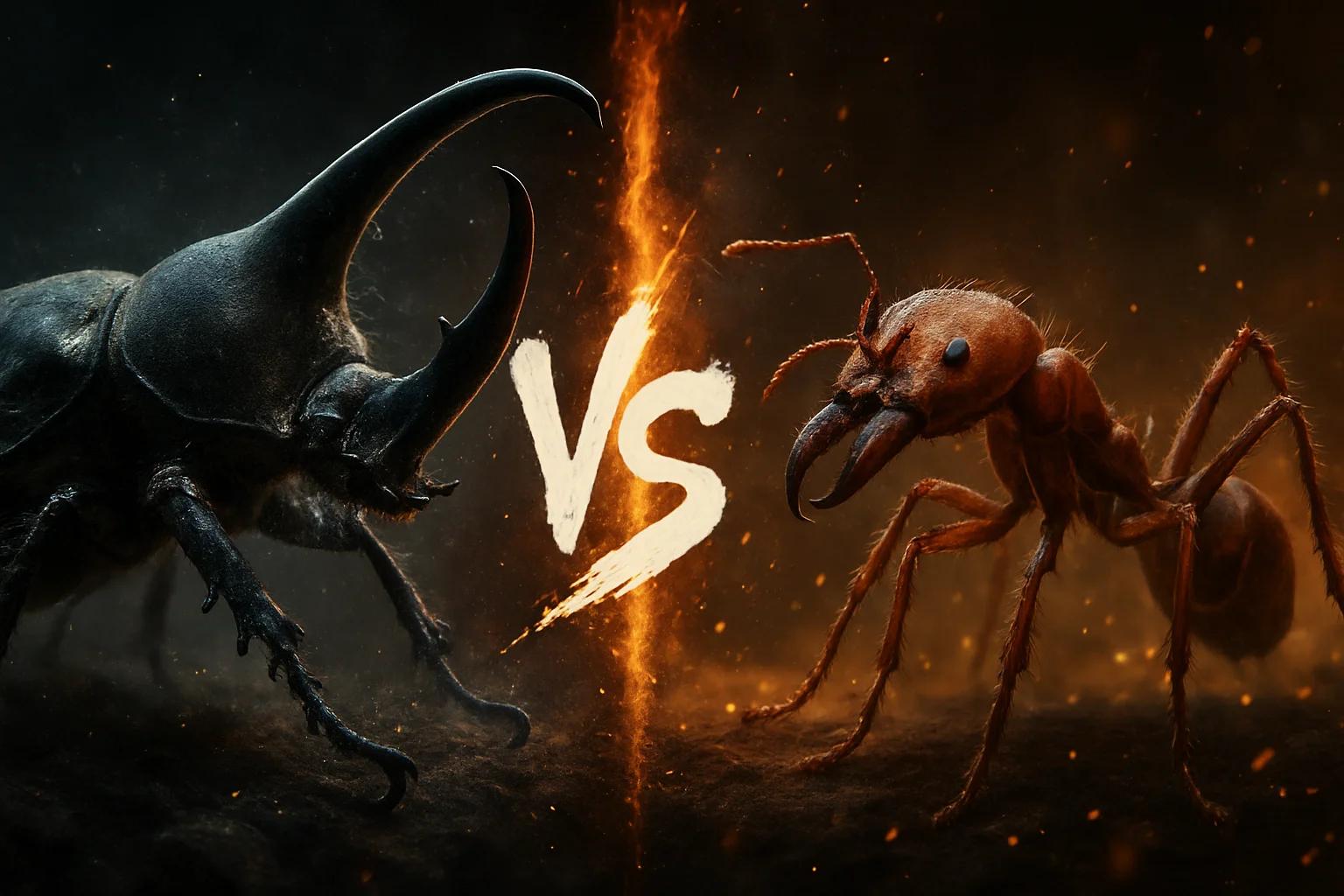
Elephant Beetle vs Leafcutter Ant: Who Actually Wins?
In a one-on-one fight, the Elephant Beetle (Megasoma elephas) wins clearly. A large male can reach roughly 7–12 cm and carries a hardened exoskeleton and forked horns. Even a big leafcutter soldier at around 1.5–2 cm cannot bite through that armor in any meaningful way. Leafcutter mandibles are built to slice soft leaves and deter vertebrate intruders, not to breach thick, domed elytra. The beetle can shove, pin, or ignore a single ant almost at will. The real argument starts when people swap 'an ant' for 'the colony.' Atta cephalotes nests can hold millions of workers, and mass swarming is the ant's genuine superpower. Even then, an adult beetle is slow, armored, and has little the colony needs to defend against or harvest. So the most likely outcome is that the beetle walks away. The ants are only dangerous to a beetle that is pinned, injured, or soft-bodied. Overall winner: Elephant Beetle.
Read comparison
Discussion
What do you think?
Share your reasoning with other readers. Be civil and stick to the animals.
Sign in to join the discussion.
Sign inNo comments yet. Start the conversation.