

Longnose Gar vs Red-bellied Piranha: Who Actually Wins?
Longnose gar vs red-bellied piranha: armor, bite, size and schooling compared. See who wins one-on-one, in a school ambush, and in open water.
Longnose Gar vs Red-bellied Piranha
Matchup winner
Longnose Gar
Quick verdict
Start with the direct answer, then use the structured comparison below to see what changes the outcome.
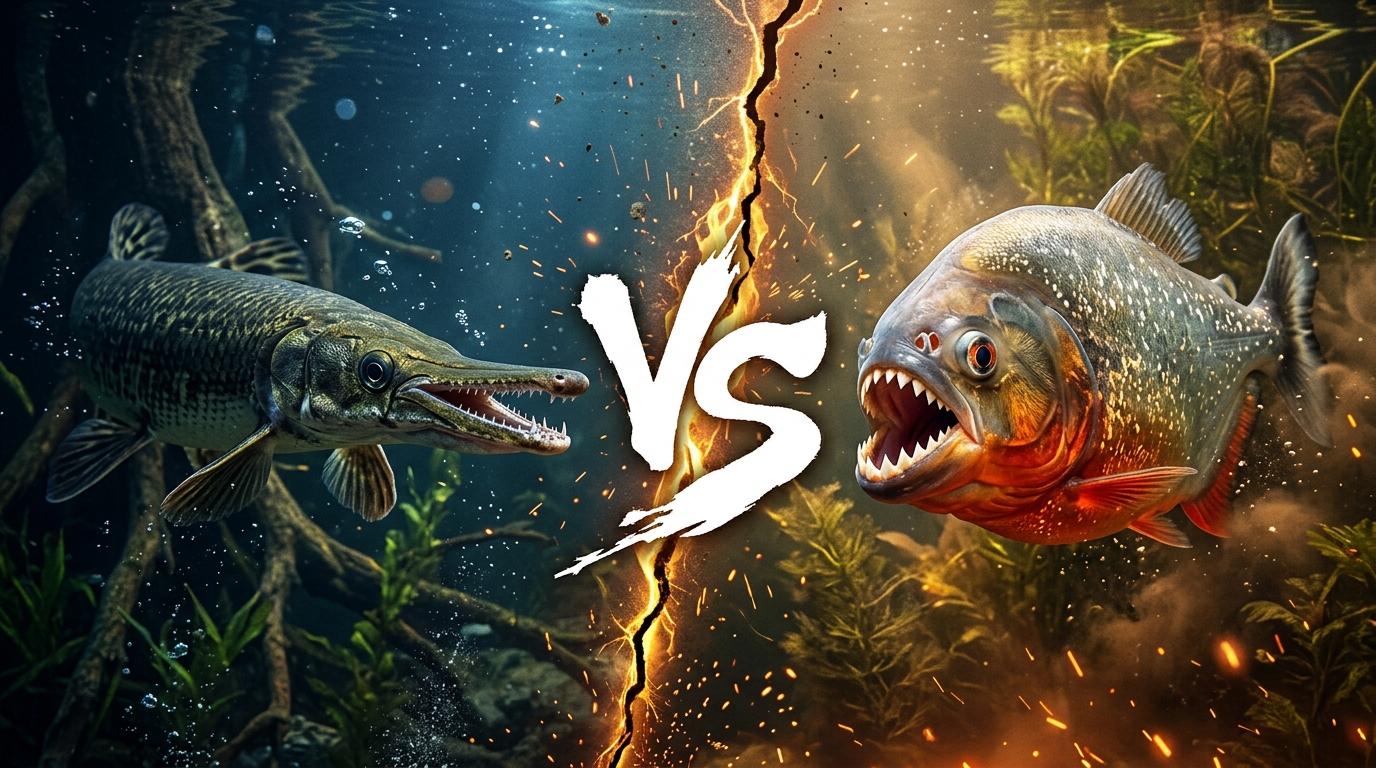
The longnose gar wins a one-on-one fight. An adult gar commonly runs 0.9–1.5 m (3–5 ft) long, while a red-bellied piranha tops out around 30–33 cm. The gar is wrapped in interlocking ganoid scales, a diamond-shaped, enamel-like armor that defeats many predators' teeth. Its long, needle-toothed snout lets it strike from a distance the piranha can't match. The piranha's bite is one of the strongest for its body size of any bony fish, and it cuts flesh cleanly. But a single piranha attacking an armored fish more than three times its length is mostly scraping at a shield. The gar's sideways snap can seize and pin a fish the piranha's size. The upset case is real: a large school of piranhas attacking a stressed or injured gar can overwhelm it. That shoal scenario is a different question from the head-to-head matchup, and in the head-to-head, armor plus reach beats bite plus bravado.
Read the full explanation
Longnose gar wins one-on-one: it is three to five times longer and covered in ganoid armor.
The piranha's bite is elite for its size but struggles against interlocking enamel-like scales.
The gar's long snout strikes first and can grip a piranha-sized fish outright.
A large piranha school attacking a weakened gar is the main upset path.
Reader vote
Who do you think wins?
Pick a side — no account needed. Results update live.
No votes yet — be the first to call it.
Editorial note
Why people disagree
Piranha reputation is built on group feeding frenzies, so people picture a swarm rather than a single fish.
Size and mass
Mass decides who can hold, shake and pin. The gar simply outweighs the piranha by an order of magnitude.
Armor and close-range durability
Ganoid armor was historically tough enough to be used as arrowheads and tools. Piranha teeth are built for soft tissue, not plate.
Bite quality
The piranha owns the better cutting tool. That makes it dangerous to fins, eyes and any unarmored tissue.
Read the full explanation +
Gar armor gets underrated because the fish looks slim and slow while hovering motionless.
These fish live on different continents (North America vs South America), so fans argue from different home-water legends.
Comparison FAQ
Short, direct answers to the next questions readers usually ask after the headline verdict.
Would a longnose gar beat a red-bellied piranha?+
Yes. In a one-on-one fight the gar wins thanks to far greater size, ganoid scale armor and a long-reach ambush strike.
Which is stronger, a gar or a piranha?+
The gar is stronger overall because of its mass and body power. The piranha has the stronger bite relative to its size.
Can piranha teeth cut through gar scales?+
Only with difficulty. Gar ganoid scales are hard, interlocking and enamel-coated. Fins, eyes and gill areas are the more exposed spots.
Why is the piranha still dangerous to a gar?+
Piranhas shoal. A group attacking a weakened or injured gar can hit many exposed points at once. Their cutting teeth also inflict real wounds on fins and soft tissue.
Would they ever meet in the wild?+
Not naturally. Longnose gar are native to North America, and red-bellied piranhas are native to South America.
Head-to-head species stats
These are the same core AnimalDex stat dimensions used on the dedicated animal pages, pulled side by side so the matchup is faster to scan.
Longnose Gar
Tier BRed-bellied Piranha
Tier CTrait-by-trait comparison
Only the categories that matter to this matchup are included. The goal is not filler stats, but the real design differences that change the result.
0.9–1.5 m, multi-kilogram adults
Size and mass
Longnose Gar
Up to ~33 cm, around 1 kg or less
Size and mass
Longnose Gar
Interlocking ganoid scales, enamel-like coating
Armor and close-range durability
Longnose Gar
Small, ordinary scales and a deep body
Armor and close-range durability
Longnose Gar
Needle teeth for gripping slippery fish
Bite quality
Red-bellied Piranha
Razor triangular interlocking teeth, huge bite force for its size
Bite quality
Red-bellied Piranha
Long beak and an explosive sideways snap
Ambush reach
Longnose Gar
Short-range lunge and bite
Ambush reach
Longnose Gar
Mostly solitary or loose groups
Group pressure
Red-bellied Piranha
Shoaling fish that can feed collectively
Group pressure
Red-bellied Piranha
Gulps air, tolerates warm, low-oxygen water
Environmental grit
Longnose Gar
Handles seasonal floodplain swings
Environmental grit
Longnose Gar
How the verdict forms
Verdict timeline
01 · Size and mass
Longnose Gar
02 · Armor and close-range durability
Longnose Gar
03 · Bite quality
Red-bellied Piranha
04 · Ambush reach
Longnose Gar
05 · Group pressure
Red-bellied Piranha
06 · Environmental grit
Longnose Gar
Change the conditions
Scenario breakdown
This is where shallow battle content usually fails. Terrain, spacing, timing, and engagement style can change the answer.
Scenario lean
Longnose Gar
Verdict confidence
82%
The gar ambushes from cover and wins.
The gar is a classic lie-in-wait predator. It hangs motionless, disguised as a stick, and then snaps sideways. In vegetation, a lone piranha that drifts within snout range gets seized across the body. Its bites against the gar's jaw and armored flank do little before the gar repositions its grip.
AnimalDex field profiles
Explore these animals
Longnose Gar
Lepisosteus osseus
river, lake, and estuary backwater
Red-bellied Piranha
Pygocentrus nattereri
river channel, floodplain lagoon, and backwater
Systems Intelligence & Hidden Purpose
See the animals behind this comparison as engineered biological systems: what each one is built to do, where it gains leverage, and why the matchup changes by scenario.
Specialized Hardware
very long tooth-lined snout, ganoid armor scales, and surface-cruising ambush give the Longnose Gar a body plan tuned for its niche.
Systems Script
Longnose Gars operate through river, lake, and estuary backwater. Their design links movement, feeding, shelter, and timing into one workable survival system.
Strategic Insight
Where water controls movement, position and timing often matter more than speed.
Specialized Hardware
silver body with red belly, triangular serrated teeth, and shoaling river feeding give the Red-bellied Piranha a body plan tuned for its niche.
Systems Script
Red-bellied Piranhas operate through river channel, floodplain lagoon, and backwater. Their design links movement, feeding, shelter, and timing into one workable survival system.
Strategic Insight
Where water controls movement, position and timing often matter more than speed.
Final take
This matchup comes down to armor and reach against a small, sharp blade. The red-bellied piranha has one of the best bites in freshwater for its body size, but it is built to shred soft-bodied prey, usually in groups. The longnose gar is a living fossil whose design has worked for millions of years: plate armor, ambush patience, and a snout that strikes from a distance.
Read the full explanation
One-on-one, the longnose gar wins clearly. The piranha flips the result only when its school does the work, and by then the question is no longer gar vs piranha. It is gar vs crowd.
Collect both animals in AnimalDex
Track the species behind this matchup, compare their real traits, and build the rivalry into your AnimalDex collection.
Related comparisons
Continue with nearby matchups to compare more real-world animal traits without dropping into junky who-wins filler.
Electric Eel vs Red-bellied Piranha: Who Actually Wins?
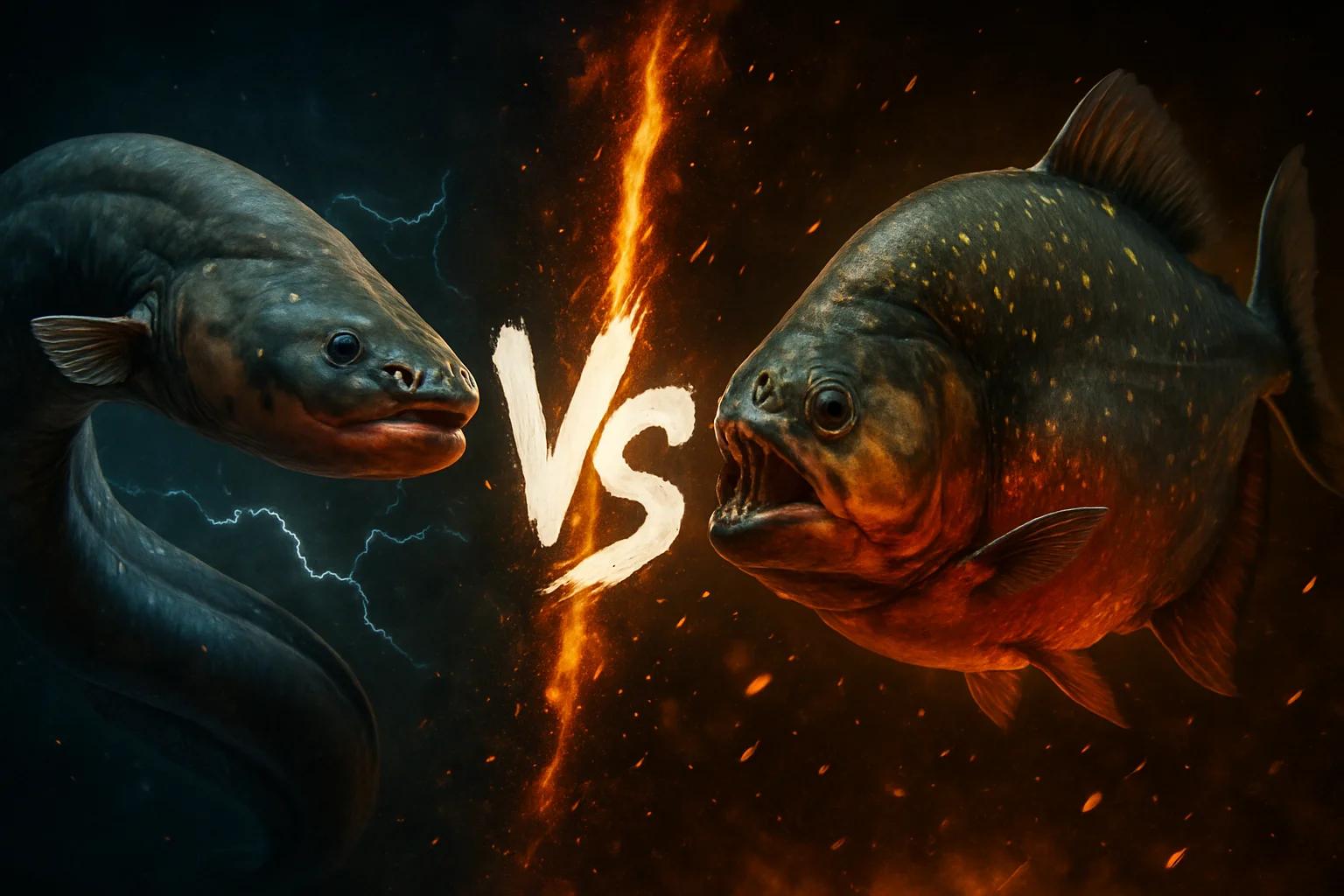
The electric eel wins, and it is not especially close in a one-on-one. Adult Electrophorus electricus commonly reach 1.5–2 m and can discharge bursts of up to roughly 600–860 volts depending on species and size. A single red-bellied piranha is about 25–33 cm long. It carries a famously powerful bite for its size, but it has to make physical contact to use it. The eel never needs to touch anything. Its high-voltage pulses travel through the water and can cause involuntary muscle spasms and temporary paralysis in nearby fish, and the eel uses low-voltage electrolocation to track prey in murky water. A piranha that closes in gets shocked before it can bite. The piranha's real threat is its numbers. A large shoal raises the risk to a weakened or exposed eel, and some of the oldest, most dramatic accounts of piranhas swarming bigger animals involve exactly that scenario. Even so, the eel's discharges hit everything within range, which blunts a group attack too.
Read comparison
Discussion
What do you think?
Share your reasoning with other readers. Be civil and stick to the animals.
Sign in to join the discussion.
Sign inNo comments yet. Start the conversation.