

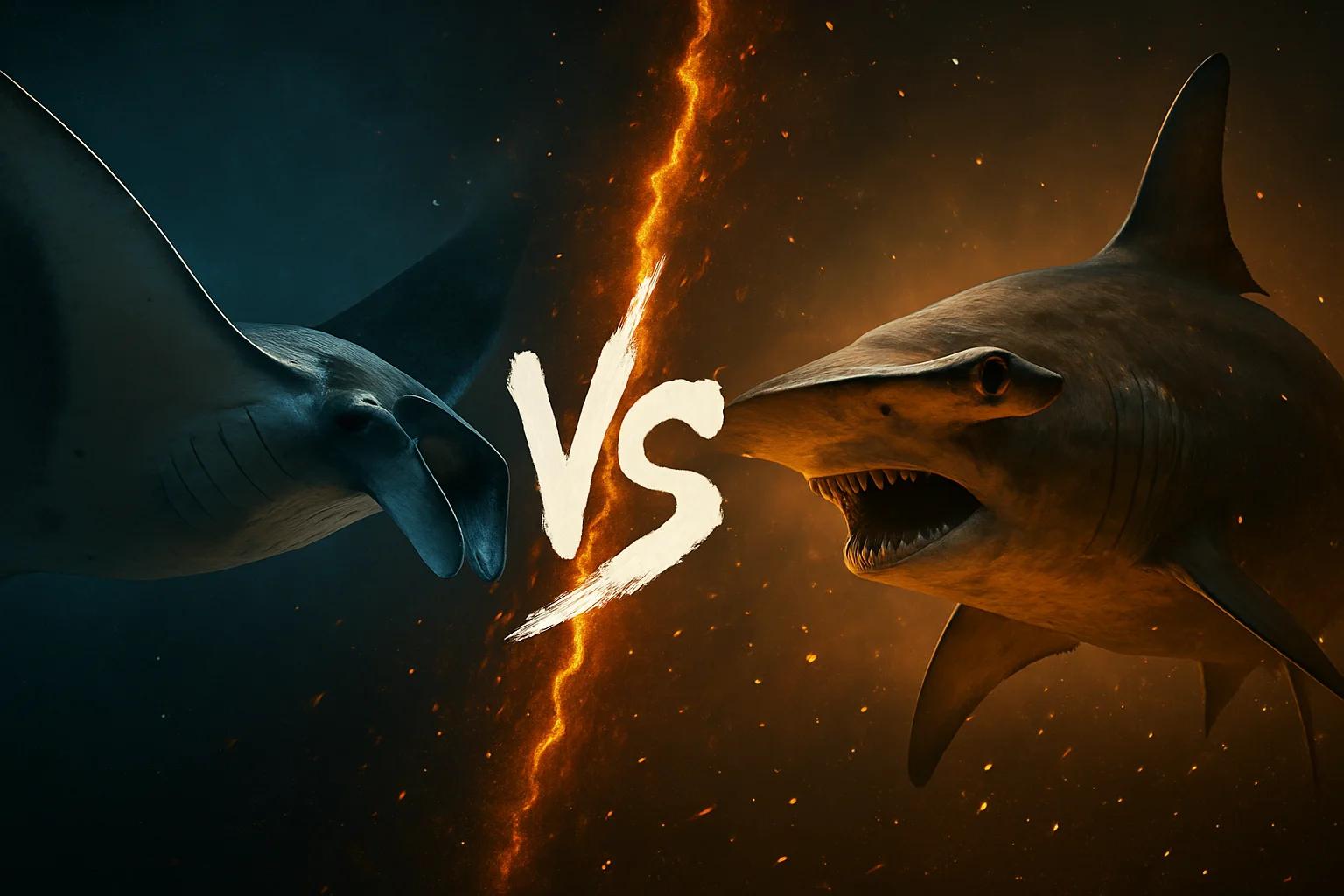
Giant Oceanic Manta Ray vs Scalloped Hammerhead: Who Actually Wins?
Giant oceanic manta ray vs scalloped hammerhead: who would win? A biology-first breakdown of size, weapons, escape speed, and real ocean encounters, with a clear verdict.
Manta Ray vs Scalloped Hammerhead
Matchup winner
Manta Ray
Quick verdict
Start with the direct answer, then use the structured comparison below to see what changes the outcome.
The giant oceanic manta ray wins this matchup overall, and it wins the way big ocean animals usually do: by being too large and too well-built to become prey. An adult manta can span up to about 7 meters and weigh well over a ton. A scalloped hammerhead is typically 2–3.5 meters and rarely exceeds a few hundred kilograms. Its mouth is sized for squid, reef fish, and small rays. It has no realistic way to subdue a flat, powerful animal ten times its mass that can simply fly away. The manta has no teeth or stinger worth using in a fight, so it cannot kill the shark. But in a battle frame, the side that cannot be harmed and leaves intact is the winner. The hammerhead's real window is narrow: juvenile, injured, or entangled mantas.
Read the full explanation
The manta wins overall. Its sheer size puts adults outside the scalloped hammerhead's prey range.
The hammerhead is the only one carrying weapons, but its jaws are built for small prey, not a two-meter-wide disc.
Mantas escape with powerful pectoral 'wingbeats' and rarely need to do anything else.
The hammerhead's realistic wins come against juvenile or compromised mantas, not healthy adults.
Reader vote
Who do you think wins?
Pick a side — no account needed. Results update live.
No votes yet — be the first to call it.
Editorial note
Why people disagree
'Shark beats ray' is a strong instinct. Hammerheads really do eat stingrays, so people assume mantas are on the menu. Size changes everything: a giant manta is not a stingray.
Sheer mass
Predators pick prey they can handle. A manta this size falls outside the scalloped hammerhead's practical range.
Offensive hardware
Only the hammerhead can inflict damage. That is why it threatens juvenile mantas and why the fight isn't a total mismatch.
Escape engine
The manta wins by leaving. Each wingbeat moves a lot of water, and the shark gains little by chasing an animal it can't bite effectively.
Read the full explanation +
Many readers score the fight by weapons alone. Under that rule the hammerhead wins by default, because the manta is a toothless filter feeder.
Bite scars on mantas are real, but most come from larger predators such as orcas, tiger sharks, and great hammerheads, not scalloped hammerheads.
Comparison FAQ
Short, direct answers to the next questions readers usually ask after the headline verdict.
Would a manta ray beat a scalloped hammerhead?+
An adult giant manta would 'win' in the sense that matters: the hammerhead can't realistically kill it, and the manta can leave unharmed. The manta wins by size and escape, not by attacking.
Which is stronger, a manta ray or a hammerhead shark?+
The giant manta is far stronger in raw mass and propulsion, often outweighing a scalloped hammerhead roughly tenfold. The hammerhead has the stronger offensive tools: teeth and a fast bite.
Do hammerhead sharks eat manta rays?+
Scalloped hammerheads eat fish, squid, and small rays. Adult giant mantas are generally too large for them. Bigger predators such as orcas, tiger sharks, and great hammerheads are the main threats to large mantas.
Why is the scalloped hammerhead still dangerous to mantas?+
It carries the only real weapons in the matchup and hunts with electroreception and agility. Juvenile, injured, or entangled mantas fall inside its prey range.
Can a manta ray hurt a shark?+
Not meaningfully. Giant mantas have tiny teeth and no venomous tail spine. Their defense is size, toughness, and escape.
Head-to-head species stats
These are the same core AnimalDex stat dimensions used on the dedicated animal pages, pulled side by side so the matchup is faster to scan.
Manta Ray
Tier BScalloped Hammerhead
Tier BTrait-by-trait comparison
Only the categories that matter to this matchup are included. The goal is not filler stats, but the real design differences that change the result.
Up to ~7 m disc span, often 1,000+ kg
Sheer mass
Manta Ray
Typically 2–3.5 m, under ~150 kg
Sheer mass
Manta Ray
Tiny teeth, no venomous spine
Offensive hardware
Scalloped Hammerhead
Serrated-edged teeth, fast bite
Offensive hardware
Scalloped Hammerhead
Huge pectoral wings, strong burst glide
Escape engine
Manta Ray
Agile, quick turns, built for pursuit
Escape engine
Manta Ray
Large eyes, good spatial awareness
Sensory targeting
Scalloped Hammerhead
Cephalofoil electroreception, wide-angle scanning
Sensory targeting
Scalloped Hammerhead
Thick disc, survives many shark bites
Close-range durability
Manta Ray
Lean frame, relies on avoiding damage
Close-range durability
Manta Ray
Among the largest fish brains for body size
Brain power
Manta Ray
Capable, routine-driven schooler
Brain power
Manta Ray
How the verdict forms
Verdict timeline
01 · Sheer mass
Manta Ray
02 · Offensive hardware
Scalloped Hammerhead
03 · Escape engine
Manta Ray
04 · Sensory targeting
Scalloped Hammerhead
05 · Close-range durability
Manta Ray
06 · Brain power
Manta Ray
Change the conditions
Scenario breakdown
This is where shallow battle content usually fails. Terrain, spacing, timing, and engagement style can change the answer.
Scenario lean
Manta Ray
Verdict confidence
82%
The adult manta is untouchable and leaves on its own terms.
In the blue, the hammerhead can circle and investigate, but it cannot get its jaws around a broad, fast-planing disc. The manta just accelerates. With no structure to pin against, the size gap decides everything.
AnimalDex field profiles
Explore these animals
Manta Ray
Mobula birostris
Coastal cleaning stations, offshore fronts, reef drop-offs, and plankton-rich ocean zones.
Scalloped Hammerhead
Sphyrna lewini
Coastal shelves, seamounts, oceanic islands, estuaries, and warm offshore waters.
Systems Intelligence & Hidden Purpose
See the animals behind this comparison as engineered biological systems: what each one is built to do, where it gains leverage, and why the matchup changes by scenario.
Specialized Hardware
Enormous pectoral fins, cephalic lobes, and filter-feeding architecture make manta rays open-water hardware for efficient suspended feeding.
Systems Script
Mantas convert plankton blooms into large graceful biomass while linking reef cleaning stations, migration routes, and productivity pulses. They ride resource patterns instead of trying to manufacture them.
Strategic Insight
Efficiency increases when you learn the flow of abundance and enter it at the right scale.
Specialized Hardware
Hammer-shaped head, expanded electroreception spacing, and coordinated schooling behavior make hammerheads broad-scan hardware for complex marine hunting.
Systems Script
Scalloped hammerheads convert unusual head geometry into better prey detection and maneuvering, especially around reefs and seamounts. Their design proves shape can be a sensing strategy.
Strategic Insight
A wider information array can change decision quality more than simply moving faster.
Final take
The giant oceanic manta ray takes this battle. It doesn't fight harder; it is simply built on a scale the scalloped hammerhead's toolkit was never designed for. An adult manta has huge mass, a damage-tolerant disc, and a powerful escape stroke.
Read the full explanation
The hammerhead still deserves respect. It is the only armed animal in this matchup, a superb sensory hunter, and a genuine danger to young or wounded mantas. Both species are threatened by overfishing, and in the real ocean, people are a far bigger risk to each than they are to one another.
Collect both animals in AnimalDex
Track the species behind this matchup, compare their real traits, and build the rivalry into your AnimalDex collection.
Related comparisons
Continue with nearby matchups to compare more real-world animal traits without dropping into junky who-wins filler.
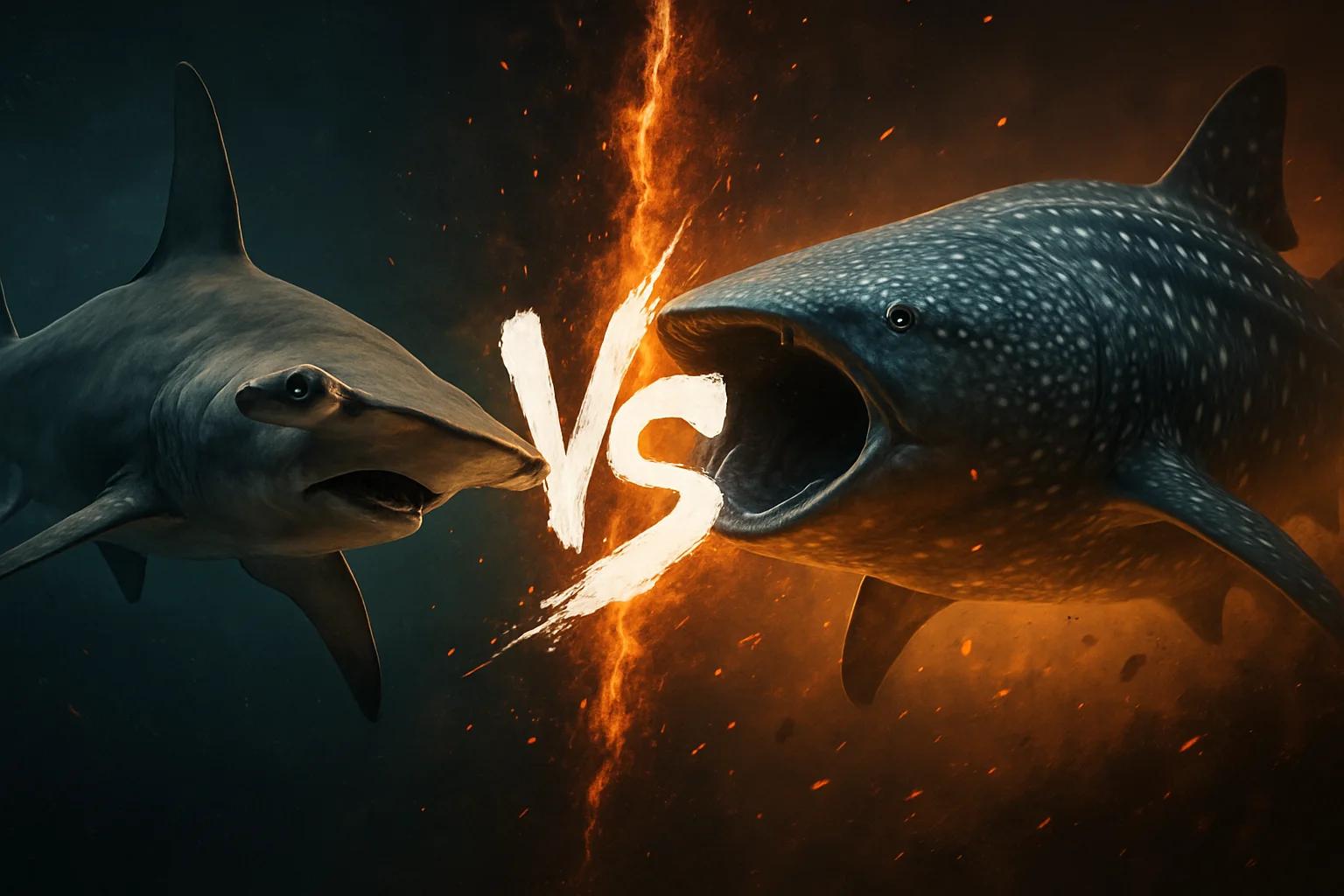
Scalloped Hammerhead vs Whale Shark: Who Actually Wins?
The whale shark wins, and not narrowly. A scalloped hammerhead is a capable predator, usually 2–3 m long, with a sensor-packed head, good acceleration, and a mouth built for squid and reef fish. A whale shark is the largest fish on Earth, commonly 5.5–10 m and sometimes more, with skin roughly 10 cm thick and a body mass more than 50 times greater. The hammerhead has no tool that can reach anything vital. Its bite is sized for prey it can swallow, and against a whale shark it would barely mark the hide. The whale shark is a harmless filter feeder with tiny, useless teeth, so it won't 'win' by killing anything. It wins by being impossible to beat. The hammerhead runs out of options long before the whale shark runs out of body. The only real exception is a newborn or very small juvenile whale shark, which is vulnerable to predatory sharks.
Read comparison
Discussion
What do you think?
Share your reasoning with other readers. Be civil and stick to the animals.
Sign in to join the discussion.
Sign inNo comments yet. Start the conversation.