


Meerkat vs Springbok: Who Actually Wins?
Meerkat vs springbok: who would win a fight? A biology-first look at size, horns, hooves, speed, burrows and group defense, and why the springbok comes out on top.
Meerkat vs Springbok
Matchup winner
Springbok
Quick verdict
Start with the direct answer, then use the structured comparison below to see what changes the outcome.
The springbok wins, and it isn't close in a straight contest. An adult springbok weighs roughly 30–45 kg and stands about 75–85 cm at the shoulder. It carries ridged, lyre-shaped horns and sharp hooves, and it can hit about 88 km/h. A meerkat weighs under 1 kg. Its weapons are small teeth and digging claws built for scorpions and beetles, not for hoofed animals forty times its weight. Neither animal hunts the other, so a real encounter is a territorial or defensive brush on the Kalahari, not predation. In that frame the springbok's mass, horn reach and stamping hooves decide almost every one-on-one. The meerkat's real strengths are vigilance, burrow access and mobbing as a coordinated gang. Those let it escape or annoy the springbok, but not beat it.
Read the full explanation
The springbok wins: it is roughly 40x heavier, with horns, hooves and elite speed.
Meerkats are hunters of insects and small reptiles; a springbok is far outside their prey or threat class.
A meerkat mob can harass and briefly deter a springbok but cannot injure it meaningfully.
The meerkat's best 'win' is vanishing into a burrow, which is survival, not victory.
Reader vote
Who do you think wins?
Pick a side — no account needed. Results update live.
No votes yet — be the first to call it.
Editorial note
Why people disagree
Meerkat mobbing videos are famous. A gang facing down snakes and jackals looks fearless, so people overestimate what group bluffing can do against a large, armored herbivore.
Mass and frame
At a ~40:1 weight gap, any physical contact favors the springbok almost automatically.
Weaponry
Horns and stamping hooves deliver force from a distance the meerkat cannot close safely.
Speed and escape
The springbok controls distance in open ground, choosing whether to engage or leave.
Read the full explanation +
Springboks look gentle. 'Gazelle' reads as prey, but males spar with horns and hooves and will stamp at small threats near lambs.
Burrows muddy the question. If 'winning' means not being caught, the meerkat can always escape underground. If it means controlling the contest, the springbok dominates.
Neither species ever needs to fight the other. That makes this a thought experiment about weapons, mass and defense, not a documented predator-prey matchup.
Comparison FAQ
Short, direct answers to the next questions readers usually ask after the headline verdict.
Would a meerkat beat a springbok in a fight?+
No. The springbok weighs around 40 times more and has horns and sharp hooves. A meerkat cannot meaningfully injure it, while a single stamp could kill the meerkat.
Which is stronger, a meerkat or a springbok?+
The springbok, by far. Its body mass, leg power and horn-sparring strength dwarf a sub-1 kg meerkat, which is built for digging, not grappling.
Can a group of meerkats drive off a springbok?+
They might make a springbok step aside through mobbing displays, but they cannot overpower it. If the springbok holds its ground or stamps, the mob breaks.
Why is the meerkat still dangerous even though it loses?+
Its danger is to things its own size: venomous scorpions, small snakes, lizards and intruding rodents. Its coordinated mobbing, partial resistance to scorpion venom and burrow escape routes make it formidable in its own weight class, even if a springbok is out of reach.
Do meerkats and springbok actually fight in the wild?+
Rarely, if ever, in a serious way. They share Kalahari habitat but don't compete for food, and neither preys on the other. Encounters are usually avoidance, with meerkats wary of hooves.
Head-to-head species stats
These are the same core AnimalDex stat dimensions used on the dedicated animal pages, pulled side by side so the matchup is faster to scan.
Meerkat
Tier CSpringbok
Tier CTrait-by-trait comparison
Only the categories that matter to this matchup are included. The goal is not filler stats, but the real design differences that change the result.
0.6–0.9 kg, slender sentinel build
Mass and frame
Springbok
30–45 kg, long-legged antelope
Mass and frame
Springbok
Small sharp teeth, curved digging claws
Weaponry
Springbok
Ridged horns up to ~35–49 cm, hard sharp hooves
Weaponry
Springbok
Quick bursts of roughly 30 km/h, darts to burrows
Speed and escape
Springbok
Up to ~88 km/h, pronking leaps of 2+ m
Speed and escape
Springbok
Rotating sentinels, alarm calls, coordinated mobbing
Vigilance and coordination
Meerkat
Herd awareness, pronking as a fitness signal
Vigilance and coordination
Meerkat
Extensive burrow networks with many bolt-holes
Refuge access
Meerkat
No refuge; relies on speed and the herd
Refuge access
Meerkat
Fragile; one hoof strike could be lethal
Close-range durability
Springbok
Tough hide and frame; meerkat bites are superficial
Close-range durability
Springbok
How the verdict forms
Verdict timeline
01 · Mass and frame
Springbok
02 · Weaponry
Springbok
03 · Speed and escape
Springbok
04 · Vigilance and coordination
Meerkat
05 · Refuge access
Meerkat
06 · Close-range durability
Springbok
Change the conditions
Scenario breakdown
This is where shallow battle content usually fails. Terrain, spacing, timing, and engagement style can change the answer.
Scenario lean
Springbok
Verdict confidence
82%
The springbok controls it completely.
With no burrow nearby, a lone meerkat has no way to threaten an animal of this size. A springbok can lower its horns, stamp or simply outpace it. Mass and reach decide contact fights, and every physical advantage sits with the antelope.
AnimalDex field profiles
Explore these animals
Meerkat
Suricata suricatta
Arid grassland, scrub, and semi-desert with burrow-friendly soil.
Springbok
Antidorcas marsupialis
dry grassland, scrub, and semi-desert plain
Systems Intelligence & Hidden Purpose
See the animals behind this comparison as engineered biological systems: what each one is built to do, where it gains leverage, and why the matchup changes by scenario.
Specialized Hardware
Upright vigilance posture, coordinated alarm language, and digging-ready limbs make meerkats social detection hardware for open dry ground.
Systems Script
Meerkats reduce predation uncertainty by turning many small mammals into one shared warning network. They prove that survival at small body size depends on information quality as much as escape speed.
Strategic Insight
Small units become formidable when they pool watch duty instead of pretending every member can do everything alone.
Specialized Hardware
high bouncing pronk leaps, light desert-grassland build, and sharp open-country eyesight give the Springbok a body plan tuned for its niche.
Systems Script
Springboks operate through dry grassland, scrub, and semi-desert plain Their design links movement, shelter, feeding, and survival into one workable system.
Strategic Insight
Sometimes a burst of visible confidence warns danger that the chase may not be worth it.
Final take
The springbok is the clear winner. It brings forty times the mass, real weapons on both ends, and elite speed to a contest the meerkat was never built for. The meerkat's teeth and claws are precision tools for beetles, scorpions and lizards, not for hoofed animals.
Read the full explanation
That doesn't make the meerkat a pushover in the Kalahari. Its sentinel rotations, alarm calls, mobbing and burrow network make it one of the hardest small animals in its habitat to catch. Against a springbok, though, those systems buy escape rather than victory.
Verdict: springbok by a wide margin in any frame that counts as a fight. The meerkat's best outcome is a clean retreat underground.
Collect both animals in AnimalDex
Track the species behind this matchup, compare their real traits, and build the rivalry into your AnimalDex collection.
Related comparisons
Continue with nearby matchups to compare more real-world animal traits without dropping into junky who-wins filler.
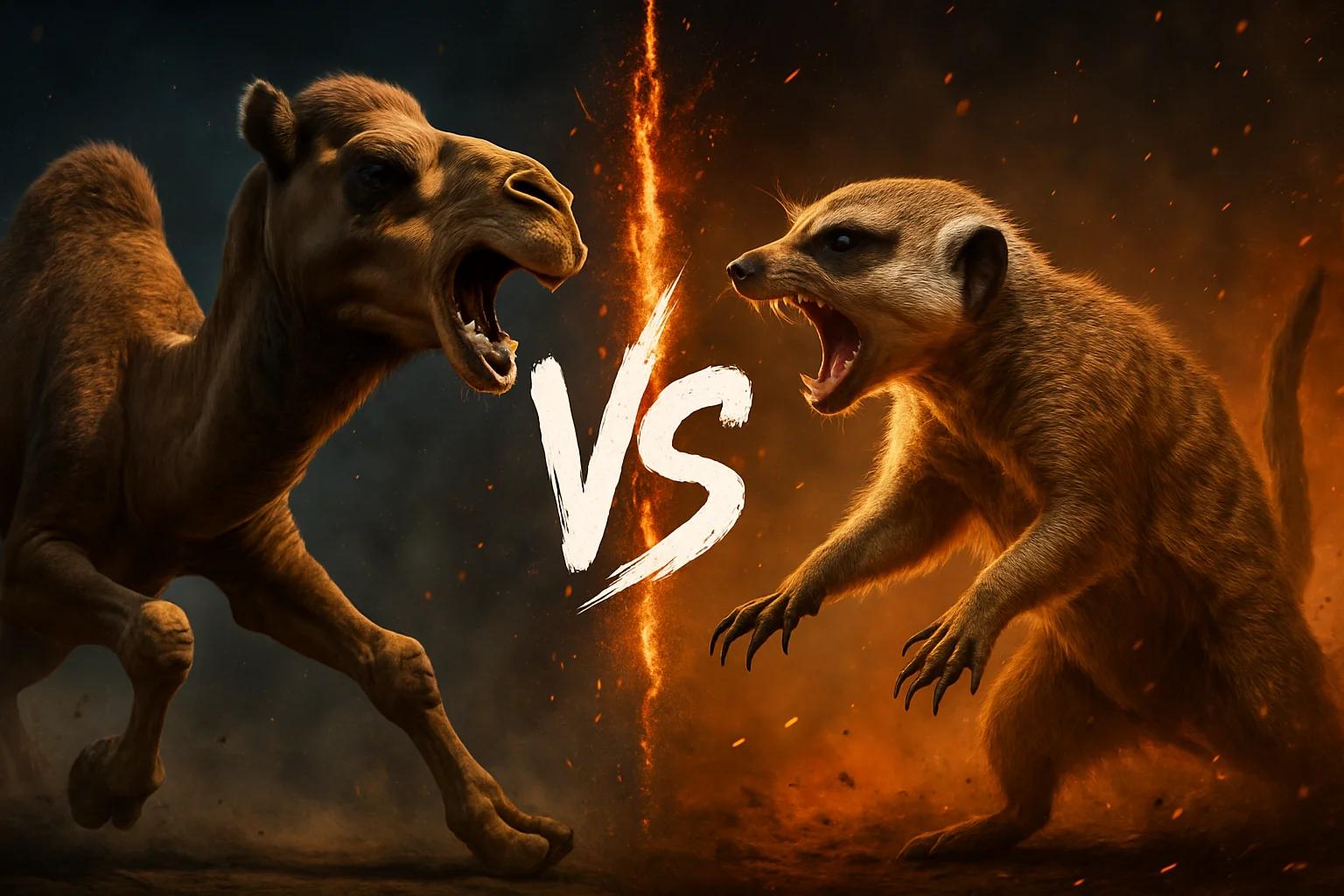
Dromedary Camel vs Meerkat: Who Actually Wins?
The dromedary camel wins, and it isn't close in a direct confrontation. An adult dromedary weighs roughly 400–600 kg against a meerkat's 0.6–1 kg, a mass gap of several hundred to one. Camels defend themselves with heavy kicks that can reach in any direction, crushing body weight, and a bite strong enough to injure large mammals, especially rutting bulls. A meerkat's sharp teeth and claws are built for scorpions, beetles and burrow digging, not for harming an animal whose legs alone outweigh an entire mob. The meerkat's real strength is avoidance. Sentinel calls, burrow networks and group mobbing mean a camel would almost never catch one. But 'who would win' means who prevails if they clash, and on that question the camel's size and durability settle it.
Read comparison
Discussion
What do you think?
Share your reasoning with other readers. Be civil and stick to the animals.
Sign in to join the discussion.
Sign inNo comments yet. Start the conversation.