

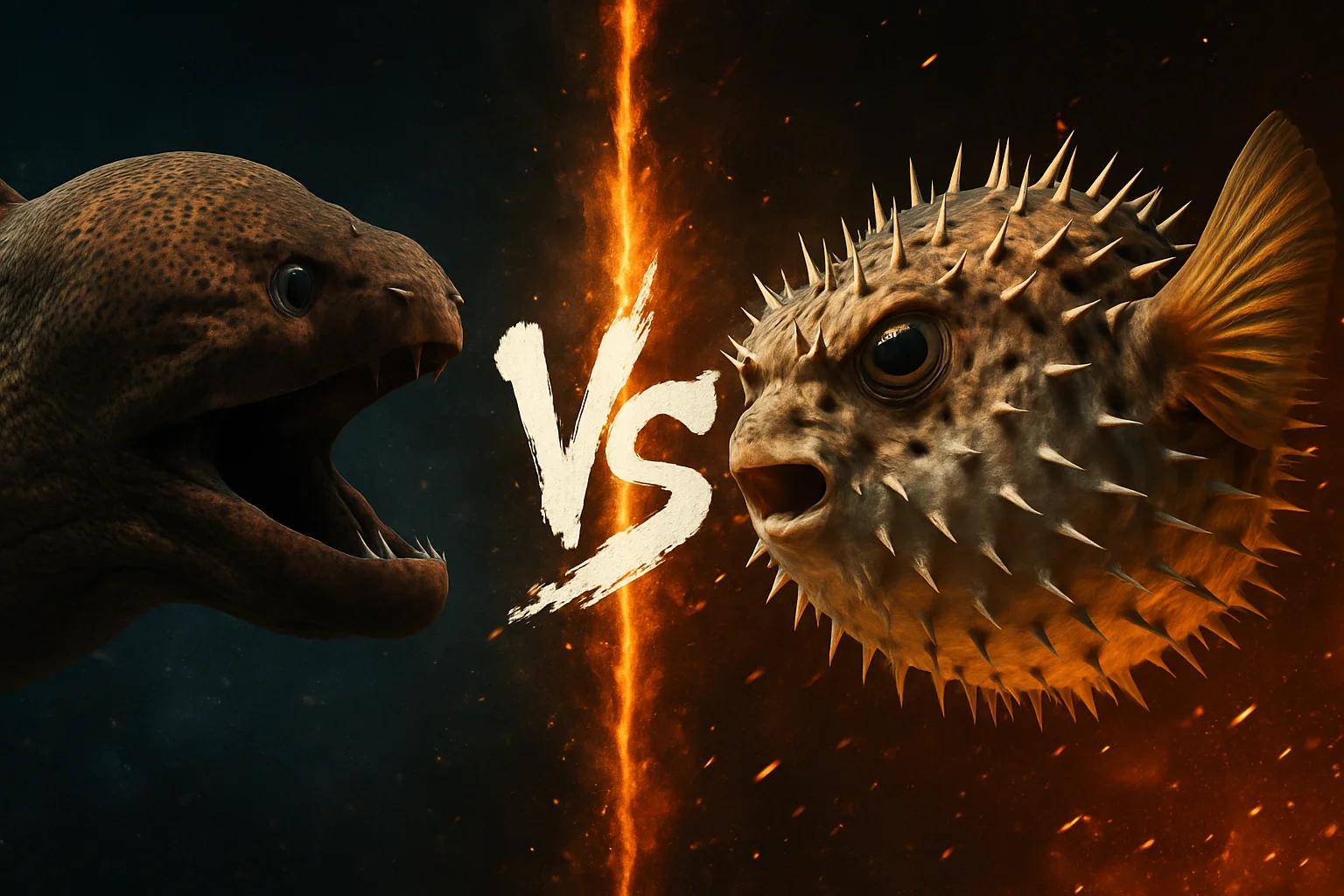
Giant Moray vs Spot-fin Porcupinefish: Who Actually Wins?
Giant moray vs spot-fin porcupinefish: a reef predator meets a spiny, toxic, inflating defender. See who wins, why, and when the pufferfish cousin turns the tables.
Moray Eel vs Porcupinefish
Matchup winner
Moray Eel
Quick verdict
Start with the direct answer, then use the structured comparison below to see what changes the outcome.
The giant moray wins this matchup clearly. At up to roughly 3 m and well over 30 kg, Gymnothorax javanicus outweighs the spot-fin porcupinefish (usually 40–70 cm) many times over. It has a muscular body, needle-lined jaws and a second set of pharyngeal jaws that drag prey inward. In a reef crevice, where the moray lives and hunts, it controls the fight from start to finish. Still, the porcupinefish is a bad meal more than an easy one. Inflation makes it a spiked ball. Its beak-like fused teeth crush shells. Its organs and skin can carry tetrodotoxin. So the moray can win the encounter and still regret the meal. The overall edge goes to the moray because size, bite and reach decide the actual contest. The porcupinefish's defenses are built to deter attacks and make predators pay afterward, not to win the exchange itself.
Read the full explanation
Giant moray wins: it is far larger, has a far stronger bite and lives in an ambush-ready lair.
The porcupinefish's inflation and spines make swallowing risky, so many morays may simply let it go.
Tetrodotoxin means a 'win' for the moray can still end badly after the meal.
Neither animal is a natural rival; this is predator vs a well-armored prey specialist.
Reader vote
Who do you think wins?
Pick a side — no account needed. Results update live.
No votes yet — be the first to call it.
Editorial note
Why people disagree
Spines and inflation look unbeatable, but they mainly stop gulping predators and do little against a predator that grips, shakes and tears.
Explosive strike power
The moray lands the first decisive grip before the porcupinefish can fully inflate.
Jaw weaponry
The porcupinefish's beak cracks snails, but the moray's jaws are built to hold and tear prey.
Size and mass
The size gap is too large for the porcupinefish to physically contest.
Read the full explanation +
People mix up 'winning the fight' with 'surviving the meal'. Toxins work after the encounter, not during it.
Video clips of morays spitting out puffers suggest the puffer won, but that is the moray choosing to stop, not losing.
Comparison FAQ
Short, direct answers to the next questions readers usually ask after the headline verdict.
Would a giant moray beat a porcupinefish?+
Yes. The moray's size, strike speed and bite decide the encounter. The porcupinefish can resist being swallowed but cannot fight back effectively.
Which is stronger, a giant moray or a porcupinefish?+
The giant moray, by a wide margin. It is far heavier and far more muscular, and its jaws are built for gripping and tearing.
Can a porcupinefish hurt a moray eel?+
Yes, mainly after the fact. Its spines can injure the mouth and throat, and tetrodotoxin can poison a moray that eats it.
Why does the porcupinefish stay dangerous even when it loses?+
Its defenses work through deterrence. Inflation blocks swallowing, spines cause injury and toxin punishes the predator, so a 'win' for the moray can still be costly.
Do moray eels eat porcupinefish in the wild?+
Large reef predators occasionally take puffers and porcupinefish, but these fish are generally avoided because of their spines and toxicity.
Head-to-head species stats
These are the same core AnimalDex stat dimensions used on the dedicated animal pages, pulled side by side so the matchup is faster to scan.
Moray Eel
Tier CPorcupinefish
Tier CTrait-by-trait comparison
Only the categories that matter to this matchup are included. The goal is not filler stats, but the real design differences that change the result.
Lightning lunge from a crevice
Explosive strike power
Moray Eel
Slow fin-driven sculling
Explosive strike power
Moray Eel
Fangs plus pharyngeal second jaw
Jaw weaponry
Moray Eel
Fused crushing beak
Jaw weaponry
Moray Eel
Up to ~3 m, 30+ kg
Size and mass
Moray Eel
Typically under 70 cm
Size and mass
Moray Eel
Thick mucus-coated skin
Passive armor
Porcupinefish
Erectile spines, balloon inflation
Passive armor
Porcupinefish
Possible ciguatoxin carrier
Chemical deterrence
Porcupinefish
Tetrodotoxin in tissues
Chemical deterrence
Porcupinefish
Lair-based, scent-guided hunter
Ambush control
Moray Eel
Nocturnal forager, little offense
Ambush control
Moray Eel
How the verdict forms
Verdict timeline
01 · Explosive strike power
Moray Eel
02 · Jaw weaponry
Moray Eel
03 · Size and mass
Moray Eel
04 · Passive armor
Porcupinefish
05 · Chemical deterrence
Porcupinefish
06 · Ambush control
Moray Eel
Change the conditions
Scenario breakdown
This is where shallow battle content usually fails. Terrain, spacing, timing, and engagement style can change the answer.
Scenario lean
Moray Eel
Verdict confidence
82%
The moray's home turf. It wins almost instantly.
Morays sense prey by smell and strike from tight rock. In confined space the porcupinefish has little room to inflate fully, and the moray's grip-and-twist method wins before the spines come into play.
AnimalDex field profiles
Explore these animals
Moray Eel
Gymnothorax javanicus
Coral reef, rocky reef, and crevice-rich tropical marine habitat.
Porcupinefish
Diodon hystrix
coral reef, seagrass flat, and rocky coastal sea
Systems Intelligence & Hidden Purpose
See the animals behind this comparison as engineered biological systems: what each one is built to do, where it gains leverage, and why the matchup changes by scenario.
Specialized Hardware
Long snake-like fish body, wide gaping mouth for breathing, and usually hidden in reef holes give the Moray Eel a body plan tuned for its niche.
Systems Script
Moray Eels operate in coral reef, rocky reef, and crevice-rich tropical marine habitat. Their design helps them match food access, shelter, and timing inside that environment.
Strategic Insight
A narrow protected position can make a long body much more dangerous and much safer.
Specialized Hardware
inflatable spiny body, beak-like crushing jaws, and reef-crevice sheltering give the Porcupinefish a body plan tuned for its niche.
Systems Script
Porcupinefishs operate through coral reef, seagrass flat, and rocky coastal sea. Their design links movement, feeding, shelter, and timing into one workable survival system.
Strategic Insight
In moving water, the best systems use flow, visibility, and depth instead of fighting every current.
Final take
The giant moray is the clear winner. It is one of the reef's top crevice predators, with size, ambush timing and a uniquely effective double-jaw system that the porcupinefish simply cannot overpower.
Read the full explanation
The porcupinefish's real success is evolutionary, not physical. Inflation, spines and toxins make attacking it a poor deal, so many predators decline. Against a determined giant moray, that deterrence becomes risk management rather than victory.
Collect both animals in AnimalDex
Track the species behind this matchup, compare their real traits, and build the rivalry into your AnimalDex collection.
Related comparisons
Continue with nearby matchups to compare more real-world animal traits without dropping into junky who-wins filler.
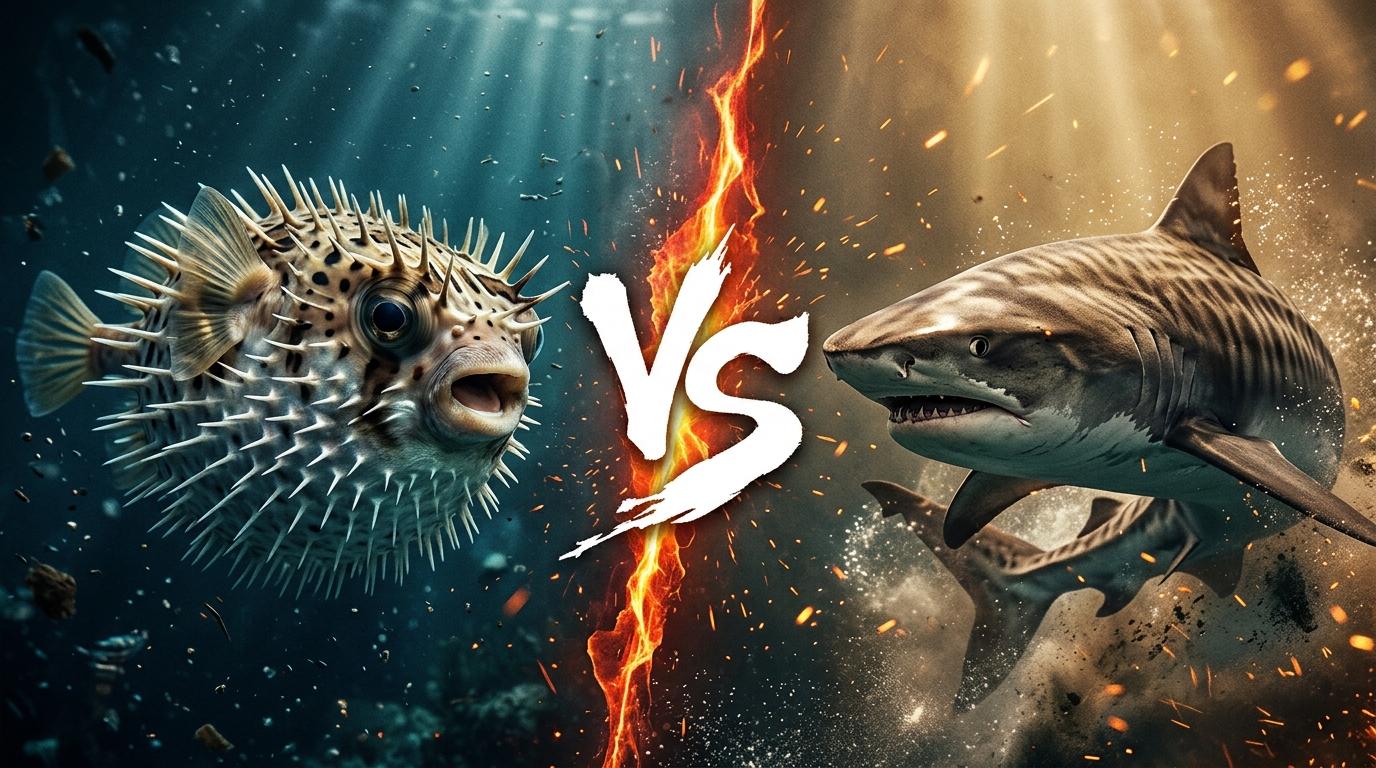
Spot-fin Porcupinefish vs Tiger Shark: Who Actually Wins?
The tiger shark wins clearly. A mature Galeocerdo cuvier can exceed 4 meters and several hundred kilograms. Its serrated, can-opener teeth evolved to saw through sea turtle shells. Few sharks are more willing to eat difficult, armored, or awkward prey. The spot-fin porcupinefish runs on a passive defense system: it gulps water to swell into a spiked ball and carries tetrodotoxin in its tissues. That combination deters most mid-sized predators and can kill a careless one. Against a tiger shark, though, inflation mostly turns the fish into a bigger, slower target, and the shark's jaws are built for exactly that kind of problem. The porcupinefish's real weapon is the toxin it delivers after being eaten. That is a cost to the predator, not a victory for the prey.
Read comparison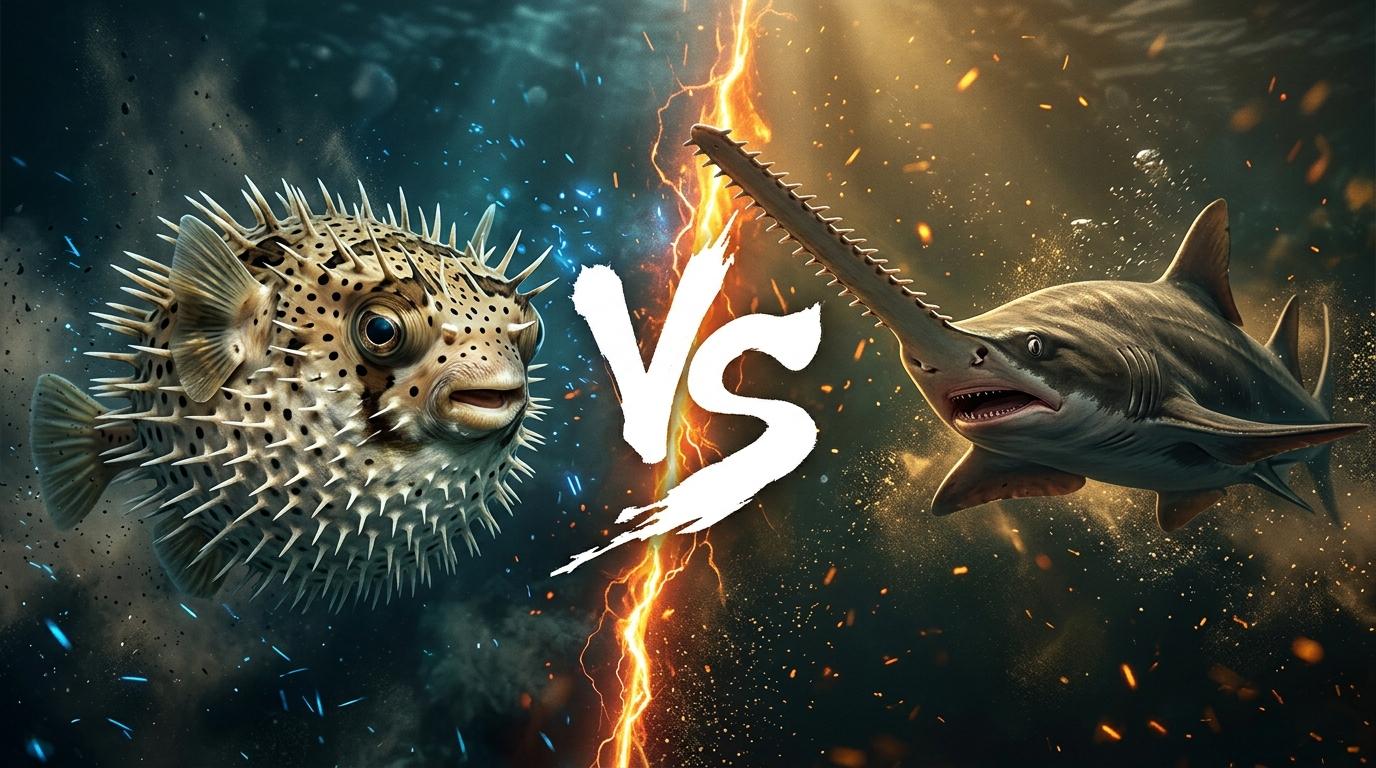
Spot-fin Porcupinefish vs Smalltooth Sawfish: Who Actually Wins?
The smalltooth sawfish wins, and it is not especially close. An adult Pristis pectinata can stretch past 5 meters, and its rostrum, a flattened saw lined with tooth-like denticles and packed with electroreceptors, is built to detect and slash small fish in the water column and pin them to the seabed. The spot-fin porcupinefish tops out around 70–90 cm. Its whole survival plan is to inflate into a spiny ball and carry tetrodotoxin that punishes anything that swallows it. That plan works against predators that bite and gulp. The sawfish does not have to do either. It can strike, stun and reposition prey with its saw, and if the puffer stays inflated and dangerous, the sawfish can simply leave it alone. The porcupinefish can make itself unappealing, but it cannot impose an outcome on an animal fifteen to twenty-five times its length.
Read comparison
Discussion
What do you think?
Share your reasoning with other readers. Be civil and stick to the animals.
Sign in to join the discussion.
Sign inNo comments yet. Start the conversation.