


Oarfish vs Opah: Who Actually Wins?
Oarfish vs opah: the longest bony fish against the first known fully warm-blooded fish. A biology-first breakdown of size, power, speed and who would win.
Oarfish vs Opah
Matchup winner
Opah
Quick verdict
Start with the direct answer, then use the structured comparison below to see what changes the outcome.
The opah wins. The oarfish has the headline length, often 3 to 5 meters and possibly more in rare cases, but that length is mostly a thin, lightly muscled ribbon built for hovering vertically and drifting. It has no teeth to speak of, a soft body, and a tail that can break off. The opah is a compact, disc-shaped slab of muscle. Its powerful pectoral fins flap like wings, and in 2015 NOAA researchers showed it is the first fish known to keep its whole body warmer than the surrounding water. That warmth keeps its muscles, heart and brain working at full output in cold, deep water where the oarfish is sluggish. In any encounter that rewards acceleration, control or sustained effort, the opah dictates terms. The oarfish's length makes it hard to subdue, but length without muscle does not win.
Read the full explanation
Opah wins: a dense, warm-bodied muscle disc beats a long, fragile ribbon.
Whole-body warmth gives the opah faster reactions and stronger swimming in cold deep water.
The oarfish is longer, but much of that length is thin, soft tissue that can tear or break off.
Neither fish is truly predatory toward the other. This is a physics and physiology contest.
Reader vote
Who do you think wins?
Pick a side — no account needed. Results update live.
No votes yet — be the first to call it.
Editorial note
Why people disagree
Length looks like power: an oarfish photo dwarfs a person, so people assume it outclasses a fish the size of a car tire.
Explosive power
The fish that accelerates first controls the distance in every exchange.
Cold-water engine
Warm muscles contract faster and recover quicker, which is decisive in the cold midwater zone where both live.
Reach and length
Length makes the oarfish awkward to grip or turn, which is its only real defensive asset.
Read the full explanation +
Opah weight is underrated: big opah can match or outweigh many oarfish because their bodies are deep and dense rather than ribbon-thin.
'Sea serpent' myth versus reality: oarfish legends imply a monster, but the real animal is a gentle plankton feeder with weak musculature.
Comparison FAQ
Short, direct answers to the next questions readers usually ask after the headline verdict.
Would an oarfish beat an opah?+
No. The opah's muscle density, warm-bodied endurance and maneuverability would beat the oarfish's length.
Which is stronger, oarfish or opah?+
The opah. Its deep body is packed with swimming muscle, while the oarfish is long but lightly built.
Is the oarfish dangerous at all?+
Not to people. It is a toothless plankton eater. In a contest, its only 'danger' is its sheer length, which makes it awkward to grapple, and that can stall an opponent briefly.
Why is the opah called warm-blooded?+
Its gills contain counter-current heat exchangers that retain heat produced by its flapping muscles. This keeps its whole body warmer than the surrounding water.
Do oarfish and opah meet in the wild?+
Their open-ocean, midwater ranges can overlap, but there is no known predatory relationship between the two.
Head-to-head species stats
These are the same core AnimalDex stat dimensions used on the dedicated animal pages, pulled side by side so the matchup is faster to scan.
Oarfish
Tier COpah
Tier CTrait-by-trait comparison
Only the categories that matter to this matchup are included. The goal is not filler stats, but the real design differences that change the result.
Slow body undulation, weak bursts
Explosive power
Opah
Wing-like pectoral strokes, strong launches
Explosive power
Opah
Ectothermic, sluggish when deep
Cold-water engine
Opah
Whole-body endothermy via counter-current gill heat exchange
Cold-water engine
Opah
Several meters of ribbon body
Reach and length
Oarfish
Roughly 1 to 2 meters, compact disc
Reach and length
Oarfish
Soft, scaleless, can lose tail sections
Close-range durability
Opah
Deep, firm, heavily muscled body
Close-range durability
Opah
Vertical hovering, limited turning
Maneuver control
Opah
Agile flapping turns and sustained cruising
Maneuver control
Opah
Tiny toothless mouth, plankton filter
Natural weaponry
Opah
Small toothless mouth, squid and fish hunter
Natural weaponry
Opah
How the verdict forms
Verdict timeline
01 · Explosive power
Opah
02 · Cold-water engine
Opah
03 · Reach and length
Oarfish
04 · Close-range durability
Opah
05 · Maneuver control
Opah
06 · Natural weaponry
Opah
Change the conditions
Scenario breakdown
This is where shallow battle content usually fails. Terrain, spacing, timing, and engagement style can change the answer.
Scenario lean
Opah
Verdict confidence
82%
Opah dominates the open column.
With unlimited space, the opah's warm-muscled flapping lets it close, disengage and reposition at will. The oarfish relies on slow dorsal-fin rippling and cannot match its tempo or endurance.
AnimalDex field profiles
Explore these animals
Opah
Lampris guttatus
open ocean and deep pelagic water
Systems Intelligence & Hidden Purpose
See the animals behind this comparison as engineered biological systems: what each one is built to do, where it gains leverage, and why the matchup changes by scenario.
Specialized Hardware
extremely long ribbon body, crimson dorsal crest, and deep open-water drifting give the Oarfish a body plan tuned for its niche.
Systems Script
Oarfishs operate through deep pelagic ocean. Their design links movement, feeding, shelter, and timing into one workable survival system.
Strategic Insight
In moving water, the best systems use flow, visibility, and depth instead of fighting every current.
Specialized Hardware
round metallic body, warm-blooded deep-water muscles, and long cruising fin beats give the Opah a body plan tuned for its niche.
Systems Script
Opahs operate through open ocean and deep pelagic water. Their design links movement, feeding, shelter, and timing into one workable survival system.
Strategic Insight
In moving water, the best systems use flow, visibility, and depth instead of fighting every current.
Final take
The opah takes this one decisively. Physiology beats appearance: its whole-body warmth is a rare evolutionary upgrade that turns a compact body into a sustained power plant.
Read the full explanation
The oarfish is a marvel of a different kind, built for low-energy drifting and filter feeding, not confrontation. Its record length is an adaptation for living quietly, not a fighting asset.
Collect both animals in AnimalDex
Track the species behind this matchup, compare their real traits, and build the rivalry into your AnimalDex collection.
Related comparisons
Continue with nearby matchups to compare more real-world animal traits without dropping into junky who-wins filler.
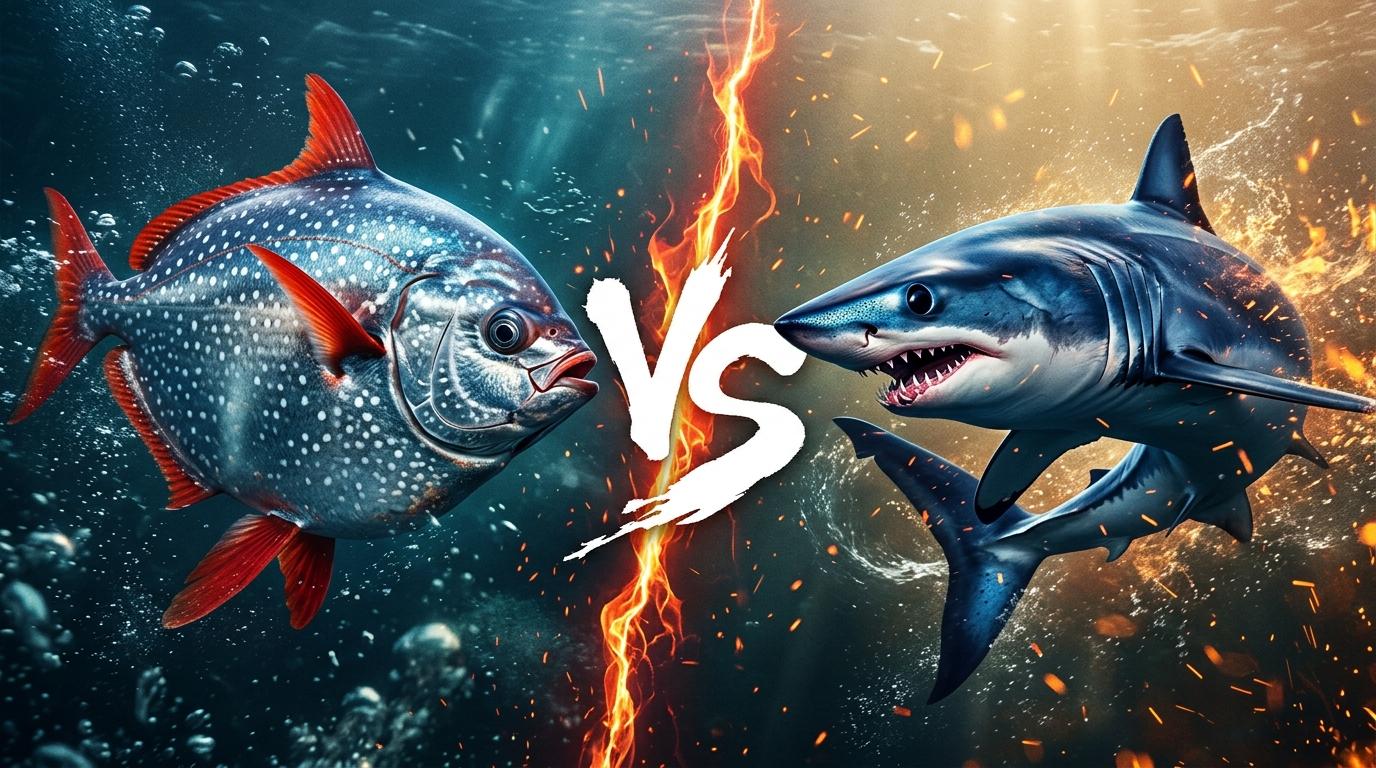
Opah vs Shortfin Mako: Who Actually Wins?
The shortfin mako wins, and it is not especially close. Both animals break the cold-blooded fish rulebook. The opah is the only fish known to warm its whole body, using a heat-trapping gill network called a counter-current exchanger. The mako runs regional endothermy, keeping its swimming muscles, eyes, and brain warm. That is where the similarity ends. The mako is a 2–4 m apex shark built for bursts above 60 km/h, with long, smooth, dagger-like teeth made for gripping fast prey. Adults are known to eat large fish, including swordfish. The opah is a disc-shaped, toothless, mid-water hunter that eats squid and small fish. In any meeting, the mako has more size, speed, weapons, and predatory intent. The opah's best survival tools are depth endurance and avoiding a fight altogether.
Read comparison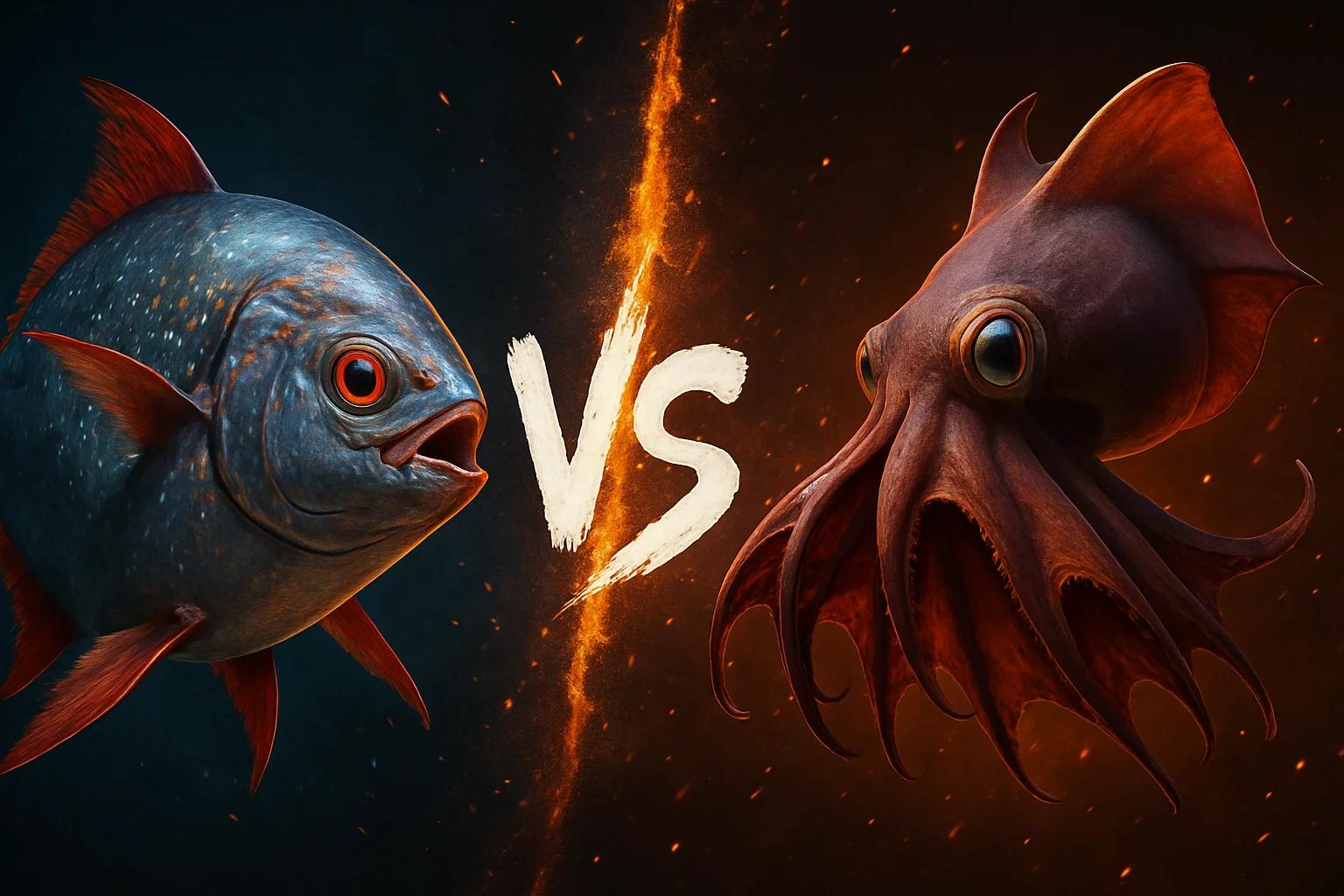
Opah vs Vampire Squid: Who Actually Wins?
The opah wins, and it isn't close. Lampris guttatus is the only fish known to be fully warm-blooded. It heats its blood with its flapping pectoral muscles and holds onto that heat with a counter-current exchanger in its gills. That gives it a brain, eyes and swimming muscles that stay fast and sharp in cold water. It can grow past 1 m long and weigh more than 50 kg, and it is an active hunter of squid and fish. The vampire squid is roughly palm-to-forearm sized and has a soft, gelatinous body. It lives in the low-oxygen zone at about 600–900 m, where saving energy matters more than speed. It isn't built to fight. Its tools are escape tools: glowing arm tips, a cloud of bioluminescent mucus, and a defensive pose that turns its webbed cloak inside out. Those defenses can confuse a predator. They can't hold off a larger, warmer animal that could easily eat it. In nearly every realistic meeting, the opah decides whether there's a fight at all.
Read comparison
Discussion
What do you think?
Share your reasoning with other readers. Be civil and stick to the animals.
Sign in to join the discussion.
Sign inNo comments yet. Start the conversation.