

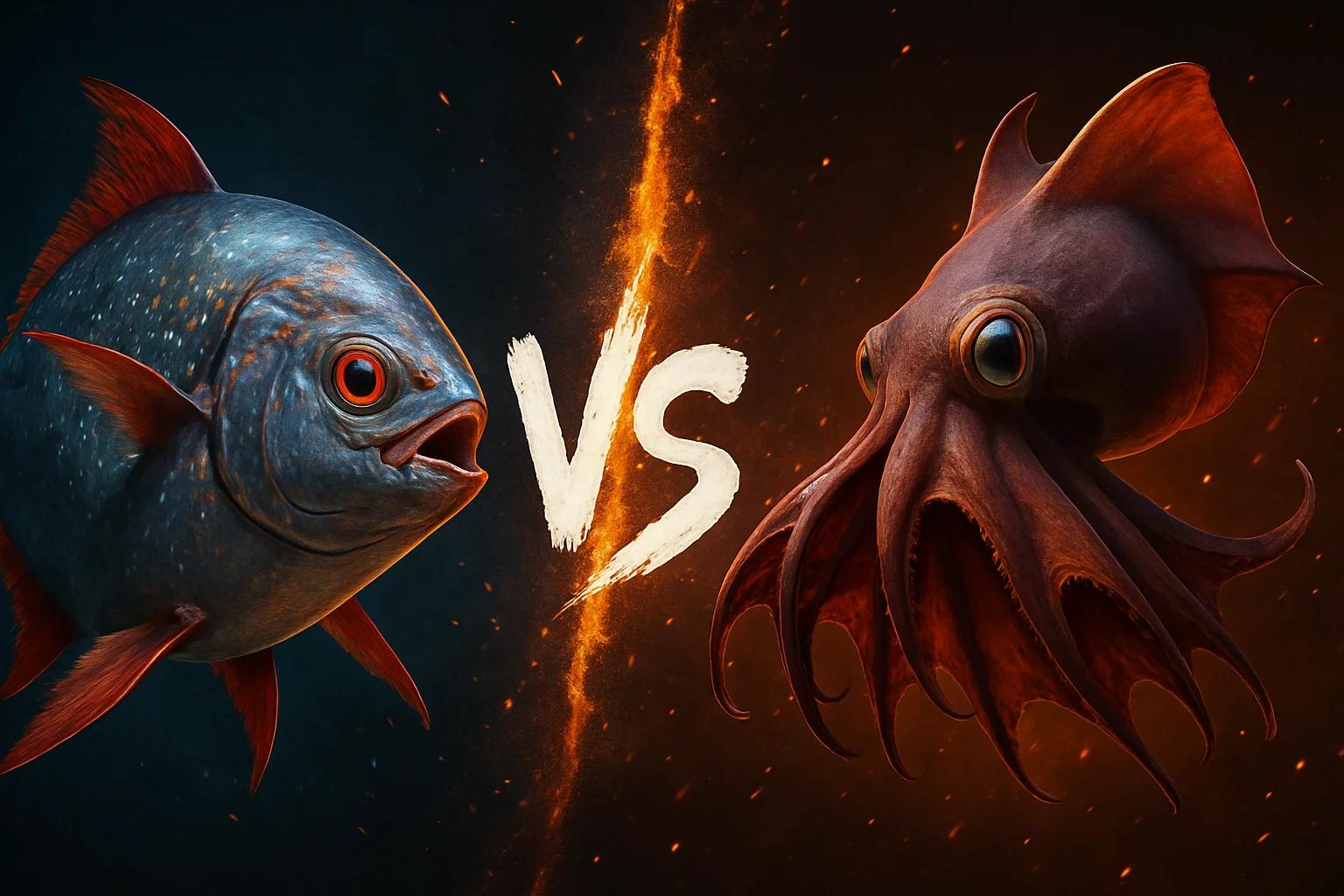
Opah vs Vampire Squid: Who Actually Wins?
Opah vs vampire squid: a warm-blooded open-ocean predator meets a deep-sea drifter built for survival. See who wins, why, and how each animal thrives.
Opah vs Vampire Squid
Matchup winner
Opah
Quick verdict
Start with the direct answer, then use the structured comparison below to see what changes the outcome.
The opah wins, and it isn't close. Lampris guttatus is the only fish known to be fully warm-blooded. It heats its blood with its flapping pectoral muscles and holds onto that heat with a counter-current exchanger in its gills. That gives it a brain, eyes and swimming muscles that stay fast and sharp in cold water. It can grow past 1 m long and weigh more than 50 kg, and it is an active hunter of squid and fish. The vampire squid is roughly palm-to-forearm sized and has a soft, gelatinous body. It lives in the low-oxygen zone at about 600–900 m, where saving energy matters more than speed. It isn't built to fight. Its tools are escape tools: glowing arm tips, a cloud of bioluminescent mucus, and a defensive pose that turns its webbed cloak inside out. Those defenses can confuse a predator. They can't hold off a larger, warmer animal that could easily eat it. In nearly every realistic meeting, the opah decides whether there's a fight at all.
Read the full explanation
The opah wins: it's far bigger, and as a warm-blooded fish it stays fast and alert in cold, deep water.
The vampire squid is a low-energy drifter whose defenses are about escaping, not fighting back.
The squid's best result is not getting caught. Light displays and glowing mucus clouds can buy it an escape.
Squid and cephalopods are already a normal part of the opah's diet.
Reader vote
Who do you think wins?
Pick a side — no account needed. Results update live.
No votes yet — be the first to call it.
Editorial note
Why people disagree
The name 'vampire squid' sounds scary, but the animal is a gentle detritus feeder that eats drifting 'marine snow.'
Explosive power
Warm muscle contracts faster in cold water, so the opah can close distance quickly.
Size and mass
The size gap is large enough to make the squid prey-sized rather than a rival.
Cold-water performance
Both are adapted to cold, but the opah uses its heat to move fast while the squid saves energy by moving slowly.
Read the full explanation +
People confuse surviving with winning. The squid is excellent at the first and isn't designed for the second.
Their depth ranges only partly overlap, so some readers argue they'd rarely meet. The question is still who wins if they do.
Comparison FAQ
Short, direct answers to the next questions readers usually ask after the headline verdict.
Would an opah beat a vampire squid?+
Yes. The opah's size, speed and warm-blooded muscles let it overpower the squid easily.
Which is stronger, an opah or a vampire squid?+
The opah, by a huge margin. It has more muscle and mass, and that muscle stays warm and powerful in cold water.
Is the vampire squid dangerous?+
Not to large animals. It is still very good at escaping, thanks to bioluminescent decoys and its ability to retreat into oxygen-poor depths.
Do opahs eat squid?+
Yes. Squid make up a significant part of the opah's diet.
Head-to-head species stats
These are the same core AnimalDex stat dimensions used on the dedicated animal pages, pulled side by side so the matchup is faster to scan.
Opah
Tier CVampire Squid
Tier CTrait-by-trait comparison
Only the categories that matter to this matchup are included. The goal is not filler stats, but the real design differences that change the result.
Strong flapping pectoral fins, warm muscles
Explosive power
Opah
Fin-flaps and brief jet bursts
Explosive power
Opah
Often 1 m+ and tens of kilograms
Size and mass
Opah
About 30 cm total, very light
Size and mass
Opah
Whole-body endothermy
Cold-water performance
Opah
Very low metabolic rate
Cold-water performance
Opah
Firm, muscular body
Close-range durability
Opah
Soft, gelatinous tissue
Close-range durability
Opah
Relies on speed
Escape tricks
Vampire Squid
Bioluminescent mucus clouds, inside-out cloak pose, glowing arm tips
Escape tricks
Vampire Squid
Needs better-oxygenated water
Low-oxygen endurance
Vampire Squid
Lives in the oxygen minimum zone
Low-oxygen endurance
Vampire Squid
How the verdict forms
Verdict timeline
01 · Explosive power
Opah
02 · Size and mass
Opah
03 · Cold-water performance
Opah
04 · Close-range durability
Opah
05 · Escape tricks
Vampire Squid
06 · Low-oxygen endurance
Vampire Squid
Change the conditions
Scenario breakdown
This is where shallow battle content usually fails. Terrain, spacing, timing, and engagement style can change the answer.
Scenario lean
Opah
Verdict confidence
82%
Opah, decisively
In open water with enough oxygen, the opah's warm eyes and muscles let it spot and chase the squid. The squid's slow fin-swimming can't outrun it, and a light display only delays the end.
AnimalDex field profiles
Explore these animals
Opah
Lampris guttatus
open ocean and deep pelagic water
Vampire Squid
Vampyroteuthis infernalis
deep ocean and oxygen-poor midwater zone
Systems Intelligence & Hidden Purpose
See the animals behind this comparison as engineered biological systems: what each one is built to do, where it gains leverage, and why the matchup changes by scenario.
Specialized Hardware
round metallic body, warm-blooded deep-water muscles, and long cruising fin beats give the Opah a body plan tuned for its niche.
Systems Script
Opahs operate through open ocean and deep pelagic water. Their design links movement, feeding, shelter, and timing into one workable survival system.
Strategic Insight
In moving water, the best systems use flow, visibility, and depth instead of fighting every current.
Specialized Hardware
deep-sea red body, cloak-like arm webbing, and low-oxygen ocean survival give the Vampire Squid a body plan tuned for its niche.
Systems Script
Vampire Squids operate through deep ocean and oxygen-poor midwater zone Their design links movement, shelter, and feeding into one workable survival system.
Strategic Insight
Extreme environments reward systems that reduce demand instead of forcing more output.
Final take
The opah is the clear winner. It is a large, warm-blooded predator, and the vampire squid's whole body plan is built around saving energy and avoiding attackers.
Read the full explanation
The vampire squid shouldn't be dismissed, though. In the dark, a cloud of glowing mucus and a well-timed retreat into low-oxygen water can turn a likely meal into an empty chase. It wins by escaping, not by fighting.
Collect both animals in AnimalDex
Track the species behind this matchup, compare their real traits, and build the rivalry into your AnimalDex collection.
Related comparisons
Continue with nearby matchups to compare more real-world animal traits without dropping into junky who-wins filler.

Oceanic Whitetip Shark vs Vampire Squid: Who Actually Wins?
The oceanic whitetip shark wins decisively. It commonly reaches 2.5–3 m and is a muscular open-ocean predator with serrated teeth, a stubborn investigative style and a body built for sustained cruising. The vampire squid is roughly 30 cm long, gelatinous, slow and harmless. Despite its menacing name, it feeds on drifting marine snow, not living prey. It has no real weapon against a shark. What it does have is one of the ocean's best escape systems. It lives 600–1,200 m down in a low-oxygen zone the whitetip rarely enters, it can turn its cloak inside out, and it can release a cloud of glowing mucus to confuse attackers. In any real contact, the shark wins. Contact is the hard part.
Read comparison
Discussion
What do you think?
Share your reasoning with other readers. Be civil and stick to the animals.
Sign in to join the discussion.
Sign inNo comments yet. Start the conversation.