


Oceanic Whitetip Shark vs Vampire Squid: Who Actually Wins?
Oceanic whitetip shark vs vampire squid: a size, power and habitat breakdown of who wins, why the shark dominates, and how the deep-sea vampire squid survives by vanishing.
Oceanic Whitetip Shark vs Vampire Squid
Matchup winner
Oceanic Whitetip Shark
Quick verdict
Start with the direct answer, then use the structured comparison below to see what changes the outcome.
The oceanic whitetip shark wins decisively. It commonly reaches 2.5–3 m and is a muscular open-ocean predator with serrated teeth, a stubborn investigative style and a body built for sustained cruising. The vampire squid is roughly 30 cm long, gelatinous, slow and harmless. Despite its menacing name, it feeds on drifting marine snow, not living prey. It has no real weapon against a shark. What it does have is one of the ocean's best escape systems. It lives 600–1,200 m down in a low-oxygen zone the whitetip rarely enters, it can turn its cloak inside out, and it can release a cloud of glowing mucus to confuse attackers. In any real contact, the shark wins. Contact is the hard part.
Read the full explanation
Winner: Oceanic Whitetip Shark, with overwhelming advantages in size, bite and speed.
The vampire squid has no offensive weapons. Its fleshy 'spines' (cirri) are soft and harmless.
The squid's real defense is location. It lives in a dark, oxygen-poor depth band the shark rarely visits.
If they met in open water, the fight would be over almost instantly.
Reader vote
Who do you think wins?
Pick a side — no account needed. Results update live.
No votes yet — be the first to call it.
Editorial note
Why people disagree
The name 'vampire squid from hell' sounds lethal, but the animal is a gentle detritus-eater the size of a football.
Explosive power
The shark closes distance and strikes with far more force than the squid can produce or absorb.
Bite & weaponry
Only one of these animals carries real weapons.
Size & mass
A roughly tenfold length gap means the squid fits in a single bite.
Read the full explanation +
Some readers count 'never getting caught' as winning. In the deep dark, the squid's evasion really is excellent.
They almost never share water, so any matchup is hypothetical, and the matchup changes depending on where you stage it.
Comparison FAQ
Short, direct answers to the next questions readers usually ask after the headline verdict.
Would an oceanic whitetip shark beat a vampire squid?+
Yes, easily. The shark is roughly ten times longer, far heavier and armed with serrated teeth. The squid has no offensive weapons.
Which is stronger, the oceanic whitetip or the vampire squid?+
The oceanic whitetip, by a huge margin. It is a muscular open-ocean predator, while the vampire squid is a slow, gelatinous detritus-eater.
Is the vampire squid dangerous?+
Not to large animals or people. It eats marine snow and has soft cirri, not spines. What makes it hard to deal with is its evasion: darkness, light control and a glowing mucus decoy.
Why is the vampire squid hard for predators to catch?+
It lives in a deep, oxygen-poor zone most active predators avoid. It can switch its lights off, turn its webbed cloak inside out and release bioluminescent mucus to distract attackers.
Do oceanic whitetips and vampire squid ever meet?+
Very rarely, if ever. Whitetips mostly hunt in warm surface waters, while vampire squid live hundreds of meters deeper.
Is the vampire squid actually a squid?+
No. It belongs to its own order, Vampyromorphida, and is related to both squid and octopuses without being either.
Head-to-head species stats
These are the same core AnimalDex stat dimensions used on the dedicated animal pages, pulled side by side so the matchup is faster to scan.
Oceanic Whitetip Shark
Tier BVampire Squid
Tier CTrait-by-trait comparison
Only the categories that matter to this matchup are included. The goal is not filler stats, but the real design differences that change the result.
Thick-bodied requiem shark with strong tail thrust
Explosive power
Oceanic Whitetip Shark
Fin-flapping drifter with a short jet escape
Explosive power
Oceanic Whitetip Shark
Serrated, triangular upper teeth built for shearing
Bite & weaponry
Oceanic Whitetip Shark
Small beak; webbed arms with soft cirri
Bite & weaponry
Oceanic Whitetip Shark
Typically 2.5–3 m, sometimes larger
Size & mass
Oceanic Whitetip Shark
About 30 cm total length
Size & mass
Oceanic Whitetip Shark
Countershaded, but visible and built for sunlit water
Darkness concealment
Vampire Squid
Deep red-black body, controllable photophores, inside-out 'pineapple' posture
Darkness concealment
Vampire Squid
Little need for one
Escape toolkit
Vampire Squid
Ejects sticky bioluminescent mucus instead of ink
Escape toolkit
Vampire Squid
Warm surface waters; mostly the upper few hundred meters
Habitat tolerance
Vampire Squid
Thrives in the oxygen-minimum zone at 600–1,200 m
Habitat tolerance
Vampire Squid
How the verdict forms
Verdict timeline
01 · Explosive power
Oceanic Whitetip Shark
02 · Bite & weaponry
Oceanic Whitetip Shark
03 · Size & mass
Oceanic Whitetip Shark
04 · Darkness concealment
Vampire Squid
05 · Escape toolkit
Vampire Squid
06 · Habitat tolerance
Vampire Squid
Change the conditions
Scenario breakdown
This is where shallow battle content usually fails. Terrain, spacing, timing, and engagement style can change the answer.
Scenario lean
Oceanic Whitetip Shark
Verdict confidence
82%
The shark wins in seconds.
In lit, open water, the vampire squid's darkness tricks lose most of their value. The whitetip spots it, closes the gap and bites. With overwhelming size, a shearing bite and greater speed, the result is never in doubt.
AnimalDex field profiles
Explore these animals
Oceanic Whitetip Shark
Carcharhinus longimanus
warm open ocean and blue-water pelagic zone
Vampire Squid
Vampyroteuthis infernalis
deep ocean and oxygen-poor midwater zone
Systems Intelligence & Hidden Purpose
See the animals behind this comparison as engineered biological systems: what each one is built to do, where it gains leverage, and why the matchup changes by scenario.
Specialized Hardware
long rounded white-tipped fins, open-ocean cruising, and patrolling pelagic hunting give the Oceanic Whitetip Shark a body plan tuned for its niche.
Systems Script
Oceanic Whitetip Sharks operate through warm open ocean and blue-water pelagic zone Their design links movement, shelter, feeding, and survival into one workable system.
Strategic Insight
In sparse environments, persistence can matter more than bursts.
Specialized Hardware
deep-sea red body, cloak-like arm webbing, and low-oxygen ocean survival give the Vampire Squid a body plan tuned for its niche.
Systems Script
Vampire Squids operate through deep ocean and oxygen-poor midwater zone Their design links movement, shelter, and feeding into one workable survival system.
Strategic Insight
Extreme environments reward systems that reduce demand instead of forcing more output.
Final take
The oceanic whitetip shark is the clear winner. It is a large, bold, well-armed predator facing a small, soft drifter that evolved to avoid fights, not to win them.
Read the full explanation
The vampire squid's real story is a different kind of success. It found a part of the ocean where fast predators struggle to operate, and it survives there on very little energy. Its defenses are camouflage, misdirection and remoteness.
Who wins? The shark, almost every time they meet. Who survives longer in practice? The squid, because they almost never meet.
Collect both animals in AnimalDex
Track the species behind this matchup, compare their real traits, and build the rivalry into your AnimalDex collection.
Related comparisons
Continue with nearby matchups to compare more real-world animal traits without dropping into junky who-wins filler.
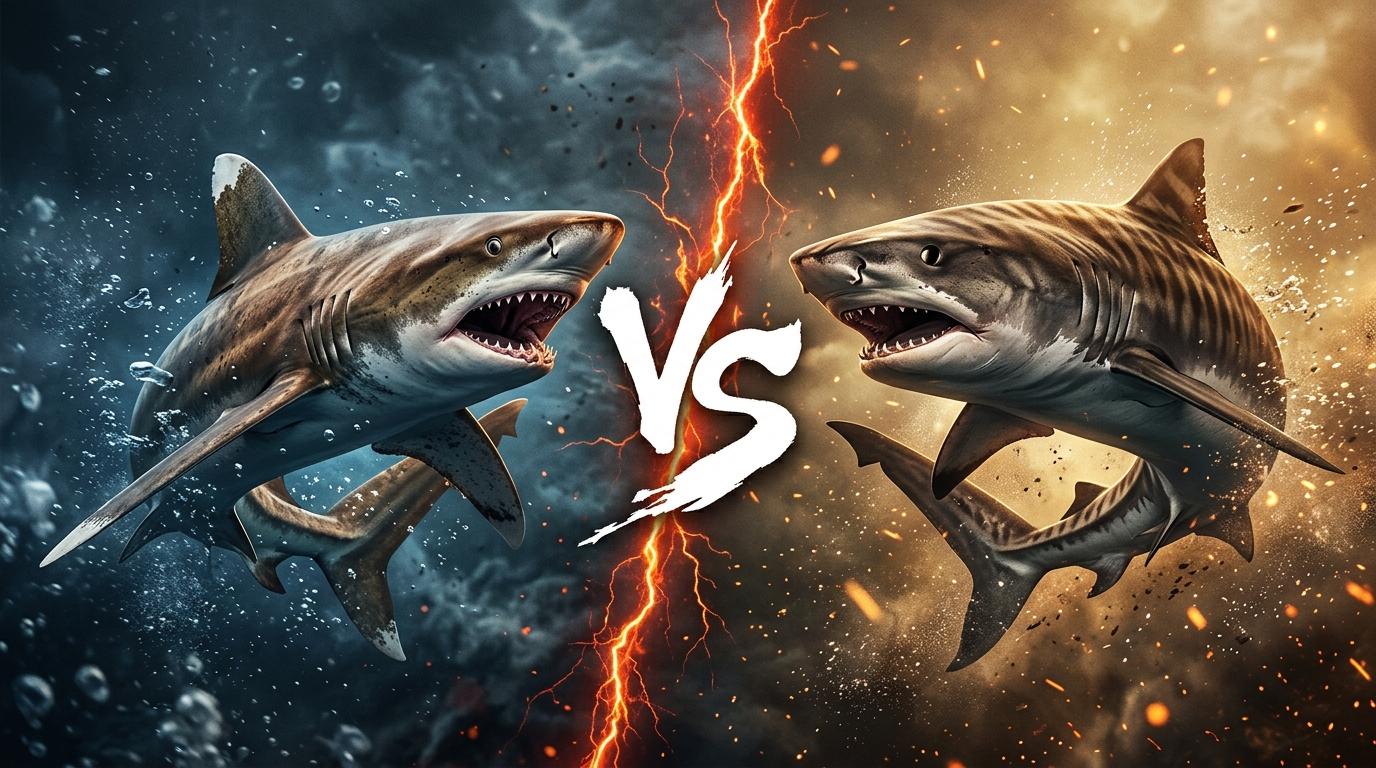
Oceanic Whitetip vs Tiger Shark: Who Actually Wins?
The tiger shark wins this matchup clearly. A large adult tiger shark commonly reaches 3.5–4.5 m and well over 400 kg. A big oceanic whitetip tops out around 3–3.5 m and far less mass. That size gap is backed by some of the most specialized teeth in the shark world. Tiger shark teeth are serrated and cockscomb-shaped, built to saw through sea turtle shells, and the jaws behind them are broad and powerful. The whitetip is a persistent, bold open-ocean opportunist with long paddle-like pectoral fins built for efficient cruising. But its hardware is tuned for scavenging and grinding down patient contests over scattered food, not for overpowering a heavier, thicker-bodied generalist predator. In almost any realistic confrontation, mass, bite design and durability favor Galeocerdo cuvier.
Read comparison
Discussion
What do you think?
Share your reasoning with other readers. Be civil and stick to the animals.
Sign in to join the discussion.
Sign inNo comments yet. Start the conversation.