

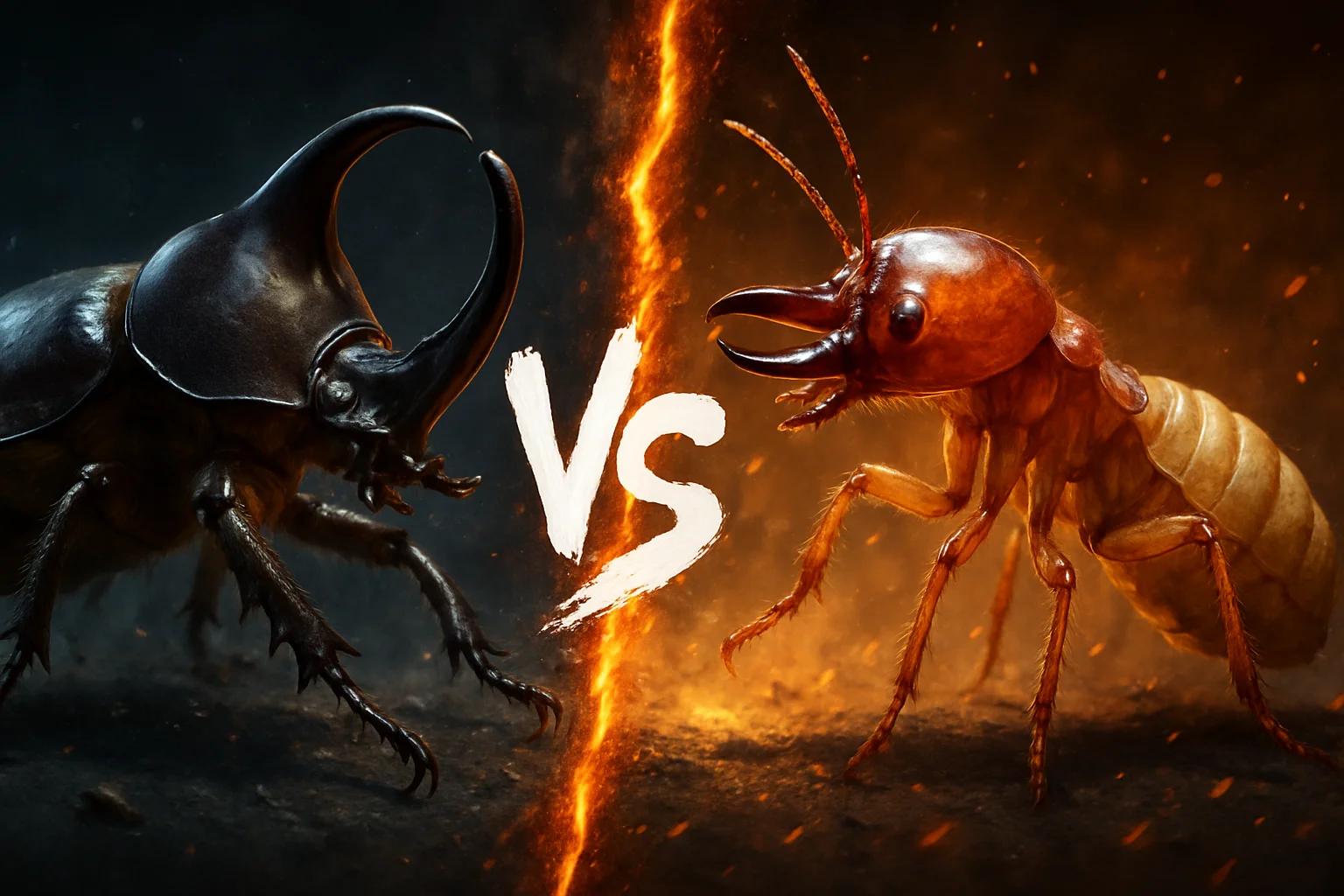
Rhinoceros Beetle vs Termite: Who Actually Wins?
Rhinoceros beetle vs termite: armor, strength, colony defense and soldier chemistry compared. See who wins one-on-one, at the mound, and why termites stay dangerous.
Rhinoceros Beetle vs Termite
Matchup winner
Rhinoceros Beetle
Quick verdict
Start with the direct answer, then use the structured comparison below to see what changes the outcome.
The rhinoceros beetle wins clearly. In any one-on-one or small-group encounter it is a fully armored tank, hundreds of times heavier than a single termite worker or soldier. Its hardened elytra and thick cuticle shrug off mandible strikes, and its legs and horn can pry, pin and flip anything in its weight class. A Macrotermes soldier has real weapons, including scissor-like mandibles and defensive secretions, but its soft abdomen and tiny mass mean it cannot meaningfully damage an adult beetle's armor. The only frame where termites flip the script is the colony itself. A beetle that blunders into an active mound breach faces thousands of defenders, and even then the beetle usually just leaves rather than dies. As an individual matchup it is not close.
Read the full explanation
Rhinoceros beetle wins one-on-one by a massive size and armor margin.
Termite soldiers bite hard for their size but cannot pierce adult beetle armor.
Termites only compete through sheer numbers at the colony itself.
The beetle's best move against a swarm is to walk away, and it usually can.
Reader vote
Who do you think wins?
Pick a side — no account needed. Results update live.
No votes yet — be the first to call it.
Editorial note
Why people disagree
Colony thinking: some readers picture a whole mound against one beetle instead of a single termite, and that swaps a duel for a siege.
Armor integrity
Termite weapons evolved to fight ants and other soft-bodied raiders, not to crack a beetle's shell.
Mass advantage
A difference of several hundredfold in mass makes any single engagement one-sided.
Pry-and-lift power
The beetle can physically remove or crush attackers, while termites can only cling and bite.
Read the full explanation +
Viral strength facts: 'strongest animal for its size' headlines make the beetle sound unbeatable, but lifting power is not the same as attacking power. Its real edge is armor.
Termite soldier hype: chemical and mandible-armed soldiers are genuinely impressive, and people overestimate how well those tools scale against a much larger, sealed exoskeleton.
Comparison FAQ
Short, direct answers to the next questions readers usually ask after the headline verdict.
Would a rhinoceros beetle beat a termite?+
Yes, easily. In a one-on-one fight the beetle's armor and size make the outcome near-certain.
Which is stronger, a rhinoceros beetle or a termite?+
The rhinoceros beetle, by far. It is among the strongest insects relative to its body size, and in absolute terms it overwhelms a termite.
Could a termite colony beat a rhinoceros beetle?+
At the mound, a colony can drive a beetle off through mass defense. Killing a healthy adult beetle is rare, however.
Why are termites still dangerous despite losing?+
Soldiers have powerful mandibles and chemical defenses, and colonies coordinate by the thousands. That makes them lethal to ants and soft-bodied invaders and very effective at defending territory.
Do rhinoceros beetles eat termites?+
No. Adult beetles mostly feed on sap and fruit, and their larvae eat decaying wood. Any conflict with termites is incidental.
Head-to-head species stats
These are the same core AnimalDex stat dimensions used on the dedicated animal pages, pulled side by side so the matchup is faster to scan.
Rhinoceros Beetle
Tier DTermite
Tier DTrait-by-trait comparison
Only the categories that matter to this matchup are included. The goal is not filler stats, but the real design differences that change the result.
Thick, fused elytra and a heavily sclerotized body
Armor integrity
Rhinoceros Beetle
Soft, pale abdomen; only the soldier's head is hardened
Armor integrity
Rhinoceros Beetle
Several grams, or far more in giant species
Mass advantage
Rhinoceros Beetle
Milligrams per individual
Mass advantage
Rhinoceros Beetle
Horn and legs built to lever rivals off branches
Pry-and-lift power
Rhinoceros Beetle
Excavation strength spread across workers
Pry-and-lift power
Rhinoceros Beetle
Blunt horn made for shoving matches
Weapon specialization
Termite
Snapping mandibles plus defensive chemicals
Weapon specialization
Termite
Solitary, with no backup
Collective defense
Termite
Thousands of coordinated defenders, plus fast breach sealing
Collective defense
Termite
Strong walker and capable flyer
Escape options
Rhinoceros Beetle
Workers and soldiers are mostly blind and stay in the colony
Escape options
Rhinoceros Beetle
How the verdict forms
Verdict timeline
01 · Armor integrity
Rhinoceros Beetle
02 · Mass advantage
Rhinoceros Beetle
03 · Pry-and-lift power
Rhinoceros Beetle
04 · Weapon specialization
Termite
05 · Collective defense
Termite
06 · Escape options
Rhinoceros Beetle
Change the conditions
Scenario breakdown
This is where shallow battle content usually fails. Terrain, spacing, timing, and engagement style can change the answer.
Scenario lean
Rhinoceros Beetle
Verdict confidence
82%
Total beetle control.
In the open, a lone termite meets a creature hundreds of times its mass. Soldier mandibles slide off the elytra, and the beetle can crush or brush the termite aside. Size and armor decide everything here.
AnimalDex field profiles
Explore these animals
Rhinoceros Beetle
Dynastinae
Forest, plantation edge, gardens, and areas with decaying wood or composting plant material.
Termite
Isoptera within Blattodea
Savannah, woodland, tropical forest, dry scrub, and built environments with cellulose-rich material and workable soil.
Systems Intelligence & Hidden Purpose
See the animals behind this comparison as engineered biological systems: what each one is built to do, where it gains leverage, and why the matchup changes by scenario.
Specialized Hardware
Horn-based lifting geometry, armored exoskeleton, and powerful thoracic muscles make rhinoceros beetles close-quarters contest hardware.
Systems Script
They turn decomposer-rich habitats into arenas where strength and leverage decide access to mates and resources. Their lesson is mechanical: shape can convert force into dominance efficiently.
Strategic Insight
Raw power matters less than where your structure lets you apply it.
Specialized Hardware
Microbe-assisted digestion, caste-based labor specialization, and climate-regulating mound architecture allow termites to process material most animals cannot use directly.
Systems Script
Termites convert dead plant matter into accessible nutrients, aerate soils, and build structures that alter temperature, moisture, and habitat availability for other organisms. They are infrastructure builders disguised as insects.
Strategic Insight
Some of the best systems create value by turning low-grade input into usable output. Waste is often just a resource without the right processing stack.
Final take
The rhinoceros beetle is the overall winner. Its advantage is not mainly its famous lifting strength. It is armor and mass so far beyond a termite's scale that termite weapons simply stop working.
Read the full explanation
Termites deserve respect as a superorganism. Their power lives in the colony, not the individual, and on their own mound they can repel almost anything small enough to fit through a tunnel. Even there, though, the beetle leaves rather than loses its life.
Collect both animals in AnimalDex
Track the species behind this matchup, compare their real traits, and build the rivalry into your AnimalDex collection.
Related comparisons
Continue with nearby matchups to compare more real-world animal traits without dropping into junky who-wins filler.
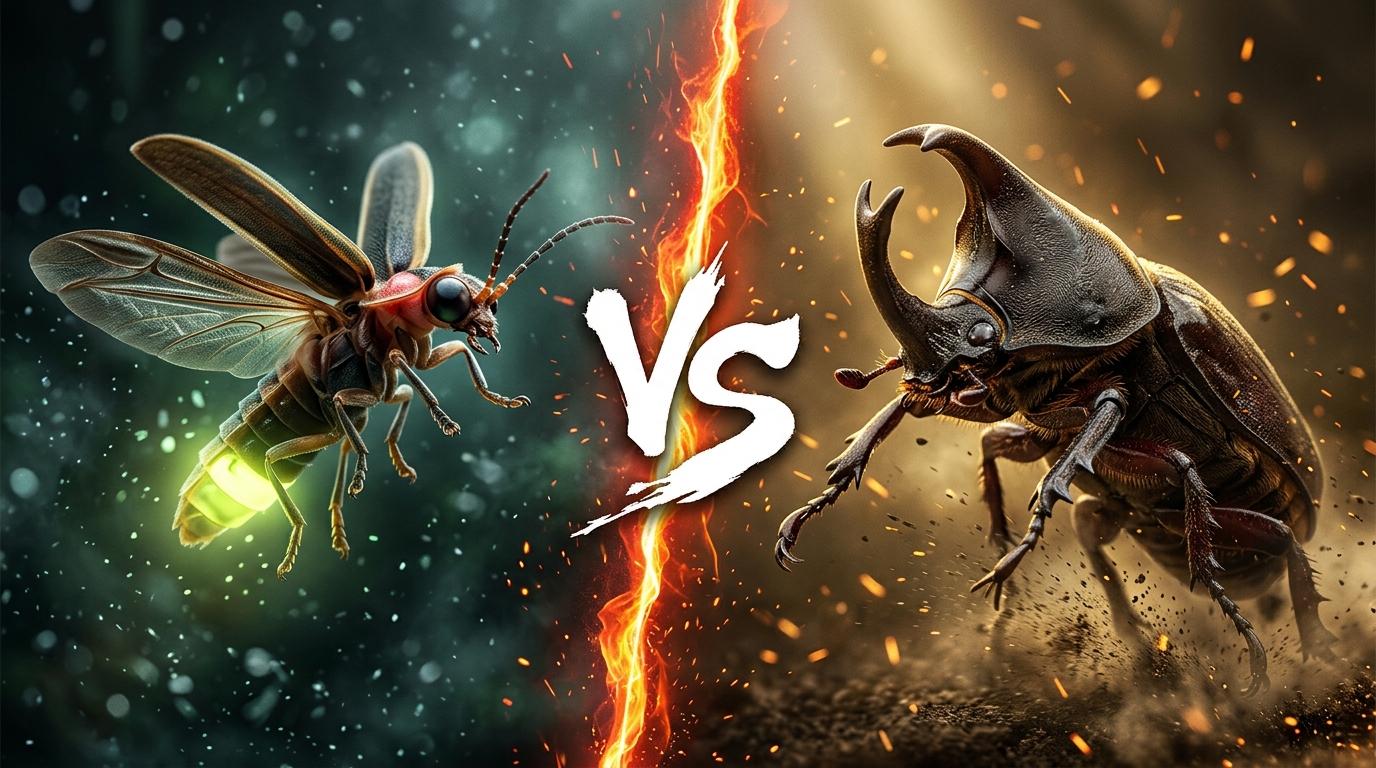
Firefly vs Rhinoceros Beetle: Who Actually Wins?
The rhinoceros beetle wins clearly. Both are beetles, but they sit at opposite ends of the order. A firefly is a soft-bodied, lightweight signaler that weighs a fraction of a gram. Its leathery wing covers are built for courtship flights, not combat. A rhinoceros beetle is a heavily armored scarab with thick, rigid elytra and a horn system evolved specifically for prying, lifting and flipping rivals. It also outweighs a firefly many times over. The firefly's real weapon is chemical. Many species carry bitter lucibufagins that make predators drop them. But a rhinoceros beetle is a plant-sap and fruit feeder, not a predator, so that toxic defense barely matters in a physical shove contest. In any forced confrontation over a branch, a sap flow or a piece of rotting fruit, the rhinoceros beetle simply levers the firefly off and keeps the spot.
Read comparison
Discussion
What do you think?
Share your reasoning with other readers. Be civil and stick to the animals.
Sign in to join the discussion.
Sign inNo comments yet. Start the conversation.