

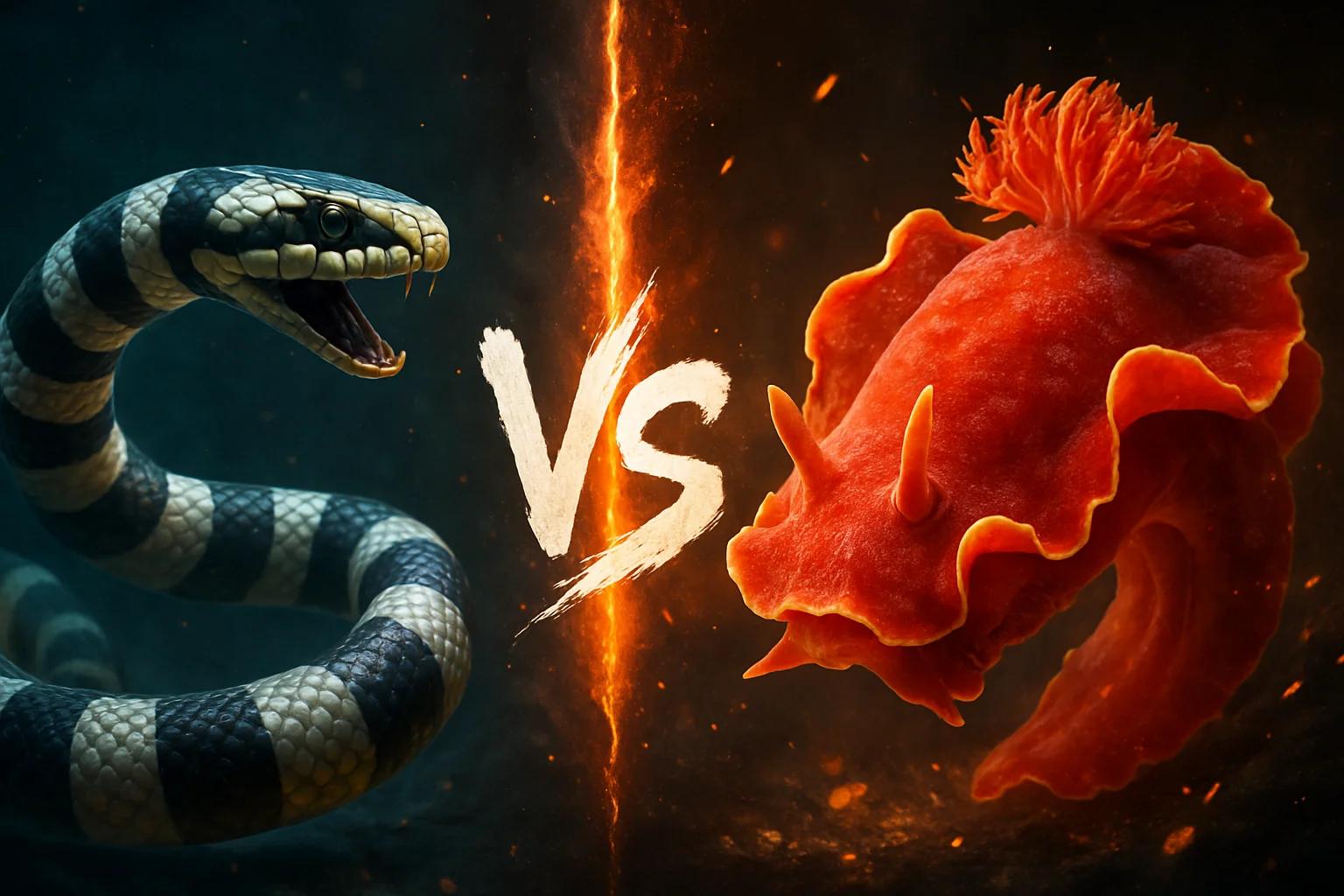
Yellow-lipped Sea Krait vs Spanish Dancer: Who Actually Wins?
Sea krait vs Spanish dancer nudibranch: venom, chemical defenses, speed and reef biology compared to show who wins and why the dancer is still no easy target.
Sea Krait vs Spanish Dancer
Matchup winner
Sea Krait
Quick verdict
Start with the direct answer, then use the structured comparison below to see what changes the outcome.
The Yellow-lipped Sea Krait wins clearly. It is a fast, maneuverable, air-breathing reef hunter armed with a potent neurotoxic venom built to subdue eels in tight crevices. The Spanish Dancer is a soft-bodied sea slug with no bite, no venom delivery system, and a top speed measured in slow undulations. In any confrontation the krait controls tempo, position and the decision to engage or leave. The dancer's real strength is defensive: it carries noxious compounds sourced from the sponges it eats, so the krait 'wins' mainly by being untouchable, not by eating its opponent. These two animals essentially never fight in nature, because the krait hunts eels and has no reason to bite a chemically defended slug.
Read the full explanation
Winner: Yellow-lipped Sea Krait. It has venom, speed and mobility, while the dancer has no offensive weapons.
The Spanish Dancer cannot meaningfully harm a krait. Its only plays are distasteful chemistry and swimming away slowly.
The krait would likely reject the dancer as food because of its noxious defenses, so a 'win' means control, not a meal.
In the wild they ignore each other. The krait specializes on eels and the dancer grazes sponges.
Reader vote
Who do you think wins?
Pick a side — no account needed. Results update live.
No votes yet — be the first to call it.
Editorial note
Why people disagree
Size confusion: a big Spanish Dancer can rival a slender krait in body length and look imposing when its flaring red mantle is fully spread, but bulk without weapons does not decide fights.
Offensive weaponry
Only one side can actually inflict damage, which decides any contest before it starts.
Reef mobility
The krait chooses when to engage or leave. The dancer cannot catch it or escape it.
Chemical deterrence
This is the dancer's whole survival script. It makes the animal unrewarding to bite, not dangerous to approach.
Read the full explanation +
'Toxic' gets mistaken for 'dangerous.' The dancer's chemical defense punishes whatever eats it. It cannot attack, so it never threatens the krait first.
Some argue the dancer 'wins' because the krait cannot eat it. Surviving untouched is a defensive draw at best, while the krait keeps every offensive option.
Comparison FAQ
Short, direct answers to the next questions readers usually ask after the headline verdict.
Would a sea krait beat a Spanish Dancer?+
Yes. The krait has venom, speed and maneuverability, and the dancer has no offensive weapons at all.
Which animal is stronger?+
The sea krait. It is a muscular, scaled predator, while the Spanish Dancer is a soft-bodied nudibranch built for grazing sponges.
Would a sea krait eat a Spanish Dancer?+
Very unlikely. Kraits specialize on eels, and the dancer's noxious chemical defenses make it a poor meal.
Why is the Spanish Dancer still dangerous to predators?+
It stores distasteful compounds obtained from its sponge diet, so animals that bite it are likely to regret it. Its eggs are reported to be chemically defended too.
Is the yellow-lipped sea krait dangerous to humans?+
Its venom is potent, but the snake is generally docile and bites to people are rare. Divers should still never handle one.
Head-to-head species stats
These are the same core AnimalDex stat dimensions used on the dedicated animal pages, pulled side by side so the matchup is faster to scan.
Sea Krait
Tier CSpanish Dancer
Tier DTrait-by-trait comparison
Only the categories that matter to this matchup are included. The goal is not filler stats, but the real design differences that change the result.
Fangs with potent neurotoxic venom
Offensive weaponry
Sea Krait
None; a soft radula for scraping sponge
Offensive weaponry
Sea Krait
Agile swimmer that also climbs onto rocks
Reef mobility
Sea Krait
Slow mantle-flapping swims or crawling
Reef mobility
Sea Krait
Venom is offensive, with little passive deterrence
Chemical deterrence
Spanish Dancer
Noxious compounds acquired from the sponges it eats
Chemical deterrence
Spanish Dancer
Probes holes and cracks for hidden eels
Crevice hunting control
Sea Krait
Grazes in the open on reef surfaces
Crevice hunting control
Sea Krait
Scaled, muscular body
Close-range durability
Sea Krait
Soft, easily damaged tissue
Close-range durability
Sea Krait
Bold black-and-blue bands
Warning display
Spanish Dancer
Flaring blood-red mantle
Warning display
Spanish Dancer
How the verdict forms
Verdict timeline
01 · Offensive weaponry
Sea Krait
02 · Reef mobility
Sea Krait
03 · Chemical deterrence
Spanish Dancer
04 · Crevice hunting control
Sea Krait
05 · Close-range durability
Sea Krait
06 · Warning display
Spanish Dancer
Change the conditions
Scenario breakdown
This is where shallow battle content usually fails. Terrain, spacing, timing, and engagement style can change the answer.
Scenario lean
Sea Krait
Verdict confidence
82%
The krait owns structured reef.
Sea kraits make their living probing crevices for eels. In tight structure the krait maneuvers freely. The dancer is slow and exposed and cannot respond with any weapon. The krait would likely test it and then abandon it as unpalatable.
AnimalDex field profiles
Explore these animals
Sea Krait
Laticauda colubrina
Tropical coastal waters, coral reef systems, rocky shores, and nearby land shelters.
Spanish Dancer
Hexabranchus sanguineus
coral reef and warm tropical seafloor
Systems Intelligence & Hidden Purpose
See the animals behind this comparison as engineered biological systems: what each one is built to do, where it gains leverage, and why the matchup changes by scenario.
Specialized Hardware
Bold black-and-white body bands, flattened paddle-like tail, and snake body equally able to swim and crawl give the Sea Krait a body plan tuned for its niche.
Systems Script
Sea Kraits operate in tropical coastal waters, coral reef systems, rocky shores, and nearby land shelters. Their design helps them match food access, shelter, and timing inside that environment.
Strategic Insight
A system can gain power by staying fluent in more than one environment.
Specialized Hardware
brilliant red body, swimming mantle undulation, and reef-floor nudibranch life give the Spanish Dancer a body plan tuned for its niche.
Systems Script
Spanish Dancers operate through coral reef and warm tropical seafloor Their design links movement, shelter, and feeding into one workable survival system.
Strategic Insight
Striking movement can change how the entire organism is perceived.
Final take
The Yellow-lipped Sea Krait is the clear winner. It is a venomous, agile, amphibious predator facing an animal that has no way to attack it. Every offensive and positional advantage belongs to the krait.
Read the full explanation
The Spanish Dancer's strategy is to be unappetizing rather than to fight. Borrowed sponge chemistry and a vivid red warning display let it survive by making attacks pointless. That earns it a moral victory in a bite test, but not the overall matchup.
Collect both animals in AnimalDex
Track the species behind this matchup, compare their real traits, and build the rivalry into your AnimalDex collection.
Related comparisons
Continue with nearby matchups to compare more real-world animal traits without dropping into junky who-wins filler.
Mantis Shrimp vs Spanish Dancer: Who Actually Wins?
The mantis shrimp wins, and it isn't close. It is one of the fastest strikers in the animal kingdom. Smasher species accelerate their raptorial clubs fast enough to crack snail shells and create cavitation bubbles that hit a second time. It also has a complex visual system and an armored, burrow-defending lifestyle built around aggression. The Spanish dancer is a large, soft-bodied nudibranch with no hard parts to absorb a blow and no real weapons. Its survival plan is to taste awful and look like a warning. It carries defensive chemicals and bright aposematic red coloring, and it can swim off with slow, flamenco-like undulations. That plan works against predators that learn and choose. It does little against a single decisive strike from an animal that crushes armored prey for a living. The dancer's best outcome is that the shrimp declines to engage. If contact happens, the shrimp controls it.
Read comparison
Discussion
What do you think?
Share your reasoning with other readers. Be civil and stick to the animals.
Sign in to join the discussion.
Sign inNo comments yet. Start the conversation.