

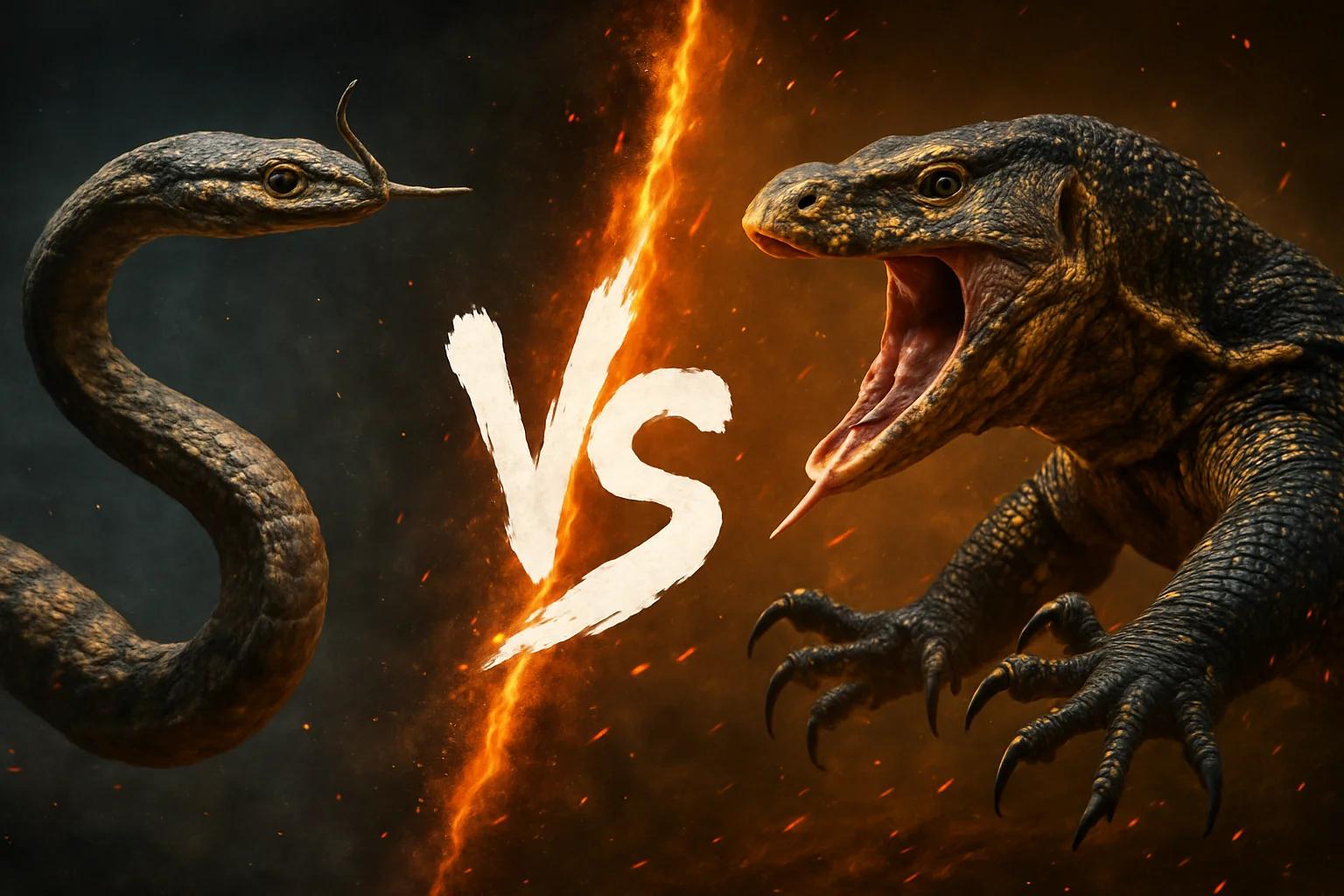
Tentacled Snake vs Asian Water Monitor: Who Actually Wins?
Tentacled snake vs Asian water monitor: a biology-first breakdown of size, venom, bite force, and aquatic ambush to show who wins and why the monitor dominates.
Tentacled Snake vs Water Monitor
Matchup winner
Water Monitor
Quick verdict
Start with the direct answer, then use the structured comparison below to see what changes the outcome.
The Asian water monitor wins, and it isn't close. Varanus salvator is one of the largest lizards on Earth. Adults commonly run 1.5–2 m and can weigh 20 kg or more. It has serrated teeth, powerful claws, a whipping tail, and a broad diet that already includes snakes, fish, and carrion. The tentacled snake is a specialist built for one job. It is a roughly 60–90 cm fish-ambusher that hangs motionless in murky Southeast Asian water and uses its rostral tentacles and a startle-reflex trick to strike fish in milliseconds. Its mild rear-fang venom is tuned for small fish, not for a large reptile. In almost every realistic encounter, the snake is prey and the monitor is the predator.
Read the full explanation
Asian water monitor wins decisively: it is many times heavier, armored with claws and serrated teeth, and routinely eats snakes.
The tentacled snake's venom is mild and fish-specialized, so it poses no meaningful threat to a large monitor.
The snake's genius is ultra-fast fish ambush, not combat; its best outcome is staying hidden.
Only a very young hatchling monitor would face a fair fight, and even then the snake would rather not engage.
Reader vote
Who do you think wins?
Pick a side — no account needed. Results update live.
No votes yet — be the first to call it.
Editorial note
Why people disagree
The tentacled snake's lightning-fast predictive strike is famous in research videos, and people mistake hunting speed for fighting power.
Raw size and mass
A mass gap this extreme decides the encounter before any technique matters. The monitor can simply overpower and swallow or tear the snake.
Explosive strike speed
This is the snake's real superpower, but it is calibrated to catch small fish, not to hurt a large armored lizard.
Weapon load-out
The monitor carries three independent damage tools. The snake has one, and it barely scales up to large prey.
Read the full explanation +
Some readers hear the word venomous and assume any venomous snake beats a lizard, but this species has weak rear-fang venom aimed at fish.
Both are aquatic in overlapping habitat, so people imagine an underwater standoff where the snake has home advantage. Water monitors are excellent swimmers, though, and can hold their breath for long dives.
Comparison FAQ
Short, direct answers to the next questions readers usually ask after the headline verdict.
Would a tentacled snake beat an Asian water monitor?+
No. In a realistic fight, the Asian water monitor wins decisively. It is far larger, armored, clawed, and already preys on snakes.
Which is stronger, the tentacled snake or the water monitor?+
The water monitor is vastly stronger. It is a muscular 20+ kg lizard, while the tentacled snake is a slender fish-eater weighing a few hundred grams.
Is the tentacled snake's venom dangerous to a monitor?+
Not meaningfully. It is a mild rear-fanged venom adapted to subdue small fish and is not considered dangerous to large animals or humans.
Why is the tentacled snake still dangerous if it loses?+
It is extremely dangerous to fish. Its predictive strike is among the fastest and most cognitively sophisticated in snakes, and its camouflage lets it dominate its niche without ever fighting larger animals.
Do water monitors actually eat snakes?+
Yes. Asian water monitors are opportunistic generalists that eat fish, crabs, birds, rodents, carrion, and snakes.
Do these two species live in the same places?+
Their ranges overlap in parts of mainland Southeast Asia, including Cambodia, Thailand, and Vietnam, where both use slow, vegetated freshwater.
Head-to-head species stats
These are the same core AnimalDex stat dimensions used on the dedicated animal pages, pulled side by side so the matchup is faster to scan.
Tentacled Snake
Tier CWater Monitor
Tier CTrait-by-trait comparison
Only the categories that matter to this matchup are included. The goal is not filler stats, but the real design differences that change the result.
Slender, ~60–90 cm, a few hundred grams
Raw size and mass
Water Monitor
1.5–2+ m, often 20+ kg
Raw size and mass
Water Monitor
Elite: millisecond-scale strike exploiting fish escape reflexes
Explosive strike speed
Tentacled Snake
Quick lunges and head snaps, not specialized
Explosive strike speed
Tentacled Snake
Small teeth, mild rear-fang venom
Weapon load-out
Water Monitor
Serrated teeth, hooked claws, whip tail
Weapon load-out
Water Monitor
Thin body, little armor, built for stillness
Close-range durability
Water Monitor
Thick beaded hide, muscular frame, tolerant of bites
Close-range durability
Water Monitor
Master of motionless camouflage in murky water
Ambush control
Tentacled Snake
Active forager that roams, digs, and probes
Ambush control
Tentacled Snake
Fully aquatic, slow and awkward on land
Aquatic mobility
Water Monitor
Strong tail-powered swimmer and long diver, also agile on land
Aquatic mobility
Water Monitor
How the verdict forms
Verdict timeline
01 · Raw size and mass
Water Monitor
02 · Explosive strike speed
Tentacled Snake
03 · Weapon load-out
Water Monitor
04 · Close-range durability
Water Monitor
05 · Ambush control
Tentacled Snake
06 · Aquatic mobility
Water Monitor
Change the conditions
Scenario breakdown
This is where shallow battle content usually fails. Terrain, spacing, timing, and engagement style can change the answer.
Scenario lean
Water Monitor
Verdict confidence
82%
Monitor wins once contact is made; snake's only win is never being found.
In dense aquatic plants, the tentacled snake's motionless, stiff-bodied disguise is at its best, and it may go unnoticed. Water monitors forage by tongue-flicking and probing, though, and they find hidden prey well. Once the monitor locates the snake, a bite-and-shake ends things. Cover delays the outcome but doesn't change it.
AnimalDex field profiles
Explore these animals
Tentacled Snake
Erpeton tentaculatum
still freshwater, rice-field canal, and flooded wetland
Water Monitor
Varanus salvator
mangrove, riverbank, swamp edge, and urban canal
Systems Intelligence & Hidden Purpose
See the animals behind this comparison as engineered biological systems: what each one is built to do, where it gains leverage, and why the matchup changes by scenario.
Specialized Hardware
sensory tentacles on the snout, fully aquatic body, and sideways fish ambush strike give the Tentacled Snake a body plan tuned for its niche.
Systems Script
Tentacled Snakes operate through still freshwater, rice-field canal, and flooded wetland. Their design links movement, feeding, shelter, and timing into one workable survival system.
Strategic Insight
Where water controls movement, position and timing often matter more than speed.
Final take
The Asian water monitor is the overall winner by a wide margin. This is a classic generalist-heavyweight versus precision-specialist pairing. The monitor's size, armor, claws, and willingness to eat snakes outweigh everything the tentacled snake brings.
Read the full explanation
The tentacled snake remains one of the most fascinating predators in Asian freshwater. Its tentacles sense water movement, and its strike exploits the escape reflex of fish to catch them as they flee into its mouth. That is a neurological hack, not a weapon of war. Its winning strategy against a monitor is invisibility, and its losing outcome is being found.
Collect both animals in AnimalDex
Track the species behind this matchup, compare their real traits, and build the rivalry into your AnimalDex collection.
Related comparisons
Continue with nearby matchups to compare more real-world animal traits without dropping into junky who-wins filler.

Mangrove Snake vs Asian Water Monitor: Who Actually Wins?
The Asian water monitor wins this matchup, and not narrowly. An adult Varanus salvator commonly reaches 1.5–2 m and can exceed 20 kg. It has a muscular body, tough beaded skin, serrated teeth and a whipping tail. A mangrove snake (Boiga dendrophila) is a slender rear-fanged colubrid, usually 1.8–2.5 m long but only a kilogram or two in weight. Its venom is mild and evolved for subduing birds, lizards and small mammals. Rear fangs need sustained chewing to deliver much venom, and a monitor's thrashing jaws and body rarely allow that. Water monitors are also opportunistic predators that eat snakes. In most realistic encounters the snake is the potential meal, not the threat.
Read comparison
King Cobra vs Asian Water Monitor: Who Actually Wins?
The King Cobra wins more often than not, but the margin is narrower than its reputation suggests. A large Asian Water Monitor is the heavier, sturdier animal. Big individuals can outweigh even a very large cobra several times over. The monitor also carries serrated teeth, raking claws, and a powerful tail. The cobra's edge is chemical rather than physical. A King Cobra delivers some of the largest venom yields of any snake, and its potent neurotoxins can stop a large animal's breathing. It strikes from a raised posture at head height, so it can land a bite before the monitor closes the distance. The monitor needs a sustained bite-and-shake to win. The cobra needs one well-placed, deep bite and the patience to retreat while the venom works. In most realistic encounters, that asymmetry favors the snake. The monitor's best path is a head-first ambush on a small or distracted cobra.
Read comparison
Water Monitor vs June Beetle: Who Actually Wins?
The Water Monitor decisively wins against the June Beetle due to its larger size, superior intelligence, and predatory prowess, allowing it to dominate in various combat scenarios.
Read comparison
Water Monitor vs Domestic Dog: Who Actually Wins?
In a battle between the Water Monitor and the Domestic Dog, the Water Monitor emerges as the overall winner due to its superior dominance, agility in ambush, and natural predatory capabilities, despite the dog's advantages in speed and intelligence.
Read comparison
Discussion
What do you think?
Share your reasoning with other readers. Be civil and stick to the animals.
Sign in to join the discussion.
Sign inNo comments yet. Start the conversation.