


Tooth-billed Pigeon vs Ultramarine Lorikeet: Who Actually Wins?
Tooth-billed Pigeon vs Ultramarine Lorikeet: a biology-first look at size, bill weaponry, agility, and attitude between two of the Pacific's rarest birds, and why the Samoan pigeon takes it.
Tooth-billed Pigeon vs Ultramarine Lorikeet
Matchup winner
Tooth-billed Pigeon
Quick verdict
Start with the direct answer, then use the structured comparison below to see what changes the outcome.
The Tooth-billed Pigeon wins this one clearly. Samoa's 'little dodo' is a stocky, roughly 30–38 cm fruit pigeon weighing several hundred grams. That makes it something like eight to ten times heavier than the Ultramarine Lorikeet, a sparrow-sized (about 18 cm, roughly 30–40 g) jewel of the Marquesas. The pigeon also carries a deep, hooked bill with tooth-like serrations on the lower mandible, a seed- and fruit-processing tool built for leverage. The lorikeet is no pushover. It is quicker in tight canopy turns, louder, and carries the scrappy, flower-guarding attitude lorikeets are known for. But its brush-tipped tongue and light bill are made for nectar and pollen, not for forcing a heavier bird off a perch. In any sustained shoving contest, mass and bill strength settle it. The lorikeet's realistic best outcome is to harass, dodge, and leave.
Read the full explanation
Tooth-billed Pigeon wins overall, mostly on size: it is roughly 8–10× heavier.
Its hooked, serrated bill is a far stronger tool than the lorikeet's nectar-feeding bill.
The Ultramarine Lorikeet is nimbler and bolder, and it can win quick skirmishes at a flowering branch.
In reality they never meet: one lives in Samoa, the other in the Marquesas, and both are critically rare.
Reader vote
Who do you think wins?
Pick a side — no account needed. Results update live.
No votes yet — be the first to call it.
Editorial note
Why people disagree
Lorikeets have huge attitude. Anyone who has watched them bully bigger birds off nectar feeders assumes the parrot wins.
Body mass advantage
In bird disputes, displacement is about who can physically hold the perch, and a tenfold mass gap is decisive.
Bill weaponry
The pigeon's bill is built to grip and slice tough fruit. The lorikeet's is a feeding brush, not a lever.
Canopy agility
Small size lets the lorikeet out-turn the pigeon in dense foliage and choose when to disengage.
Read the full explanation +
The tooth-billed pigeon looks fierce because of its 'tooth' bill, but it is a shy, secretive frugivore, not a fighter, so some readers overcorrect and call it timid.
Speed scores are nearly identical, so the debate comes down to whether agility can offset a massive weight gap. In birds, it usually can't for long.
Comparison FAQ
Short, direct answers to the next questions readers usually ask after the headline verdict.
Would a Tooth-billed Pigeon beat an Ultramarine Lorikeet in a fight?+
Yes. The pigeon is roughly 8–10 times heavier and has a much stronger bill, so it would win any sustained physical contest.
Which bird is stronger?+
The Tooth-billed Pigeon, by a wide margin. Its bulk and hooked, tooth-edged bill outclass the lorikeet's lightweight, nectar-adapted build.
Why is the Ultramarine Lorikeet still dangerous to the pigeon?+
Lorikeets are fearless and persistent. At a flowering tree, repeated harassment can drive off a shy pigeon without any real fight, and the lorikeet's agility means it can't easily be caught.
Do these birds ever meet in the wild?+
No. The Tooth-billed Pigeon lives only in Samoa, and the Ultramarine Lorikeet lives in the Marquesas Islands of French Polynesia.
Why is it called a tooth-billed pigeon?+
Its lower mandible has notches that look like teeth, likely helping it grip and process tough native fruits. It is a close relative of the extinct dodo.
Are both species endangered?+
Yes. Both are critically rare, threatened largely by introduced predators like rats and by habitat loss.
Head-to-head species stats
These are the same core AnimalDex stat dimensions used on the dedicated animal pages, pulled side by side so the matchup is faster to scan.
Tooth-billed Pigeon
Tier BUltramarine Lorikeet
Tier BTrait-by-trait comparison
Only the categories that matter to this matchup are included. The goal is not filler stats, but the real design differences that change the result.
Stocky pigeon, several hundred grams
Body mass advantage
Tooth-billed Pigeon
Tiny lorikeet, roughly 30–40 g
Body mass advantage
Tooth-billed Pigeon
Deep hooked bill with tooth-like serrations
Bill weaponry
Tooth-billed Pigeon
Slim bill, brush-tipped nectar tongue
Bill weaponry
Tooth-billed Pigeon
Fast, direct flier; clumsy in tangles
Canopy agility
Ultramarine Lorikeet
Darting, acrobatic among blossoms
Canopy agility
Ultramarine Lorikeet
Secretive, avoids confrontation
Territorial attitude
Ultramarine Lorikeet
Noisy, bold defender of flowering trees
Territorial attitude
Ultramarine Lorikeet
Robust frame absorbs jostling
Close-range durability
Tooth-billed Pigeon
Fragile, easily knocked aside
Close-range durability
Tooth-billed Pigeon
Specialist on a few native fruits
Behavioral flexibility
Ultramarine Lorikeet
Parrot-level curiosity and adaptability
Behavioral flexibility
Ultramarine Lorikeet
How the verdict forms
Verdict timeline
01 · Body mass advantage
Tooth-billed Pigeon
02 · Bill weaponry
Tooth-billed Pigeon
03 · Canopy agility
Ultramarine Lorikeet
04 · Territorial attitude
Ultramarine Lorikeet
05 · Close-range durability
Tooth-billed Pigeon
06 · Behavioral flexibility
Ultramarine Lorikeet
Change the conditions
Scenario breakdown
This is where shallow battle content usually fails. Terrain, spacing, timing, and engagement style can change the answer.
Scenario lean
Tooth-billed Pigeon
Verdict confidence
82%
Pigeon holds the branch.
On a shared perch in closed forest, the lorikeet can feint and scold, but it cannot physically move a bird ten times its weight. The pigeon's bill and bulk make close contact one-sided, so the lorikeet's smart move is retreat.
AnimalDex field profiles
Explore these animals
Tooth-billed Pigeon
Didunculus strigirostris
humid tropical forest, mountain woodland, and island valley canopy
Ultramarine Lorikeet
Vini ultramarina
island forest, coconut grove, and flowering tropical woodland
Systems Intelligence & Hidden Purpose
See the animals behind this comparison as engineered biological systems: what each one is built to do, where it gains leverage, and why the matchup changes by scenario.
Specialized Hardware
deep ultramarine-blue plumage, brush-tipped nectar tongue, and flowering-canopy flock movement give the Ultramarine Lorikeet a body plan tuned for its niche.
Systems Script
Ultramarine Lorikeets operate through island forest, coconut grove, and flowering tropical woodland. Their design links movement, feeding, shelter, and timing into one workable survival system.
Strategic Insight
Dense environments reward precision, patience, and the ability to read layered cover.
Final take
The Tooth-billed Pigeon is the clear winner. Neither bird is a fighter, but the pigeon is so much heavier, and its serrated bill is a real mechanical tool, that it controls any physical contest.
Read the full explanation
The Ultramarine Lorikeet earns respect as the bolder bird. It can win a feeding squabble through sheer nerve and agility. That is a win of tactics, not force, and it only works when it can disengage.
The real story is shared vulnerability. Both are among the rarest birds in the Pacific and are threatened mainly by introduced rats, cats, and habitat loss. Their biggest fight is survival.
Collect both animals in AnimalDex
Track the species behind this matchup, compare their real traits, and build the rivalry into your AnimalDex collection.
Related comparisons
Continue with nearby matchups to compare more real-world animal traits without dropping into junky who-wins filler.

Great Hornbill vs Ultramarine Lorikeet: Who Actually Wins?
The Great Hornbill wins, and the margin is enormous. At roughly 2–4 kg and well over a meter long, it outweighs the 30–40 g Ultramarine Lorikeet by about 60 to 100 times. Its massive casqued bill is a long-reach tool that already handles fruit, lizards, rodents, and small birds. The lorikeet is a tiny Marquesan nectar specialist. It has a sharp hooked beak, quick reflexes, and tight maneuvering, but nothing that can hurt a bird this large. If they actually make contact, the hornbill controls the encounter. The lorikeet's only real victory condition is to never be caught.
Read comparison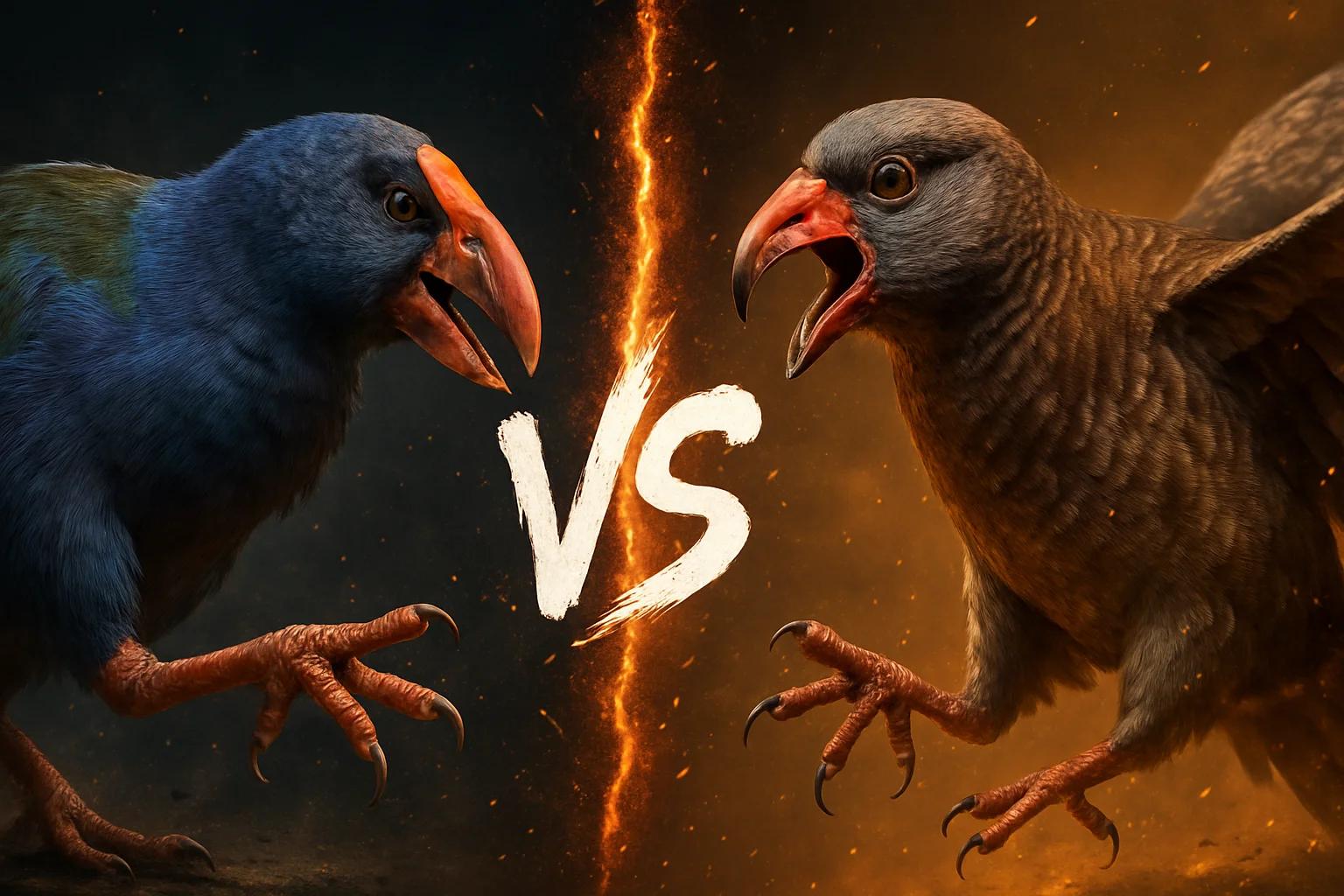
Takahe vs Tooth-billed Pigeon: Who Actually Wins?
The takahe wins, and it is not especially close in a direct contest. New Zealand's flightless swamphen weighs roughly 2.5–3.5 kg, several times the mass of Samoa's tooth-billed pigeon (manumea), which is usually estimated at a few hundred grams. The takahe also carries one of the heaviest bills of any rail, a deep red shearing tool built to snip tough tussock bases. It defends territory on foot, while the manumea's hooked, notched bill is a precision instrument for working seeds and fruit, not a weapon. The pigeon's real advantage is flight. It can leave whenever it wants, so it 'wins' only in the sense of refusing to fight. When the two actually meet and engage, mass, bill force, and ground-level territorial commitment decide it for the takahe.
Read comparison
Discussion
What do you think?
Share your reasoning with other readers. Be civil and stick to the animals.
Sign in to join the discussion.
Sign inNo comments yet. Start the conversation.