

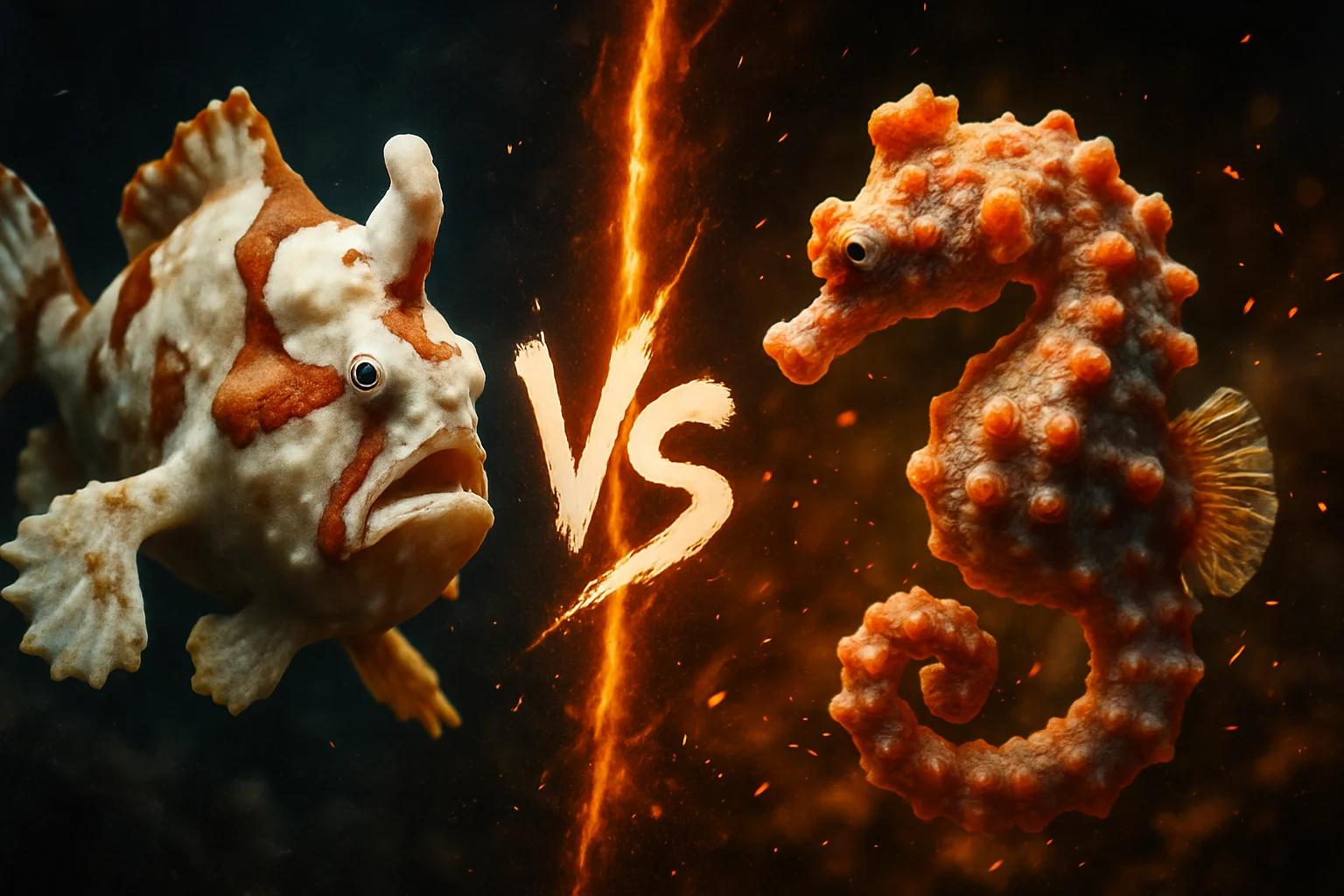
Warty Frogfish vs Pygmy Seahorse: Who Actually Wins?
Warty frogfish vs pygmy seahorse: who would win? A biology-first breakdown of strike speed, size, camouflage and reef survival, and why the frogfish takes it.
Warty Frogfish vs Pygmy Seahorse
Matchup winner
Warty Frogfish
Quick verdict
Start with the direct answer, then use the structured comparison below to see what changes the outcome.
The warty frogfish wins clearly. At roughly 10–12 cm against a pygmy seahorse barely 2 cm long, the frogfish has about a 5–6x length advantage. It also has one of the fastest feeding strikes recorded in any vertebrate: a mouth-expanding gulp that can engulf prey in a few milliseconds and handle prey nearly its own size. The pygmy seahorse has no bite, no venom, no spines and no meaningful escape speed. Its real weapon is never being noticed. It matches the knobby pink or yellow polyps of its gorgonian sea fan so precisely that the species was only discovered by accident on a collected fan. If the frogfish detects it, the encounter ends in one gulp. The seahorse's only winning line is invisibility, so it can survive, but it cannot beat the frogfish.
Read the full explanation
Warty frogfish wins: it is far larger and armed with an ultra-fast suction gulp.
Pygmy seahorse has zero offensive tools. It is roughly fingernail-sized and moves very slowly.
The seahorse's only edge is near-perfect camouflage on its host sea fan.
Detection decides everything, and the frogfish only needs to detect it once.
Reader vote
Who do you think wins?
Pick a side — no account needed. Results update live.
No votes yet — be the first to call it.
Editorial note
Why people disagree
Both are camouflage specialists, so some readers assume a stalemate. But the frogfish hides in order to attack, while the seahorse hides in order to survive.
Explosive power
The frogfish's strike is built for whole-animal capture. The seahorse's suction only works on plankton-sized prey.
Size and swallow math
Frogfish can swallow prey close to their own length, so a pygmy seahorse falls well inside the menu range.
Ambush control
The frogfish controls when contact happens. The seahorse can only hope contact never happens.
Read the full explanation +
The pygmy seahorse's camouflage is so extreme that 'it can't be found' gets mistaken for 'it can't be beaten.'
Frogfish look slow and lumpy, which hides the fact that their strike is one of the quickest movements in the fish world.
Comparison FAQ
Short, direct answers to the next questions readers usually ask after the headline verdict.
Would a warty frogfish beat a pygmy seahorse?+
Yes. If the frogfish detects the seahorse, it can swallow it whole in a single, near-instant strike.
Which is stronger, the frogfish or the pygmy seahorse?+
The frogfish, by a wide margin. It is several times longer, far heavier, and its suction strike is built to capture whole fish.
Does a pygmy seahorse have any defense against a frogfish?+
Its defense is camouflage. On its host sea fan it is extremely hard to detect, and staying still denies predators the motion cues they rely on.
Why is the pygmy seahorse still considered formidable if it loses?+
It is not dangerous to the frogfish, but it is formidable at survival. It was hidden so well that scientists first found it only after collecting its host fan, and that same camouflage keeps it alive among predators.
Do frogfish actually eat seahorses?+
Frogfish eat almost any small animal that fits in their mouth and triggers a strike, so small seahorses fall within their prey range.
Head-to-head species stats
These are the same core AnimalDex stat dimensions used on the dedicated animal pages, pulled side by side so the matchup is faster to scan.
Warty Frogfish
Tier CPygmy Seahorse
Tier CTrait-by-trait comparison
Only the categories that matter to this matchup are included. The goal is not filler stats, but the real design differences that change the result.
Gulp strike measured in milliseconds
Explosive power
Warty Frogfish
Snout-pipette suction for copepods
Explosive power
Warty Frogfish
~10–12 cm, highly expandable mouth
Size and swallow math
Warty Frogfish
~2 cm, rigid tiny body
Size and swallow math
Warty Frogfish
Lure-fishing with a fleshy esca and a waiting posture
Ambush control
Warty Frogfish
No predatory ambush beyond plankton picking
Ambush control
Warty Frogfish
Warty skin mimics sponge and rock, and color can shift over weeks
Disappearing act
Pygmy Seahorse
Tubercles match host gorgonian polyps almost exactly
Disappearing act
Pygmy Seahorse
Walks on pectoral 'hands,' jet-swims short bursts
Escape mobility
Warty Frogfish
Tail-anchored, nearly sessile
Escape mobility
Warty Frogfish
Thick, loose skin with no scales
Close-range durability
Warty Frogfish
Bony ring plating at tiny scale
Close-range durability
Warty Frogfish
How the verdict forms
Verdict timeline
01 · Explosive power
Warty Frogfish
02 · Size and swallow math
Warty Frogfish
03 · Ambush control
Warty Frogfish
04 · Disappearing act
Pygmy Seahorse
05 · Escape mobility
Warty Frogfish
06 · Close-range durability
Warty Frogfish
Change the conditions
Scenario breakdown
This is where shallow battle content usually fails. Terrain, spacing, timing, and engagement style can change the answer.
Scenario lean
Pygmy Seahorse
Verdict confidence
82%
The seahorse survives by never being seen.
On its own gorgonian, the pygmy seahorse's color and bumps mirror the host polyps. It barely moves, giving the frogfish no motion cue to key on. Frogfish rely heavily on visual triggers, so an unseen target is effectively unavailable. This counts as survival rather than a fight win, but in this frame the seahorse comes out ahead.
AnimalDex field profiles
Explore these animals
Warty Frogfish
—
Habitat details are not published on a dedicated AnimalDex species page yet.
Species guide coming soon.
Pygmy Seahorse
Hippocampus bargibanti
gorgonian coral reef and tropical seafan habitat
Systems Intelligence & Hidden Purpose
See the animals behind this comparison as engineered biological systems: what each one is built to do, where it gains leverage, and why the matchup changes by scenario.
Specialized Hardware
coral-matching body bumps, upright drifting posture, and tiny grasping tail give the Pygmy Seahorse a body plan tuned for its niche.
Systems Script
Pygmy Seahorses operate through gorgonian coral reef and tropical seafan habitat. Their design links movement, feeding, shelter, and timing into one workable survival system.
Strategic Insight
In moving water, the best systems use flow, visibility, and depth instead of fighting every current.
Final take
The warty frogfish is the overall winner, and it is not close. It is larger, it is an active predator, and it carries one of the most effective close-range capture systems on the reef.
Read the full explanation
The pygmy seahorse's achievement is different. It is a masterpiece of not participating. Its survival strategy works by avoiding the contest entirely, so whenever a real contest happens, it loses.
Collect both animals in AnimalDex
Track the species behind this matchup, compare their real traits, and build the rivalry into your AnimalDex collection.
Related comparisons
Continue with nearby matchups to compare more real-world animal traits without dropping into junky who-wins filler.

Clown Triggerfish vs Warty Frogfish: Who Actually Wins?
The clown triggerfish wins clearly. It reaches roughly 40–50 cm against the warty frogfish's 10–15 cm. It swims faster and has fused, chisel-like teeth built to crush urchins and crabs. It can also lock its first dorsal spine upright to wedge itself into crevices. The frogfish's weapon is real. Its gape-and-suck strike ranks among the fastest feeding events among fishes and can engulf prey up to about its own length. But that weapon works only on animals that drift unsuspecting into range, and an adult clown triggerfish is far too big to swallow. Once the triggerfish identifies the lump on the reef as food or as an intruder, the frogfish has no armor, no speed and no escape plan that beats a bigger, aggressive, crushing-jawed predator.
Read comparison
Warty Frogfish vs Ribbon Eel: Who Actually Wins?
The ribbon eel wins this matchup overall. A warty frogfish is a lump of camouflage around 10–15 cm long. Its weapon is one of the fastest suction strikes in the fish world, and it can engulf prey nearly its own length. A ribbon eel, by contrast, can stretch past a metre. It is pencil-thin but muscular, armed with small grasping teeth, and anchored in a sand or rubble burrow it can vanish into instantly. The frogfish's whole game depends on prey drifting within a few centimetres of its mouth and fitting inside its stomach. A metre-long eel fails that size test, and it can strike, recoil and retreat on its own terms. The frogfish may win the first millisecond, but the eel controls reach, escape and the long exchange. That makes the ribbon eel the clear overall winner.
Read comparison
Discussion
What do you think?
Share your reasoning with other readers. Be civil and stick to the animals.
Sign in to join the discussion.
Sign inNo comments yet. Start the conversation.