

sharkstiger sharkHawaii
Sharktober Is Real, and Tiger Shark Births Are the Suspect
Sharktober is real: 20% of Hawaii's shark bites land in October. A 30-year study names tiger shark birth season as the suspect. Here's how big the risk is.
Dalam panduan ini
- Is Sharktober real?
- Why are there more shark bites in Hawaii in October?
- Which shark bites the most people in Hawaii?
- When is tiger shark pupping season in Hawaii?
- How many babies does a tiger shark have?
- Did the study prove tiger shark births cause Sharktober?
- Is it safe to surf or swim in Hawaii in October?
- What actually lowers your risk of a shark bite?
- Where can you see a tiger shark safely?
The short answer
Quick answer
Yes. A University of Hawaiʻi at Mānoa study of 165 unprovoked shark bites from 1995 to 2024 found 32 in October: 20% of the total and 2 to 4 times the number of bites in any other month. Crowds don't explain it. The leading suspect is tiger shark pupping season, and the risk stays very low.
The verdict
Is Sharktober real?
One month out of twelve produces a fifth of Hawaii's unprovoked shark bites. Of 165 bites recorded between January 1995 and October 2024, 32 happened in October. That is 2 to 4 times the number of bites in any other single month.
Even the name is borrowed. According to Live Science, “Sharktober” first described an autumn rise in bites off the west coast of North America. Hawaii's surfers adopted the joke, and now it sits in the title of a scientific paper.
That paper is by Carl Meyer of the Hawaiʻi Institute of Marine Biology Shark Lab at the University of Hawaiʻi at Mānoa. He ran 30 years of shark incident records from the state Department of Land and Natural Resources (DLNR) through statistical models. October came out with a significantly higher chance of a bite and a higher number of bites.
This is not one freak year dragging up the average. “Roughly every other October has at least one shark bite, and you don't see anything like that with the other calendar months,” Meyer told the Honolulu Star-Advertiser. He had wanted to answer the question for at least a decade, and the study appeared in Frontiers in Marine Science on 6 January 2026.
Roughly every other October has at least one shark bite.
Not the crowds
Why are there more shark bites in Hawaii in October?
The obvious suspect is people. More swimmers and surfers should mean more chances for a shark to make a mistake. Meyer found “no corresponding increase in ocean recreational activity” in October.
The swimmer and surfer counts in the study actually peak in August and September. The beaches are busiest in late summer, and the bites cluster a month later. Whatever changes in October, it changes in the water.
The prime suspect is a shark. “This pattern appears to be driven by tiger shark biology, not by more people being in the water,” Meyer said in the university's announcement. October falls in tiger shark pupping season, when large adult females turn up around the main Hawaiian Islands to give birth.
The paper proposes two ways this could raise the odds. First, more big females close to shore means more overlap with people. Second, after giving birth those females are run down and hungry, so they forage harder to rebuild their energy.
The usual suspect
Which shark bites the most people in Hawaii?
Of the 165 unprovoked bites in the study, tiger sharks were identified in 77, or 47%. Another 54 (33%) were by sharks nobody could identify, and 27 (16%) were by other requiem sharks in the genus Carcharhinus. Cookiecutter sharks caused 6, and a white shark caused just 1.
Zoom in on October and the tiger shark's share jumps to at least 63%. Another 28% of October bites came from unidentified sharks, and some of those may have been tigers too.
That fits the global pattern, where the great white shark, the tiger shark and the bull shark account for most unprovoked bites.
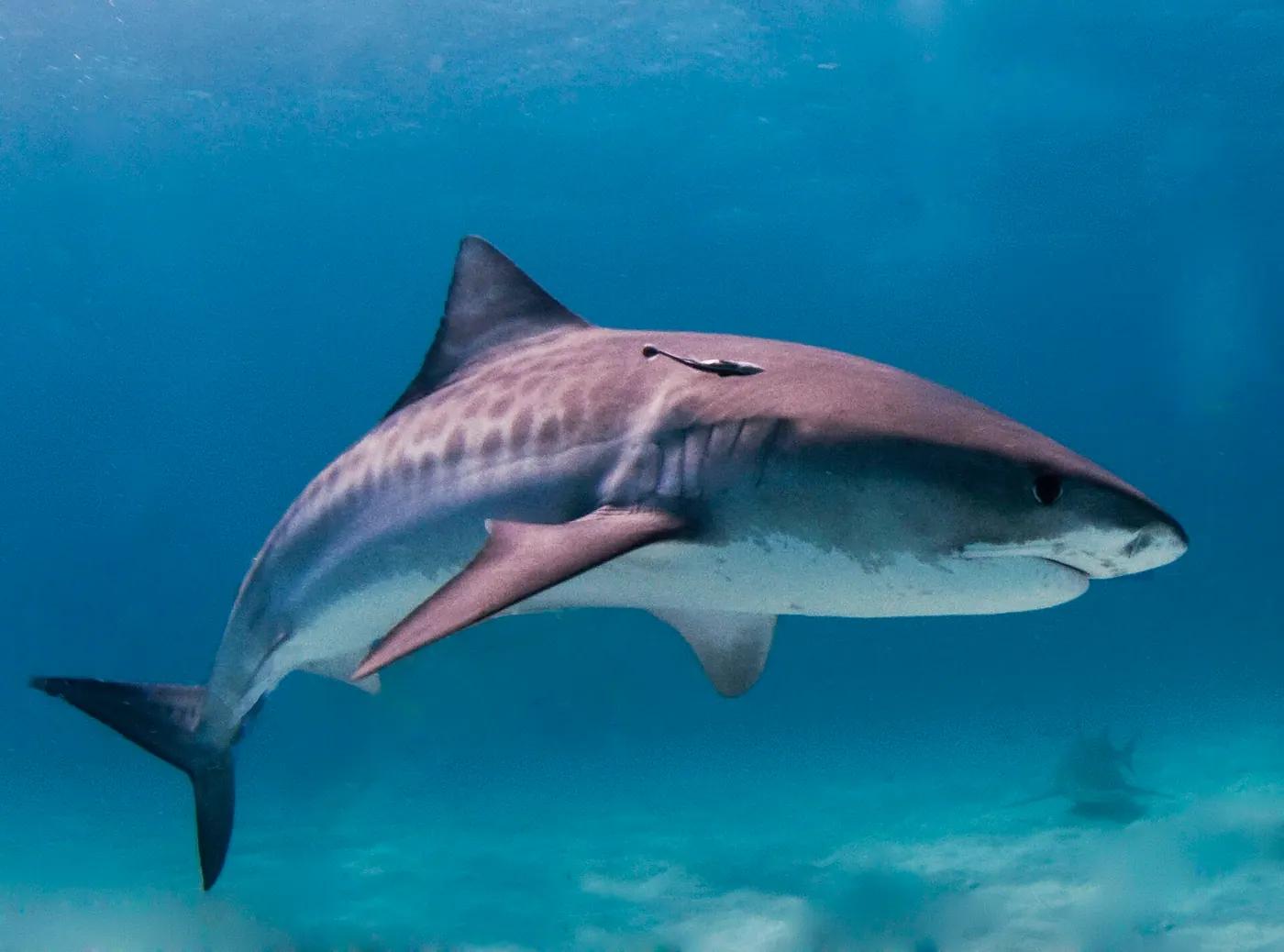
Tiger sharks are the largest of the requiem sharks, and typical adults measure 3–4.3 m (10–14 ft). The stripes that give them their name are boldest on juveniles.
The long swim
When is tiger shark pupping season in Hawaii?
Some of the sharks behind Sharktober have travelled in from the remote Northwestern Hawaiian Islands. Tracking data shows mature females regularly migrating from the northwest to the main islands at this time of year, which puts them where most people swim and surf. Scientists call it a partial migration of mature females.
The timing matches pupping season. The paper and the university place it in September and October, and Meyer has also described it as running from September to November with an October peak. Tiger shark sightings at shark ecotourism sites rise through the season, which fits earlier work going back to 2007 identifying the main islands as pupping grounds.
Then the second mechanism kicks in. A female who has just given birth is depleted and hungry, and a hungry tiger shark is not a fussy eater. The menu includes fish, sea turtles, dolphins, sea snakes, other sharks, seabirds and whale carcasses, plus metal, plastic and rubbish bags.
And the licence plates? That story is half true. Plates have turned up in tiger shark stomachs before, but rarely, and according to The Ocean Foundation, a researcher who studied tiger shark stomach contents found none at all.
Tiger sharks really have swallowed licence plates. A researcher who studied their stomachs found none.
Shark mothers
How many babies does a tiger shark have?
A tiger shark can have up to 82 pups, after a pregnancy of 15 to 16 months. A more typical litter is 25–30, so a female still spends well over a year carrying a small school of sharks.
The way they grow is unusual for their family. Tiger sharks are the only requiem sharks that don't use a placenta. The embryos develop on yolk inside their mother instead.
Pups are born 0.5–0.9 m long and are on their own from that moment. Their mother gives them no protection. They often stay in shallow water to avoid being eaten by bigger sharks, including her.
That rules out a tempting theory. Sharktober is not mothers biting people to defend their young, because the pups are independent and keep clear of adults. The proposed causes are more big females nearby, and hungry females after giving birth.
Females probably breed only every three years. They mature at anywhere from 4 to 13 years old depending on the study, and live 27–37 years. That slow pace matters at the end of this story.
Up to 82 pups
The largest litters on record. 25–30 is more typical.
15–16 months
A typical tiger shark pregnancy, well over a year.
No placenta
The only requiem shark whose embryos grow on yolk instead.
0.5–0.9 m
Size at birth. From then on, the pups get no protection from their mother.
Newborn tiger sharks get zero mothering, and they keep clear of adults, including Mum.
The fine print
Did the study prove tiger shark births cause Sharktober?
Not yet, and the paper is open about that. It is a single-author article in the “Hypothesis and Theory” category. Its title says birthing “drives” the October spike, but its abstract says only that the pattern suggests “a potential link” and that birthing “may increase” encounters.
The October spike itself is solid. The pupping explanation is the best-supported one available, but nobody has measured it directly. So far, no one has followed pregnant females through pupping season and matched their movements to bites.
Other factors could add to the effect, such as a seasonal rise in favourite prey like large reef fish. Meyer's next step is to track adult females during pupping season and use non-invasive tools to check whether they are pregnant and what condition their bodies are in.
Daryl McPhee of Bond University in Australia, who was not involved, says any seasonal change that brings people and large sharks together more often can raise bite risk. He adds that the risk stays low.
Real risk
Is it safe to surf or swim in Hawaii in October?
For almost everyone, yes. Hawaii averages about 3–4 shark bites a year across the whole state. DLNR logged 8 in 2023, 5 in 2024 and 4 in 2025. Those yearly lists include provoked incidents, so they are not the same measure as the study's unprovoked tally.
“The October spike is real and statistically significant, but the overall risk remains very low,” Meyer says. He still surfs in October himself. He lowers his risk by surfing with other people and paying attention to what is around him.
The rare bites show what those numbers mean in real life. In October 2015 a swimmer was seriously injured at Lanikai Beach on Oʻahu. In October 2023 two surfers were bitten, one at Kuau Bay on Maui and one at Hanalei Bay on Kauaʻi. In November 2025 off-duty lifeguard Chance Martin was bitten while surfing alone at “Pine Trees” in Hanalei Bay, and he survived even though a major artery in his leg was severed.
Tiger sharks are around in other months too. On 26 August 2026, KHON2 reported that a 10-foot tiger shark described as “aggressive” bit a surfer's board at Ala Moana Beach Park, and a shark warning followed. For perspective, see where sharks land in our 100 most dangerous animals ranking and our deadliest animals guide.
| Measure | Shark bites | Note |
|---|---|---|
| Hawaii long-run average | About 3–4 a year | Statewide |
| 2023 (DLNR) | 8 | Includes provoked incidents; two were October surfer bites |
| 2024 (DLNR) | 5 | Includes provoked incidents |
| 2025 (DLNR) | 4 | Includes provoked incidents |
| Octobers, 1995–2024 | 32 of 165 | Unprovoked bites only, from the UH study |
100 most dangerous animalsdeadliest animals
Smart swimming
What actually lowers your risk of a shark bite?
Meyer sums up the main lesson as “awareness, not alarm.” In his words, “Understanding when risk is slightly elevated helps people make informed choices, not fearful ones.” For October, the university specifically advises extra care with high-risk activities done alone, such as surfing or swimming along the coast.
DLNR's advice starts with company: swim, surf or dive with other people. Stay out of the water at dawn, at dusk and at night. Avoid murky water, harbour entrances, stream mouths (especially after rain), channels and steep drop-offs, and don't go in with open wounds.
Leave high-contrast clothing and shiny jewellery on land. Choose lifeguarded beaches, keep splashing to a minimum and keep pets out of the water. Get out if fish or turtles start behaving erratically, and if you see a shark, leave the water quickly and calmly.
Two popular beliefs are wrong. Midday is not a safe window, because tiger sharks bite at all times of day. And dolphins nearby are no sign that sharks are absent, since dolphins are prey for some large sharks.
Your move
Where can you see a tiger shark safely?
The safest tiger shark encounter is a planned one. Shark ecotourism operators in Hawaii see more tiger sharks during pupping season, and that rise in sightings is part of the evidence behind the study. If you go, choose a reputable operator, follow the crew's instructions and never touch or harass a shark. If you spot one from the boat or the shore, AnimalDex lets you capture the real animal with your phone camera and add it to your collection.
Before you go, read our tiger shark profile, browse the Animals in Hawaii guide, meet the rest of the family on our shark page, or see who wins in Oceanic Whitetip vs Tiger Shark and Thresher Shark vs Tiger Shark.
Here is the twist. Tiger sharks are listed as Near Threatened, after declining by close to 30% globally over three generations. Because females breed only about every three years, the species recovers slowly from fishing, and shark control programmes have added to the losses.
So treat October as a reason for awareness, not alarm. “When we enter the ocean, we enter a wilderness area and it's the natural habitat of those predators,” Meyer says. “They don't have a choice. That's where they live.”
They don't have a choice. That's where they live.
Animals in HawaiiOceanic Whitetip vs Tiger SharkThresher Shark vs Tiger Shark
Pertanyaan singkat
Jawaban ringkas untuk pertanyaan yang paling sering muncul pada topik ini.
- Is Sharktober real?
- Yes. A University of Hawaiʻi at Mānoa study of 30 years of records found that October accounted for 32 of 165 unprovoked shark bites in Hawaii, which is 2 to 4 times the number of bites in any other month. The rise is statistically significant, but the overall risk remains very low.
- Why are there more shark attacks in Hawaii in October?
- The leading explanation is tiger shark pupping season. Large adult females move into nearshore waters around the main islands to give birth, and afterwards they are hungry and forage harder. The study found no increase in people using the ocean in October, but the pupping link still has to be confirmed by tracking the sharks directly.
- When is tiger shark pupping season in Hawaii?
- The study and the University of Hawaiʻi place it in September and October. Carl Meyer has also described it as running from September to November with a peak in October.
- Is it safe to surf or swim in Hawaii in October?
- For most people, yes. The risk is slightly higher than in other months but still very low, and Meyer surfs in October himself. Avoid going in alone, stay out at dawn, dusk and night, and avoid murky water, stream mouths and harbour entrances.
- How many shark attacks does Hawaii have each year?
- Hawaii averages about 3–4 shark bites a year statewide. DLNR recorded 8 in 2023, 5 in 2024 and 4 in 2025, and its yearly list includes provoked incidents.
- How many babies does a tiger shark have?
- Litters can reach 82 pups, but 25–30 is more typical, after a pregnancy of 15 to 16 months. The pups are born 0.5–0.9 m long and are independent from birth.
Hewan yang disebut
Lompat dari artikel ini ke halaman spesies di balik contoh, catatan systems, dan referensi field guide.
Tiger SharkGreat White SharkBull SharkSea TurtleDolphinShark
Sources and further reading
- Frontiers in Marine Science: 'Sharktober': tiger shark parturition drives seasonality in shark bite incidents in Hawaiian waters
- University of Hawaiʻi News: Sharktober: UH scientists confirm spike in tiger shark bites in October
- Hawaii Tribune-Herald: 'Sharktober' is real: UH study confirms shark bites do increase in October
- Live Science: Shark attacks in Hawaii spike in October, and scientists think they know why
- Hawaiʻi DLNR: Shark Safety Tips
- Hawaii-guide.com: Sharks in Hawaii: An Honest Safety Guide for Visitors
- KHON2: 'Aggressive' 10-foot tiger shark sighted at Ala Moana Beach Park
- Save Our Seas Foundation: Tiger shark
- Sharkwater: Tiger Shark
- The Ocean Foundation: What's in a Tiger Shark's Stomach?
Panduan jawaban terkait topik ini
Kalau kamu ingin perbandingan langsung dan rekomendasi yang jelas, lanjutkan ke halaman jawaban berikut.
Best Animal Identification Apps
Compare the best animal identification apps by features like photo/video identification, species coverage, collection capabilities, offline use, and more.
What Is Animal Collecting
Learn what animal collecting means in modern apps and how AnimalDex turns real-world sightings into cards, sets, rarity, and species learning.
Pokemon-Like Animal App
Looking for a Pokemon-like animal app with real species? AnimalDex combines creature-collection energy with AI scanning and wildlife learning.