
Back to Powers

Animal Powers

Adaptation

Spend slowly in heat.

Animals grouped here express a similar power through their behavior in nature. Each species still has its own principle, lesson, meaning, and field-guide page.

71 species

Addax (Addax nasomaculatus) thumbnail image on AnimalDex

Addax

Species principle: Desert Sparing

Spend slowly in heat.

Hard heat rewards the body that spends slowly.

Addax are desert antelope adapted to extreme aridity, with pale coats, broad hooves, and the ability to survive long periods with little free water.
African Civet (Civettictis civetta) thumbnail image on AnimalDex

African Civet

Species principle: Scented Adaptation

Keep the stripe.

Adjust to the night without losing your pattern.

African Civets are nocturnal omnivores with striped coats, scent-marking glands, and flexible diets that let them forage across varied habitats.

African Jacana (Actophilornis africanus) thumbnail image on AnimalDex

African Jacana

Species principle: Light Footing

Walk the leaves.

The impossible crossing becomes possible when pressure is spread with care.

African Jacanas have extremely long toes that spread their weight across floating vegetation, allowing them to walk over lily pads and other aquatic plants.

American Marten (Martes americana) thumbnail image on AnimalDex

American Marten

Species principle: Agility

Slip the hidden path.

Agility finds routes that force cannot enter.

American Martens have long flexible bodies, sharp claws, and arboreal ability that help them hunt and travel through snowy conifer forests.

Andean Goose (Chloephaga melanoptera) thumbnail image on AnimalDex

Andean Goose

Species principle: Altitude Fit

Graze the thin air.

A hard place becomes home when the body accepts its altitude.

Andean Geese live in high-elevation wetlands and grasslands of the Andes, grazing in cold thin-air environments with strong bodies and pair bonds.

Arctic Fox animal lesson image on AnimalDex

Arctic Fox

Species principle: Seasonal Disguise

Match the season.

Adaptability is stronger when timing, color, and behavior shift together.

Arctic Foxes grow dense winter coats, often turn white in snowy habitats, and use caching and opportunistic feeding to survive extreme seasonal change.

Argentine Black and White Tegu (Salvator merianae) thumbnail image on AnimalDex

Argentine Black and White Tegu

Species principle: Robust Adaptation

Roam and adjust.

Change becomes manageable when the body can dig, bask, roam, and feed widely.

Argentine Black and White Tegus are large omnivorous lizards that dig, bask, forage broadly, and use seasonal dormancy in cooler periods of their range.

Atlantic Puffin (Fratercula arctica) thumbnail image on AnimalDex

Atlantic Puffin

Species principle: Three-World Fit

Belong in three worlds.

One body can belong to more than one world.

Atlantic Puffins nest on cliffs and burrows, fly over water, and swim underwater with their wings to catch fish.

Bali Cattle animal lesson image on AnimalDex

Bali Cattle

Species principle: Tropical Steadiness

Steady in heat.

Strength becomes dependable when it is adapted to the climate it must serve.

Bali Cattle descend from banteng and are hardy domestic cattle adapted to tropical conditions, work, and local farming systems.

Banteng animal lesson image on AnimalDex

Banteng

Species principle: Tropical Wild Strength

Strength in heat.

Adaptation becomes power when the body fits a demanding climate.

Banteng are wild cattle of Southeast Asia associated with forest edges, grazing, and domestic ancestry in Bali cattle.

Blind Cave Tetra animal lesson image on AnimalDex

Blind Cave Tetra

Species principle: Darkschool

School in darkness.

Community can guide movement when the environment gives little light.

Blind Cave Tetras are cave-adapted fish with reduced eyes that navigate using sensory systems suited to darkness.

Blobfish (Psychrolutes marcidus) thumbnail image on AnimalDex

Blobfish

Species principle: Pressure Belonging

Belong to your pressure.

What looks weak at the surface may be perfectly made for pressure.

Blobfish have soft gelatinous bodies adapted to deep-sea pressure. Their distorted appearance mostly occurs when brought to the surface, away from the pressure they are built for.

Blood Parrot Cichlid animal lesson image on AnimalDex

Blood Parrot Cichlid

Species principle: Rounded Mouth Hold

Hold the shape.

Adapted form can hold space when the body is built for containment rather than speed.

Blood Parrot Cichlids have a rounded, beak-like mouth and compact hybrid body that favors steady presence and territorial hold over fast pursuit.

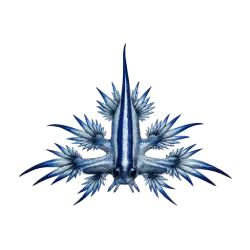
Blue Glaucus animal lesson image on AnimalDex

Blue Glaucus

Species principle: Alchemy

Turn threat into armor.

The right adaptation can turn danger into an advantage.

Blue glaucuses feed on stinging siphonophores and can store defensive stinging cells from that prey.

Brangus Cattle animal lesson image on AnimalDex

Brangus Cattle

Species principle: Hybrid Strength

Blend for strength.

Strength can come from blending different advantages into one working body.

Brangus Cattle combine Brahman and Angus ancestry, selected for hardiness, beef quality, and climate performance.

Bull Shark (Carcharhinus leucas) thumbnail image on AnimalDex

Bull Shark

Species principle: Osmotic Range

Cross the water line.

Real range comes from being able to change water without losing power.

Bull Sharks tolerate both salt and fresh water through osmoregulation and can move far into rivers as well as coastal marine habitats.

California Sea Lion animal lesson image on AnimalDex

California Sea Lion

Species principle: Fluidity

Move with the wave.

Mastery is movement that knows how to follow the water instead of fighting it.

California Sea Lions are agile marine mammals that use strong front flippers for maneuvering and sensitive whiskers to detect movement while hunting fish and navigating through water.

Celebes Crested Macaque animal lesson image on AnimalDex

Celebes Crested Macaque

Species principle: Bold Social Learning

Learn out loud.

Curiosity becomes power when it learns from social consequences.

Celebes Crested Macaques are social primates known for expressive group behavior, intelligence, and complex interactions.

Explore related indexes