
Animal field guide
Brazilian Lava Lizard
Tropidurus torquatus
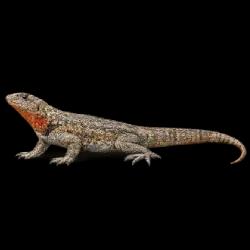
A stocky, rough-scaled lizard named for the dark collar band on each side of its neck; torquatus is Latin for collared. On cool mornings it flattens its body and turns side-on to the sun, warming up quickly before it starts to hunt.
Brazilian Lava Lizard at a glance
Reptile · South America · Open · Relatively common
Known for: Rough, Grey to brown back finely speckled with pale and, Tail often faintly banded, Stocky body with a short
Its Power
Sun-Rock Speckle
Shuttle between sun-rock and shade to hold body heat steady.
Staying steady under changing conditions can come from repositioning often rather than from enduring whatever one spot delivers.
“Shift spots, hold steady.”
Capture a Brazilian Lava Lizard, and it's yours when you finish one step it gives you.
Biological basis
Tropidurus torquatus is a mottled, collared lizard of open rocky, sandy and disturbed ground, including towns, in eastern and central South America. On cool mornings it flattens and turns side-on to the sun, and through the day it moves between sun and shade to keep body temperature in a narrow band.
Put it into practice
On a cold day a baker moves the bowl of proving dough between the sunny windowsill and the cooler counter every half hour, keeping it warm enough to rise evenly.
What does the Brazilian lava lizard symbolize?
The Brazilian lava lizard symbolizes sun-rock speckle: shuttle between sun-rock and shade to hold body heat steady. It represents self-regulation, balance and rhythm. Its AnimalDex motto: "Shift spots, hold steady."
The Brazilian lava lizard as a spirit animal
If the Brazilian lava lizard is your spirit animal, the AnimalDex reading is Sun-Rock Speckle: staying steady under changing conditions can come from repositioning often rather than from enduring whatever one spot delivers. It suggests a strength in self-regulation and balance, and a reminder to use it on purpose.
What can the Brazilian lava lizard help you with in life?
The Brazilian lava lizard is a guide for self-regulation, balance and rhythm. Its lesson applies wherever self-regulation matters: staying steady under changing conditions can come from repositioning often rather than from enduring whatever one spot delivers.
- Self-Regulation
- Balance
- Rhythm
In practice: On a cold day a baker moves the bowl of proving dough between the sunny windowsill and the cooler counter every half hour, keeping it warm enough to rise evenly.
What can we learn from the Brazilian Lava Lizard?What does it mean to dream about or encounter a wild Brazilian lava lizard?
Dreaming about a wild Brazilian lava lizard, or coming across one, usually points to self-regulation and balance: the qualities the Brazilian lava lizard lives by. In AnimalDex, the Brazilian lava lizard's principle is Sun-Rock Speckle: shuttle between sun-rock and shade to hold body heat steady. Read the moment through its core lesson: Staying steady under changing conditions can come from repositioning often rather than from enduring whatever one spot delivers.
Neither good nor bad on its own. How the Brazilian lava lizard acts matters: at ease, it reflects self-regulation; hostile, it flags self-regulation out of balance.
Spotting a Brazilian lava lizard in the wild
A real encounter is the plainest version of the sign: notice what the Brazilian lava lizard was doing. Shuttle between sun-rock and shade to hold body heat steady. That is the self-regulation worth borrowing today.
A Brazilian lava lizard that keeps appearing
Repeated sightings of a Brazilian lava lizard usually mean the Sun-Rock Speckle lesson is still open: staying steady under changing conditions can come from repositioning often rather than from enduring whatever one spot delivers.
Dreaming of being chased by a Brazilian lava lizard
If the Brazilian lava lizard pursues you, look at where balance is being asked of you and you are stepping away instead of meeting it.
Dreaming that a Brazilian lava lizard attacks you
When the Brazilian lava lizard attacks, the dream may be about pressure: balance or rhythm applied too hard, by you or by someone close to you.
A calm or friendly Brazilian lava lizard
A calm Brazilian lava lizard suggests you have made peace with self-regulation and can use it without force.
A dead or injured Brazilian lava lizard
A dead or injured Brazilian lava lizard, dreamed or found, can mark self-regulation you have let lapse, or a phase built on Sun-Rock Speckle coming to an end.
These readings are reflective prompts drawn from how the Brazilian lava lizard really lives, not predictions. If you meet one in the wild, watch from a distance and leave it undisturbed.
Capture your own Brazilian Lava Lizard
Photograph or film one in the wild, at a zoo or at home with the app. It becomes yours: it remembers you, gives you steps, and can debate your problems with your other animals.
Animal field guide
Brazilian Lava Lizard
Sign in to hear this read by a natural AI voice instead of your browser's.
A stocky, rough-scaled lizard named for the dark collar band on each side of its neck; torquatus is Latin for collared. On cool mornings it flattens its body and turns side-on to the sun, warming up quickly before it starts to hunt.
Native range
Natural range, not this capture location
Open, sunny ground in Brazil and neighbouring countries: granite outcrops, sandy coastal restinga, cerrado savanna, forest edges and clearings, and walls and gardens in towns.
Search near meAnimalDex stats
Size scale
Understand the animal
Understand the Brazilian Lava Lizard
Factual biology first: what this animal is like, where it lives, how it survives, and why those traits exist.
01
Introduction to Brazilian Lava Lizard
A stocky, rough-scaled lizard named for the dark collar band on each side of its neck; torquatus is Latin for collared. On cool mornings it flattens its body and turns side-on to the sun, warming up quickly before it starts to hunt.
How to identify a Brazilian Lava Lizard
- Rough, keeled scales across the back
- Grey to brown back finely speckled with pale and dark spots
- Tail often faintly banded
- Stocky body with a short, broad head
Why Brazilian Lava Lizard are interesting
- Males bob their heads and do push-up displays from rocks and walls to warn rivals off their territory.
- It has been recorded eating cactus fruit and passing the seeds, so it may help disperse some plants.
- Pockets in the skin folds at the sides of the neck often hold clusters of parasitic mites.
- Besides insects, it has been recorded eating small lizards, including young of its own species.
02
Adaptations and biological abilities
03
Why does Brazilian Lava Lizard behave this way?
- Rough, keeled scales across the back
- Grey to brown back finely speckled with pale and dark spots
- Tail often faintly banded
- Stocky body with a short, broad head
Hunts through the sunny hours of the day. At night it shelters in rock crevices, under loose bark or in holes in walls.
04
Why Open?
Habitat: Open, sunny ground in Brazil and neighbouring countries: granite outcrops, sandy coastal restinga, cerrado savanna, forest edges and clearings, and walls and gardens in towns.
Native range: South America
Native range
Natural range, not this specific capture location.
Open, sunny ground in Brazil and neighbouring countries: granite outcrops, sandy coastal restinga, cerrado savanna, forest edges and clearings, and walls and gardens in towns.
05
Why this diet?
06
Activity, rest, and lifespan
07
Brazilian Lava Lizard reproduction
Females lay small clutches, often about three to six eggs, in soil or sand, and may lay more than one clutch in a season. Breeding is concentrated in the warm, wet months, and there is no parental care.
Males are larger with broader heads and black patches under the thighs and on the flap in front of the vent; females usually lack these patches.
08
Predators, threats, and defense
09
Conservation and rarity
Rarity: Relatively common · 20/100. AnimalDex canonical rarity score: 20/100, maintained by the live indexed species profile.
- Observe from a respectful distance and avoid changing the animal's behavior.
- Do not block feeding, shelter, nesting, or travel routes.
- Use a live camera capture without handling or staging wildlife.
Talk to it
Talk to the Brazilian Lava Lizard
It answers as itself: ask about how it lives, or bring it something of yours and hear what it would do, from its own Power.
Anonymous: 6/day. Signed-in: 10/day. Pro: 100/day.
Side by side
The Brazilian Lava Lizard, side by side
Nothing written side by side for the Brazilian Lava Lizard yet. Pick any animal to compare it with. Compare with any animal →
Where to find them
Where to find Brazilian Lava Lizard
To find Brazilian Lava Lizard in the wild, focus on the exact habitat patches that match its body design and daily behavior, not just the broad country where it exists. You usually do better by working one good piece of habitat inside south America than by covering too much ground.
- Forest edge, canopy gaps, fruiting trees, or shaded trails where cover and food meet
- Headlands, reef edges, island colonies, tidal channels, or productive coastal water
- Sunlit logs, exposed branches, warm rocks, or regular perch sites used for scanning
Where explorers saw it
- Barra da Tijuca, Rio de Janeiro, BrasilAug · 1 sighting
- Minas Gerais, BrasilAug · 1 sighting
Guides to seeing Brazilian Lava Lizard
In the Ark
4 Brazilian Lava Lizards are aboard right now.
Since November 17: 2 born.
The Ark is a live, shared animal world. Animals come aboard when people capture them, and live there by rules based on their field guides.
Scientific name
Tropidurus torquatus
Category
Reptile
Habitat
Open, sunny ground in Brazil and neighbouring countries: granite outcrops, sandy coastal restinga, cerrado savanna, forest edges and clearings, and walls and gardens in towns.
Rarity
Relatively common · 20/100
Native range
South America
Take the encyclopedia outside
AnimalDex helps you scan real animals, identify species, collect cards, and learn from nature wherever you are.