
Animal field guide
Collared Peccary
Pecari tajacu
Herd members stand head to tail and rub their cheeks against a scent gland on each other's rump, giving the whole group a shared musky odour. This pig-like hoofed mammal of the Americas lives, feeds and rests in these close-knit herds.
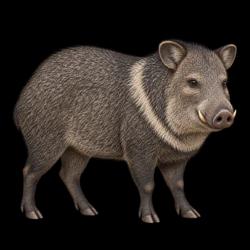
Collared Peccary at a glance
Animal · North America · Unusually varied for one species · Relatively common
Known for: Coarse, Pale band of hair around the neck and shoulders, Pig-like snout ending in a flat disc, Stocky body on thin legs
Its Power
Community Strength
Rely on your group for protection and support.
Collared peccaries thrive in groups, using their social bonds for protection against predators and to navigate their environment effectively.
“Share one herd scent.”
Capture a Collared Peccary, and it's yours when you finish one step it gives you.
Biological basis
Collared peccaries live in herds of up to 50 individuals, which provides safety in numbers and aids in cooperative foraging and predator defense.
Put it into practice
Neighbours on one street walk home from the late bus together so nobody walks alone.
What does the collared peccary symbolize?
The collared peccary symbolizes community strength: rely on your group for protection and support. It represents community, belonging and social bonds. Its AnimalDex motto: "Share one herd scent."
The collared peccary as a spirit animal
If the collared peccary is your spirit animal, the AnimalDex reading is Community Strength: collared peccaries thrive in groups, using their social bonds for protection against predators and to navigate their environment effectively. It suggests a strength in community and belonging, and a reminder to use it on purpose.
What can the collared peccary help you with in life?
The collared peccary is a guide for community, belonging and social bonds. Its lesson applies wherever community matters: collared peccaries thrive in groups, using their social bonds for protection against predators and to navigate their environment effectively.
- Community
- Belonging
- Social Bonds
In practice: Neighbours on one street walk home from the late bus together so nobody walks alone.
What can we learn from the Collared Peccary?What does it mean to dream about or encounter a wild collared peccary?
Meeting a wild collared peccary, asleep or awake, is often a nudge toward community, the quality the collared peccary is built around. In AnimalDex, the collared peccary's principle is Community Strength: rely on your group for protection and support. Read the moment through its core lesson: Collared peccaries thrive in groups, using their social bonds for protection against predators and to navigate their environment effectively.
Mostly a prompt rather than a warning. A calm collared peccary suggests community you already have; a threatening one suggests community is being tested or pushed too far.
Spotting a collared peccary in the wild
Coming across a collared peccary in person asks for attention more than interpretation. Watch it for a minute; the collared peccary's way of working is Community Strength, and the lesson is: collared peccaries thrive in groups, using their social bonds for protection against predators and to navigate their environment effectively.
A collared peccary that keeps appearing
A collared peccary that keeps turning up points to belonging you keep circling back to. The repetition is the message.
Dreaming of being chased by a collared peccary
A chase often means a demand for community is catching up with you. The collared peccary's lesson, "Collared peccaries thrive in groups, using their social bonds for protection against predators and to navigate their environment effectively", is the part you may be running from.
Dreaming that a collared peccary attacks you
An aggressive collared peccary can mirror a conflict where community has become a weapon rather than a strength.
A calm or friendly collared peccary
Meeting a peaceful collared peccary is usually encouraging: belonging and social bonds are within reach.
A dead or injured collared peccary
A dead or injured collared peccary, dreamed or found, can mark community you have let lapse, or a phase built on Community Strength coming to an end.
These readings are reflective prompts drawn from how the collared peccary really lives, not predictions. If you meet one in the wild, watch from a distance and leave it undisturbed.
Capture your own Collared Peccary
Photograph or film one in the wild, at a zoo or at home with the app. It becomes yours: it remembers you, gives you steps, and can debate your problems with your other animals.
Animal field guide
Collared Peccary
Sign in to hear this read by a natural AI voice instead of your browser's.
Herd members stand head to tail and rub their cheeks against a scent gland on each other's rump, giving the whole group a shared musky odour. This pig-like hoofed mammal of the Americas lives, feeds and rests in these close-knit herds.
Native range
Natural range, not this capture location
Unusually varied for one species: desert scrub with prickly pear and mesquite, oak and pine-oak woodland, dry tropical forest, rainforest and dry chaco, from the south-western United States through Central America to northern Argentina.
Search near meAnimalDex stats
Size scale
Understand the animal
Understand the Collared Peccary
Factual biology first: what this animal is like, where it lives, how it survives, and why those traits exist.
01
Introduction to Collared Peccary
Herd members stand head to tail and rub their cheeks against a scent gland on each other's rump, giving the whole group a shared musky odour. This pig-like hoofed mammal of the Americas lives, feeds and rests in these close-knit herds.
How to identify a Collared Peccary
- Coarse, grizzled grey-black bristly coat
- Pale band of hair around the neck and shoulders
- Pig-like snout ending in a flat disc
- Stocky body on thin legs, tail barely visible
- Mane of long bristles along the back, raised when alarmed
Why Collared Peccary are interesting
- Peccaries form their own family, Tayassuidae, and are only distantly related to the pigs of the Old World.
- Its upper and lower canines rub together as the jaw moves, keeping them sharp, and clacking them is a warning signal.
- A complex, multi-chambered stomach helps it break down tough plant food.
- Herds usually number from a handful to about 20 animals of both sexes and all ages, occasionally more.
02
Adaptations and biological abilities
03
Why does Collared Peccary behave this way?
- Coarse, grizzled grey-black bristly coat
- Pale band of hair around the neck and shoulders
- Pig-like snout ending in a flat disc
- Stocky body on thin legs, tail barely visible
- Mane of long bristles along the back, raised when alarmed
Usually active in the early morning, late afternoon and evening, resting through the heat of the day. In hot desert summers it becomes largely nocturnal, lying up by day in shade, caves or hollows under banks.
04
Why Unusually varied for one species?
Habitat: Unusually varied for one species: desert scrub with prickly pear and mesquite, oak and pine-oak woodland, dry tropical forest, rainforest and dry chaco, from the south-western United States through Central America to northern Argentina.
Native range: North America, South America
Native range
Natural range, not this specific capture location.
Unusually varied for one species: desert scrub with prickly pear and mesquite, oak and pine-oak woodland, dry tropical forest, rainforest and dry chaco, from the south-western United States through Central America to northern Argentina.
05
Why this diet?
Mainly plants: prickly pear pads and fruit, agave, mesquite beans, fruits and nuts, and roots, bulbs and tubers dug up with the snout, plus insects and occasionally eggs or small animals. In deserts, cactus pads supply much of its water.
06
Activity, rest, and lifespan
Usually active in the early morning, late afternoon and evening, resting through the heat of the day. In hot desert summers it becomes largely nocturnal, lying up by day in shade, caves or hollows under banks.
Often around 10 years in the wild, though many die younger; captive animals have been reported living beyond 20 years.
07
Collared Peccary reproduction
Usually two young are born after about 145 days' gestation, at any time of year. They follow the mother within a day or two and wear a reddish-brown coat with a dark stripe down the back until they grow the adult coat.
Males and females are similar in size and colour, and both carry short, straight canine tusks, so the sexes are hard to tell apart in the field.
08
Predators, threats, and defense
09
Conservation and rarity
Rarity: Relatively common · 27/100. AnimalDex canonical rarity score: 27/100, maintained by the live indexed species profile.
- Observe from a respectful distance and avoid changing the animal's behavior.
- Do not block feeding, shelter, nesting, or travel routes.
- Use a live camera capture without handling or staging wildlife.
Talk to it
Talk to the Collared Peccary
It answers as itself: ask about how it lives, or bring it something of yours and hear what it would do, from its own Power.
Anonymous: 6/day. Signed-in: 10/day. Pro: 100/day.
Side by side
The Collared Peccary, side by side
Nothing written side by side for the Collared Peccary yet. Pick any animal to compare it with. Compare with any animal →
Where to find them
Where to find Collared Peccary
To find Collared Peccary in the wild, focus on the exact habitat patches that match its body design and daily behavior, not just the broad country where it exists. You usually do better by working one good piece of habitat inside north America, South America than by covering too much ground.
- Forest edge, canopy gaps, fruiting trees, or shaded trails where cover and food meet
- Water sources, dune bases, rocky wadis, or shaded scrub at first and last light
- Burrow systems, sandy banks, fallen logs, or ground with clear den entrances
In the Ark
2 Collared Peccaries are aboard right now.
None have come aboard or left since November 17.
The Ark is a live, shared animal world. Animals come aboard when people capture them, and live there by rules based on their field guides.
Scientific name
Pecari tajacu
Category
Animal
Habitat
Unusually varied for one species: desert scrub with prickly pear and mesquite, oak and pine-oak woodland, dry tropical forest, rainforest and dry chaco, from the south-western United States through Central America to northern Argentina.
Rarity
Relatively common · 27/100
Native range
North America, South America
Take the encyclopedia outside
AnimalDex helps you scan real animals, identify species, collect cards, and learn from nature wherever you are.